What Are Math Terms?
Math terms are the precise words mathematics uses for its numbers, shapes, operations, relationships and methods, such as quotient, hypotenuse, coefficient and derivative. Each one has a single agreed meaning, which is why a problem that says "find the product" leaves no room for guessing.
Many of them look like ordinary English and mean something narrower. "Odd" is not strange, "mean" is not unkind, and a "product" is not something you buy. Most of the confusion students run into with word problems starts right there.
ES = 0.51: the average strength of the link between language skills and math performance across 12 meta-analyses covering more than 3.6 million participants. Geçici, Geçici and Kaya, Journal of Intelligence, July 2026
How Do You Use This Math Glossary?
Jump straight to a letter: A · B · C · D · E · F · G · H · I · J · K · L · M · N · O · P · Q · R · S · T · U · V · W · X · Y · Z
One line per term. Each entry gives the meaning first, then a small example where an example makes the idea click.
Other names are listed too. "Global maximum" sits under G and points you to the absolute maximum, so you find a term under whichever name your textbook uses.
Linked terms go deeper. A linked term opens a full lesson with worked examples, diagrams and common mistakes.
Which Math Terms Should You Learn First?
Start with the words your current math topic uses every day. The table groups the most-used math terms by branch, with the school stage where they usually appear.
Branch | First terms to learn | Usually met in (grade or class) |
|---|---|---|
Numbers and operations | sum, difference, product, quotient, digit, place value, even number, odd number | Grades 1 to 3 |
Fractions, decimals and percent | numerator, denominator, equivalent fractions, mixed number, decimal, percent, ratio | Grades 3 to 6 |
Geometry | angle, vertex, parallel, perpendicular, polygon, perimeter, area, volume | Grades 2 to 8 |
Algebra | variable, expression, equation, coefficient, term, exponent, inequality, function | Grades 6 to 9 |
Data and probability | mean, median, mode, range, frequency, outcome, probability | Grades 5 to 8 |
Trigonometry | hypotenuse, sine, cosine, tangent, radian, unit circle | Grades 9 to 11 |
Calculus | limit, derivative, integral, continuous function, rate of change | Grades 11 to 12 |
Students who meet "perimeter" and "area" in the same week often swap them on the next quiz. Learning them as a pair, with one drawing that shows the fence around a garden and the grass inside it, keeps them apart.
Which Everyday Words Mean Something Different In Math?
These are the math terms that trip readers up most, because the everyday meaning pulls against the math meaning.
Word | Everyday meaning | Math meaning |
|---|---|---|
Mean | unkind | the average: add the values, divide by how many there are |
Odd | strange | a whole number that leaves remainder 1 when divided by 2 |
Product | something you buy | the result of multiplying |
Difference | how two things are unlike | the result of subtracting |
Volume | loudness | the space a solid takes up, in cubic units |
Degree | a university qualification | a unit of angle, or the highest power in a polynomial |
Power | strength | an exponent, or a number written as a base with an exponent |
Table | furniture | a grid of values, as in a multiplication table |
Improper | rude or wrong | a fraction whose numerator is at least its denominator |
Rational | sensible | a number that can be written as a fraction of two integers |
Which Math Definitions Are Often Stated Wrongly?
Some short definitions get copied from list to list with a mistake built in. These are the ones worth correcting before they stick.
"Whole numbers are the positive integers." Whole numbers include zero: 0, 1, 2, 3 and so on.
"1 is a prime number." A prime has exactly two factors. The number 1 has only one, so it is neither prime nor composite.
"Irrational numbers have digits that keep repeating." It is the other way round. An irrational number's decimal never ends and never repeats. A repeating decimal such as equals , which is rational.
"The 4th root of 3 is 81." Reversed. Since , the 4th root of 81 is 3.
"A rhombus has no right angles." A rhombus only needs four equal sides. A square has four equal sides and four right angles, so every square is a rhombus.
"Circumference is the distance around a circle or a square." Circumference belongs to circles. The distance around a square, or any polygon, is its perimeter.
"A mixed number is a whole number with a fraction or a decimal, like 3.5." A mixed number pairs a whole number with a fraction, such as . The decimal 3.5 has the same value but is not a mixed number.
"A tangent touches a curve at only one point." That holds for circles, not every curve. The tangent to at is , and it crosses the curve again at .
"A yard is about 91.5 centimeters." A yard is exactly 0.9144 meters, which is 91.44 centimeters, fixed by international agreement in 1959 (NIST).
Wait, one more deserves a note, because textbooks genuinely disagree: the trapezoid. Some books say "exactly one pair of parallel sides", others say "at least one pair", which makes every parallelogram a trapezoid. Check which definition your course uses before a test.
Math Terms Starting With A
AAS Congruence: A rule for proving two triangles congruent: if two angles and a side that is not between them match the corresponding parts of another triangle, the triangles are congruent.
AA Similarity: A rule stating that if two angles of one triangle equal two angles of another triangle, the two triangles are similar. The third angles then match automatically.
Abacus: A counting frame with beads that slide along rods or wires, used for adding, subtracting and other calculations. Each rod stands for a place value such as ones, tens or hundreds.
Abscissa: The x-coordinate of a point, which gives its horizontal position. For the point , the abscissa is 4.
Absolute Convergence: A series converges absolutely when the series of absolute values also converges. Every absolutely convergent series is convergent, but not every convergent series is absolutely convergent.
Absolutely Convergent: Describes a series with absolute convergence: the series still converges after every term is replaced by its absolute value.
Absolute Maximum: The greatest value a function reaches on its whole domain or on a stated interval. For , the absolute maximum is 0, reached at .
Absolute Minimum: The smallest value a function reaches on its whole domain or on a stated interval. For , the absolute minimum is 0, reached at .
Absolute Value: The distance of a number from zero on the number line, so it is never negative. For example, and .
Absolute Value of a Complex Number: The distance of the complex number from the origin in the complex plane, equal to . For example, .
Absolute Value Rules: Facts used to simplify and solve with absolute values, such as and . If , then or .
Acceleration: The rate at which velocity changes over time. In calculus, acceleration is the derivative of velocity, which makes it the second derivative of position.
Accuracy: How close a measurement or calculated value is to the true value. It differs from precision, which describes how fine or how repeatable a measurement is.
Acute Angle: An angle that measures more than and less than . For example, a angle is acute.
Acute Triangle: A triangle in which all three angles are acute, meaning each is less than . Every equilateral triangle is an acute triangle.
Addend: Any of the numbers being added together. In , the addends are 3 and 5.
Addition: The operation of combining two or more numbers to find their total, called the sum. For example, .
Addition Rule: In probability, the rule . When the two events cannot happen together, the last term is 0.
Additive Inverse of a Matrix: The matrix formed by changing the sign of every entry of a given matrix. Adding a matrix to its additive inverse gives the zero matrix.
Additive Inverse of a Number: The number that gives 0 when added to the original number. The additive inverse of 7 is , and the additive inverse of is 2.
Additive Property of Equality: Adding the same number to both sides of an equation keeps the equation true. If , adding 4 to both sides gives .
Adjacent: Next to each other, sharing a side or a vertex. In a right triangle, the adjacent side of an angle is the leg that forms that angle, not the hypotenuse.
Adjacent Angles: Two angles that share a vertex and a common arm but do not overlap. Two angles sitting side by side on a straight line are an example.
Adjoint, Classical: For a square matrix, the transpose of its matrix of cofactors, also called the adjugate. It appears in the inverse formula .
Adjugate: The transpose of the cofactor matrix of a square matrix. Dividing the adjugate by the determinant gives the inverse, when the determinant is not zero. See also Adjoint, Classical.
Affine Transformation: A transformation made of a linear transformation followed by a translation. It keeps straight lines straight and parallel lines parallel, and includes rotations, reflections, stretches and shifts.
Aleph Null: The size of the set of natural numbers, written . It is the smallest infinite cardinal number, and any set that can be listed in an endless sequence has this size.
Algebra: The branch of mathematics that uses letters and symbols to stand for numbers and to describe relationships between them. Solving for is an algebra problem.
Algebraic Numbers: Numbers that are roots of a polynomial equation with integer coefficients (not all zero). For example, is algebraic because it solves , while is not.
Algorism: An older word for the decimal number system that uses the digits 0 to 9, and for doing arithmetic with it. The word algorithm grew out of it.
Algorithm: A step-by-step set of instructions that solves a problem in a finite number of steps. Long division is an algorithm for dividing numbers.
Alpha (α): The first letter of the Greek alphabet. In math it often names an angle, and in statistics it stands for the significance level of a test.
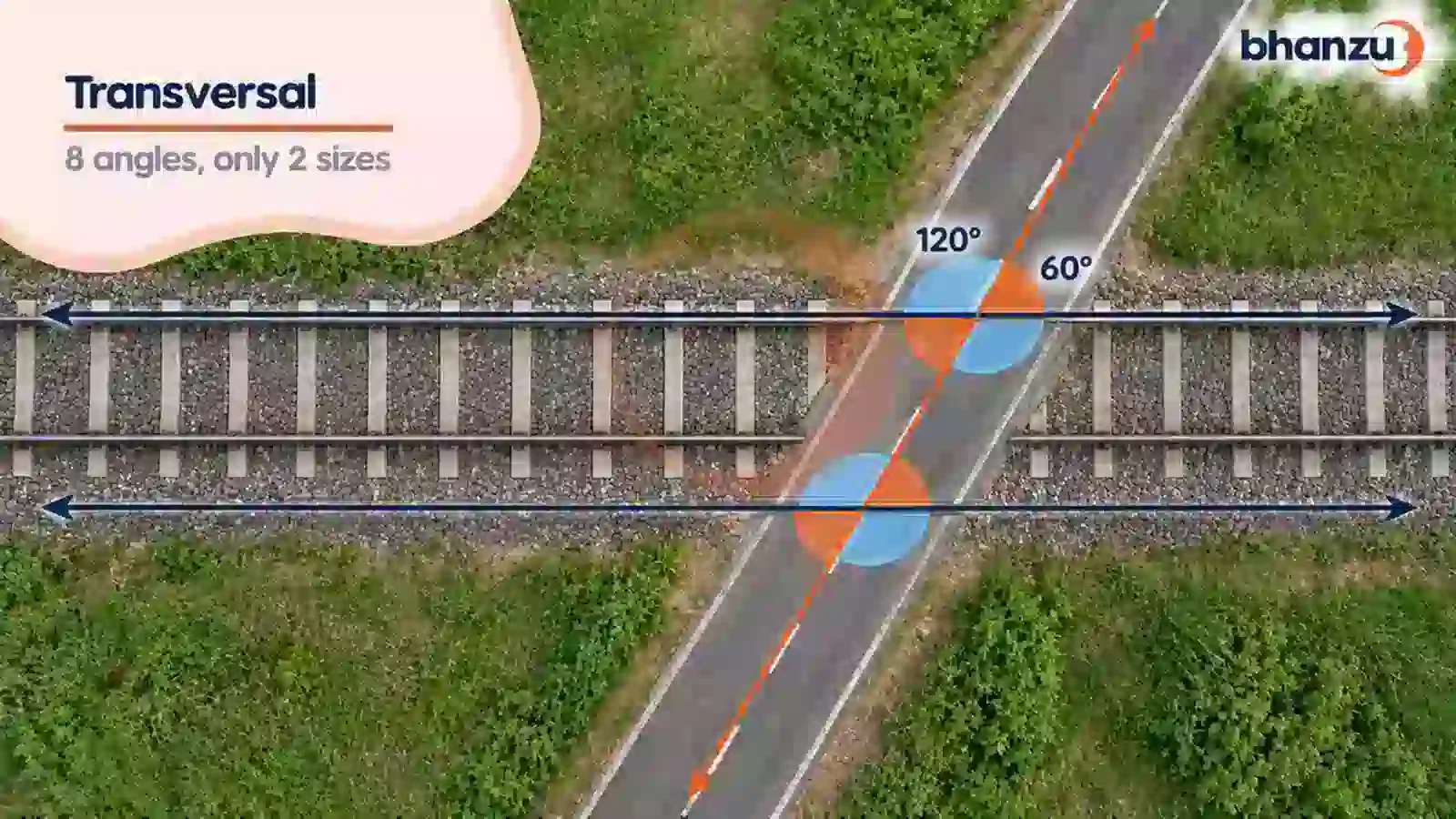
Alternate Angles: A pair of angles on opposite sides of a transversal that cuts two lines. When the two lines are parallel, alternate angles are equal.
Alternate Exterior Angles: Two angles outside a pair of lines and on opposite sides of the transversal that crosses them. If the lines are parallel, these angles are equal.
Alternate Interior Angles: Two angles between a pair of lines and on opposite sides of the transversal that crosses them. If the lines are parallel, these angles are equal.
Alternating Series: A series whose terms switch between positive and negative. For example, is an alternating series.
Alternating Series Remainder: The error made when an alternating series is stopped after a certain term. If the series passes the alternating series test, this error is no larger than the absolute value of the first term left out.
Alternating Series Test: A test for convergence: an alternating series converges if the absolute values of its terms keep decreasing and approach 0. It does not say whether the convergence is absolute.
Altitude: The perpendicular height of a shape, or the segment that shows that height. It is measured at a right angle to the base.
Altitude of a Cone: The perpendicular distance from the tip (apex) of a cone to the plane of its circular base.
Altitude of a Cylinder: The perpendicular distance between the two circular bases of a cylinder.
Altitude of a Parallelogram: The perpendicular distance between a chosen base of a parallelogram and the side opposite it. Area equals base times this altitude.
Altitude of a Prism: The perpendicular distance between the two bases of a prism. Volume equals base area times this altitude.
Altitude of a Pyramid: The perpendicular distance from the apex of a pyramid to the plane of its base.
Altitude of a Trapezoid: The perpendicular distance between the two parallel sides of a trapezoid.
Altitude of a Triangle: A segment from a vertex that meets the opposite side, or the line through it, at a right angle. Every triangle has three altitudes, and their lines meet at one point.
Amplitude: For a periodic graph with a highest and lowest value, such as a sine or cosine wave, half the distance between those two values. The graph of has amplitude 3.
Analytic Geometry: The study of geometry using a coordinate system, so shapes can be described by equations. It is also called coordinate geometry.
Analytic Methods: Solving a problem with algebra and exact calculation instead of reading the answer off a graph. "Solve analytically" usually means working it out by hand, without a graphing calculator.
Angle: The figure formed by two rays that share a common endpoint, called the vertex. Angles are measured in degrees or radians.
Angle Bisector: A ray or line that divides an angle into two equal angles. The bisector of a angle makes two angles.
Angle of Depression: The angle between the horizontal line of sight and the line down to an object below the observer, such as a boat seen from a cliff.
Angle of Elevation: The angle between the horizontal line of sight and the line up to an object above the observer, such as the top of a tree.
Angle of Inclination of a Line: The angle a line makes with the positive x-axis, measured counterclockwise, from up to but not including . The slope of the line equals the tangent of this angle.
Annulus: The ring-shaped region between two circles that share a center. Its area is , where and are the outer and inner radii.
Anticlockwise: Turning in the direction opposite to the hands of a clock, the same as counterclockwise. Positive angles in the coordinate plane are measured anticlockwise.
Antiderivative of a Function: A function whose derivative is the given function. Both and are antiderivatives of , since any constant can be added.
Antipodal Points: Two points on a sphere (or circle) that are exactly opposite each other, so the line joining them passes through the center. The North and South Poles are antipodal.
Apex: The highest point or tip of a shape, such as the point of a cone or the vertex of a pyramid opposite its base.
Apothem: The segment from the center of a regular polygon to the midpoint of one side, meeting that side at a right angle. Its length is used in the polygon's area formula.
Approximation by Differentials: Estimating a function's value near a known point using its derivative: . It works well when is small.
ARC: Short for average rate of change, the change in a function's output divided by the change in its input over an interval, .
arccos: The inverse cosine function, which gives the angle between 0 and whose cosine is a given number. For example, .
Arccos: Another way of writing arccos, the inverse cosine function that returns the angle whose cosine is a given number.
arccosec: The inverse cosecant function, which gives an angle whose cosecant is a given number. It is defined for inputs with .
Arccosec: Another way of writing arccosec, the inverse cosecant function that returns an angle whose cosecant is a given number.
arccot: The inverse cotangent function, which gives an angle whose cotangent is a given number. Books differ slightly on which range of angles it returns.
Arccot: Another way of writing arccot, the inverse cotangent function that returns an angle whose cotangent is a given number.
arccsc: Another name for arccosec, the inverse cosecant function that returns an angle whose cosecant is a given number.
Arccsc: Another name for arccosec, the inverse cosecant function, written with a capital letter.
Arc Length of a Curve: The distance measured along a curve between two points. For from to , it equals .
Arc of a Circle: A part of a circle's circumference between two points on it. An arc with central angle in radians has length .
arcsec: The inverse secant function, which gives an angle whose secant is a given number. It is defined for inputs with .
Arcsec: Another way of writing arcsec, the inverse secant function that returns an angle whose secant is a given number.
arcsin: The inverse sine function, which gives the angle between and whose sine is a given number. For example, .
Arcsin: Another way of writing arcsin, the inverse sine function that returns the angle whose sine is a given number.
arctan: The inverse tangent function, which gives the angle strictly between and whose tangent is a given number. For example, .
Arctan: Another way of writing arctan, the inverse tangent function that returns the angle whose tangent is a given number.
Area: The amount of surface a flat shape covers, measured in square units. A rectangle 3 cm by 4 cm has an area of .
Area below a Curve: The area of the region between the graph of a function and the x-axis over an interval. When , it equals the definite integral .
Area between Curves: The area of the region trapped between two graphs over an interval, found by integrating the top function minus the bottom function.
Area of a Circle: The space inside a circle, given by . A circle of radius 3 has area , about 28.27 square units.
Area of a Convex Polygon: The space inside a convex polygon. It can be found by splitting the polygon into triangles, or from the vertex coordinates using the shoelace formula.
Area of a Kite: Half the product of the kite's diagonals, . Diagonals of 6 and 8 give an area of 24.
Area of an Ellipse: Given by , where and are the semi-major and semi-minor axes. When , this becomes the circle formula.
Area of an Equilateral Triangle: For side length , the area is . A side of 2 gives an area of .
Area of a Parabolic Segment: The region between a parabola and a chord across it. When the chord is perpendicular to the axis, the area is of the base times the height of the segment.
Area of a Parallelogram: Base times the perpendicular height, . A base of 5 and height of 3 give an area of 15.
Area of a Rectangle: Length times width, . A rectangle 7 by 2 has an area of 14 square units.
Area of a Regular Polygon: Half the apothem times the perimeter, . This works for any regular polygon, such as a regular hexagon.
Area of a Rhombus: Half the product of the diagonals, , or base times height. Diagonals of 4 and 10 give an area of 20.
Area of a Sector of a Circle: The area of a pie-shaped slice of a circle. With central angle in radians, it is , or with in degrees.
Area of a Segment of a Circle: The area between a chord and its arc, found as the sector area minus the triangle area. With in radians, it equals .
Area of a Trapezoid: Half the sum of the parallel sides times the height, . Parallel sides of 3 and 5 with height 4 give 16.
Area of a Triangle: Half the base times the height, . A base of 6 and height of 4 give an area of 12.
Area under a Curve: Another name for the area below a curve: the region between a graph and the x-axis, found with a definite integral.
Area Using Parametric Equations: For a curve given by and , the area is found by integrating with respect to over the matching range of .
Area Using Polar Coordinates: For a curve , the area swept out between two angles is .
Argand Plane: A coordinate plane for complex numbers, with the real part on the horizontal axis and the imaginary part on the vertical axis. The number is plotted at .
Argument of a Complex Number: The angle from the positive real axis to the line joining the origin and the complex number. The argument of is .
Argument of a Function: The input value a function acts on. In , the argument is .
Argument of a Vector: The angle a vector makes with the positive x-axis, measured counterclockwise. It describes the vector's direction.
Arithmetic: The branch of mathematics that deals with numbers and the operations of addition, subtraction, multiplication and division.
Arithmetic Mean: The sum of a set of values divided by how many values there are. The arithmetic mean of 2, 4 and 9 is .
Arithmetic Progression: A sequence in which each term is found by adding the same fixed number, called the common difference, to the previous term. For example, 3, 7, 11, 15 has common difference 4.
Arithmetic Sequence: Another name for an arithmetic progression: a sequence that grows or shrinks by the same amount each step, such as 5, 8, 11, 14.
Arithmetic Series: The sum of the terms of an arithmetic sequence. For terms, it equals , so .
Arm of an Angle: Either of the two rays that form an angle, also called a side of the angle.
Arm of a Right Triangle: Either of the two sides that form the right angle, also called a leg. The third side is the hypotenuse.
Array: An arrangement of objects or numbers in equal rows and columns. Three rows of 4 dots show that .
ASA Congruence: A rule for proving two triangles congruent: if two angles and the side between them match the corresponding parts of another triangle, the triangles are congruent.
Associative: Describes an operation where the grouping does not change the result, such as . Addition and multiplication are associative, but subtraction and division are not.
Asymptote: A line that a curve gets closer and closer to as it heads off toward infinity. The graph of has asymptotes and .
Attribute: A feature of an object, such as its color, size, shape or number of sides, often used to sort or classify objects.
Augmented Matrix: A matrix that holds the coefficients of a system of linear equations with an extra column for the constants. It is used to solve the system by row operations.
Average: A single number that represents the center of a set of data. It usually means the arithmetic mean, though the median and mode are also kinds of average.
Average Rate of Change: The full name for ARC: how much a function's output changes per unit of input over an interval, equal to the slope of the secant line.
Average Value of a Function: The height of the rectangle with the same area as the region under a curve over , given by .
Axes: The plural of axis. In a coordinate plane, the axes are the horizontal x-axis and the vertical y-axis, which meet at the origin.
Axiom: A statement accepted as true without proof and used as a starting point for reasoning. For example, one axiom states that exactly one straight line passes through any two points.
Axis of a Cylinder: The line joining the centers of the two circular bases of a cylinder.
Axis of Reflection: The line a shape is flipped across in a reflection, also called the mirror line. Each point and its image are the same distance from it.
Axis of Rotation: The fixed line that a flat shape is turned around in space to create a solid. Spinning a rectangle around one of its sides traces out a cylinder.
Axis of Symmetry: A line that divides a figure into two halves that are mirror images of each other. A square has four axes of symmetry.
Axis of Symmetry of a Parabola: The line through the vertex of a parabola that splits it into two mirror halves. For , it is the vertical line .
Math Terms Starting With B
Back Substitution: A method for finishing a system of equations in triangular form: solve the last equation first, then substitute that value into the equations above, one at a time.
Bar Graph: A chart that uses rectangular bars of different lengths to compare amounts across categories. Taller or longer bars show larger values.
Base: A word with several meanings. In geometry, it is a chosen side or face of a shape. In powers, it is the number being multiplied, and in number systems it is how many digits are used.
Base 10: The place value system that uses the ten digits 0 to 9, where each place is worth ten times the place to its right. It is also called the decimal system.
Base (Geometry): A side or face of a shape chosen as the bottom, from which height is measured. Prisms and cylinders have two bases, while pyramids and cones have one.
Base of an Exponential Expression: The number that is multiplied by itself in a power. In , the base is 2 and the exponent is 5.
Base of an Isosceles Triangle: The side of an isosceles triangle that is not one of the two equal sides. The two angles touching the base are equal.
Base of a Trapezoid: Either of the two parallel sides of a trapezoid.
Base of a Triangle: Any side of a triangle chosen as the bottom, with the height measured perpendicular to it. Any of the three sides can serve as the base.
Bearing: A direction given as an angle. A three-figure bearing is measured clockwise from north, so east is . A compass bearing such as S E means from due south toward east.
BEDMAS: A memory aid for the order of operations: Brackets, Exponents, Division and Multiplication, Addition and Subtraction. Division and multiplication share one rank and are done left to right, as are addition and subtraction.
Bell Curve: The symmetric, bell-shaped graph of a normal distribution. Most values sit near the mean in the middle, with fewer values toward either end.
Bernoulli Trials: Repeated independent experiments, each with only two outcomes (success or failure) and the same probability of success every time. Flipping a coin 10 times is an example.
Beta (β): The second letter of the Greek alphabet. In math it often names an angle, and in statistics it stands for the probability of a Type II error.
Between: Point lies between points and when all three are on one line and .
Biconditional: A statement of the form "P if and only if Q", meaning P and Q are either both true or both false. It combines a conditional with its converse.
Binomial: A polynomial with exactly two terms. For example, and are binomials.
Binomial Coefficients: The numbers that appear in the expansion of , written . Each one also counts the ways to choose items from , so .
Binomial Coefficients in Pascal's Triangle: Row of Pascal's triangle lists the binomial coefficients to . Row 3 is 1, 3, 3, 1, matching .
Binomial Probability Formula: The probability of exactly successes in Bernoulli trials, , where is the chance of success on each trial.
Binomial Theorem: A formula for expanding any power of a binomial, , using binomial coefficients. For example, .
Bisect: To divide something into two equal parts. The midpoint of a segment bisects it.
Bisector: A line, ray or segment that divides a segment or an angle into two equal parts. A perpendicular bisector also meets the segment at a right angle.
Boundary Value Problem: A differential equation together with conditions the solution must meet at two or more points, often the ends of an interval. It differs from an initial value problem, where conditions are given at one point.
Bounded Function: A function whose values never go above some fixed number or below some other fixed number. The function is bounded because it always stays between and 1.
Bounded Sequence: A sequence whose terms all lie between two fixed numbers. The sequence is bounded between 0 and 1.
Bounded Set of Geometric Points: A set of points that fits entirely inside some circle, or sphere in space, of finite radius. A line segment is bounded, but a whole line is not.
Bounded Set of Numbers: A set of numbers that has both an upper bound and a lower bound. The set of all numbers between 2 and 5 is bounded.
Bounds of Integration: The numbers and in a definite integral , which mark where the integration starts and stops. They are also called limits of integration.
Box: A solid with six rectangular faces, also called a rectangular prism or cuboid. A shoebox is a common example.
Box and Whisker Plot: A graph that shows data using five values: minimum, lower quartile, median, upper quartile and maximum. The box covers the middle half of the data, and the whiskers reach the extremes.
Boxplot: A graph with a box from the lower to upper quartile and a line at the median. In a modified boxplot, whiskers stop at the last values that are not outliers, and outliers are marked as separate dots. See also Box and Whisker Plot.
Braces: The curly symbols , used to list the members of a set, as in , and sometimes to group terms.
Brachistochrone: The curve along which an object slides without friction, under gravity alone, from one point to a lower point in the shortest time. The answer is part of a cycloid, not a straight line.
Brackets: The square symbols , used to group parts of an expression, often around parentheses, as in . In interval notation, a square bracket means the endpoint is included.
Math Terms Starting With C
Calculus: The branch of mathematics that studies change and accumulation. Derivatives measure rates of change, and integrals add up quantities such as the area under a curve.
Capacity: The amount a container can hold, usually measured in liters, milliliters, gallons or cups. For example, a bottle with a capacity of 2 liters holds 2 liters of water when full.
Cardinality: The number of elements in a set, written or . For example, the set has cardinality 3.
Cardinal Numbers: Numbers that tell how many things are in a group, such as 1, 2, 3 and so on, with 0 used for an empty group. In set theory, cardinal numbers also measure the size of infinite sets.
Cardioid: A heart-shaped curve traced by a point on a circle as that circle rolls around another circle of the same size. One polar equation for it is .
Cartesian Coordinates: An ordered pair that locates a point by its signed distances from two perpendicular axes. In three dimensions, a third number is added, giving .
Cartesian Form: A way of writing an equation using , (and ) coordinates, such as for a line. For complex numbers, Cartesian form means writing the number as .
Cartesian Plane: A flat surface formed by a horizontal x-axis and a vertical y-axis that cross at right angles at the origin . It is used to plot points and graphs.
Catenary: The U-shaped curve formed by a chain or cable hanging freely between two supports under its own weight. Its equation is , and although it looks like a parabola, it is a different curve.
Cavalieri’s Principle: If two solids have the same height and their cross-sections at every level have equal areas, then the solids have equal volumes. It explains why a slanted stack of coins has the same volume as a straight one.
Ceiling Function: The function that rounds a number up to the nearest integer, written . For example, and .
Center of Mass Formula: Formulas that locate the balance point of a flat shape of uniform density. For a region of area , , the average x-value over the region, and is found the same way.
Center of Rotation: The fixed point that a figure turns around during a rotation. Every other point stays the same distance from this center as it moves.
Centers of a Triangle: Special points built from a triangle's lines: the centroid (where medians meet), circumcenter (perpendicular bisectors), incenter (angle bisectors) and orthocenter (altitudes).
Centimeter: A metric unit of length equal to one hundredth of a meter, written cm. There are 100 centimeters in a meter, and 1 inch is exactly 2.54 centimeters.
Central Angle: An angle whose vertex is at the center of a circle and whose sides are two radii. Its measure equals the measure of the arc it cuts off.
Centroid: The point where the three medians of a triangle meet, dividing each median in the ratio 2 to 1 from the vertex. More generally, it is the balance point (center of mass) of any shape of uniform density.
Centroid Formula: The rule that finds a triangle's centroid by averaging the coordinates of its vertices: for vertices , and , it is .
Ceva’s Theorem: For triangle with points , and on sides , and , the lines , and meet at one point exactly when .
Cevian: A line segment from a vertex of a triangle to a point on the opposite side, or on that side extended. Medians, altitudes and angle bisectors are all cevians.
Chain Rule: A derivative rule for composite functions: if , then . For example, the derivative of is .
Change of Base Formula: A rule that rewrites a logarithm in a different base: . For example, .
Check a Solution: To substitute an answer back into the original equation or problem to confirm it makes the statement true. For example, checks in because .
Chi (χ): The 22nd letter of the Greek alphabet. In statistics, (chi-square) names a test and a distribution used to compare observed counts with expected counts.
Chord: A line segment whose endpoints both lie on a circle or another curve. The longest chord of a circle is a diameter.
Circle: The set of all points in a plane that are the same distance, called the radius, from a fixed point called the center. A circle with radius has area .
Circle Identities: The trigonometric identities that come from the unit circle equation , mainly . They are also called the Pythagorean identities.
Circle Trig Definitions: Definitions of the trig functions using a point on a circle of radius centered at the origin: , and . They work for any angle, not only acute ones.
Circular Cone: A cone whose base is a circle. When the apex sits directly above the center of the base, it is a right circular cone, the usual cone of school geometry.
Circular Cylinder: A cylinder whose two bases are congruent circles. Its volume is , where is the perpendicular height, and in a right circular cylinder the curved side meets the bases at right angles.
Circular Functions: Another name for the trigonometric functions (sine, cosine, tangent and the rest), so called because they can be defined using points on the unit circle.
Circumcenter: The point where the perpendicular bisectors of a triangle's sides meet. It is the same distance from all three vertices and is the center of the circumcircle.
Circumcircle: The circle that passes through every vertex of a polygon, when such a circle exists. Every triangle has exactly one, centered at its circumcenter.
Circumference: The distance around a circle, found with or . For example, a circle with radius 5 cm has circumference cm.
Circumscribable: Describes a polygon that can have a circle drawn through all of its vertices. Every triangle is circumscribable, and a quadrilateral is circumscribable exactly when its opposite angles add up to .
Circumscribed: Drawn around another figure so that it encloses it and touches it without cutting into it. A circle through all the vertices of a polygon is circumscribed about it, and a polygon whose sides all touch a circle is circumscribed about the circle.
Circumscribed Circle: Another name for the circumcircle: the circle that passes through every vertex of a polygon.
Cis: Shorthand used with complex numbers, where . It lets a complex number be written in polar form as .
Classical Adjoint: Another name for the adjugate of a square matrix: the transpose of its cofactor matrix, used to find the inverse.
Clockwise: Turning in the same direction as the hands of a clock, from the top toward the right. In math, clockwise rotations are usually measured as negative angles.
Closed Interval: The set of all real numbers between two endpoints, including both endpoints, written . For example, contains 1, 3 and every number in between.
Coefficient: The number multiplying a variable in a term. In , the coefficient is 3, and in , the coefficient is .
Coefficient Matrix: The matrix formed from only the coefficients of the variables in a system of linear equations. For and , its rows are 2, 3 and 1, .
Cofactor: For an entry of a square matrix, the minor of that entry (the determinant left after deleting its row and column) multiplied by , where and are the row and column numbers. Cofactors are used to compute determinants.
Cofactor Matrix: The matrix made by replacing each entry of a square matrix with its cofactor. Its transpose is the adjugate, which is used to find the inverse matrix.
Cofunction Identities: Identities showing that a trig function of an angle equals its cofunction of the complementary angle, such as and .
Coincident: Lying exactly on top of each other. Coincident lines are the same line and share every point, as with and .
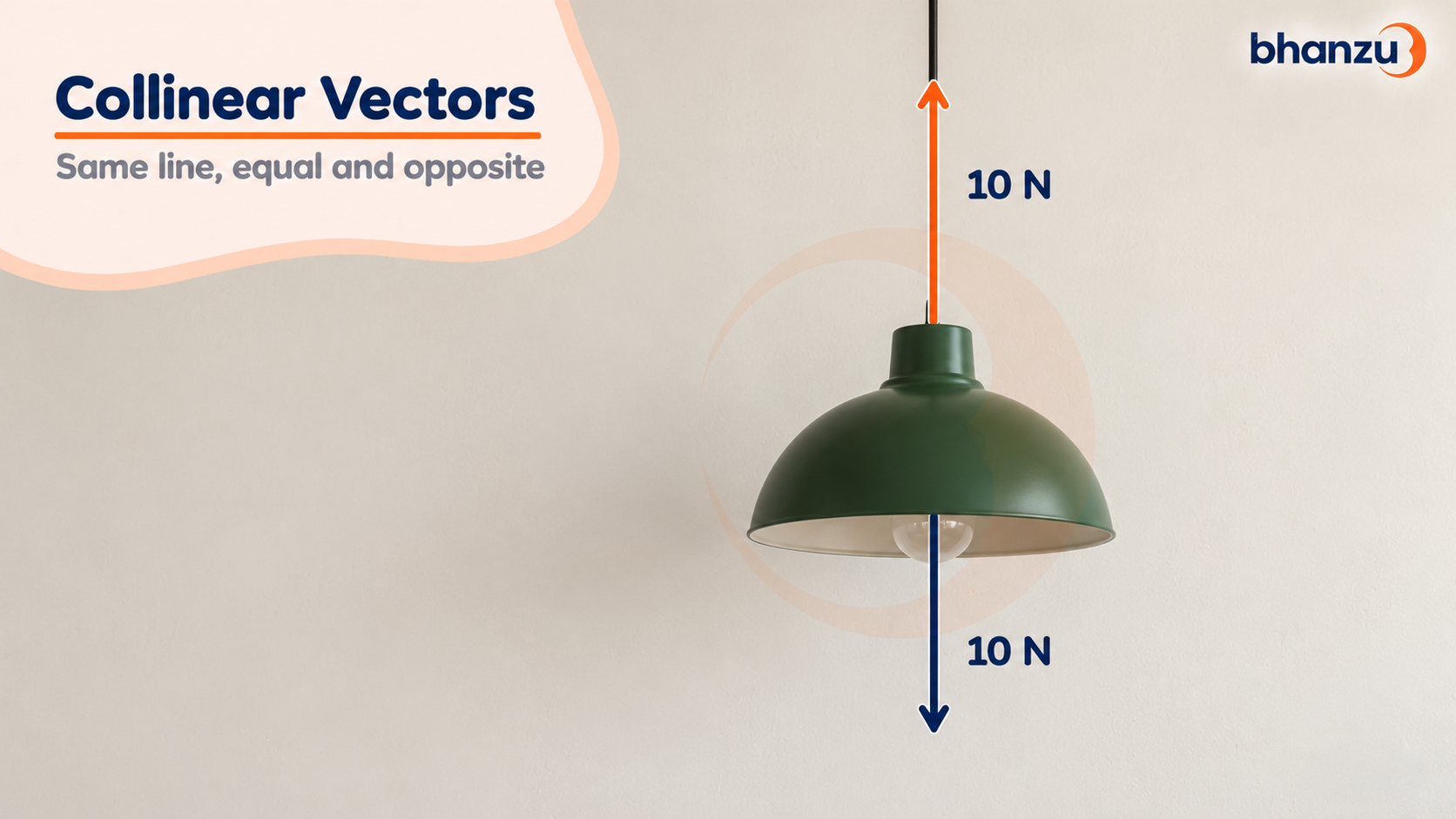
Collinear: Describes points that lie on the same straight line. For example, , and are collinear.
Column of a Matrix: A vertical line of entries in a matrix. A matrix with rows and columns has columns, each holding entries.
Combination: A selection of items where order does not matter. Choosing 2 letters from A, B and C gives 3 combinations: AB, AC and BC.
Combination Formula: The count of ways to choose items from when order does not matter, equal to n factorial divided by r factorial times (n minus r) factorial. For example, .
Combinatorics: The branch of mathematics that studies counting, arranging and selecting objects, including permutations, combinations and the structure of networks called graphs.
Common Factor: A number or expression that divides two or more numbers or expressions exactly. The common factors of 12 and 18 are 1, 2, 3 and 6.
Common Logarithm: A logarithm with base 10, written or . For example, because .
Common Ratio: The fixed number that each term of a geometric sequence is multiplied by to get the next term. In 3, 6, 12, 24, ... the common ratio is 2.
Commutative: Describes an operation where changing the order of the two inputs does not change the result. Addition and multiplication are commutative (), but subtraction and division are not.
Comparison Test: A test for series with nonnegative terms. If each term is at most the matching term of a known convergent series, the series converges, and if each term is at least the matching term of a known divergent series, it diverges.
Compatible Matrices: Two matrices whose sizes allow an operation between them. For the product , the number of columns of must equal the number of rows of , and for addition the sizes must match.
Complementary Angles: Two angles whose measures add up to . For example, and are complementary.
Complement of an Angle: The angle that must be added to a given angle to make . The complement of is .
Complement of an Event: All the outcomes in which an event does not happen, with probability . If the chance of rain is 0.3, the chance of no rain is 0.7.
Complement of a Set: The set of all elements of the universal set that are not in the given set, written or . If and , then .
Complex Conjugate: The complex number formed by changing the sign of the imaginary part. The conjugate of is , and their product, 25, is a real number.
Complex Fraction: A fraction whose numerator, denominator or both contain a fraction, such as , which simplifies to .
Complex Number Formulas: Key rules for working with complex numbers, such as , and the modulus .
Complex Numbers: Numbers of the form , where and are real numbers and is the imaginary unit with . Every real number is a complex number with .
Complex Plane: Another name for the Argand plane: a coordinate plane whose horizontal axis shows the real part and vertical axis the imaginary part of complex numbers.
Composite: In number work, describes a whole number greater than 1 with more than two factors, such as 9. In functions, a composite function is one function applied to the output of another.
Composite Number: A whole number greater than 1 that has more than two factors. For example, 12 is composite (factors 1, 2, 3, 4, 6 and 12), while 1 is neither prime nor composite.
Composition: Combining two functions by using the output of one as the input of the other, written . If and , then .
Compounded: Used for compound interest: interest added to the balance at set periods, so that later interest is also earned on earlier interest.
Compounded Continuously: Interest that is compounded at every instant rather than at set periods. The amount after years is , where is the starting amount and is the yearly rate as a decimal.
Compound Fraction: Another name for a complex fraction: a fraction with a fraction in its numerator, denominator or both.
Compound Inequality: Two inequalities joined by "and" or "or". For example, means and at the same time.
Compound Interest: Interest calculated on the starting amount plus all interest already earned. The formula is for compounding periods per year over years.
Compression: A transformation that squeezes a graph or figure toward an axis or a point. For example, is a vertical compression of by a factor of .
Compression of a Geometric Figure: A transformation that shrinks a figure by multiplying distances by a scale factor between 0 and 1. When all directions shrink equally, the result is a smaller figure similar to the original.
Compression of a Graph: A transformation that squeezes a graph toward an axis. The graph of with is compressed vertically, and with is compressed horizontally.
Compute: To find a numerical answer or result by calculating. For example, to compute is to work out that it equals 28.
Concave: In geometry, a polygon is concave if at least one interior angle is greater than , so part of it caves inward. In calculus, a graph is described as concave up or concave down depending on how it bends.
Concave Down: Describes part of a graph that bends downward like an upside-down bowl, where the slope is decreasing. The graph is concave down wherever the second derivative is negative, as with .
Concave Up: Describes part of a graph that bends upward like a bowl, where the slope is increasing. The graph is concave up wherever the second derivative is positive, as with .
Concentric: Describes circles or other shapes that share the same center. The rings of a dartboard are concentric circles.
Conclusion: The "then" part of an if-then statement, or the final statement reached in a proof. In "If a number is even, then it is divisible by 2," the conclusion is "it is divisible by 2."
Concurrent: Describes three or more lines that pass through a single common point. The three medians of any triangle are concurrent at the centroid.
Conditional: A statement of the form "if , then ," written . It is false only when is true and is false.
Conditional Convergence: The behavior of a series that converges while the series of the absolute values of its terms diverges. For example, converges, but does not.
Conditional Equation: An equation that is true for some values of the variable but not all. For example, is true only when .
Conditional Inequality: An inequality that is true for some values of the variable but not all. For example, holds only when .
Conditional Probability: The probability that an event happens given that another event has happened, written when .
Cone: A solid with a flat base, usually a circle, that narrows smoothly to a single point called the apex. Its volume is one third of base area times height, which is for a circular base.
Cone Angle: The angle of the paper sector left over after the takeout angle is cut away, so the paper rolls into a right circular cone. It equals , with base radius and slant height .
Congruence: The relationship between figures that have exactly the same shape and size, shown by the symbol . In number theory, two integers are congruent if they leave the same remainder when divided by a given number. See also Congruence Tests for Triangles.
Congruence Tests for Triangles: Rules that prove two triangles congruent from only some matching parts: SSS, SAS, ASA, AAS and, for right triangles, HL (hypotenuse-leg). SSA and AAA are not valid tests.
Congruent: Having exactly the same shape and size. Two figures are congruent if one can be moved onto the other by slides, turns and flips, so matching sides and angles are equal.
Conic Sections: The curves formed when a plane cuts a double cone: circles, ellipses, parabolas and hyperbolas. Each can be written as a second-degree equation in and .
Conjecture: A statement believed to be true, based on patterns or evidence, that has not yet been proved. Once it is proved, it becomes a theorem.
Conjugate Pair Theorem: A theorem stating that if a polynomial has real coefficients and is a root, then its conjugate is also a root. So the non-real roots of such polynomials come in pairs.
Conjugates: Pairs of expressions of the form and , often with a square root or in the second part, such as and . Multiplying them gives , which removes the root.
Conjunction: A compound statement that joins two statements with "and," written . It is true only when both parts are true.
Consecutive Interior Angles: When a transversal crosses two lines, the pair of angles on the same side of the transversal and between the two lines. If the lines are parallel, these angles add up to .
Consistent System of Equations: A system of equations that has at least one solution. It may have exactly one solution, where lines cross, or infinitely many, where lines coincide.
Constant: A value that does not change, such as 7, or . In , the number 5 is a constant.
Constant Function: A function that gives the same output for every input, such as . Its graph is a horizontal line.
Constant Term: The term in an expression or polynomial that has no variable. In , the constant term is .
Continued Sum: A sum of a list of terms, usually written in compact form with sigma notation. For example, .
Continuous: Without breaks, jumps or holes. A continuous set of numbers, such as an interval, has no gaps, unlike the integers, and a continuous graph can be drawn without lifting the pencil.
Continuous Compounding: Another name for interest compounded continuously: growth at every instant, given by .
Continuous Function: A function whose graph has no breaks, jumps or holes on its domain. At each point of the domain, .
Continuously Compounded Interest: Another name for interest compounded continuously, where the amount grows at every instant according to .
Continuously Differentiable Function: A function that has a derivative at every point of its domain, where that derivative is itself continuous. Smooth curves such as are examples.
Contraction: Another name for a compression: a transformation that squeezes a graph or figure toward an axis or a point.
Contraction of a Geometric Figure: Another name for the compression of a geometric figure: shrinking it by a scale factor between 0 and 1.
Contrapositive: The statement formed by swapping and negating both parts of a conditional: the contrapositive of "if , then " is "if not , then not ." It is true exactly when the original statement is true.
Converge: To approach a single finite value. A sequence or series converges if its terms, or its partial sums, get closer and closer to one limit, as approaches 0.
Converge Absolutely: Another name for absolute convergence: a series converges absolutely when the sum of the absolute values of its terms converges.
Converge Conditionally: Another name for conditional convergence: a series converges, but the series of its absolute values diverges.
Convergence Tests: Methods for deciding whether an infinite series converges or diverges, such as the nth-term, comparison, ratio, root, integral and alternating series tests.
Convergent Sequence: A sequence whose terms approach a single finite limit. For example, converges to 1.
Convergent Series: An infinite series whose partial sums approach a finite limit, called its sum. For example, converges to 1.
Converse: The statement formed by swapping the two parts of a conditional: the converse of "if , then " is "if , then ." A true statement can have a false converse.
Convex: In geometry, a polygon is convex if every interior angle is less than , so any segment joining two points inside it stays inside. In calculus, a convex function is one that is concave up.
Coordinate Geometry: Another name for analytic geometry: the study of shapes using coordinates and equations on a coordinate plane.
Coordinate Plane: Another name for the Cartesian plane: the flat grid formed by a horizontal x-axis and a vertical y-axis, used to plot points.
Coordinates: The ordered numbers that give a point's position, such as , meaning 3 units right along the x-axis and 2 units down. Other systems, such as polar coordinates, use a distance and an angle.
Coplanar: Describes points, lines or shapes that lie in the same plane. Any three points are always coplanar, but four points may not be.
Corollary: A result that follows directly from a theorem that has just been proved, with little or no extra work.
Correlation: A relationship between two variables in which they tend to change together. It is positive when both rise together and negative when one rises as the other falls, and correlation alone does not prove cause.
Correlation Coefficient: A number from to 1 that measures the strength and direction of a linear relationship between two variables. Values near 1 or show a strong relationship, and values near 0 a weak one.
Corresponding: Matching in position when two figures are compared. In congruent or similar figures, corresponding sides and angles sit in the same relative places, and corresponding angles also appear when a transversal crosses two lines.
cos: Short for cosine. In a right triangle, equals the adjacent side divided by the hypotenuse, and on the unit circle it is the x-coordinate of the point at angle .
cos-1: Another name for arccos, the inverse cosine: gives the angle whose cosine is , not .
Cos-1: Another name for arccos, written with a capital letter in some books to mean the principal value of the inverse cosine, from 0 to .
cosec: Short for cosecant, the reciprocal of sine: . In a right triangle, it equals the hypotenuse divided by the opposite side.
cosec-1: Another name for arccosec, the inverse cosecant: it gives the angle whose cosecant is , for .
Cosec-1: Another name for arccosec, written with a capital letter in some books to mean the principal value of the inverse cosecant.
cosecant: Another name for cosec: the reciprocal of sine, equal to the hypotenuse over the opposite side in a right triangle.
cosine: Another name for cos: the trig function equal to the adjacent side over the hypotenuse in a right triangle.
cot: Short for cotangent, the reciprocal of tangent: . In a right triangle, it equals the adjacent side divided by the opposite side.
cot-1: Another name for arccot, the inverse cotangent: gives the angle whose cotangent is .
Cot-1: Another name for arccot, written with a capital letter in some books to mean the principal value of the inverse cotangent.
Cotangent: Another name for cot: the reciprocal of tangent, equal to the adjacent side over the opposite side in a right triangle.
Coterminal: Describes angles in standard position that share the same terminal side. They differ by a multiple of , so , and are coterminal.
Countable: Describes a set whose elements can be listed one by one and matched with the counting numbers 1, 2, 3, and so on. Finite sets and the integers are countable, but the real numbers are not.
Countably Infinite: Describes an infinite set that can be matched one-to-one with the counting numbers. The integers and the rational numbers are countably infinite.
Counterclockwise: Another name for anticlockwise: turning opposite to the hands of a clock, the direction of positive angles in math.
Counterexample: A single example that shows a general statement is false. The number 2 is a counterexample to the claim "all prime numbers are odd."
Counting Numbers: The numbers 1, 2, 3, 4 and so on, used for counting. They are the natural numbers (some books also include 0 in the natural numbers).
CPCFC: Short for "corresponding parts of congruent figures are congruent." Once two figures are shown to be congruent, every pair of matching sides and angles is equal.
CPCTC: Short for "corresponding parts of congruent triangles are congruent." After two triangles are proved congruent, it justifies that their matching sides and angles are equal.
Cramer’s Rule: A method for solving a system of linear equations with determinants: each variable equals the determinant of the coefficient matrix with that variable's column replaced by the constants, divided by the coefficient matrix's determinant. It works only when that determinant is not zero.
Critical Number: A value in the domain of where or does not exist. Local maximums and minimums inside the domain can occur only at critical numbers.
Critical Point: A point on a graph where the derivative is zero or does not exist, located at a critical number. For , the critical point is .
Critical Value: In statistics, a cutoff score such as $z^{}t^{}f(c)$ there.
Cross Product: An operation on two vectors in three dimensions that gives a vector perpendicular to both, written . Its length, , equals the area of the parallelogram the vectors form.
csc: Another name for cosec, the cosecant: the reciprocal of sine, written .
csc-1: Another name for arccosec, the inverse cosecant, also written : the angle whose cosecant is .
Csc-1: Another name for arccosec, with a capital letter used in some books for the principal value of the inverse cosecant.
ctg: Another name for cot, used in some countries: the cotangent, equal to .
ctg-1: Another name for arccot, the inverse cotangent, in the ctg notation used in some countries.
Ctg-1: Another name for arccot, with a capital letter marking the principal value of the inverse cotangent in ctg notation.
Cube: A solid with six equal square faces, 12 equal edges and 8 vertices, with volume for edge length . To cube a number is to raise it to the third power, as in .
Cube Root: The number that, multiplied by itself three times, gives the original number, written . For example, and .
Cubic Polynomial: A polynomial of degree 3, such as with . With real coefficients, it has at least one real root and at most three.
Cuboid: Another name for a box, or rectangular prism: a solid with six rectangular faces, like a brick.
Curly d: The symbol , used for partial derivatives. The expression is the rate of change of with respect to while all other variables are held fixed.
Curve: A continuous line, straight or bending, such as a circle, a parabola or the graph of a function. In many math books, a straight line also counts as a curve.
Curve Sketching: Drawing the graph of a function from key features found with algebra and calculus, such as intercepts, asymptotes, critical points, intervals of increase and decrease, and concavity.
Cusp: A sharp point on a curve where the two sides meet while heading in the same direction, like the point of at the origin. The derivative does not exist there.
Cycloid: The curve traced by a point on the rim of a circle as the circle rolls along a straight line. It looks like a row of arches.
Cylinder: A solid with two parallel, congruent bases joined by a side surface. The bases are usually circles, and a right circular cylinder with radius and height has volume .
Cylindrical Shell Method: A calculus method for finding the volume of a solid of revolution using thin cylindrical shells. For a region under from to (with ) rotated around the y-axis, .
Math Terms Starting With D
Decagon: A polygon with 10 sides and 10 angles. The interior angles of any decagon add up to , and each angle of a regular decagon measures .
Deciles: The nine values that split an ordered data set into 10 equal parts, each holding about 10 percent of the data. The first and ninth deciles are the 10th and 90th percentiles, and the fifth decile is the median.
Decimal: A number written in base 10 that uses a decimal point to show parts smaller than one. For example, means 3 ones, 2 tenths and 5 hundredths.
Decreasing Function: A function whose output goes down as the input goes up on an interval, so that gives . For example, is decreasing everywhere.
Definite Integral: An integral with lower and upper limits, written , that gives a single number. It measures the signed area between the curve and the x-axis from to , with area below the axis counted as negative.
Definite Integral Rules: Properties that make definite integrals easier to work with. Examples are , swapping the limits changes the sign, and the integral of a sum equals the sum of the integrals.
Degenerate: Describes a limiting case of a figure that has collapsed into a simpler form. For example, a triangle whose three vertices lie on one line is a degenerate triangle.
Degenerate Conic Sections: The shapes formed when a plane slices a double cone through its vertex: a single point, a single line, or a pair of intersecting lines. Some books also count two parallel lines, which come from certain second-degree equations.
Degree: In geometry, a unit of angle measure, with in a full turn. In algebra, a term's degree is the sum of its variables' exponents, and a polynomial's degree is its highest term degree. It is also a unit of temperature.
Degree (angle measure): A unit for measuring angles equal to of a full turn. A right angle measures and a straight angle measures .
Degree of a Polynomial: The highest degree of any term in a polynomial, found after like terms are combined. For example, has degree 3.
Degree of a Term: The sum of the exponents of all the variables in that term. For example, has degree 5, and a nonzero constant such as 7 has degree 0.
Deleted Neighborhood: An interval around a point with the point itself removed, such as all with . It is used in the definition of a limit, where the value at itself does not matter.
Del Operator: The symbol , a vector of partial derivative operators used in multivariable calculus. Applied to a function, it gives the gradient, and it also appears in divergence and curl.
Delta (δ): The fourth Greek letter. Capital often means "change in," as in , and lowercase often names a small positive number in limits.
De Moivre's Theorem: For any real number and integer , . It is used to find powers and roots of complex numbers.
Denominator: The bottom number of a fraction, showing how many equal parts make one whole. In , the denominator is 4.
Dependent Variable: The variable whose value depends on another variable, usually the output. In , is the dependent variable because its value is set by .
Derivative: The instantaneous rate of change of a function, equal to the slope of the tangent line at a point. It is written or . For example, the derivative of is .
Derivative of a Power Series: Inside its open interval of convergence, a power series can be differentiated term by term, and the new series has the same radius of convergence. For example, differentiating gives .
Derivative Rules: Standard shortcuts for finding derivatives, including the power, constant multiple, sum, product, quotient and chain rules. For example, the power rule gives .
Descartes' Rule of Signs: A way to bound the number of positive real roots of a polynomial: count sign changes between consecutive nonzero coefficients, and the number of positive roots equals that count or is less by an even number. Using does the same for negative roots.
Determinant: A single number computed from a square matrix. For a matrix with rows and , it equals , and a matrix has an inverse only when its determinant is not zero.
Diagonal: In geometry, a line segment joining two vertices of a polygon that are not next to each other. In a matrix, the main diagonal is the entries running from the top left to the bottom right. See also Diagonal of a Polygon.
Diagonal Matrix: A square matrix in which every entry off the main diagonal is zero. The identity matrix is one example.
Diagonal of a Polygon: A line segment joining two vertices of a polygon that are not neighbors. A polygon with sides has diagonals, so a pentagon has 5.
Diameter: A chord that passes through the center of a circle or sphere, or the length of such a chord. The diameter is twice the radius.
Diametrically Opposed: Describes two points on a circle or sphere that sit at opposite ends of a diameter. For example, the North and South Poles are diametrically opposed on a globe.
Difference: The result of subtracting one number from another. The difference of 12 and 5 is 7.
Difference Identities: Trigonometric identities for the sine, cosine and tangent of a difference of two angles, such as and .
Difference Quotient: The expression , which gives the slope of the secant line between two points on a graph. Its limit as approaches 0 is the derivative.
Differentiable: Describes a function whose derivative exists at a point, so the graph has a single non-vertical tangent line there. Every differentiable function is continuous, but not the reverse: is continuous at 0 yet not differentiable there because of its sharp corner.
Differential: A small change in a variable, written or . For , the differential is , which estimates how much changes when changes slightly.
Differential Equation: An equation that relates a function to one or more of its derivatives, such as . Solving it means finding the function, and such equations model growth, motion and cooling.
Differentiation: The process of finding a derivative. For example, differentiating gives .
Differentiation Rules: Another name for the derivative rules: shortcuts such as the power, product, quotient and chain rules for finding derivatives.
Digit: Any of the ten symbols 0 to 9 used to write numbers in base 10. The number 507 has three digits: 5, 0 and 7.
Dihedral Angle: The angle between two planes that meet along a line, such as two faces of a polyhedron sharing an edge. It is measured in a plane perpendicular to that line, and every dihedral angle of a cube is .
Dilation: A transformation that enlarges or shrinks a figure or graph by a scale factor. A factor greater than 1 stretches it, and a factor between 0 and 1 shrinks it.
Dilation of a Geometric Figure: A transformation that resizes a figure from a fixed center by a scale factor . Each point moves along a line through the center to times its original distance, so the image is similar to the original.
Dilation of a Graph: A stretch or compression of a graph in one direction. For , the graph of is times taller than , and the graph of is times narrower.
Dimensions: The measurements of an object, such as length, width and height, or the number of independent directions in a space. A line is one-dimensional, a square two-dimensional and a cube three-dimensional.
Dimensions of a Matrix: The number of rows and columns in a matrix, written rows by columns. A matrix with 2 rows and 3 columns is a matrix.
Directly Proportional: Another name for direct proportion: two quantities are directly proportional when one is always a fixed multiple of the other, as in .
Direct Proportion: A relationship in which one quantity is a constant multiple of another, written with . If doubles, doubles, as when total cost grows with the number of items bought at a fixed price.
Directrices of a Hyperbola: The two fixed lines, one for each focus, used to define a hyperbola. For every point on the curve, its distance to a focus divided by its distance to the matching directrix equals the eccentricity, which is greater than 1.
Directrices of an Ellipse: The two fixed lines outside an ellipse, one for each focus. For every point on the ellipse, its distance to a focus divided by its distance to the matching directrix equals the eccentricity, which is less than 1.
Directrix of a Parabola: The fixed line used to define a parabola: every point on the parabola is the same distance from the focus as from the directrix. For , the directrix is .
Direct Variation: Another name for direct proportion: varies directly with when for some nonzero constant .
Discontinuity: A point where a function is not continuous, for example where its graph has a hole, a jump or a vertical asymptote. The graph of breaks at .
Discontinuous Function: A function whose graph has at least one break, such as a hole, a jump or a vertical asymptote, so it cannot be drawn without lifting the pencil. The floor function, which jumps at every integer, is an example.
Discrete: Made of separate, countable values with gaps between them rather than a continuous range. The number of students in a class is discrete data, while height is continuous.
Discriminant of a Quadratic: The value for the quadratic . If it is positive there are two real roots, if it is zero there is one repeated real root, and if it is negative there are no real roots.
Disjoint Events: Events that cannot happen at the same time, also called mutually exclusive events. Rolling a 2 and rolling a 5 on one die are disjoint, so .
Disjoint Sets: Sets that have no elements in common, so their intersection is the empty set. For example, and are disjoint.
Disjunction: In logic, a compound statement that joins two statements with "or," written . It is true when at least one of the two statements is true.
Disk: The region made of a circle together with all the points inside it. A closed disk includes the boundary circle, and an open disk does not.
Disk Method: A way to find the volume of a solid of revolution by slicing it into thin circular disks and adding their volumes with an integral. Rotating about the x-axis from to gives .
Distance Formula: A formula for the distance between points and : . It comes from the Pythagorean theorem.
Distance from a Point to a Line: The length of the perpendicular segment from the point to the line. For the line and the point , it equals .
Distinct: Different from one another. For example, a quadratic with two distinct roots has two roots that are not equal.
Distribute: To multiply a factor across each term inside parentheses, also called expanding. For example, becomes .
Distributing Rules: The patterns used to multiply out expressions, such as and . They show how to remove parentheses correctly.
Distributive Property: The rule that multiplying a sum by a number gives the same result as multiplying each addend and then adding: . For example, .
Diverge: To fail to approach a single finite value. A sequence or series diverges if its terms or sums grow without bound, swing back and forth, or otherwise settle on no limit.
Divergent Sequence: A sequence that does not have a finite limit. For example, and both diverge.
Divergent Series: An infinite series whose partial sums do not approach a finite limit. The harmonic series diverges even though its terms shrink toward 0.
Dividend: The number being divided in a division problem. In , the dividend is 20.
Divisor: The number you divide by. In , the divisor is 4. The word also means a number that divides another exactly, so the positive divisors of 6 are 1, 2, 3 and 6.
Dodecagon: A polygon with 12 sides and 12 angles. Its interior angles add up to , and each angle of a regular dodecagon measures .
Dodecahedron: A polyhedron with 12 faces. The regular dodecahedron, one of the five Platonic solids, has 12 regular pentagon faces, 20 vertices and 30 edges.
Domain: The set of all input values for which a function is defined. For example, the domain of in the real numbers is all .
Domain of Definition: The largest set of inputs for which a function's formula makes sense, used when no domain is stated. For , it is all real numbers except 2.
Dot Product: A way of multiplying two vectors that gives a single number, found by adding the products of matching components. For example, . Two nonzero vectors with a dot product of 0 are perpendicular.
Double Angle Identities: Trigonometric identities that express functions of using functions of , such as and .
Double Cone: Two cones placed tip to tip along the same axis, like an hourglass. Slicing a double cone with a plane produces the conic sections.
Double Number Identities: Another name for the double angle identities: formulas such as that rewrite functions of a doubled angle.
Double Root: A root that appears twice, so its factor is squared. For example, has a double root at , where the graph touches the x-axis without crossing it.
Doubling Time: The time it takes a quantity that grows exponentially to double in size. For continuous growth , it equals , no matter how large the starting amount is.
Math Terms Starting With E
e: An irrational number, approximately , that is the base of the natural logarithm. It is the limit of as grows without bound and appears in exponential growth and decay.
Eccentricity: A number that describes how far a conic section is from being a circle. A circle has eccentricity 0, an ellipse between 0 and 1, a parabola exactly 1, and a hyperbola greater than 1.
Echelon Form of a Matrix: A staircase-shaped form in which any zero rows are at the bottom and each row's first nonzero entry lies to the right of the one in the row above. It is reached by row operations and used to solve systems of linear equations.
Edge: A line segment where two faces of a solid meet, or in a graph (network), a line connecting two vertices. A cube has 12 edges. See also Edge of a Polyhedron.
Edge of a Polyhedron: A line segment where two faces of a polyhedron meet. A cube has 12 edges and a triangular prism has 9.
Element of a Matrix: One of the numbers in a matrix, also called an entry. The element in row and column is written .
Element of a Set: An object that belongs to a set, also called a member. The statement means 3 is an element of the set.
Ellipse: A closed oval curve made of all points whose distances to two fixed points, the foci, add up to the same constant. A circle is the special case where the two foci coincide.
Ellipsoid: A closed three-dimensional surface whose flat cross sections are ellipses or circles, like a stretched or squashed sphere. Its standard equation is .
Elliptic Geometry: A non-Euclidean geometry in which there are no parallel lines, since any two lines meet. Geometry on the surface of a sphere is a model of it, and there the angles of a triangle add up to more than .
Empty Set: The set that has no elements, written or . For example, the set of whole numbers between 3 and 4 is empty.
End Behavior: How a function's values behave as becomes very large in the positive or negative direction. For example, as , grows without bound, and as , it decreases without bound.
Endpoint: A point at the end of a line segment or ray, or a boundary value of an interval. A segment has two endpoints, a ray has one, and the interval has endpoints 2 and 5.
Epsilon (ε): The fifth letter of the Greek alphabet. Lowercase often stands for a very small positive number, as in the formal definition of a limit.
Equality, Properties of: The rules that keep an equation true as you work with it. They include the reflexive, symmetric, transitive and substitution properties, plus doing the same operation to both sides (never dividing by 0).
Equation: A mathematical statement that two expressions are equal, joined by an equals sign. For example, is an equation whose solution is .
Equation of a Line: An equation whose graph is a straight line. Common forms are slope-intercept form , point-slope form and standard form .
Equation Rules: Another name for the properties of equality: rules, such as doing the same operation to both sides, that keep an equation true.
Equiangular Triangle: A triangle whose three angles are equal, each measuring . Every equiangular triangle is also equilateral.
Equidistant: At the same distance. Every point on the perpendicular bisector of a segment is equidistant from the segment's two endpoints.
Equilateral: Having all sides equal in length. An equilateral triangle has three equal sides, and every rhombus, including every square, is an equilateral quadrilateral. See also Equilateral Triangle.
Equilateral Triangle: A triangle with all three sides equal in length. Its three angles are also equal, each measuring .
Equivalence Properties of Equality: The reflexive, symmetric and transitive properties: , if then , and if and then .
Equivalence Relation: A relation that is reflexive, symmetric and transitive. Equality is one example, and "has the same remainder when divided by 3" is another on the integers.
Equivalent Systems of Equations: Systems that have exactly the same solution set. Adding a multiple of one equation to another produces an equivalent system, which is why the elimination method works.
Essential Discontinuity: A discontinuity that cannot be fixed by filling in or moving a single point. Some books use the term for jumps and vertical asymptotes, while others reserve it for points where a one-sided limit does not exist.
Eta (η): The seventh letter of the Greek alphabet. Lowercase is used for various quantities in math and science, such as efficiency.
Euclidean Geometry: The geometry of flat planes and ordinary space built on Euclid's axioms, including the parallel postulate. In it, the angles of every triangle add up to .
Euler Line: The straight line that passes through the orthocenter, centroid and circumcenter of any triangle that is not equilateral. The center of the nine-point circle also lies on it.
Euler's Formula: The identity , which links the exponential function to trigonometry. Setting gives .
Euler's Formula (Polyhedra): For any convex polyhedron, , where , and are the numbers of vertices, edges and faces. A cube checks out: .
Evaluate: To find the value of an expression. Evaluating when gives 14.
Even Function: A function with for every in its domain, so its graph is symmetric about the y-axis. Examples are and .
Even Number: An integer that is divisible by 2 with no remainder, such as , 0, 6 and 18. Every even number can be written as for some integer .
Event: In probability, a set of outcomes of an experiment. When rolling a die, "rolling an even number" is the event made of the outcomes 2, 4 and 6.
Exact Values of Trig Functions: The precise values of sine, cosine and tangent at special angles such as , and , written with fractions and square roots. For example, and .
Exclusive (interval): Describes an interval that does not include its endpoints, shown with parentheses. The interval contains every number between 2 and 5 but not 2 or 5 themselves.
Exclusive or: A logical connective that is true when exactly one of two statements is true, and false when both are true or both are false. It differs from the ordinary inclusive "or."
Expand: Another name for distributing: multiplying out parentheses, so expands to .
Expansion by Cofactors: A method of finding a determinant by choosing one row or column, multiplying each entry by its cofactor, and adding the results. It breaks a large determinant into smaller ones.
Expected Value: The long-run average result of a random quantity, found by multiplying each possible value by its probability and adding. For one roll of a fair die, the expected value is .
Experiment: In probability, any process whose results can be observed and recorded, such as flipping a coin or rolling a die. Each possible result is called an outcome.
Explicit Differentiation: Finding the derivative of a function written in the form , with already alone on one side. It contrasts with implicit differentiation, used when is not isolated.
Explicit Formula of a Sequence: A formula that gives any term directly from its position . For example, gives the 10th term as 31 without finding the earlier terms.
Explicit Function: A function written with the output alone on one side, as in . In an implicit equation such as , the output is not isolated.
Exponent: A small raised number that shows how many times a base is used as a factor. In , the exponent is 5, so .
Exponential Decay: A decrease in which a quantity shrinks by the same factor over each equal time interval, modeled by with and . Radioactive decay is an example.
Exponential Function: A function of the form , where , and . The variable is in the exponent, so the output is multiplied by the same factor each time increases by 1.
Exponential Growth: An increase in which a quantity multiplies by the same factor over each equal time interval, modeled by with and . A population that doubles every year grows exponentially.
Exponential Model: Another name for an exponential function used to describe real data, such as for growth or decay over time.
Exponentiation: The operation of raising a base to a power. For example, means .
Exponent Rules: The laws for working with powers, such as , , and for .
Expression: A combination of numbers, variables and operation signs with no equals sign, such as . An expression can be simplified or evaluated, but not solved.
Exterior Angle of a Polygon: The angle between one side of a polygon and the extension of the next side. The exterior angles of any convex polygon, one at each vertex, add up to .
Extraneous Solution: A value produced by the solving process that does not satisfy the original equation. Squaring both sides of gives , which fails the original, so answers must be checked.
Extreme Values of a Polynomial: The maximum and minimum values of a polynomial, either local or absolute. Local extreme values occur where the derivative equals zero, and a polynomial of degree has at most turning points.
Extreme Value Theorem: If a function is continuous on a closed interval , then it reaches both an absolute maximum and an absolute minimum somewhere on that interval. Both conditions, continuity and a closed interval, are needed.
Extremum: A maximum or minimum value of a function, either local or absolute. The plural is extrema.
Math Terms Starting With F
Face: A flat surface of a solid figure. A cube has 6 faces, each of them a square. See also Face of a Polyhedron.
Face of a Polyhedron: One of the flat polygons that form the surface of a polyhedron. A square pyramid has 5 faces: 1 square base and 4 triangles.
Factor: A number or expression that divides another exactly, or one of the quantities multiplied to form a product. Since , both 3 and 4 are factors of 12. As a verb, to factor means to write something as a product.
Factorial: The product of all positive integers from 1 up to a given whole number . For example, 5 factorial equals , and 0 factorial is defined as 1.
Factorial Notation: The way factorials are written, with an exclamation mark placed after the number, so 4 factorial is written as 4 followed by an exclamation mark and equals 24. It is common in counting, permutations and combinations.
Factoring: Writing a number or expression as a product of factors. For example, factors as . See also Factoring Rules.
Factoring Rules: Standard patterns for factoring, such as , and .
Factor of an Integer: An integer that divides the given integer with no remainder. The positive factors of 18 are 1, 2, 3, 6, 9 and 18.
Factor of a Polynomial: A polynomial that divides another polynomial with no remainder. For example, is a factor of because .
Factor Theorem: For a polynomial , is a factor exactly when . For example, gives , so is a factor.
Factor Tree: A branching diagram that breaks a number into factors until only primes remain. A factor tree for 24 ends with .
Falling Bodies: Objects moving under gravity alone. Ignoring air resistance, the height after seconds is , where is the acceleration due to gravity.
Fibonacci Sequence: The sequence 1, 1, 2, 3, 5, 8, 13, and so on, in which each term after the first two is the sum of the two before it. Some books start the sequence with 0.
Figure: A shape made of points, lines, curves or surfaces, such as a triangle, circle or cube. The word can also mean a digit or a numbered diagram in a book.
Finite: Having a limited size or number that can be counted or measured. The set is finite, while the set of all whole numbers is infinite.
First Derivative: The derivative of a function, which gives its rate of change and the slope of its graph. On an interval where the function is increasing, and where it is decreasing.
First Derivative Test: A way to classify a critical point by checking the sign of on each side. Positive to negative marks a local maximum, negative to positive marks a local minimum, and no sign change means neither.
First Order Differential Equation: A differential equation that contains the first derivative of the unknown function but no higher derivatives. For example, is first order.
First Quartile: The value below which about 25 percent of an ordered data set lies, written . It is the median of the lower half of the data.
Five Number Summary: A description of a data set using five values: the minimum, first quartile, median, third quartile and maximum. These are the values shown in a box plot.
Fixed: Unchanging. A fixed point stays in place under a transformation, such as the center of a rotation, and a fixed quantity is a constant.
Flip: An everyday name for a reflection, a transformation that mirrors a figure across a line. A flip reverses the figure's orientation but keeps its size and shape.
Floor Function: A function that gives the greatest integer less than or equal to a number, written . For example, and .
Focal Radius: A line segment from a focus of a conic section to a point on the curve, or the length of that segment. In an ellipse, the two focal radii from any point add up to the length of the major axis.
Foci of a Hyperbola: The two fixed points used to define a hyperbola: every point on the curve has distances to the two foci that differ by the same constant. For , they are at with .
Foci of an Ellipse: The two fixed points inside an ellipse for which the distances from any point on the ellipse add up to the same constant. For with , they are at , where .
Focus: A fixed point used to define a conic section. A parabola has one focus, while an ellipse and a hyperbola each have two, called foci.
Focus of a Parabola: The fixed point such that every point on the parabola is equally far from it and from the directrix. For , the focus is .
FOIL Method: A memory aid for multiplying two binomials: First, Outer, Inner, Last. For example, .
Formula: A rule written as an equation that shows how quantities are related. For example, the area of a rectangle is given by the formula .
Fractal: A shape with detailed structure at every scale, often built by repeating a simple rule, so that smaller parts resemble the whole. The Sierpinski triangle and the Koch snowflake are examples.
Fraction: A number written as , with not zero, that represents part of a whole or a division. In , the whole is split into 8 equal parts and 3 of them are taken.
Fractional Equation: An equation with a variable in a denominator, also called a rational equation, such as . Solutions must be checked, since values that make a denominator zero are not allowed.
Fractional Exponents: Exponents written as fractions, where means the th root of raised to the power . For example, .
Fractional Expression: An expression that is a fraction with a variable in the denominator, such as . When the top and bottom are polynomials, it is also called a rational expression.
Fraction Rules: The rules for working with fractions, such as and . Dividing by a fraction is the same as multiplying by its reciprocal.
Frequency: How often something happens. In statistics, it is the number of times a value occurs in a data set, and for a repeating pattern it is the number of cycles per unit of time. See also Frequency of a Periodic Function.
Frequency of a Periodic Function: The number of complete cycles a periodic function makes per unit of input, equal to the reciprocal of the period. A function with period has frequency 4.
Frequency of Periodic Motion: The number of complete cycles per unit of time for something that repeats, such as a spinning wheel or a swinging pendulum. It is the reciprocal of the period and is often measured in hertz, or cycles per second.
Frustum of a Cone or Pyramid: The solid left when the top of a cone or pyramid is cut off by a plane parallel to its base. A frustum has two parallel bases of different sizes, like a lampshade or a bucket.
Function: A rule that assigns each input exactly one output. For example, sends the input 4 to the output 11.
Function Operations: Combining functions by adding, subtracting, multiplying, dividing or composing them. For example, and .
Fundamental Theorem of Algebra: Every polynomial of degree with complex coefficients has at least one complex root. As a result, it has exactly complex roots when repeated roots are counted by multiplicity.
Fundamental Theorem of Arithmetic: Every whole number greater than 1 is either prime or can be written as a product of primes in exactly one way, apart from the order of the factors. For example, .
Fundamental Theorem of Calculus: The result that links derivatives and integrals. If is continuous on and , then , and differentiating gives back .
Furlong: A unit of length equal to 220 yards, or one-eighth of a mile, which is about 201 meters. Today it is used mainly in horse racing.
Math Terms Starting With G
Gambling Odds: Betting odds that describe the payout: odds of to mean a winning bet of earns in profit. They are quoted much like odds against, so 5 to 1 pays 5 for every 1 staked.
Gamma (γ): The third letter of the Greek alphabet. Lowercase often names an angle, and uppercase names the gamma function, which extends factorials to numbers that are not whole numbers.
Gaussian Elimination: A method for solving a system of linear equations by using row operations to turn its matrix into row echelon form, with zeros below each leading entry, then solving by back substitution.
Gaussian Integer: A complex number in which both and are integers. For example, is a Gaussian integer, but is not.
Gauss-Jordan Elimination: An extension of Gaussian elimination that keeps applying row operations until the matrix reaches reduced row echelon form, so the solution can be read off directly. It is also used to find the inverse of a matrix.
GCF: Short for greatest common factor, the largest whole number that divides each of two or more numbers with no remainder. For example, the GCF of 12 and 18 is 6.
General Form for the Equation of a Line: A way of writing a line's equation as , where , and are constants and and are not both 0, such as . The closely related form is often called standard form.
Geometric Figure: Any set of points studied in geometry, such as a point, line, angle, polygon, circle or solid.
Geometric Mean: For positive numbers, the th root of their product. For example, the geometric mean of 4 and 9 is .
Geometric Progression: A sequence in which each term after the first is found by multiplying the previous term by the same nonzero number, called the common ratio. For example, 3, 6, 12, 24, ... has common ratio 2.
Geometric Sequence: Another name for a geometric progression: a sequence where each term is the previous term times a fixed common ratio, like 2, 6, 18, 54.
Geometric Series: The sum of the terms of a geometric sequence, such as . With first term and ratio , the sum of the first terms is .
Geometric Solid: A three-dimensional figure that encloses a region of space, such as a cube, cylinder, cone or sphere.
Geometry: The branch of mathematics that studies shapes, sizes, angles, positions and the properties of space, from flat figures like triangles to solids like spheres.
GLB: Short for greatest lower bound, the largest number that is less than or equal to every member of a set. For the set of numbers strictly between 2 and 3, the GLB is 2, even though 2 is not in the set.
Glide: Another word for a translation or shift: sliding a figure or graph to a new position without turning or flipping it.
Glide Reflection: A transformation that reflects a figure across a line and then translates it in a direction parallel to that line. A trail of footprints in sand shows this pattern.
Global Maximum: Another name for the absolute maximum: the greatest value a function reaches on its whole domain.
Global Minimum: Another name for the absolute minimum: the least value a function reaches on its whole domain.
Golden Mean: The number , often written (phi). It is the ratio at which a whole divided by its longer part equals the longer part divided by the shorter part.
Golden Ratio: Another name for the golden mean: the number , about 1.618, often written .
Golden Rectangle: A rectangle whose length divided by its width equals the golden ratio, about 1.618. Cutting a square off one end leaves a smaller golden rectangle.
Golden Spiral: A spiral that grows wider by a factor of the golden ratio with every quarter turn. It is often approximated by drawing quarter circles inside the squares of nested golden rectangles.
Googol: The number , written as 1 followed by 100 zeros.
Googolplex: The number 10 raised to the power of a googol, written . It is 1 followed by a googol zeros, far too many to write out.
Graphic Methods: Ways of solving problems by drawing graphs. For example, the solution of a system of two linear equations can be found where their lines cross.
Graphing Calculator: A handheld calculator that can plot graphs of equations, find where graphs cross, make tables of values and carry out statistical calculations.
Graph of an Equation or Inequality: The set of all points whose coordinates make the equation or inequality true. The graph of is a line, while the graph of is the shaded region above that line.
Graph Theory: The study of graphs made of points called vertices joined by lines called edges. It models networks such as roads, friendships and computer connections.
Gravity: The force that pulls objects toward each other, such as toward the Earth. Near the Earth's surface, it gives falling objects an acceleration of about 9.8 meters per second squared, or about 32 feet per second squared.
Great Circle: A circle on a sphere whose center is the center of the sphere, such as the equator on a globe. The shortest path between two points on a sphere runs along a great circle.
Greatest Common Factor: The full name for GCF: the largest whole number that divides two or more numbers exactly, such as 6 for 12 and 18.
Greatest Integer Function: Another name for the floor function: it gives the greatest integer less than or equal to , so and .
Greatest Lower Bound: The full name for GLB: the largest number that is less than or equal to every member of a set.
Greek Alphabet: The 24 letters of Greek, alpha to omega. Many serve as math symbols, such as for pi, for angles and for sums.
Math Terms Starting With H
Half Angle Identities: Trigonometric formulas that give the sine, cosine or tangent of half an angle using trig values of the whole angle. For example, , with the sign set by the quadrant.
Half-Closed Interval: An interval that includes exactly one of its two endpoints. For example, contains every number with .
Half-Life: The time it takes for a quantity that decays exponentially to fall to half its amount. With a half-life of 5 years, 100 grams becomes 50 grams after 5 years and 25 grams after 10 years.
Half Number Identities: Another name for the half angle identities: formulas for the sine, cosine or tangent of half an angle.
Half-Open Interval: Another name for a half-closed interval: an interval containing exactly one of its endpoints, such as .
Harmonic Mean: For positive numbers, divided by the sum of their reciprocals. For example, the harmonic mean of 2 and 6 is .
Harmonic Progression: A sequence whose reciprocals form an arithmetic sequence. For example, is a harmonic progression because 1, 2, 3, 4 is arithmetic.
Harmonic Sequence: Another name for a harmonic progression: a sequence whose reciprocals form an arithmetic sequence, like .
Harmonic Series: The infinite series . Its terms shrink toward 0, yet the sum grows without bound, so the series diverges.
Height: Another name for altitude: the perpendicular distance from a base of a figure to the opposite vertex, side or face.
Height of a Cone: Another name for the altitude of a cone: the perpendicular distance from the tip (apex) to the plane of the circular base.
Height of a Cylinder: Another name for the altitude of a cylinder: the perpendicular distance between its two circular bases.
Height of a Parallelogram: Another name for the altitude of a parallelogram: the perpendicular distance between a chosen base and the side opposite it.
Height of a Prism: Another name for the altitude of a prism: the perpendicular distance between its two bases.
Height of a Pyramid: Another name for the altitude of a pyramid: the perpendicular distance from the apex to the plane of the base.
Height of a Trapezoid: Another name for the altitude of a trapezoid: the perpendicular distance between its two parallel sides.
Height of a Triangle: Another name for the altitude of a triangle: the perpendicular distance from a vertex to the line containing the opposite side.
Helix: A three-dimensional curve that winds around a cylinder at a constant rate while moving along its length, like a spring, a screw thread or a spiral staircase.
Heptagon: A polygon with 7 sides and 7 angles. Its interior angles add up to .
Heron’s Formula: Another name for Hero’s formula, which finds the area of a triangle from its three side lengths.
Hero’s Formula: A formula for the area of a triangle with sides , and : , where . For sides 3, 4 and 5, the area is 6.
Hexagon: A polygon with 6 sides and 6 angles. Its interior angles add up to , so each angle of a regular hexagon measures .
Hexahedron: A polyhedron with six faces. A cube is the regular hexahedron, with six equal square faces, and a rectangular box is another example.
Higher Derivative: A derivative taken more than once, such as the second derivative , which is the derivative of the derivative. For , the second derivative is .
Higher Quartile: Another name for the high quartile, or third quartile: the value below which about three quarters of an ordered data set falls.
High Quartile: The third quartile, : the median of the upper half of an ordered data set, so about three quarters of the values lie at or below it. For 1, 3, 5, 7, 9, 11, the high quartile is 9.
Histogram: A bar graph that shows how many data values fall in each of a set of intervals, called bins, usually of equal width. The bars touch because the intervals cover a continuous range of numbers.
HL Congruence: A rule for right triangles: if the hypotenuse and one leg of one right triangle equal the hypotenuse and one leg of another, the triangles are congruent.
HL Similarity: A rule for right triangles: if the hypotenuse and one leg of one right triangle are proportional to the hypotenuse and one leg of another, the triangles are similar.
Hole: A single missing point on a graph where the function is undefined but its limit exists, also called a removable discontinuity. For example, has a hole at .
Homogeneous System of Equations: A system of linear equations in which every constant term is 0, such as and . It always has at least one solution: every variable equal to 0.
Horizontal: Running level from left to right, parallel to the horizon. On the coordinate plane, horizontal lines are parallel to the x-axis and have slope 0.
Horizontal Compression: A transformation that squeezes a graph toward the y-axis. The graph of with is the graph of compressed by a factor of .
Horizontal Dilation: A transformation that stretches a graph away from the y-axis, as in , which widens by a factor of 3. Some books use dilation for both stretches and compressions.
Horizontal Ellipse: An ellipse whose major (longer) axis is horizontal, such as .
Horizontal Hyperbola: A hyperbola whose two branches open left and right, with an equation of the form when it is centered at the origin.
Horizontal Line Equation: The equation of a horizontal line, , where is a constant. For example, is the horizontal line through every point with y-coordinate 3.
Horizontal Line Test: A way to check whether a function is one-to-one: if no horizontal line crosses its graph more than once, it passes and has an inverse function. The graph of fails.
Horizontal Parabola: A parabola that opens left or right, with an equation of the form where . It is not the graph of a function of .
Horizontal Reflection: A flip of a graph from left to right across the y-axis, given by . Some books use the term for a reflection across a horizontal line instead.
Horizontal Shift: A slide of a graph left or right. The graph of is moved units right when , so sits 3 units right of .
Horizontal Shrink: Another name for a horizontal compression: squeezing a graph toward the y-axis, as in .
Horizontal Stretch: Another name for a horizontal dilation: pulling a graph away from the y-axis, as in .
Horizontal Translation: Another name for a horizontal shift: sliding a graph left or right without changing its shape.
Hyperbola: A curve with two separate branches, made of all points where the difference of the distances to two fixed points (the foci) is constant.
Hyperbolic Geometry: A non-Euclidean geometry in which, through a point not on a given line, there are infinitely many lines parallel to it. The angles of a triangle add up to less than .
Hyperbolic Trig: The study of the hyperbolic functions, such as and . They relate to the hyperbola as sine and cosine relate to the unit circle.
Hyperbolic Trigonometry: Another name for hyperbolic trig: the study of functions such as sinh and cosh, which are built from and .
Hypotenuse: The longest side of a right triangle, opposite the right angle. In a triangle with sides 3, 4 and 5, the hypotenuse is 5.
Hypothesis: In logic, the "if" part of a conditional statement, as in "if , then ". In statistics, a claim about a population that is tested using data.
Math Terms Starting With I
i: The imaginary unit, a number whose square is , so . It is the building block of imaginary and complex numbers, such as .
Icosahedron: A polyhedron with 20 faces. The regular icosahedron has 20 equilateral triangle faces, 12 vertices and 30 edges.
Identity: A general term for something that stays the same: an equation true for every value of its variable, or an element that leaves others unchanged, like 0 in addition. See also Identity (Equation), Identity Function, Identity Matrix and Identity of an Operation.
Identity (Equation): An equation that is true for every value of its variable. For example, and are identities.
Identity Function: The function , which returns every input unchanged. Its graph is the straight line through the origin.
Identity Matrix: A square matrix with 1s on the main diagonal and 0s everywhere else, written . Multiplying a matrix by it leaves the matrix unchanged: .
Identity of an Operation: The number that leaves any number unchanged when combined with it by that operation. The identity for addition is 0, since , and for multiplication it is 1.
if and only if: Another way of saying biconditional: "p if and only if q" is true when p and q are both true or both false.
iff: Shorthand for "if and only if", the biconditional: a statement that is true when both parts are true or both are false.
If-Then Statement: Another name for a conditional: a statement of the form "if p, then q", such as "if , then ".
Image of a Transformation: The figure or point that results after a transformation is applied. If point is reflected, its image is often labeled , read "A prime".
Imaginary Numbers: Numbers that are real multiples of , such as or , where . Squaring a nonzero imaginary number gives a negative real number, as .
Imaginary Part: In a complex number , the real number that multiplies . For example, the imaginary part of is .
Implicit Differentiation: A way to find when is not written alone: differentiate both sides with respect to , treating as a function of , then solve. From , it gives .
Implicit Function or Relation: A relation given by an equation that is not solved for one variable, such as or .
Impossible Event: An event that cannot happen, so its probability is 0. Rolling a 7 on a standard six-sided die is an impossible event.
Improper Fraction: A fraction whose numerator is greater than or equal to its denominator, such as , which equals the mixed number .
Improper Integral: A definite integral in which a limit of integration is infinite, or the integrand becomes infinite within the interval. It is found using limits, for example .
Improper Rational Expression: A rational expression whose numerator has a degree greater than or equal to the degree of its denominator, such as . Polynomial division rewrites it as a polynomial plus a proper rational expression.
Incenter: The point where the three angle bisectors of a triangle meet. It is the same distance from all three sides and is the center of the triangle's incircle.
Incircle: The largest circle that fits inside a triangle, touching each side at exactly one point. Its center is the incenter. Regular polygons and some other polygons also have an incircle.
Inclusive (interval): Including its endpoints. "From 1 to 5 inclusive" means 1 and 5 are both counted, written in interval notation.
Inclusive or: The meaning of "or" that allows one, the other or both to be true. In logic, "p or q" is true unless p and q are both false.
Inconsistent System of Equations: A system of equations with no solution. For example, and are parallel lines that never meet.
Increasing Function: A function whose output rises as its input rises: whenever , . Some books call this strictly increasing and allow equal outputs in the word increasing.
Indefinite Integral: The family of all antiderivatives of a function, written with an integral sign and a constant . For example, .
Indefinite Integral Rules: The rules for finding antiderivatives, such as the power rule for . The sum and constant multiple rules match the definite integral rules.
Independent Events: Events where the outcome of one does not change the probability of the other, such as a coin flip and a die roll. For independent events, .
Independent Variable: The input variable in a relationship, whose values are chosen freely and determine the output. It is usually and is plotted on the horizontal axis.
Indeterminate Expression: An expression such as , or that has no single value. When a limit takes one of these forms, more work is needed to find it.
Indirect Proof: A proof that assumes the opposite of the statement to be proved and shows that this leads to a contradiction. It is also called proof by contradiction.
Induction: Mathematical induction proves a statement for all positive integers by showing it holds for 1 and that truth for implies truth for . Inductive reasoning, in contrast, draws general conclusions from examples.
Inequality: A statement that compares two quantities using a symbol such as , , , or . For example, is true for every .
Inequality Rules: The rules for solving inequalities. Adding or subtracting the same number keeps the direction of the sign, but multiplying or dividing by a negative number reverses it, so becomes .
Infinite: Without end or bound. A set is infinite if its members cannot all be counted in a finite list, such as the set of whole numbers.
Infinite Geometric Series: A geometric series that goes on forever, . When , its sum is , so .
Infinite Limit: A limit in which the function's values grow without bound, positively or negatively, as the input approaches a number. For example, .
Infinite Series: The sum of infinitely many terms, such as . If its partial sums approach a finite number, the series converges to that number.
Infinitesimal: An informal idea of a quantity so small that it is closer to 0 than any positive number, yet not 0. Early calculus used it for tiny changes like , and modern calculus replaces it with limits.
Infinity: The idea of something without end or bound, written . It is not a real number, but it describes quantities that grow beyond any limit.
Inflection Point: A point on a graph where the concavity changes, from curving up to curving down or the reverse. The curve has one at .
Initial Side of an Angle: The ray where the measurement of an angle begins. For an angle in standard position, it lies along the positive x-axis.
Initial Value Problem: A differential equation together with a known value of the solution at one point. For example, with has the solution .
Inner Product: An operation that combines two vectors into a single number, extending the dot product. For example, the dot product of and is .
Inradius: The radius of a polygon's incircle. For a triangle, it equals the area divided by half the perimeter, so a triangle with sides 3, 4 and 5 has inradius 1.
Inscribed Angle in a Circle: An angle whose vertex lies on a circle and whose sides are chords of the circle. It measures half the arc it intercepts.
Inscribed Circle: Another name for the incircle: the circle inside a triangle or other polygon that touches every side.
Instantaneous Acceleration: The acceleration of an object at one exact moment: the derivative of velocity with respect to time, or the second derivative of position.
Instantaneous Rate of Change: The rate at which a quantity is changing at one exact input value. It equals the derivative there, which is the slope of the tangent line to the graph.
Instantaneous Velocity: The velocity of an object at one exact moment, found as the derivative of position with respect to time. If , the velocity at is 6.
Integers: The whole numbers and their negatives: . Integers have no fractional or decimal parts.
Integrable Function: A function whose definite integral exists on a given interval. Every function that is continuous on a closed interval is integrable there.
Integral: The result of integration. A definite integral gives the signed area between a graph and the x-axis over an interval, and an indefinite integral gives the family of antiderivatives.
Integral Methods: Techniques for evaluating integrals, such as substitution, integration by parts, partial fractions and trigonometric substitution.
Integral of a Function: For a function , either its family of antiderivatives or its definite integral , the limit of Riemann sums that measures signed area from to .
Integral of a Power Series: The series found by integrating a power series term by term, as in . The new series has the same radius of convergence.
Integral Rules: Another name for the definite integral rules: properties such as splitting the integral of a sum and moving a constant factor outside the integral.
Integral Table: A list of common integrals and their antiderivative formulas, used to look up results instead of working them out each time.
Integral Test: A test for a series with , where is positive, continuous and decreasing for . The series converges if and only if converges.
Integral Test Remainder: Bounds on the error left when a series that converges by the integral test is stopped after terms: the remainder lies between and .
Integrand: The function being integrated. In , the integrand is .
Integration: The process of finding an integral, which reverses differentiation. It is used to find areas, volumes and total change from a rate.
Integration by Parts: A method based on the product rule: . It helps with products such as .
Integration by Substitution: A method that reverses the chain rule by replacing an inner expression with a new variable . For , letting gives .
Integration Methods: Another name for integral methods: techniques such as substitution and integration by parts used to evaluate integrals.
Interest: Money paid for borrowing money, or earned on money saved or invested. Simple interest is , so 1,000 dollars at 5 percent for 2 years earns 100 dollars.
Interior: The set of points inside a figure, not on its boundary. The interior of a circle is every point closer to the center than the radius.
Interior Angle: An angle inside a polygon, formed by two adjacent sides. The interior angles of an -sided polygon add up to . The term also names angles between two lines cut by a transversal.
Intermediate Value Theorem: If is continuous on and is any number between and , then for at least one in . It guarantees solutions without finding them.
Interquartile Range: The difference between the third and first quartiles, . It measures the spread of the middle half of a data set and is little affected by extreme values.
Intersection: In sets, the elements that belong to both sets, written , so . In geometry, the point or points where figures meet.
Interval: All the real numbers between two endpoints, with or without the endpoints themselves. For example, the numbers from 2 to 5 form an interval.
Interval Notation: A way of writing intervals with brackets for included endpoints and parentheses for excluded ones. For example, means , and means .
Interval of Convergence: The set of all values for which a power series converges. For example, converges exactly when .
Invariant: A property or quantity that does not change under a transformation or process. Lengths and angle measures are invariant under rotations and reflections.
Inverse: Something that undoes another. Subtraction is the inverse of addition, and the multiplicative inverse of 4 is because .
Inverse Cosecant: Another name for arccosec, also written arccsc or : the function that gives the angle whose cosecant is a given number.
Inverse Cosine: Another name for arccos: the function that gives the angle from 0 to whose cosine is a given number, so .
Inverse Cotangent: Another name for arccot: the function that gives the angle whose cotangent is a given number.
Inverse Function: A function that reverses another: if , then . For , the inverse is . Only one-to-one functions have inverses.
Inversely Proportional: Describes two quantities in inverse proportion: when one doubles, the other halves, so their product stays constant.
Inverse of a Conditional: The statement formed by negating both parts of a conditional: the inverse of "if p, then q" is "if not p, then not q". It is not always true when the original is.
Inverse of a Matrix: The matrix that satisfies , the identity matrix. Only square matrices with a nonzero determinant have an inverse.
Inverse of an Operation: Another name for an inverse operation: the operation that undoes another, as division undoes multiplication.
Inverse Proportion: A relationship where one quantity equals a constant divided by the other, with . For a fixed distance, speed and travel time are in inverse proportion.
Inverse Secant: Another name for arcsec, also written : the function that gives the angle whose secant is a given number.
Inverse Sine: Another name for arcsin: the function that gives the angle from to whose sine is a given number, so .
Inverse Tangent: Another name for arctan: the function that gives the angle strictly between and whose tangent is a given number.
Inverse Trig: The part of trigonometry that works backward from a ratio to an angle, using inverse functions such as arcsin, arccos and arctan.
Inverse Trig Functions: The functions arcsin, arccos, arctan, arccsc, arcsec and arccot, which give an angle from a trig ratio. Each undoes a trig function on a restricted domain, such as to for sine.
Inverse Trigonometry: Another name for inverse trig: working backward from a trig ratio to find the angle, using functions such as arcsin.
Inverse Variation: Another name for inverse proportion: a relationship in which the product of the two quantities stays constant.
Invertible Matrix: A square matrix that has an inverse, which happens exactly when its determinant is not 0. It is also called a nonsingular matrix.
Iota (ι): The ninth letter of the Greek alphabet, matching the letter i. It appears far less often in math than or .
IQR: Short for interquartile range: the third quartile minus the first quartile, which measures the spread of the middle half of the data.
Irrational Numbers: Real numbers that cannot be written as a fraction of two integers. Their decimals never end and never repeat, as with and .
Isometry: A transformation that keeps all distances the same, so a figure and its image are congruent. Translations, rotations, reflections and glide reflections are isometries.
Isosceles: Having two sides of equal length. The word describes triangles with at least two equal sides and trapezoids whose two legs are equal.
Isosceles Trapezoid: A trapezoid whose two non-parallel sides (legs) are equal in length. Its base angles are equal and its two diagonals are equal.
Isosceles Triangle: A triangle with at least two sides of equal length (some books say exactly two). The angles opposite the equal sides are also equal.
Iterative Process: A procedure repeated over and over, where each result is fed back in as the next input. For example, repeating from gives values that approach .
IVP: Short for initial value problem: a differential equation paired with a known value of the solution at one point.
IVT: Short for intermediate value theorem: a function continuous on takes every value between and .
Math Terms Starting With J
Joint Variation: A relationship in which one quantity varies directly with the product of two or more other quantities, written for a constant . For example, the area of a triangle varies jointly with its base and height.
Jump Discontinuity: A break in a graph where the function jumps from one value to another, because the left-hand and right-hand limits both exist but are not equal. The floor function has a jump at every integer.
Math Terms Starting With K
Kappa (κ): The 10th letter of the Greek alphabet. In math, often stands for the curvature of a curve.
Kilometer: A metric unit of length equal to 1,000 meters. One kilometer is about 0.62 miles, so a 5-kilometer race is a little over 3 miles.
Kite: A quadrilateral with two pairs of equal-length sides, where each pair of equal sides is next to each other rather than opposite. Its diagonals are perpendicular, and under the usual inclusive definition a rhombus is a special kite.
Knot: A unit of speed used at sea and in the air, equal to one nautical mile (1,852 meters) per hour, or about 1.15 miles per hour. In knot theory, a knot is a closed loop in space that does not cross itself.
Math Terms Starting With L
Lambda (λ): The 11th letter of the Greek alphabet. In math and science, often names an eigenvalue of a matrix or a wavelength.
Lateral Area: The total area of the side surfaces of a solid, not counting its base or bases. For a right cylinder with radius and height , the lateral area is .
Lateral Surface Area: Another name for the lateral area: the combined area of a solid's side surfaces, leaving out the bases.
Lateral Surface/Face: Any face or surface of a solid that is not a base. The lateral faces of a pyramid are triangles, and the lateral surface of a cylinder is its curved side.
Latus Rectum: The chord of a conic that passes through a focus and is perpendicular to the axis containing the focus. For the parabola , the latus rectum has length .
Law of Cosines: A rule relating the sides and one angle of any triangle: , where is the angle opposite side . It extends the Pythagorean theorem to triangles without a right angle.
Law of Sines: A rule stating that in any triangle, each side divided by the sine of its opposite angle gives the same value: .
LCM: Short for least common multiple, the smallest positive number that is a multiple of each of two or more given numbers. For example, the LCM of 4 and 6 is 12.
Leading Coefficient: The coefficient of the term with the highest power of the variable in a polynomial. In , the leading coefficient is 4.
Leading Term: The term of a polynomial with the highest degree, which controls the graph's end behavior. In , the leading term is , even though it is written last.
Least Common Denominator: The smallest number that every denominator in a group of fractions divides into evenly, which is the LCM of the denominators. For and , the least common denominator is 12.
Least Common Multiple: The full name behind LCM: the smallest positive number that is a multiple of each given number, such as 12 for 4 and 6.
Least Integer Function: Another name for the ceiling function, which rounds a number up to the nearest integer, so .
Least-Squares Fit: The line or curve that best fits a set of data by making the sum of the squared vertical distances (residuals) from the points to the graph as small as possible. The straight-line version is used in linear regression.
Least-Squares Line: Another name for the least-squares fit line: the straight line that makes the sum of a data set's squared residuals as small as possible.
Least-Squares Regression Equation: The equation of the least-squares line, used to predict from . Its slope is , using the correlation and the standard deviations, and its intercept is .
Least-Squares Regression Line: Another name for the least-squares fit line, the line of best fit that minimizes the sum of squared residuals.
Least Upper Bound: The smallest number that is greater than or equal to every number in a set. The set of all numbers less than 2 has least upper bound 2, even though 2 itself is not in the set.
Leg of an Isosceles Triangle: Either of the two equal sides of an isosceles triangle. The third side is called the base.
Leg of a Right Triangle: Another name for an arm of a right triangle: either of the two sides that form the right angle, not the hypotenuse.
Leg of a Trapezoid: Either of the two sides of a trapezoid that connect the parallel bases. In an isosceles trapezoid the two legs are equal in length.
Lemma: A proven statement used mainly as a step toward proving a larger theorem.
Lemniscate: A figure-eight shaped curve with two loops meeting at a single point. The best-known example, the lemniscate of Bernoulli, has the polar equation .
Length: The measurement of how long something is from one end to the other, given in units such as centimeters, meters or inches. For a rectangle, length usually names the longer side.
L'Hôpital's Rule: A calculus rule for limits of the form or : if and are differentiable near with there, then , provided the second limit exists.
Like Fractions: Fractions that have the same denominator, such as and . They are added or subtracted by combining the numerators: .
Like Terms: Terms that have exactly the same variables raised to the same powers, such as and . Like terms combine by adding their coefficients: .
Limaçon: A looped or dimpled polar curve with equation or . When it has an inner loop, and when it is a cardioid.
Limit: The value that a function's output gets closer and closer to as the input approaches a certain number or grows without bound. For example, .
Limit Comparison Test: A test for series with positive terms: if where is a finite positive number, then and either both converge or both diverge.
Limit from Above: The value approaches as gets close to using only values greater than , written . It is also called the right-hand limit.
Limit from Below: The value approaches as gets close to using only values less than , written . It is also called the left-hand limit.
Limit from the Left: Another name for the limit from below: the value approaches as nears from values less than .
Limit from the Right: Another name for the limit from above: the value approaches as nears from values greater than .
Limit Involving Infinity: Another name for an infinite limit, where function values grow without bound, or a limit taken as itself grows without bound.
Limits of Integration: Another name for the bounds of integration: the numbers and in that mark where the integral starts and ends.
Limit Test for Divergence: A series test stating that if the terms do not approach 0, then diverges. If the terms do approach 0, the test gives no conclusion, as the harmonic series shows.
Line: A straight path of points that has no thickness and extends forever in both directions. Exactly one line passes through any two distinct points.
Linear: Having the form or graph of a straight line. A linear expression or equation has variables only to the first power, with no products of variables, as in .
Linear Combination: A sum of multiples of given quantities, such as for vectors and . In algebra, the linear combination (elimination) method adds multiples of equations to remove a variable.
Linear Equation: An equation in which each variable appears only to the first power and is not multiplied by another variable. With two variables, as in , its graph is a straight line.
Linear Factorization: Writing a polynomial as a product of linear (degree 1) factors, such as . Over the complex numbers, every nonconstant polynomial can be factored this way.
Linear Fit: A straight line drawn through a scatterplot to show the trend of the data, often found by the least-squares method.
Linear Inequality: An inequality whose sides are linear expressions, using , , or in place of an equals sign. For example, has the solution .
Linear Pair of Angles: Two adjacent angles whose outer sides form a straight line. The angles in a linear pair are supplementary, so their measures add up to 180 degrees.
Linear Polynomial: A polynomial of degree 1, of the form with , such as . Its graph is a straight line that is not horizontal.
Linear Programming: A method for finding the largest or smallest value of a linear expression when the variables must satisfy a set of linear inequalities called constraints. When an optimal value exists, it is reached at a corner point of the feasible region.
Linear Regression: The statistical process of finding the straight line that best describes the relationship between two variables, usually by least squares, so that one variable can be predicted from the other.
Linear System of Equations: Two or more linear equations in the same variables, solved together. A solution must satisfy every equation, and a system can have exactly one solution, no solution or infinitely many.
Line of Symmetry: A line that divides a figure into two halves that are mirror images of each other. A square has four lines of symmetry, and a circle has infinitely many.
Line Segment: The part of a line between two endpoints, including the endpoints. Unlike a line, a segment has a definite length.
Local Behavior: How a function's graph behaves close to a particular point, such as near an x-intercept, a turning point or a vertical asymptote. It is the counterpart of end behavior, which describes the graph far to the left and right.
Local Maximum: A function value that is greater than or equal to every value for close to . On a graph it appears as the top of a hill, even if the function goes higher elsewhere.
Local Minimum: A function value that is less than or equal to every value for close to . On a graph it appears as the bottom of a valley, even if the function goes lower elsewhere.
Locus: The set of all points that satisfy a given condition. For example, the locus of points in a plane at a fixed distance from a center point is a circle.
Logarithm: The exponent to which a base must be raised to produce a given number: means . For example, because .
Logarithmic Differentiation: A calculus technique that takes the natural logarithm of both sides of and then differentiates. It simplifies derivatives of products, quotients and functions like .
Logarithm Rules: The laws for working with logarithms: , and , for positive and .
Logic: The study of correct reasoning, including how statements combine with words like and, or, not and if-then, and which arguments are valid. It underlies every mathematical proof.
Logistic Growth: Growth that starts out nearly exponential, then slows as it approaches a maximum value called the carrying capacity, giving an S-shaped curve. A common model is .
Long Division of Polynomials: A step-by-step method for dividing one polynomial by another, following the divide, multiply, subtract and bring-down steps of number long division. For example, .
Lower Bound: A number that is less than or equal to every value in a set or every output of a function. For polynomials, a lower bound for the real zeros is a number that no real zero is smaller than.
Lower Quartile: Another name for the first quartile: the value with the lowest quarter of an ordered data set below it, often the lower half's median.
LSRL: Short for least-squares regression line, the line of best fit that minimizes the sum of squared residuals.
LUB: Short for least upper bound: the smallest number that is greater than or equal to every number in a set.
Math Terms Starting With M
Maclaurin Series: A Taylor series centered at 0, which writes a function as an infinite polynomial whose coefficients come from its derivatives at 0. For example, .
Magnitude: The size of a quantity, ignoring direction or sign. For a number it is the absolute value, for a vector it is the length, and order of magnitude refers to size measured in powers of 10.
Magnitude of a Vector: The length of a vector. For it equals , so has magnitude 5.
Main Diagonal of a Matrix: The entries of a matrix that run from the top-left corner toward the bottom-right, namely , , and so on. It is most often used with square matrices.
Major Arc: An arc of a circle that is larger than a semicircle, measuring more than 180 degrees. It is usually named with three letters, such as arc ABC.
Major Axis of a Hyperbola: The segment joining the two vertices of a hyperbola, lying on the line through both foci, also called the transverse axis. In , it has length .
Major Axis of an Ellipse: The longest chord of an ellipse, passing through the center and both foci, with the two vertices as its endpoints. In with , it has length .
Major Diameter of an Ellipse: The length of the major axis of an ellipse, which is the greatest distance across the ellipse through its center. It equals , where is the semi-major axis.
Mathematical Model: An equation, graph, function or system that represents a real situation so it can be studied and used to make predictions. For example, models the distance traveled at 60 miles per hour.
Matrix: A rectangular array of numbers arranged in rows and columns and written inside brackets. A matrix with 2 rows and 3 columns is called a matrix.
Matrix Addition: Adding two matrices of the same dimensions by adding the entries in matching positions. Matrices with different dimensions cannot be added.
Matrix Element: Another name for an element of a matrix: one of the individual numbers in a matrix, identified by its row and column.
Matrix Inverse: Another name for the inverse of a matrix: the matrix for which , the identity matrix.
Matrix Multiplication: Multiplying matrix by matrix , which requires to have as many columns as has rows. Each entry of is a row of times a column of (a dot product), and usually .
Matrix of Cofactors: Another name for the cofactor matrix: the matrix formed by replacing each entry with its cofactor, used in finding a matrix's inverse.
Matrix Subtraction: Subtracting two matrices of the same dimensions by subtracting the entries in matching positions.
Maximize: To find the greatest possible value of a quantity, often while meeting certain conditions, such as the largest area a fixed length of fencing can enclose.
Maximum of a Function: The greatest output value a function reaches. An absolute maximum is the greatest over the whole domain, and a local maximum is the greatest among nearby points.
Möbius Strip: A surface with only one side and one edge, made by giving a strip of paper a half twist and joining its ends.
Mean: The average of a set of numbers, found by adding them and dividing by how many there are. The mean of 2, 4 and 9 is 5. In a proportion , the terms and are called the means.
Mean of a Random Variable: Another name for the expected value: the long-run average of a random variable, found by multiplying each value by its probability and adding.
Mean Value Theorem: A calculus theorem: if is continuous on and differentiable on , then for some in . So the tangent slope somewhere equals the average slope.
Mean Value Theorem for Integrals: A theorem stating that if is continuous on , then for some in . In other words, reaches its average value on the interval.
Measurement: The process of finding the size or amount of a quantity, such as length, mass, time or temperature, by comparing it with a standard unit. The result is a number with a unit, such as 12 centimeters.
Measure of an Angle: The size of the opening between an angle's two sides, usually given in degrees or radians. A right angle measures 90 degrees, or radians.
Median: In statistics, the middle value of an ordered data set. In geometry, a segment from a triangle's vertex to the midpoint of the opposite side, or the midsegment of a trapezoid. See also Median of a Set of Numbers.
Median of a Set of Numbers: The middle value when the numbers are listed in order. With an even count, it is the mean of the two middle values, so the median of 3, 7, 9 and 12 is 8.
Median of a Trapezoid: The segment joining the midpoints of a trapezoid's two legs, also called the midsegment. It is parallel to the bases, and its length is the average of the two base lengths.
Median of a Triangle: A segment from a vertex of a triangle to the midpoint of the opposite side. Every triangle has three medians, and they meet at a single point called the centroid.
Member of an Equation: Either side of an equation. In , the left member is and the right member is 10.
Menelaus’s Theorem: A triangle theorem: if a straight line through no vertex crosses the lines BC, CA and AB of triangle ABC at D, E and F, then , using lengths.
Mensuration: The branch of mathematics that deals with measuring lengths, perimeters, areas and volumes of geometric shapes and solids.
Mesh: In calculus, the length of the longest subinterval in a partition of an interval, also called the norm of the partition. As the mesh shrinks to 0, Riemann sums of an integrable function approach the definite integral.
Meter: The base metric (SI) unit of length, equal to 100 centimeters or 1,000 millimeters. One meter is about 39.37 inches, a little longer than a yard.
Midpoint: The point that divides a line segment into two equal parts, exactly halfway between the endpoints.
Midpoint Formula: The formula for the point halfway between and , which is . For and , the midpoint is .
Millennium: A period of 1,000 years, or ten centuries. The plural is millennia.
Minimize: To find the smallest possible value of a quantity, often while meeting certain conditions, such as the least material needed to build a box of a given volume.
Minimum of a Function: The smallest output value a function reaches. An absolute minimum is the smallest over the whole domain, and a local minimum is the smallest among nearby points.
Min/Max Theorem: Another name for the extreme value theorem: a function continuous on a closed interval reaches both an absolute maximum and an absolute minimum there.
Minor Arc: An arc of a circle that is smaller than a semicircle, measuring less than 180 degrees. It is usually named by its two endpoints, such as arc AB.
Minor Axis of a Hyperbola: The segment through a hyperbola's center that is perpendicular to the transverse axis, also called the conjugate axis. In , it has length .
Minor Axis of an Ellipse: The shortest chord of an ellipse through its center, perpendicular to the major axis. In with , it has length .
Minor Diameter of an Ellipse: The length of the minor axis of an ellipse, which is the shortest distance across the ellipse through its center. It equals , where is the semi-minor axis.
Minute: A unit of time equal to 60 seconds, or one sixtieth of an hour. In angle measure, a minute (arcminute) is one sixtieth of a degree.
Mixed Number: A number written as a whole number and a proper fraction together, such as , which equals .
Mode: The value that appears most often in a data set. In 2, 3, 3, 5, 7, the mode is 3, and a data set can have one mode, several modes or none.
Model: Another name for a mathematical model: an equation, graph or function that represents a real situation so it can be studied and used to predict.
Modified Boxplot: A version of the boxplot that plots outliers as separate points, with each whisker stopping at the most extreme value that is not an outlier.
Modular Arithmetic: A system of arithmetic for integers in which numbers wrap around after reaching a fixed number called the modulus, like hours on a clock. In modulo 12, .
Modular Equivalence: The relationship between two integers that leave the same remainder when divided by , written . For example, because both leave remainder 2.
Modular Equivalence Rules: The rules that let equivalences modulo be added, subtracted and multiplied: if and , then and .
Modular Numbers: The remainders used when working modulo , where any integer is replaced by its remainder on division by . Clock arithmetic uses modulo 12.
Modulo n: Another name for modular numbers: arithmetic in which each integer is replaced by its remainder after division by .
Modulus of a Complex Number: Another name for the absolute value of a complex number: its distance from 0, so .
Modus Ponens: A rule of logic stating that if the statement "if P, then Q" is true and P is true, then Q must be true.
Modus Tolens: A rule of logic stating that if the statement "if P, then Q" is true and Q is false, then P must be false. It is more often spelled modus tollens.
Moment: A measure of the turning effect of a mass or force about a point or axis, found by multiplying it by its distance from that point or axis. In calculus, moments are used to locate a center of mass.
Monomial: An algebraic expression with a single term: a number, a variable, or a product of a number and variables with whole-number exponents. Examples are 7, and .
Mu (μ): The 12th letter of the Greek alphabet. In statistics, stands for a population mean, and as a unit prefix it means micro, or one millionth.
Multiple: The product of a given number and an integer. The multiples of 4 include 4, 8, 12 and 16, and every number is a multiple of itself.
Multiplicand: A number that is being multiplied by another number. In , the 6 is often called the multiplicand and the 4 the multiplier, though books differ on which is which.
Multiplication: An operation that combines equal groups, giving a result called the product. For whole numbers it is repeated addition, so .
Multiplication Rule: A probability rule for the chance that two events both happen: . For independent events it becomes .
Multiplicative Inverse of a Matrix: Another name for the inverse of a matrix: the matrix that gives the identity matrix when multiplied by .
Multiplicative Inverse of a Number: The number that gives 1 when multiplied by the original number, also called its reciprocal. The multiplicative inverse of 5 is , and 0 has no multiplicative inverse.
Multiplicative Property of Equality: The rule that multiplying both sides of an equation by the same number keeps the two sides equal. For example, if , multiplying both sides by 3 gives .
Multiplicity: The number of times a zero's factor repeats in a polynomial. In , the zero 2 has multiplicity 3. The graph crosses the x-axis at a zero of odd multiplicity and only touches it at one of even multiplicity.
Multivariable: Involving two or more variables, such as the function , whose output depends on both and .
Multivariable Analysis: The study of calculus for functions of two or more variables, including partial derivatives, multiple integrals and vector fields. It is used to describe surfaces, fluid flow and other quantities that change in several directions.
Multivariable Calculus: Another name for multivariable analysis: calculus applied to functions of two or more variables.
Multivariate: Another word for multivariable: involving two or more variables, a term used especially in statistics.
Mutually Exclusive: Another name for disjoint events: events that cannot happen at the same time, so .
MVT: Short for the mean value theorem: a function continuous on and differentiable on has a tangent slope equal to its average slope somewhere.
Math Terms Starting With N
Natural Domain: Another name for the domain of definition: all inputs for which a function's formula makes sense, such as for .
Natural Logarithm: The logarithm with base , where , written . For example, and .
Natural Numbers: Another name for the counting numbers 1, 2, 3, ... (some books include 0).
n-Dimensional: Having independent directions, so that each point is described by an ordered list of coordinates. A line is 1-dimensional, a plane 2-dimensional and ordinary space 3-dimensional.
n Dimensions: Another way of saying n-dimensional: a setting where each point needs coordinates to locate it.
Negative Direction: A description of a scatterplot of negatively associated data, where the points trend downward from left to right because one variable tends to decrease as the other increases. On an axis, it also means the way values decrease.
Negative Exponents: Exponents less than zero, which mean taking the reciprocal of the positive power: for . For example, .
Negatively Associated Data: Paired data in which one variable tends to decrease as the other increases. On a scatterplot, the points trend downward from left to right.
Negative Number: A number less than zero, written with a minus sign, such as or . On a number line, negative numbers lie to the left of 0.
Negative Reciprocal: The number found by flipping a fraction and changing its sign. The negative reciprocal of is , and perpendicular lines (neither vertical) have slopes that are negative reciprocals.
Neighborhood: An open interval around a point, containing all numbers within some distance of it, such as . In higher dimensions it is an open disk or ball around the point.
Net: In geometry, a flat pattern of connected polygons that folds up to form a solid, such as six squares that fold into a cube. In money problems, net means the amount left after deductions.
Newton's Method: A way to approximate a root of by repeating , starting from a first guess. Each step follows the tangent line to where it crosses the x-axis.
n-gon: A polygon with sides. For example, a 12-gon has 12 sides, and the interior angles of any n-gon add up to degrees.
Non-Adjacent: Not next to each other. Non-adjacent angles do not share both a vertex and a side, and non-adjacent vertices of a polygon are not joined by a side.
Nonagon: A polygon with 9 sides and 9 angles. Its interior angles add up to 1,260 degrees, so each angle of a regular nonagon measures 140 degrees.
Noncollinear: Not all lying on the same straight line. Any three noncollinear points are the vertices of a triangle and determine exactly one plane.
Non-Convex: Another name for concave: describing a polygon with at least one interior angle greater than 180 degrees, so it caves inward somewhere.
Non-Euclidean Geometry: Any geometry in which Euclid's parallel postulate does not hold, such as spherical or hyperbolic geometry. In these systems, the angles of a triangle do not add up to 180 degrees.
Noninvertible Matrix: A square matrix that has no inverse, also called a singular matrix. A square matrix is noninvertible exactly when its determinant equals 0.
Nonnegative: Greater than or equal to zero, that is, either zero or positive. The square of any real number is nonnegative.
Nonnegative Integers: The integers 0, 1, 2, 3 and so on, which are the same as the whole numbers.
Non-Overlapping Sets: Another name for disjoint sets: sets that have no elements in common.
Nonreal Numbers: Complex numbers that are not real numbers, written with . Examples are and .
Nonsingular Matrix: Another name for an invertible matrix: a square matrix that has an inverse, which happens exactly when its determinant is not 0.
Nontrivial: Not the obvious or simplest case. For example, a nontrivial solution of a system of equations is any solution other than all variables equal to 0.
Nonzero: Not equal to zero. A nonzero number can be positive or negative, and only nonzero numbers can be divisors.
Norm: For vectors, a measure of size or length, such as for . In statistics and everyday use, a norm is a typical or standard value used for comparison.
Normal: In geometry, normal means perpendicular, and a normal line to a curve at a point is perpendicular to the tangent line there. In statistics, normal refers to the bell-shaped normal distribution.
Normal Distribution: A symmetric, bell-shaped probability distribution described by its mean and standard deviation. About 68%, 95% and 99.7% of values fall within 1, 2 and 3 standard deviations of the mean.
Normalizing a Vector: Dividing a vector by its magnitude to get a unit vector (length 1) pointing in the same direction. Normalizing gives .
Norm of a Partition: Another name for the mesh: the length of the longest subinterval in a partition used for Riemann sums.
Norm of a Vector: Another name for the magnitude of a vector: its length, such as 5 for .
No Slope: A phrase often used for the slope of a vertical line, which is undefined because the run is 0. Some books avoid it because it is easily confused with zero slope, the slope of a horizontal line.
nth Degree Taylor Polynomial: The polynomial of degree at most whose value and first derivatives match those of at . It approximates near , and the approximation usually improves as grows.
nth Derivative: The result of differentiating a function times, written . For example, the third derivative of is .
nth Partial Sum: The sum of the first terms of a series, . A series converges when its partial sums approach a finite limit.
nth Root: The number that, multiplied by itself times, gives the original number, written . For example, because .
nth Root Rules: The laws for working with radicals, including , and . When is even, and must be nonnegative, with in a quotient.
n-tuple: An ordered list of numbers, such as , often used as the coordinates of a point in n-dimensional space.
Nu (ν): The 13th letter of the Greek alphabet. In statistics, often stands for degrees of freedom, and in physics it stands for frequency.
Null Set: Another name for the empty set: the set with no elements, written or .
Number: A value used to count, measure or label, such as 7, , or . Numbers are grouped into types including whole numbers, integers, rational numbers and real numbers.
Number Line: A straight line on which numbers are marked at equal spacing, with negative numbers to the left of 0 and positive numbers to the right. It is used to compare, add and subtract numbers.
Numeral: A symbol or group of symbols that represents a number. For example, 7 and VII are two numerals for the number seven.
Numerator: The top number of a fraction, which tells how many equal parts are being counted. In , the numerator is 3.
Math Terms Starting With O
Oblate Spheroid: A solid made by spinning an ellipse around its shorter (minor) axis, giving a ball that is flattened at the top and bottom. Earth is close to an oblate spheroid.
Oblique: Slanted, meaning neither parallel nor perpendicular to a given line or plane. In solids, oblique describes a shape whose sides lean instead of standing straight up from the base.
Oblique Asymptote: A slanted straight line, with , that a graph gets closer and closer to as grows without bound in the positive or negative direction. It is also called a slant asymptote.
Oblique Cone: A cone whose tip (apex) is not directly above the center of its circular base, so the cone leans to one side.
Oblique Cylinder: A cylinder whose two circular bases are parallel but not lined up directly above each other, so the curved side slants. Its volume is still base area times height.
Oblique Prism: A prism whose side edges are not perpendicular to its bases, so the solid leans. Its volume is still the base area times the perpendicular height.
Oblique Pyramid: A pyramid whose apex is not directly above the center of its base, so it appears to lean to one side.
Obtuse Angle: An angle that measures more than but less than . For example, is an obtuse angle.
Obtuse Triangle: A triangle with one angle greater than . A triangle can have only one obtuse angle, because all three angles add up to .
Octagon: A polygon with eight sides and eight angles. In a regular octagon, like a stop sign, every side is the same length and each interior angle is .
Octahedron: A polyhedron with eight faces. The regular octahedron has eight equilateral triangle faces, six vertices and twelve edges, and looks like two square pyramids joined at their bases.
Octants: The eight regions that three-dimensional space is split into by the -, - and -axes. In the first octant, all three coordinates are positive.
Odd/Even Identities: Trigonometry identities that show what happens when the angle is negated: , and . Sine and tangent are odd functions, cosine is even.
Odd Function: A function where for every in its domain. Its graph is symmetric about the origin, as with and .
Odd Number: An integer that cannot be divided evenly by 2, so it leaves a remainder of 1. Examples are 1, 3, 5, 7 and also negative values such as .
Odds: A way of comparing chances by setting the number of favorable outcomes against the number of unfavorable ones. When rolling a die, the odds of getting a 6 are 1 to 5.
Odds Against: The ratio of unfavorable outcomes to favorable outcomes. For rolling a 6 on a die, the odds against are 5 to 1.
Odds in Favor: The ratio of favorable outcomes to unfavorable outcomes. For rolling a 6 on a die, the odds in favor are 1 to 5.
Odds in Gambling: Another name for gambling odds: betting odds of 5 to 1 mean a winning stake of 1 earns 5 in profit.
Omega (ω): The 24th and last letter of the Greek alphabet. In math and science, often stands for angular speed, and can stand for the ohm or for a sample space in probability.
Omicron (ο): The 15th letter of the Greek alphabet. It is rarely used as a math symbol because it looks just like the Latin letter o.
One Dimension: Space in which a position can be described by a single number, such as a point on a number line. A line has one dimension: length.
One-Sided Limit: The value a function approaches as comes toward a number from only one side. The left-hand limit is written and the right-hand limit .
One-to-One Function: A function in which different inputs always give different outputs. Its graph passes the horizontal line test, and only one-to-one functions have inverse functions.
Open Interval: The set of all real numbers between two endpoints, not including the endpoints. For example, means all with .
Open Set: A set that does not include any of its boundary points, so around every point in it there is a small region still inside the set. The open interval is an open set on the number line.
Operation: A rule for combining numbers or other objects to produce a result. Addition, subtraction, multiplication and division are the four basic operations.
Operations on Functions: Another name for function operations: adding, subtracting, multiplying, dividing or composing functions to make a new function.
Operator: A symbol or rule that tells you which operation to carry out, such as , or . In calculus, is an operator that means "take the derivative."
Opposite Reciprocal: Another name for the negative reciprocal: flip a number and change its sign, so the opposite reciprocal of is .
Ordered Pair: Another name for coordinates in two dimensions: a pair where order matters, such as for a point on a grid.
Ordered Triple: Another name for coordinates in three dimensions: a list in a fixed order that locates a point in space.
Order of a Differential Equation: The order of the highest derivative that appears in the equation. For example, is a second-order differential equation.
Order of Operations: The agreed order for working out an expression: parentheses first, then exponents, then multiplication and division from left to right, then addition and subtraction from left to right. So .
Ordinal Numbers: Numbers that show position or rank in a list, such as first, second and third (1st, 2nd, 3rd). They differ from cardinal numbers, which tell how many.
Ordinary Differential Equation: An equation that links an unknown function of one variable with its derivatives. For example, is an ordinary differential equation, often shortened to ODE.
Ordinate: The -coordinate of a point, which gives its vertical position. For the point , the ordinate is 7.
Origin: The point where the axes of a coordinate system cross. In the plane, the origin is , and on a number line it is the point 0.
Orthocenter: The point where the three altitudes of a triangle, or the lines containing them, meet. It lies inside an acute triangle, on the right-angle vertex of a right triangle and outside an obtuse triangle.
Orthogonal: Another word for normal: at right angles to each other. Two vectors are orthogonal when their dot product is 0.
Outcome: One possible result of a probability experiment. When a coin is tossed, the outcomes are heads and tails.
Outlier: A data value that is much larger or much smaller than most of the other values in a data set. In 3, 4, 5, 5, 6, 40, the value 40 is an outlier.
Oval: A closed, smooth, egg-like or stretched-circle shape. An ellipse is one kind of oval, but the word oval has no single exact mathematical definition.
Overdetermined System of Equations: A system that has more equations than unknowns. Such systems often have no solution, though they can have one when some equations repeat the information in others.
Math Terms Starting With P
Paired Data: Data in which each value in one set is matched with exactly one value in another set, such as the height and weight of each student in a class. Paired data is often shown on a scatter plot.
Pappus’s Theorem: A rule for solids of revolution: the volume equals the area of a flat region times the distance its centroid travels when the region is spun around an axis that does not cross it.
Parabola: A U-shaped curve made of all points that are the same distance from a fixed point (the focus) and a fixed line (the directrix). The graph of is a parabola.
Parallel Cross Sections: A method for finding the volume of a solid by slicing it into thin parallel slices, finding the area of each slice and adding them with an integral: .
Parallelepiped: A three-dimensional solid with six faces, each a parallelogram, where opposite faces are parallel and congruent. A rectangular box and a cube are special cases.
Parallel Lines: Lines in the same plane that never meet, however far they are extended. Parallel lines on a graph have equal slopes, such as and .
Parallelogram: A quadrilateral with two pairs of parallel sides. Its opposite sides are equal, its opposite angles are equal, and rectangles, rhombuses and squares are all parallelograms.
Parallel Planes: Planes that never meet, however far they are extended. The floor and ceiling of a room are a good picture of parallel planes.
Parallel Postulate: The basic rule of Euclidean geometry saying that through a point not on a given line, exactly one line can be drawn parallel to the given line.
Parameter: A quantity that stays fixed within one problem but can change to give a family of cases. In statistics, a parameter is a number describing a whole population, such as its mean. See also Parameter (algebra).
Parameter (algebra): The extra variable, often , used in parametric equations so that and are both written in terms of it, as in and .
Parametric Derivative Formulas: Formulas for finding slopes of curves given by parametric equations. The first derivative is , which works wherever .
Parametric Equations: A pair of equations that give and each in terms of a third variable, the parameter. For example, and trace out a circle of radius 1.
Parametric Integral Formula: Another name for the area using parametric equations: the area under a curve , found with .
Parametrize: To describe a curve or surface using parametric equations, writing each coordinate in terms of one or more parameters. The line can be parametrized as , .
Parent Functions: The simplest function in a family of functions, which other members are built from by shifting, stretching or reflecting. For example, is the parent function of all quadratics.
Parentheses: The grouping symbols ( ), used to show which part of an expression is worked out first. In , the addition inside the parentheses comes first, giving 14.
Partial Derivative: The derivative of a function of several variables with respect to one variable, while the other variables are treated as constants. For , the partial derivative with respect to is .
Partial Differential Equation: An equation that involves an unknown function of two or more variables and its partial derivatives. Such equations describe heat flow, waves and many other physical processes.
Partial Fractions: A method of splitting a rational expression into a sum of simpler fractions. For example, , which makes integration easier.
Partial Sum of a Series: The sum of the first terms of a series. For , the third partial sum is .
Partition of an Interval: A division of an interval into smaller subintervals using points . Partitions are used to build Riemann sums.
Partition of a Positive Integer: A way of writing a positive integer as a sum of positive integers, where order does not matter. The number 4 has five partitions: 4, 3 + 1, 2 + 2, 2 + 1 + 1 and 1 + 1 + 1 + 1.
Partition of a Set: A way of splitting a set into non-empty subsets that do not overlap and together contain every element. For example, and form a partition of .
Pascal's Triangle: A triangle of numbers with 1s along the edges, where each inside number is the sum of the two numbers directly above it. Its rows give the binomial coefficients, such as 1, 3, 3, 1.
PEMDAS: A memory aid for the order of operations: Parentheses, Exponents, Multiplication and Division (left to right), Addition and Subtraction (left to right).
Pentagon: A polygon with five sides and five angles. Its interior angles add up to , so each angle of a regular pentagon is .
Per Annum: A Latin phrase meaning "per year," used mainly for interest rates. An interest rate of per annum means is charged or earned each year.
Percent: A way of writing a number as a part of 100, shown with the symbol . For example, means 25 out of 100, which equals or 0.25.
Percentile: A value below which a given percentage of the data falls. Scoring in the 90th percentile means you did as well as or better than about of the group.
Perfect Number: A positive integer that equals the sum of its factors other than itself. For example, 6 is perfect because , and 28 is the next one.
Perfect Square: A number that is the square of an integer, such as 49, because . Some books also count squares of fractions, such as . In algebra, is a perfect square trinomial.
Perimeter: The total distance around the outside of a closed two-dimensional shape. A rectangle 5 cm long and 3 cm wide has a perimeter of .
Periodic Function: A function whose values repeat at regular intervals, so for some positive number and every . Sine and cosine are periodic functions.
Periodicity Identities: Trigonometry identities showing that trig functions repeat, such as , and .
Periodic Motion: Motion that repeats itself in equal intervals of time, such as a swinging pendulum or a spring bouncing up and down.
Period of a Periodic Function: The smallest positive number for which for all . The period of is , and the period of is .
Period of Periodic Motion: The time it takes for a repeating motion to complete one full cycle. If a pendulum swings out and back every 2 seconds, its period is 2 seconds.
Permutation: An arrangement of objects in which the order matters. The letters A, B and C have six permutations: ABC, ACB, BAC, BCA, CAB and CBA.
Permutation Formula: The formula for the number of ways to arrange objects chosen from when order matters: . For example, .
Perpendicular: Meeting at a right angle (), the same idea as normal or orthogonal, like the two edges at the corner of a page.
Perpendicular Bisector: A line that cuts a segment into two equal halves and crosses it at a right angle. Every point on it is the same distance from both ends of the segment.
Phase Shift: The horizontal shift of a periodic graph such as a sine curve. In , the graph of moves units to the right.
Phi (φ): The 21st letter of the Greek alphabet. In math, or often names an angle or the golden ratio, about 1.618.
Pi (π): The ratio of any circle's circumference to its diameter, the same for every circle. Pi is irrational, and .
Piecewise Continuous Function: A function that is continuous everywhere on an interval except at a finite number of points, where it may jump but its one-sided limits still exist and are finite.
Piecewise Function: A function defined by different rules on different parts of its domain. For example, when and when gives the absolute value function.
Pinching Theorem: Another name for the squeeze theorem: if near , and and both approach as , then also approaches .
Plane: A flat surface with no thickness that extends forever in all directions. A plane can be named by three points on it that are not in a line.
Plane Figure: A two-dimensional shape that lies flat in a plane, such as a triangle, circle or square.
Plane Geometry: The branch of geometry that studies flat, two-dimensional figures such as lines, angles, triangles and circles.
Platonic Solids: The five convex polyhedra whose faces are identical regular polygons with the same number meeting at each vertex: the tetrahedron, cube, octahedron, dodecahedron and icosahedron.
Plus/Minus Identities: Another name for the odd/even identities, which show how trig functions change when the angle is negated, such as .
Point: An exact location in space with no length, width or thickness. A point is shown as a dot and named with a capital letter, such as point .
Point of Division Formula: A formula for the point that divides the segment from to in the ratio : . It is also called the section formula.
Point of Symmetry: A point about which a figure can be turned and look exactly the same. The center of a circle or of a parallelogram is a point of symmetry.
Point-Slope Equation of a Line: The form , used when you know the slope and one point on the line.
Polar Angle of a Complex Number: Another name for the argument of a complex number: the angle its arrow on the complex plane makes with the positive real axis.
Polar Axis: The fixed ray in polar coordinates from which angles are measured. It starts at the pole (the origin) and usually points along the positive -axis.
Polar Conversion Formulas: Formulas for switching between polar and rectangular coordinates: , , and when .
Polar Coordinates: A way of locating a point by its distance from the origin and the angle measured from the polar axis, written .
Polar Curves: Graphs drawn from polar equations, such as circles, cardioids, spirals and rose curves.
Polar Derivative Formulas: Formulas for the slope of a polar curve : , where is .
Polar Equation: An equation that relates and in polar coordinates. For example, is a circle of radius 3 centered at the origin.
Polar Form of a Complex Number: A way of writing a complex number using its size and angle : . For example, .
Polar Integral Formula: Another name for the area using polar coordinates: the area inside a polar curve, found with .
Polar-Rectangular Conversion Formulas: Another name for the polar conversion formulas, such as and , which switch between polar and rectangular coordinates.
Polygon: A closed, flat shape made of straight line segments that meet only at their endpoints. Triangles, rectangles and hexagons are polygons, but a circle is not.
Polygon Interior: The region inside a polygon, not including its sides. The area of a polygon is the size of its interior.
Polyhedron: A three-dimensional solid whose faces are all flat polygons, with straight edges and corner vertices. Cubes, prisms and pyramids are polyhedra, but spheres and cylinders are not.
Polynomial: An expression made of terms that are numbers times whole-number powers of variables, joined by addition or subtraction. For example, is a polynomial.
Polynomial Facts: Key properties of polynomials, such as: a polynomial of degree has at most real zeros, exactly complex zeros when repeated zeros are counted, and at most turning points.
Polynomial Long Division: Another name for long division of polynomials: dividing one polynomial by another step by step, much like long division of numbers.
Population: The entire group of people, objects or events that a statistical study is about. A sample is a smaller part of the population that is actually measured.
Positive Direction: A description of a scatterplot of positively associated data, where the points trend upward from left to right because both variables tend to increase together. On an axis, it also means the way values increase.
Positively Associated Data: Paired data in which larger values of one variable tend to go with larger values of the other. On a scatter plot, the points trend upward from left to right.
Positive Number: A number greater than zero, such as 3, 0.5 or . Zero is neither positive nor negative.
Positive Series: A series whose terms are all positive numbers, such as . Many convergence tests apply only to positive series.
Postulate: A statement accepted as true without proof and used as a starting point for proving other results. For example, through any two points there is exactly one line.
Power: A number written with an exponent, or the exponent itself. In , 3 is the power (exponent), and 8 is called the third power of 2.
Power Rule: The derivative rule . For example, the derivative of is . In algebra, "power rule" can also mean .
Power Series: An infinite series of the form , like a polynomial that never ends. Power series are used to represent functions such as and .
Power Series Convergence: The rule that a power series centered at converges for within a certain distance of (the radius of convergence) and diverges beyond it. The endpoints must be checked separately.
Precision: How finely a measurement is recorded, set by the smallest unit used. A length given as 12.35 cm is more precise than one given as 12.4 cm. Precision is different from accuracy, which is closeness to the true value.
Pre-Image of a Transformation: The original figure before a transformation such as a translation, reflection or rotation is applied. The figure after the transformation is called the image.
Prime Factorization: Writing a whole number as a product of prime numbers. For example, , and every whole number greater than 1 has only one prime factorization, apart from order.
Prime Number: A whole number greater than 1 that has exactly two factors: 1 and itself. Examples are 2, 3, 5, 7 and 11. The number 1 is neither prime nor composite.
Principal: The original amount of money that is borrowed, deposited or invested, before any interest is added.
Prism: A solid with two identical, parallel polygon bases joined by flat faces that are parallelograms. It is named after its base, as in a triangular prism or rectangular prism.
Probability: A number from 0 to 1 that measures how likely an event is, where 0 means impossible and 1 means certain. The probability of rolling a 4 on a fair die is .
Product: The result of multiplying numbers or expressions. The product of 6 and 7 is 42. The word also names other ways of combining objects, such as the dot product of vectors.
Product Rule: The derivative rule for a product of two functions: . In algebra, the product rule for exponents is .
Product to Sum Identities: Trigonometry identities that turn a product of sines or cosines into a sum. For example, .
Projectile Motion: Another name for falling bodies: the motion of an object thrown or launched while only gravity acts on it, usually along a parabola.
Prolate Spheroid: A solid made by spinning an ellipse around its longer (major) axis, giving a stretched ball shape like a rugby ball.
Proof: A step-by-step logical argument showing that a mathematical statement is true, using definitions, postulates and results already proven.
Proof by Contradiction: Another name for indirect proof: assume the statement is false and show this leads to something impossible.
Proper Fraction: A fraction whose numerator is smaller than its denominator, such as . For positive fractions, a proper fraction is always less than 1.
Proper Rational Expression: A rational expression in which the degree of the numerator is less than the degree of the denominator, such as .
Proper Subset: A set is a proper subset of when every element of is in and has at least one element not in . For example, .
Properties of Equality: Another name for the equality rules: facts such as , and that doing the same operation to both sides keeps an equation true.
Proportion: A statement that two ratios are equal. For example, is a proportion.
Proportional: Describes two quantities whose ratio always stays the same, so one is a constant multiple of the other: . If 1 pen costs 2 dollars, then pens bought and total cost are proportional.
Protractor: A tool, usually a half circle marked from to , used to measure and draw angles.
p-series: A series of the form . It converges when and diverges when , so the harmonic series () diverges.
Psi (ψ): The 23rd letter of the Greek alphabet. In science, is used for the wave function in quantum physics.
Pure Imaginary Numbers: Another name for imaginary numbers: numbers of the form , where is a non-zero real number and , such as .
Pyramid: A solid with a polygon base and triangular faces that meet at a single point called the apex. Its volume is times base area times height.
Pythagoras' Theorem: The rule that in a right triangle, the square of the hypotenuse equals the sum of the squares of the other two sides: . See also Pythagorean Theorem.
Pythagorean Identities: Another name for the circle identities: trig rules from the Pythagorean theorem, mainly .
Pythagorean Theorem: In a right triangle with legs and and hypotenuse , the lengths satisfy . For example, legs of 3 and 4 give a hypotenuse of 5.
Pythagorean Triple: A set of three positive integers , and with , so they can be the sides of a right triangle. Examples are 3, 4, 5 and 5, 12, 13.
Math Terms Starting With Q
Q1: Another name for the first quartile: the value that 25% of an ordered data set falls below.
Q3: Another name for the high (upper, or third) quartile: the value that 75% of an ordered data set falls below.
QED: Short for the Latin phrase "quod erat demonstrandum," meaning "which was to be shown." It is written at the end of a proof to mark that it is finished.
Quadrangle: A polygon with four sides and four angles, the same as a quadrilateral. Squares, rectangles and kites are all quadrangles.
Quadrantal Angle: An angle in standard position whose terminal side lies on an axis, such as , , or , or any angle coterminal with these.
Quadrants: The four regions the - and -axes divide the coordinate plane into, numbered I to IV counterclockwise starting from the upper right. In Quadrant I, both coordinates are positive.
Quadratic: Describes an expression, equation or function of degree 2, where the highest power of the variable is 2, such as .
Quadratic Equation: An equation that can be written as , where . It has at most two real solutions, such as and for .
Quadratic Formula: The formula , which gives the solutions of any quadratic equation with .
Quadratic Polynomial: A polynomial of degree 2, written in the form with . Its graph is a parabola.
Quadrilateral: Another name for a quadrangle: a polygon with four sides, whose interior angles add up to .
Quadruple: To multiply by 4, so quadrupling 15 gives 60. As a noun, a quadruple is an ordered list of four numbers, such as .
Qualitative: Describes data that records qualities or categories instead of numbers, such as eye color or favorite sport. Data given as numbers is called quantitative.
Quartic: Describes a polynomial, equation or function of degree 4, such as . See also Quartic Polynomial.
Quartic Polynomial: A polynomial of degree 4, written as with . It has at most four real zeros.
Quartiles: The three values that split an ordered data set into four equal parts. The second quartile is the median, and the first and third quartiles are usually found as the medians of the lower and upper halves.
Quintic: Describes a polynomial, equation or function of degree 5, such as . See also Quintic Polynomial.
Quintic Polynomial: A polynomial of degree 5, where the highest power of the variable is 5. Unlike quadratics, there is no general formula using only roots and arithmetic that solves every quintic equation.
Quintiles: The four values that split an ordered data set into five equal groups, each holding of the data.
Quintuple: To multiply by 5, so quintupling 8 gives 40. As a noun, a quintuple is an ordered list of five numbers, such as .
Quotient: The result of dividing one number by another. In , the quotient is 5.
Quotient Rule: The derivative rule for a quotient of two functions: , where . In algebra, the quotient rule for exponents is .
Math Terms Starting With R
Radian: A unit of angle measure: one radian is the angle at the center of a circle that cuts off an arc as long as the radius. A full turn is radians, which equals 360 degrees.
Radical: The root sign used to show a square root or nth root, or an expression written with it, such as or . The small number in the notch of the sign, called the index, tells which root to take.
Radical Rules: Another name for the nth root rules: the laws for working with roots, such as when and are not negative.
Radicand: The number or expression written under a root sign. In , the radicand is 7, and in , it is .
Radius: The distance from the center of a circle or sphere to any point on it, or a line segment joining the center to such a point. The plural is radii. See also Radius of a Circle or Sphere.
Radius of a Circle or Sphere: A segment from the center of a circle or sphere to a point on its edge or surface, or the length of that segment. Every radius is half the diameter, so a circle 10 cm across has radius 5 cm.
Radius of Convergence: For a power series centered at , the number such that the series converges when and diverges when . At exactly , each endpoint must be checked separately.
Range: In functions, the set of all output values a function actually produces. In statistics, the largest value minus the smallest value in a data set, so the range of 3, 7 and 12 is 9.
Ratio: A comparison of two quantities by division, written as , or "3 to 4". If a class has 12 girls and 8 boys, the ratio of girls to boys is , or .
Ratio Identities: The trigonometric identities and , which write tangent and cotangent as ratios of sine and cosine.
Rational Equation: Another name for a fractional equation: an equation containing at least one fraction with a variable in its denominator, such as .
Rational Exponents: Another name for fractional exponents, powers written as fractions that stand for roots, so .
Rational Expression: Another name for a fractional expression: a fraction whose numerator and denominator are both polynomials, such as .
Rational Function: A function that can be written as one polynomial divided by another, , where is not the zero polynomial. For example, is a rational function.
Rationalizing Substitutions: An integration method in calculus that replaces a root in the integrand with a new variable, such as letting , so the integral turns into one involving only a rational function.
Rationalizing the Denominator: Rewriting a fraction so that no root appears in its denominator, usually by multiplying top and bottom by a suitable root. For example, .
Rational Numbers: Numbers that can be written as a fraction of two integers with , such as , and . Their decimals either end or repeat.
Rational Root Theorem: If a polynomial with integer coefficients has a rational root in lowest terms, then divides the constant term and divides the leading coefficient. It gives a short list of possible rational roots to test.
Rational Zero Theorem: Another name for the rational root theorem, which lists every possible rational zero of a polynomial with integer coefficients.
Ratio Test: A test for whether an infinite series converges, using . If the series converges absolutely, if it diverges, and if the test gives no answer.
Ray: Part of a line that starts at one endpoint and goes on forever in one direction. Ray starts at point and passes through point .
Real Numbers: All the rational and irrational numbers together, which fill every point on the number line. Examples include , , , and .
Real Part: For a complex number written as , the real number . The real part of is 3.
Reciprocal: Another name for the multiplicative inverse: the number you multiply by to get 1, so the reciprocal of 4 is . Zero has no reciprocal.
Reciprocal Identities: The trigonometric identities that pair each function with its reciprocal: , and .
Reciprocal Rule: A derivative rule for the reciprocal of a function: the derivative of is , wherever .
Rectangle: A quadrilateral with four right angles. Its opposite sides are parallel and equal in length, and every square is also a rectangle.
Rectangular Coordinates: Another name for Cartesian coordinates, the ordered pairs that locate a point by its distances along perpendicular axes.
Rectangular Form: Another name for Cartesian form: an equation written in and coordinates rather than polar or parametric form. For a complex number, it is .
Rectangular Parallelepiped: Another name for a box (cuboid): a solid with six rectangular faces meeting at right angles, like a shoebox.
Recursive Formula of a Sequence: A rule that gives each term of a sequence from the term or terms before it, along with a starting value. For example, and gives 3, 5, 7, 9, and so on.
Reduce a Fraction: To rewrite a fraction in lowest terms by dividing its numerator and denominator by their common factors. For example, reduces to .
Reduced Row-Echelon Form of a Matrix: A row-echelon form in which every leading entry is 1 and is the only nonzero entry in its column. Row reducing a system's matrix to this form lets you read off the solution directly.
Reference Angle: The acute angle between the terminal side of an angle in standard position and the -axis. The reference angle of 150 degrees is 30 degrees.
Reflection: Another name for a flip: a transformation that makes a mirror image of a figure across a line.
Reflexive Property: The rule that any quantity is equal to itself, . In geometry, it says a segment or angle is congruent to itself.
Regression: A statistical method for finding the equation that best describes how one variable depends on another, based on data. It is used to spot trends and make predictions.
Regression Equation: The equation produced by a regression, used to predict one variable from another. For example, might predict a test score from hours studied .
Regression Line: Another name for a linear fit: the straight line of best fit drawn through the points of a scatter plot.
Regular Dodecahedron: Another name for a dodecahedron with 12 identical regular pentagon faces, one of the five Platonic solids.
Regular Hexahedron: Another name for a cube: a solid with six identical square faces, one of the five Platonic solids.
Regular Icosahedron: Another name for an icosahedron with 20 identical equilateral triangle faces, one of the five Platonic solids.
Regular Octahedron: Another name for an octahedron with 8 identical equilateral triangle faces, one of the five Platonic solids.
Regular Polygon: A polygon whose sides are all equal and whose angles are all equal. Equilateral triangles and squares are regular polygons.
Regular Polyhedra: Another name for the Platonic solids, the five solids whose faces are identical regular polygons with the same number meeting at every corner.
Regular Prism: A prism whose two bases are regular polygons, such as a prism with equilateral triangle bases.
Regular Pyramid: A pyramid whose base is a regular polygon. Many books also require the apex to sit directly above the center of the base, which makes the side faces identical isosceles triangles.
Regular Right Prism: A right prism whose bases are regular polygons, so all of its side faces are identical rectangles.
Regular Right Pyramid: A pyramid with a regular polygon base and its apex directly above the center of that base, so all of its side faces are identical isosceles triangles.
Regular Tetrahedron: A solid with four faces that are identical equilateral triangles. It is one of the five Platonic solids.
Related Rates: Calculus problems in which two or more changing quantities are linked by an equation, and differentiating with respect to time connects their rates of change. For example, finding how fast a balloon's radius grows as air is pumped in.
Relation: Any set of ordered pairs, which pairs inputs with outputs. A function is a special relation in which each input has exactly one output.
Relatively Prime: Describes two whole numbers whose only common factor is 1. For example, 8 and 15 are relatively prime, even though neither is a prime number.
Relative Maximum: Another name for a local maximum: a point where a function's value is greater than or equal to all nearby values.
Relative Minimum: Another name for a local minimum: a point where a function's value is less than or equal to all nearby values.
Remainder: The amount left over when one whole number does not divide another exactly. When 17 is divided by 5, the quotient is 3 and the remainder is 2.
Remainder of a Series: For a convergent infinite series, the difference between its full sum and a partial sum, . It measures the error when only the first terms are added.
Remainder Theorem: When a polynomial is divided by , the remainder equals . For example, dividing by leaves remainder .
Removable Discontinuity: Another name for a hole: a single missing point in a graph that could be filled in to make the function continuous there.
Repeating Decimal: A decimal in which one digit or a block of digits repeats forever, such as or . Every repeating decimal is a rational number.
Residual: In statistics, the difference between an observed value and the value predicted by a model, found as observed minus predicted. Small residuals mean the model fits the data well.
Restricted Domain: A smaller set of inputs chosen for a function on purpose, often to make it one-to-one so it has an inverse. For example, is limited to to define .
Restricted Function: A function used only on part of its natural domain. Restricting to gives a function whose inverse is .
Rho (ρ): The 17th letter of the Greek alphabet. In math it often stands for the distance from the origin in spherical coordinates, for density, or for a population correlation coefficient.
Rhombus: A quadrilateral with four equal sides. Its opposite sides are parallel, its diagonals cross at right angles, and a square is a special rhombus.
Riemannian Geometry: A name sometimes used for elliptic geometry, a non-Euclidean geometry in which there are no parallel lines, as with great circles on a sphere.
Riemann Sum: An approximation of the area under a curve made by adding the areas of thin rectangles, . As the rectangles get thinner, Riemann sums approach the definite integral.
Right Angle: An angle that measures exactly 90 degrees, a quarter of a full turn. It is often marked with a small square in the corner.
Right Circular Cone: A cone with a circular base whose apex lies directly above the center of that circle. Its volume is .
Right Circular Cylinder: A cylinder with two identical, parallel circular bases whose side meets the bases at right angles, like a soup can. Its volume is .
Right Cone: A cone whose apex lies directly above the center of its base, so the line from apex to that center is perpendicular to the base.
Right Cylinder: A cylinder whose side is perpendicular to its two bases, so the line joining the centers of the bases meets them at right angles.
Right Prism: A prism whose side edges are perpendicular to its bases, so all of its side faces are rectangles.
Right Pyramid: A pyramid whose apex lies directly above the center of its base.
Right Regular Prism: Another name for a regular right prism: a right prism whose bases are regular polygons.
Right Regular Pyramid: Another name for a regular right pyramid: a pyramid with a regular polygon base and its apex directly above the base's center.
Right Square Parallelepiped: A box with a square top and bottom and rectangular sides at right angles, also called a right square prism. A cube is the all-square case.
Right Square Prism: A right prism whose two bases are squares, like a box with a square top and bottom. A cube is the special case where the height equals the base side.
Right Triangle: A triangle with one right angle. The side opposite the right angle is the hypotenuse, and the sides satisfy , where is the hypotenuse.
RMS: Short for root mean square: the square root of the mean of the squares of a set of numbers. For 1 and 7, the RMS is .
Rolle's Theorem: If a function is continuous on , differentiable on , and , then there is at least one point in where . Geometrically, the graph has a horizontal tangent somewhere between.
Roman Numerals: A number system that uses letters: I = 1, V = 5, X = 10, L = 50, C = 100, D = 500 and M = 1000. A smaller letter before a larger one is subtracted, so XIV means 14.
Root Mean Square: Another name for RMS: the square root of the average of the squares of a set of values.
Root of an Equation: A value of the variable that makes an equation true, also called a solution. The equation has roots 3 and .
Root of a Number: A number that, multiplied by itself a given number of times, gives the original number. The square root of 25 is 5, and the 4th root of 81 is 3.
Root Rules: Another name for the nth root rules, the laws for simplifying and combining roots, such as for nonnegative and .
Root Test: A test for whether an infinite series converges, using . If the series converges absolutely, if it diverges, and if the test gives no answer.
Rose Curve: A flower-shaped graph in polar coordinates with equation or . For a whole number greater than 1, it has petals when is odd and petals when is even.
Rotation: A transformation that turns a figure a set angle around a fixed point called the center of rotation. The size and shape of the figure do not change.
Rounding a Number: Replacing a number with a nearby, simpler value to a chosen place. For example, 3.847 rounded to the nearest tenth is 3.8, and 265 rounded to the nearest hundred is 300.
Row-Echelon Form of a Matrix: Another name for echelon form: a staircase layout where each row's first nonzero entry sits right of the one above it.
Row of a Matrix: One horizontal line of entries in a matrix. A matrix with 2 rows and 3 columns is called a matrix.
Row Operations: The three allowed moves on the rows of a matrix: swapping two rows, multiplying a row by a nonzero number, and adding a multiple of one row to another. They do not change the solutions of the related system of equations.
Row Reduction: Using row operations step by step to turn a matrix into row-echelon or reduced row-echelon form. It is the main method for solving systems of linear equations with matrices.
RPM: Short for revolutions per minute, a unit for how many complete turns something makes in one minute. A wheel at 60 RPM turns once every second.
Math Terms Starting With S
SAA Congruence: Another name for AAS congruence: two triangles are congruent if two angles and a non-included side of one match those of the other.
Sample Space: The set of all possible outcomes of an experiment. For example, rolling one die has the sample space .
Sandwich Theorem: Another name for the squeeze theorem: a function trapped between two functions that approach the same limit must approach that limit as well.
SAS Congruence: A test for congruent triangles: if two sides and the angle between them in one triangle equal the matching parts of another, the triangles are congruent.
SAS Similarity: A test for similar triangles: if two pairs of matching sides are in the same ratio and the angles between those sides are equal, the triangles are similar.
Satisfy: A value satisfies an equation or inequality when substituting it makes the statement true. For example, satisfies .
Scalar: A quantity that has size (magnitude) but no direction, such as temperature, mass or speed. In vector and matrix work, a scalar is an ordinary real number.
Scalar Product: Another name for the inner (dot) product: multiply the matching components of two vectors and add the results, giving a single number.
Scale Factor: The number by which every length is multiplied when a figure is enlarged or reduced. A scale factor of 2 doubles all lengths, and a scale factor of halves them.
Scalene Triangle: A triangle with all three sides of different lengths, so all three angles are also different.
Scatterplot: A graph of paired data shown as individual points on a coordinate plane. It is used to see whether two variables are related, such as height and shoe size.
Scientific Notation: A way of writing a number as a value at least 1 and less than 10 multiplied by a power of 10. For example, .
sec: The abbreviation for the secant function in trigonometry. In a right triangle, , which equals .
sec-1: Notation for the inverse secant function, arcsec, which returns the angle whose secant is a given number (it does not mean the reciprocal of secant).
Sec-1: Another way of writing arcsec, the inverse secant, with some textbooks using the capital S to mark the principal (restricted) inverse.
Secant Line: A line that crosses a curve at two or more points. In calculus, the slope of a secant line between two points of a graph gives the average rate of change.
Secant (Trig Function): The trigonometric function equal to 1 divided by cosine, , usually shortened to sec.
Second: A unit of time, with 60 seconds in a minute. In angle measure, a second is of a minute of arc, or of a degree.
Second Derivative: The derivative of the derivative, written or . It shows how the rate of change is itself changing and tells whether a graph is concave up or concave down.
Second Derivative Test: A way to classify a critical point where : if it is a local minimum, if it is a local maximum, and if the test gives no answer.
Second Order Critical Point: A point on a graph where the second derivative is zero or undefined. These points are the candidates for inflection points, where concavity may change.
Second Order Differential Equation: A differential equation whose highest derivative is the second derivative, such as . Equations like this model motion such as springs and pendulums.
Sector: A region of a circle bounded by two radii and the arc between them, shaped like a slice of pizza. See also Sector of a Circle.
Sector of a Circle: The part of a circle enclosed by two radii and their arc. For a central angle of degrees, its area is .
Segment: Short for line segment: the part of a line between two endpoints, which has a definite length.
Segment of a Circle: The region of a circle between a chord and the arc it cuts off. When the chord is a diameter, the segment is a semicircle.
Self-Similarity: A shape has self-similarity when a small part of it looks like the whole shape, possibly scaled or rotated. Fractals such as the Koch snowflake are self-similar.
Semicircle: Half of a circle, cut off by a diameter. Its curved arc has length , and the region it encloses has area .
Semiperimeter: Half the perimeter of a polygon, usually written . For a triangle with sides , and , , which is used in Heron's formula.
Separable Differential Equation: A differential equation that can be rearranged so all the terms sit with on one side and all the terms sit with on the other, as in . Both sides are then integrated.
Sequence: An ordered list of numbers, called terms, that often follow a rule. For example, 2, 4, 6, 8, ... is a sequence in which each term is 2 more than the one before.
Sequence of Partial Sums: For a series, the sequence formed by adding the first term, then the first two terms, then the first three, and so on. The series converges when this sequence has a finite limit.
Series: The sum of the terms of a sequence, such as . A series can be finite or infinite.
Series Rules: Rules for working with convergent series: and , and the same holds for subtraction.
Set: A collection of distinct objects, called elements or members. For example, is a set of three even numbers.
Set Braces: The curly brackets used to list the elements of a set, as in .
Set-Builder Notation: A way of describing a set by stating a rule its elements follow. For example, means the set of all such that is greater than 3.
Set Complement: Another name for the complement of a set: all the elements of the universal set that are not in the given set.
Set Intersection: Another name for the intersection of sets: the elements that belong to both sets, written .
Set Subtraction: The set of elements in one set that are not in another, written or . For example, .
Set Union: The set of all elements that are in either set or in both, written . For example, .
Shell Method: Another name for the cylindrical shell method: finding the volume of a solid of revolution by adding up thin cylindrical shells.
Shift: Another name for a translation: sliding a figure or graph to a new position without turning or flipping it.
Shrink: Another name for compression of a graph: squeezing a graph toward an axis by multiplying by a factor between 0 and 1.
Side of an Angle: Another name for an arm of an angle: one of the two rays that meet at the vertex to form the angle.
Side of an Equation: Another name for a member of an equation: the expression on the left or on the right of the equals sign.
Side of a Polygon: One of the line segments that form the boundary of a polygon. A pentagon has 5 sides.
Sigma (σ): The 18th letter of the Greek alphabet, where capital Σ is used for sums and lowercase σ stands for standard deviation.
Sigma Notation: A compact way to write a sum using the symbol , as in .
Significant Digits: The digits in a number that carry meaning about its precision. For example, 0.0450 has three significant digits: 4, 5 and the final 0.
Similar: Figures are similar when they have the same shape but possibly different sizes, so matching angles are equal and matching sides are in the same ratio.
Similarity Tests for Triangles: Rules that prove two triangles are similar without checking every part: AA (two pairs of equal angles), SAS similarity and SSS similarity.
Simple Closed Curve: A curve that starts and ends at the same point and never crosses itself, such as a circle or the outline of a triangle. A figure 8 is closed but not simple.
Simple Harmonic Motion (SHM): Back-and-forth motion in which the acceleration is proportional to the distance from a center point and directed toward it. Position over time follows a sine or cosine curve, as with an ideal spring.
Simple Interest: Interest earned or paid only on the original amount, called the principal. The formula is , so 1000 dollars at 5% a year for 3 years earns 150 dollars.
Simplify: To rewrite an expression in a shorter or easier form without changing its value. For example, simplifies to , and simplifies to .
Simpson's Rule: A method for estimating a definite integral by fitting parabolas over pairs of subintervals. It needs an even number of subintervals and is usually more accurate than the trapezoidal rule.
Simultaneous Equations: Two or more equations with the same unknowns that are solved together. The solution makes every equation true at once, such as , for and .
sin: The abbreviation for the sine function. In a right triangle, .
sin-1: Notation for the inverse sine function, arcsin, which gives the angle whose sine is a given number (it does not mean ).
Sin-1: Another way of writing arcsin, the inverse sine, with some textbooks using the capital S for the principal value between and .
Sine: The trigonometric function that, in a right triangle, gives the ratio of the side opposite an angle to the hypotenuse, written sin.
Singular Matrix: Another name for a noninvertible matrix: a square matrix whose determinant is 0, so it has no inverse.
Sinusoid: Any graph shaped like a sine wave, of the form . Cosine graphs are sinusoids too.
Skew Lines: Lines in three-dimensional space that never meet and are not parallel, so no single plane contains both of them.
Slant Height: The distance along the surface from the apex of a cone or pyramid down to the base edge (for a pyramid, to the midpoint of a base side). For a right circular cone it is .
Slope: A number that measures how steep a line is: the change in divided by the change in , often described as rise over run. See also Slope of a Line.
Slope-Intercept Equation of a Line: The form , where is the slope and is the y-intercept. For example, has slope 2 and crosses the y-axis at 3.
Slope of a Curve: At a given point, the slope of the tangent line to the curve there. It is found with the derivative and can change from point to point.
Slope of a Line: The ratio of vertical change to horizontal change between any two points on a line, . Lines that rise to the right have positive slope.
SOHCAHTOA: A memory aid for the right triangle ratios: Sine is Opposite over Hypotenuse, Cosine is Adjacent over Hypotenuse, and Tangent is Opposite over Adjacent.
Solid: Another name for a geometric solid: a three-dimensional figure that takes up space, such as a cube, sphere or cylinder.
Solid Geometry: The branch of geometry that studies three-dimensional figures, such as prisms, cones and spheres, along with their surface areas and volumes.
Solid of Revolution: A three-dimensional shape made by rotating a flat region around a line. Rotating a rectangle about one of its sides, for example, produces a cylinder.
Solution: A value or set of values that makes an equation, inequality or system true. For example, is the solution of .
Solution Set: The set of all solutions of an equation, inequality or system, such as for .
Solve: To find all values of the unknown that make an equation, inequality or system true.
Solve Analytically: To solve a problem with algebra and exact reasoning, rather than by reading a graph or using a numerical estimate.
Solve Graphically: To find solutions by drawing graphs and reading off key points, such as where two graphs intersect or where a graph crosses the x-axis. Answers found this way are often approximate.
Special Angles: Angles whose trigonometric values have exact, simple forms, usually , and and related angles. For example, .
Speed: How fast something moves: distance traveled divided by time taken. Unlike velocity, speed has no direction.
Sphere: The set of all points in space at the same distance (the radius) from a center point, shaped like a ball. Its surface area is and its volume is .
Spherical Trigonometry: The study of triangles drawn on the surface of a sphere, whose sides are arcs of great circles. Their angles add up to more than , and the subject is used in navigation and astronomy.
Spheroid: A solid shaped like a sphere stretched or squashed along one axis, made by rotating an ellipse about one of its axes. Earth is close to a slightly flattened spheroid.
Spiral: A curve that winds around a center point while its distance from the center steadily grows or shrinks, like a coiled rope seen from above.
Spurious Solution: Another name for an extraneous solution: a value found while solving that does not satisfy the original equation.
Square: A quadrilateral with four equal sides and four right angles. A square is both a rectangle and a rhombus, and its area is the side length squared.
Square Matrix: A matrix with the same number of rows and columns, such as a or matrix. Only square matrices have determinants.
Square Root: A number that, multiplied by itself, gives the original number. Both 5 and are square roots of 25, and names the positive (principal) one.
Square Root Rules: Rules for simplifying roots of nonnegative numbers, such as and for . For example, .
Square System of Equations: A system with the same number of equations as unknowns, such as two equations in and .
Squeeze Theorem: Another name for the pinching theorem: if and and approach the same limit, then approaches it too.
SSA: Two sides and a non-included angle of a triangle. SSA is not a congruence test, because these three facts can sometimes fit two different triangles (the ambiguous case).
SSS Congruence: A test for congruent triangles: if all three sides of one triangle equal the three sides of another, the triangles are congruent.
SSS Similarity: A test for similar triangles: if all three pairs of matching sides are in the same ratio, the triangles are similar.
Standard Form for the Equation of a Line: The form for the equation of a line, with and not both zero, as in .
Standard Position: An angle is in standard position when its vertex is at the origin and its starting side (the initial side) lies along the positive x-axis.
Stem-and-Leaf Plot: A display that splits each data value into a stem (the leading digits) and a leaf (the last digit), so 47 becomes stem 4 and leaf 7. It lists every value while showing the shape of the data.
Stemplot: Another name for a stem-and-leaf plot, which lists data values by splitting each one into a stem and a leaf.
Step Discontinuity: Another name for a jump discontinuity: a point where a graph suddenly jumps from one value to another, so the left and right limits differ.
Step Function: A function whose graph looks like a staircase: constant on intervals, then jumping to a new value. The floor function, which rounds down to the nearest integer, is an example.
Stewart's Theorem: In triangle ABC, a formula for the length of a segment from A to a point D on . With and , , where , , .
Straight Angle: An angle that measures exactly , whose arms point in opposite directions and form a straight line.
Stretch: Another name for dilation of a graph: pulling a graph away from an axis by multiplying by a factor greater than 1.
Strict Inequality: An inequality that uses or , so the two sides cannot be equal. For example, does not include 2, while does.
Subset: Set is a subset of set when every element of is also in , written . For example, is a subset of .
Substitution Method: In algebra, solving a system by solving one equation for a variable and substituting into the other. In calculus, another name for integration by substitution (u-substitution).
Subtraction: The operation of taking one number away from another to find the difference. In , 9 is the minuend, 4 is the subtrahend and 5 is the difference.
Subtraction of Sets: Another name for set subtraction: removing from one set every element that also belongs to another set.
Sum: The result of adding two or more numbers. For example, the sum of 6 and 9 is 15.
Sum/Difference Identities: Trig formulas for the sine, cosine or tangent of a sum or difference of angles, such as .
Sum Rule for Probability: Another name for the addition rule, which finds the chance of A or B: .
Sum to Product Identities: Trigonometric formulas that rewrite a sum or difference of sines or cosines as a product, such as .
Superset: Set is a superset of set when contains every element of , written . For example, is a superset of .
Supplement: The supplement of an angle is the angle that adds with it to make . For example, the supplement of is .
Supplementary Angles: Two angles whose measures add up to , such as and . They do not have to be next to each other.
Surd: A root of a whole number or fraction whose value is irrational, such as or . The root is not a surd because it equals 3.
Sure Event: An event that is certain to happen, so its probability is 1. Rolling a number less than 7 on a standard die is a sure event.
Surface: A two-dimensional shape that may bend through three-dimensional space, such as a plane or the outer skin of a sphere. It has area but no thickness.
Surface Area: The total area of all the outer surfaces of a solid. A cube with edge 2 cm has surface area .
Surface Area of a Surface of Revolution: The area of a surface formed by rotating a curve about an axis. For with rotated about the x-axis from to , it equals .
Surface of Revolution: A surface made by rotating a curve around a line, called the axis. Rotating a semicircular arc about its diameter, for example, produces a sphere.
Symmetric: A figure or graph is symmetric when a reflection, rotation or similar motion maps it exactly onto itself.
Symmetric about the Origin: A graph is symmetric about the origin if rotating it about the origin leaves it unchanged, so is on it whenever is. Odd functions such as have this symmetry.
Symmetric about the x-axis: A graph is symmetric about the x-axis if reflecting it over the x-axis leaves it unchanged, so is on it whenever is. The parabola is an example.
Symmetric about the y-axis: A graph is symmetric about the y-axis if it matches its mirror image across the y-axis, so is on it whenever is. Even functions such as have this symmetry.
Symmetric across the Origin: Another way of saying symmetric about the origin: the graph looks the same after a half-turn about .
Symmetric across the x-axis: Another way of saying symmetric about the x-axis: the part of the graph below the x-axis mirrors the part above it.
Symmetric across the y-axis: Another way of saying symmetric about the y-axis: the left half of the graph mirrors the right half.
Symmetric Property: The property of equality stating that if , then . It allows the two sides of an equation to be swapped.
Symmetric with Respect to the Origin: Same meaning as symmetric about the origin: whenever is on the graph, so is .
Symmetric with Respect to the x-axis: Same meaning as symmetric about the x-axis: whenever is on the graph, so is .
Symmetric with Respect to the y-axis: Same meaning as symmetric about the y-axis: whenever is on the graph, so is .
Symmetry: The property of a shape that looks the same after a reflection, rotation or other motion. A square has 4 lines of symmetry and rotational symmetry of order 4.
Synthetic Division: A shortcut for dividing a polynomial by a linear divisor of the form , using only the coefficients. It gives the quotient and the remainder quickly.
Synthetic Substitution: Using synthetic division to evaluate a polynomial at . By the remainder theorem, the remainder from dividing by equals .
System of Equations: Another name for simultaneous equations: a group of equations with the same unknowns, solved so that all of them are true at once.
System of Inequalities: Two or more inequalities with the same variables considered together. Its solution is the region where the solution regions of all the inequalities overlap.
System of Linear Equations: Another name for a linear system of equations: a set of linear equations with the same variables, such as and .
Math Terms Starting With T
Table of Integrals: Another name for an integral table: a reference list of common integrals and their antiderivatives.
Takeout Angle: The wedge-shaped angle cut out of a flat paper disk so the rest can be rolled into a right circular cone. In radians it equals , with base radius and slant height .
tan: The abbreviation for the tangent function. In a right triangle, is the opposite side divided by the adjacent side, and , so .
tan-1: Another name for arctan, the inverse tangent, which gives the angle whose tangent is a given number, so .
Tan-1: Another name for arctan, with the capital letter sometimes used to mark the principal value, the answer between and .
Tangent: In geometry, a line that touches a circle at exactly one point, or touches a curve at a point while matching its direction there. In trigonometry, the ratio of the opposite side to the adjacent side in a right triangle. See also Tangent Line.
Tangent Line: A line that touches a curve at a point and has the same direction as the curve there. In calculus, its slope at that point equals the derivative.
Tangent (Trig Function): Another name for tan, the trigonometric function equal to the opposite side over the adjacent side, or .
Tau (τ): The 19th letter of the Greek alphabet. In math and science it can stand for torque or a time constant, and some writers use it for the constant .
Tautochrone: A curve with the property that a bead sliding down it without friction reaches the lowest point in the same time from any starting point. The curve is an upside-down cycloid.
Taylor Polynomial: Another name for an nth degree Taylor polynomial: a polynomial built from a function's derivatives at one point to approximate the function near that point.
Taylor Series: An infinite sum that represents a function near a point , where each term uses a derivative of the function at divided by a factorial and multiplied by a power of . It is used to approximate functions like .
Taylor Series Remainder: The difference between a function and its Taylor polynomial, . Formulas for it give an upper bound on the error of the approximation.
Term: In an expression, a single part separated from the others by plus or minus signs, so has three terms. In a sequence, each number in the list is a term.
Terminal Side of an Angle: The ray where an angle ends after rotating from its initial side. In standard position, the initial side lies on the positive -axis.
Tessellate: To cover a flat surface with copies of one or more shapes so there are no gaps and no overlaps. Squares, equilateral triangles and regular hexagons each tessellate on their own.
Tessellation: A pattern of shapes that covers a flat surface with no gaps and no overlaps, like floor tiles or a honeycomb.
Tetrahedron: A solid with four triangular faces. When all four faces are identical equilateral triangles, it is a regular tetrahedron.
Theorem: A mathematical statement that has been proven true using definitions, axioms and earlier results. The Pythagorean theorem is one example.
Theorem of Menelaus: Another name for Menelaus's theorem, about the segment ratios formed when a straight line cuts the three sides (or their extensions) of a triangle.
Theorem of Pappus: Another name for Pappus's theorem: a solid of revolution's volume equals the region's area times the distance its centroid travels.
Theta (θ): The 8th letter of the Greek alphabet. In math it is the most common symbol for an unknown angle, as in .
Third Quartile: Another name for the high quartile: the value that about 75% of a data set lies below, found as the median of the upper half.
Three Dimensional Coordinates: Ordered triples that locate a point in space using three perpendicular axes. The point is 2 units along , 3 along and 4 along .
Three Dimensions: Space that has length, width and height, so a point needs three numbers to describe its position. Cubes, spheres and cones are three-dimensional.
Tilted Asymptote: Another name for an oblique asymptote: a slanted line , with , that a graph approaches as grows very large or very negative.
Toolkit Functions: Another name for parent functions, the basic functions such as , and that other graphs are built from by transformations.
Torus: A doughnut-shaped surface formed by rotating a circle around a line in its plane that does not cross the circle.
Transcendental Numbers: Real or complex numbers that are not a root of any nonzero polynomial with integer coefficients. Both and are transcendental, and every transcendental real number is irrational.
Transformations: Rules that move or change a figure or graph. The main ones are translations (slides), reflections (flips), rotations (turns) and dilations (resizing).
Transitive Property of Equality: If and , then . Two quantities equal to the same quantity are equal to each other.
Transitive Property of Inequalities: If and , then . The same holds with , or in place of .
Translation: Another name for a glide or slide: a transformation that moves every point of a figure the same distance in the same direction.
Transpose of a Matrix: The matrix formed by turning the rows of a matrix into columns, written . The transpose of a matrix is a matrix.
Transversal: A line that crosses two or more other lines at different points. When it crosses parallel lines, it forms pairs of equal angles such as alternate interior angles.
Trapezium: In British usage, a quadrilateral with at least one pair of parallel sides, the same shape Americans call a trapezoid. In some American books, trapezium instead means a quadrilateral with no parallel sides.
Trapezoid: In US usage, a quadrilateral with at least one pair of parallel sides (inclusive definition) or exactly one pair (exclusive definition), and books differ on which they use. The British name is trapezium.
Trapezoid Rule: A method for estimating a definite integral by splitting the area under a curve into trapezoids and adding their areas. It is usually more accurate than a left or right rectangle sum with the same number of pieces.
Tree Diagram: A branching diagram that lists every possible outcome of a sequence of events, often with probabilities on each branch. Tossing a coin twice gives four branches: HH, HT, TH and TT.
Triangle: A polygon with three sides and three angles. The three interior angles of any triangle add up to 180 degrees.
Triangle Congruence Tests: Another name for the congruence tests for triangles, such as SSS, SAS, ASA and AAS, which prove two triangles identical in size and shape.
Triangle Inequality: In any triangle, the sum of the lengths of any two sides is greater than the length of the third side. So sides of 2, 3 and 6 cannot form a triangle.
Triangle Inequality with Absolute Value: For any real numbers and , . The two sides are equal only when and do not have opposite signs.
Triangle Similarity Tests: Another name for the similarity tests for triangles, such as AA, SAS and SSS similarity, which prove two triangles have the same shape.
Triangulation: Dividing a polygon or surface into triangles. The word also names a way of locating a point by measuring angles to it from two known points.
Trichotomy: The property that for any two real numbers and , exactly one of , or is true.
Trig: Short for trigonometry, the branch of math that studies the relationships between the angles and side lengths of triangles, and the functions such as sine and cosine that come from them.
Trig Functions: Another name for the circular functions: sine, cosine, tangent, cosecant, secant and cotangent, which link angles to ratios of lengths.
Trig Identities: Equations with trigonometric functions that are true for every angle where both sides are defined. The best known is .
Trigonometry: Another name for trig, the study of how the angles and sides of triangles are related and of the sine, cosine and tangent functions.
Trig Substitution: An integration method in calculus that replaces with a trigonometric expression to remove a square root. For example, simplifies to .
Trig Values of Special Angles: Another name for the exact values of trig functions at angles such as 30, 45 and 60 degrees, for example .
Trinomial: A polynomial with exactly three terms, such as .
Triple: To multiply by 3, so tripling 7 gives 21. As a noun, a triple is an ordered list of three numbers, such as the point . In "triple product" it means three vectors are involved.
Triple Root: A root that appears three times as a factor of a polynomial. In , is a triple root, and the graph flattens as it crosses the -axis there.
Triple (Scalar) Product: For three vectors, the number . Its absolute value is the volume of the parallelepiped formed by the three vectors.
Trivial: Describes a result or solution that is obvious or follows directly from the definitions. For example, is the trivial solution of .
Truncated Cone or Pyramid: A cone or pyramid with its tip cut off by a plane. When the cut is parallel to the base, the solid is called a frustum.
Truncated Cylinder or Prism: A cylinder or prism cut by a plane that is not parallel to its base, so one end is slanted.
Truncating a Number: Cutting off the digits after a chosen place without rounding. For example, 2.789 truncated to two decimal places is 2.78.
Twin Primes: A pair of prime numbers that differ by 2, such as 3 and 5, 11 and 13, or 17 and 19. Whether there are infinitely many twin primes is still unproven.
Two Dimensions: A flat space with length and width but no height, like a sheet of paper. A point in two dimensions is located by an ordered pair .
Two Intercept Form for the Equation of a Line: The equation , where is the -intercept and is the -intercept, with both nonzero.
Math Terms Starting With U
Unbounded Set of Numbers: A set of numbers that lacks an upper bound, a lower bound, or both, so it extends forever in at least one direction. The positive integers form an unbounded set.
Uncountable: An infinite set is uncountable when its elements cannot be listed one by one and matched with the counting numbers. The real numbers are uncountable, while the integers are not.
Uncountably Infinite: Another name for uncountable: infinite in a way too large to be listed in a sequence, as with the real numbers.
Undecagon: A polygon with 11 sides and 11 angles, also called a hendecagon. The interior angles of any undecagon add up to .
Undefined Slope: Another name for no slope: the slope of a vertical line, undefined because the change in is 0 and division by zero is impossible.
Underdetermined System of Equations: A system with fewer equations than unknowns, such as one equation in and . A linear system of this kind has either no solution or infinitely many.
Uniform: Unchanging or evenly spread. Uniform motion has constant speed, and a uniform distribution gives every outcome the same probability.
Union: Another name for set union: combining all the elements that are in either set or in both, written .
Unit: A standard amount used in measurement, such as a meter, second or kilogram. In place value, units are the ones, and the word also means 1, as in unit circle and unit vector.
Unit Circle: A circle of radius 1 centered at the origin. For an angle in standard position, the point where its terminal side meets the circle is .
Unit Circle Trig Definitions: Definitions of the trig functions that work for any angle: if the angle's terminal side meets the unit circle at , then , and for .
Unit Vector: A vector with length 1, used to show direction. Dividing any nonzero vector by its length gives a unit vector pointing the same way.
Upper Bound: A number greater than or equal to every value in a set, or every output of a function. For example, 10 is an upper bound of .
Upper Quartile: Another name for the third quartile (Q3): the median of the upper half of an ordered data set.
Upsilon (υ): The 20th letter of the Greek alphabet, written Υ (capital) and υ (lowercase), and used now and then as a variable name.
u-Substitution: Another name for integration by substitution: replacing part of an integrand with to turn a hard integral into an easier one.
Math Terms Starting With V
Variable: A letter or symbol that stands for a number that can change or is not yet known. In , the variable is .
Varignon Parallelogram of a Quadrilateral: The shape formed by joining the midpoints of the sides of any quadrilateral in order. It is always a parallelogram, and for a convex quadrilateral its area is half the original area.
Vector: A quantity with both size (magnitude) and direction, often drawn as an arrow. Velocity and force are vectors, and is a vector of length 5.
Vector Calculus: Another name for multivariable calculus: the calculus of functions of several variables and of vector fields, widely used in physics and engineering.
Velocity: The rate at which position changes, including the direction of motion. A car moving at 60 km per hour north has a velocity, while 60 km per hour alone is a speed.
Venn Diagrams: Diagrams that use overlapping circles inside a rectangle to show sets and how they relate. The overlapping regions show elements the sets share.
Verify a Solution: Another name for checking a solution: substituting it into the original equation to confirm it makes the statement true.
Vertex: A point where two or more lines, edges or rays meet, such as a corner of a polygon or polyhedron, or the common endpoint of an angle's arms. A parabola's vertex is its turning point.
Vertex of a Hyperbola: Either of the two points where a hyperbola crosses its transverse axis, one on each branch. They are the points of each branch closest to the center.
Vertex of an Ellipse: One of the two endpoints of the major axis of an ellipse, the points farthest from the center. Some books also call the minor axis endpoints vertices, while others call them co-vertices.
Vertex of a Parabola: The turning point of a parabola, where it meets its axis of symmetry. For , the vertex is .
Vertical: Running straight up and down, at right angles to the horizontal. On a coordinate plane, the y-axis and every line are vertical.
Vertical Angles: The pairs of opposite angles formed when two lines cross. Vertical angles are always equal in measure.
Vertical Compression: A transformation that squeezes a graph toward the x-axis. The graph of with is a vertical compression of .
Vertical Dilation: A transformation that pulls a graph away from the x-axis by multiplying every output by the same factor, as in with . Some books use the term for compressions too.
Vertical Ellipse: An ellipse whose major axis is vertical, so it is taller than it is wide, as in .
Vertical Hyperbola: A hyperbola that opens upward and downward, with a vertical transverse axis, as in .
Vertical Line Equation: The equation , which describes the vertical line through all points with x-coordinate . Its slope is undefined.
Vertical Line Test: A graph shows as a function of only if no vertical line crosses it more than once. A circle fails the test.
Vertical Parabola: A parabola that opens up or down, with a vertical axis of symmetry, as with or .
Vertical Reflection: Flipping a graph upside down across the x-axis, as in . Some books instead use the term for a flip across a vertical line.
Vertical Shift: Moving a graph straight up or down without changing its shape. The graph of moves up units if and down if .
Vertical Shrink: Another name for a vertical compression: squeezing a graph toward the x-axis, as in with .
Vertical Stretch: Another name for a vertical dilation: pulling a graph away from the x-axis, as in with .
Vertical Translation: Another name for a vertical shift: sliding a graph up or down, as in .
Vertices of a Hyperbola: Plural of vertex of a hyperbola: the two points, one on each branch, where the hyperbola meets its transverse axis.
Vertices of an Ellipse: Plural of vertex of an ellipse: the endpoints of the major axis, where the ellipse is farthest from its center.
Vinculum: A horizontal bar used in math notation, such as the fraction bar, the bar over a repeating decimal as in , or the top of a square root sign.
Volume: The amount of space a solid takes up, measured in cubic units. A box 2 cm by 3 cm by 4 cm has a volume of .
Volume by Parallel Cross Sections: Another name for the method of parallel cross sections: finding a solid's volume by integrating the areas of its slices, .
Math Terms Starting With W
Washer: Another name for an annulus: the ring-shaped region between two circles that share the same center.
Washer Method: A way to find the volume of a solid of revolution with a hole in it by adding up thin washers. The volume is , where and are the outer and inner radii.
Wavelength: The distance over which a wave's shape repeats, such as from one peak to the next. For the graph of a sinusoid, it equals the period, so has wavelength .
Weight: How heavy an object is, measured in units such as kilograms or pounds. In science it is the force of gravity on an object, and in statistics a weight shows how much a value counts in an average.
Weighted Average: An average in which some values count more than others. Each value is multiplied by its weight, the results are added, and the total is divided by the sum of the weights.
Whole Numbers: Another name for the nonnegative integers: 0, 1, 2, 3, and so on, with no fractions or negative numbers.
Width: The measure of an object from side to side. In a rectangle it is often the shorter side, and area equals length times width.
Work: In physics and calculus, the energy transferred when a force moves an object, equal to force times distance for a constant force. For a changing force, work is .
Math Terms Starting With X
X-Axis: The horizontal number line on a coordinate plane. Every point on it has a y-coordinate of 0.
Xi (ξ): The 14th letter of the Greek alphabet, written Ξ (capital) and ξ (lowercase), often used as a variable in advanced math and physics.
x-intercept: A point where a graph crosses or touches the x-axis, where . The line has x-intercept .
x-y Plane: The flat plane formed by the x-axis and the y-axis. In three dimensions, it is the plane where .
x-z Plane: In three-dimensional coordinates, the plane that contains the x-axis and the z-axis, where every point has .
Math Terms Starting With Y
Yard: A unit of length in the US customary and imperial systems, equal to 3 feet or 36 inches. One yard is exactly 0.9144 meters.
Y-Axis: The vertical number line on a coordinate plane. Every point on it has an x-coordinate of 0.
y-intercept: The point where a graph crosses the y-axis, where . In , the y-intercept is .
y-z Plane: In three-dimensional coordinates, the plane containing the y-axis and the z-axis, made up of all points with .
Math Terms Starting With Z
Zero: The whole number that stands for no amount, written 0. It is neither positive nor negative, and adding it to any number leaves that number unchanged.
Zero Dimensions: Having no length, width or height. A point is the standard example of a zero-dimensional object.
Zero Matrix: A matrix in which every entry is 0. Adding it to a matrix of the same size leaves that matrix unchanged.
Zero of a Function: An input for which , also called a root. On a graph, real zeros are the x-intercepts, so has zeros 3 and .
Zero Slope: The slope of a horizontal line, which is 0 because the y-values do not change. Lines of the form have zero slope.
Zero Vector: The vector with length 0 and every component equal to 0, such as . It has no particular direction.
Zeta (ζ): The 6th letter of the Greek alphabet, written Ζ (capital) and ζ (lowercase), and used to name the Riemann zeta function.
z-intercept: In three-dimensional coordinates, a point where a graph, such as a plane, crosses the z-axis, where and .
What to Remember About Math Terms
Math terms are precise words with one agreed meaning each, so learning them is part of learning the math itself.
Start with the terms your current topic uses, then add their neighbours in families such as sum, difference, product and quotient.
Everyday words change meaning in math: mean, odd, product, volume, degree and power all need their math sense.
Several popular short definitions carry errors, such as calling 1 prime or leaving 0 out of the whole numbers.
For help with math vocabulary and the topics behind it, a math tutor or math help online session works through the words inside real problems.
Read More
Was this article helpful?
Your feedback helps us write better content