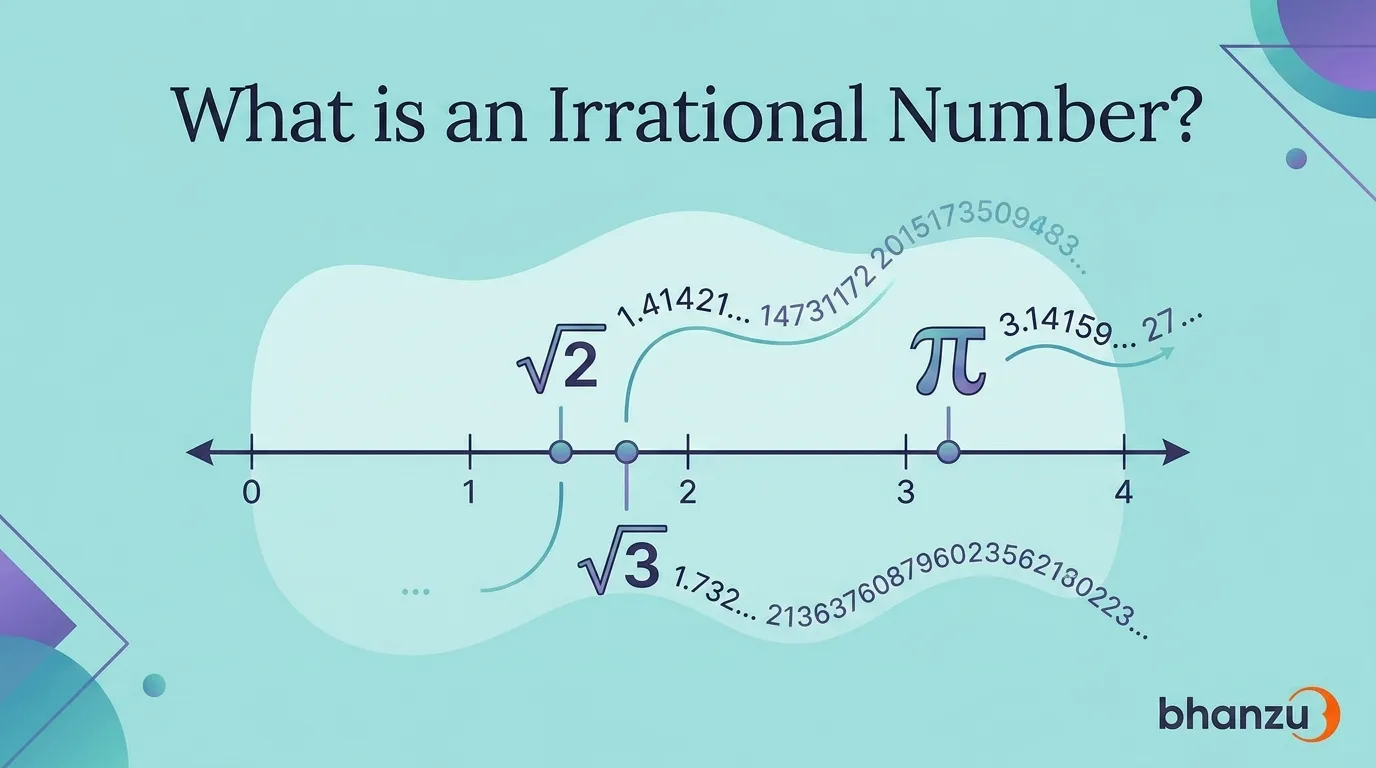
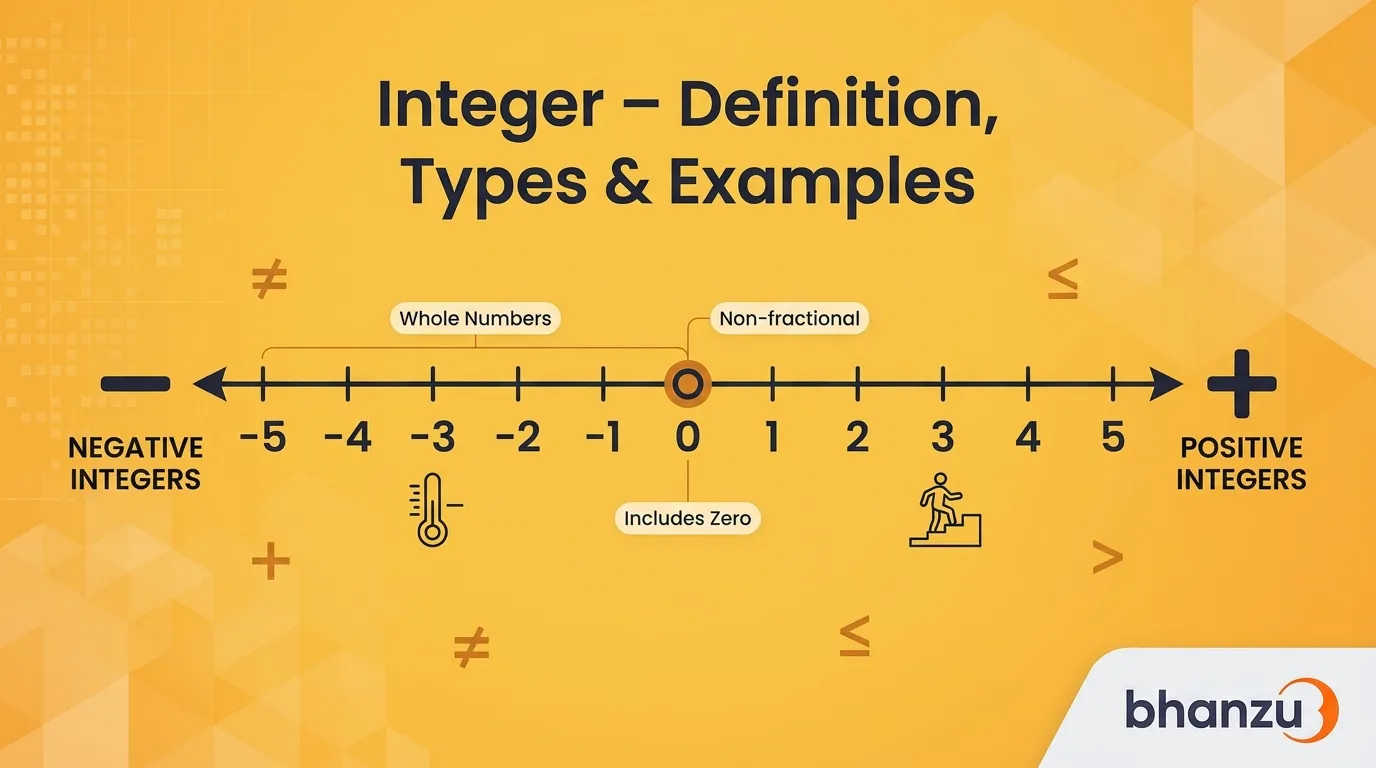
So what is a real number? A real number is any number that can be plotted on the number line — including whole numbers, integers, fractions, decimals (terminating or repeating), and irrationals like or . The set of real numbers is denoted and contains every number you have likely worked with up to high-school maths, with the single exception of imaginary numbers (which involve ).
Quick Reference
Field | Value |
|---|---|
Definition | Any number representable on the number line |
Symbol | |
Includes | Integers, fractions, terminating decimals, repeating decimals, irrationals |
Excludes | Imaginary numbers (, , ) |
Used in | Algebra, geometry, calculus, statistics — every quantitative field |
What is a Real Number?
A real number is any value that can correspond to a point on a continuous, infinite straight line — the number line. Move right along the line and the values get larger; move left and they get smaller. Every position is occupied by some real number, and every real number has exactly one position.
The real numbers form a complete number system. There are no gaps.
Between any two real numbers, no matter how close they are, there are infinitely many more real numbers. This is the property that lets calculus work — limits, continuity, and integrals all rely on the real-number line being seamless.
The Types of Real Numbers
Real numbers split into rationals and irrationals. Rationals split further:
Type | Definition | Examples |
|---|---|---|
Natural numbers () | Counting numbers | |
Whole numbers | Naturals + zero | |
Integers () | Whole numbers + negatives | |
Rationals () | Ratios where are integers and | |
Irrationals | Real numbers that cannot be written as |
Every natural number is a whole number, every whole number is an integer, every integer is a rational, and every rational is a real. Irrationals are the real numbers that fall outside the rationals.
Why Irrationals Exist
The Pythagorean theorem forces irrationals into existence. A right triangle with legs and has hypotenuse , and cannot be written as a ratio of integers. Hippasus of Metapontum (5th century BCE, Greece) proved this within the Pythagorean school — and was reportedly killed for the discovery, because the Pythagoreans believed all quantities were rational.
The number — the ratio of a circle's circumference to its diameter — is irrational, as proved by Johann Heinrich Lambert in 1761. The number (the base of natural logarithms) is irrational, proved by Leonhard Euler. Both are also transcendental, meaning they are not roots of any polynomial with integer coefficients — a stronger property that puts them in a special subset of the irrationals.
Worked Examples of Real Number
Example 1: Classify each number.
Classify: , , , , , .
— integer, rational, real.
— rational (ratio of integers), real.
— integer, rational, real.
— irrational, real.
— irrational, real, transcendental.
— repeating decimal, rational, real.
Final answer: All six are real numbers; only and are irrational.
Example 2: Show that equals .
Let Then Subtract: , so , giving .
Final answer: is the repeating decimal form of the rational number .
Common Confusions of Real Number
Real vs imaginary. A real number sits on the number line. An imaginary number (, , ) does not — it sits on a perpendicular axis. Together, real and imaginary form the complex numbers.
Rational vs real. Every rational is real. Not every real is rational — and are real but not rational.
Terminating decimal vs irrational. A decimal that terminates (like or ) is rational. A decimal that repeats forever in a pattern (like ) is also rational. Only a decimal that never terminates and never repeats is irrational.
Where Real Numbers Appear
Real numbers underlie every quantity that can be measured. Distance, time, mass, temperature, currency, voltage, probability — all real-valued.
Calculus is built on the real numbers; the entire framework of derivatives and integrals depends on the real-line being continuous. Even computer science, which usually works with floating-point approximations, defines its goals against the ideal of real-valued computation.
Was this article helpful?
Your feedback helps us write better content