Definition of a Natural Number
A natural number is any number used for counting, starting from 1 and continuing through 2, 3, 4, 5, and so on without end. The set of natural numbers is written as N = {1, 2, 3, 4, 5, ...}, where the three dots show that the set never stops. Some conventions also include 0 in this set — that distinction is covered below.
Examples of Natural Numbers (and What Isn't One)
What makes a number natural is simple: it must be a positive whole number with no decimal, fraction, or negative sign.
Natural numbers:
1, 7, 23, 100, 1,564, 50,000
Not natural numbers:
0 (under the standard K–12 convention)
−5 (negative)
2.5 (decimal)
1/2 (fraction)
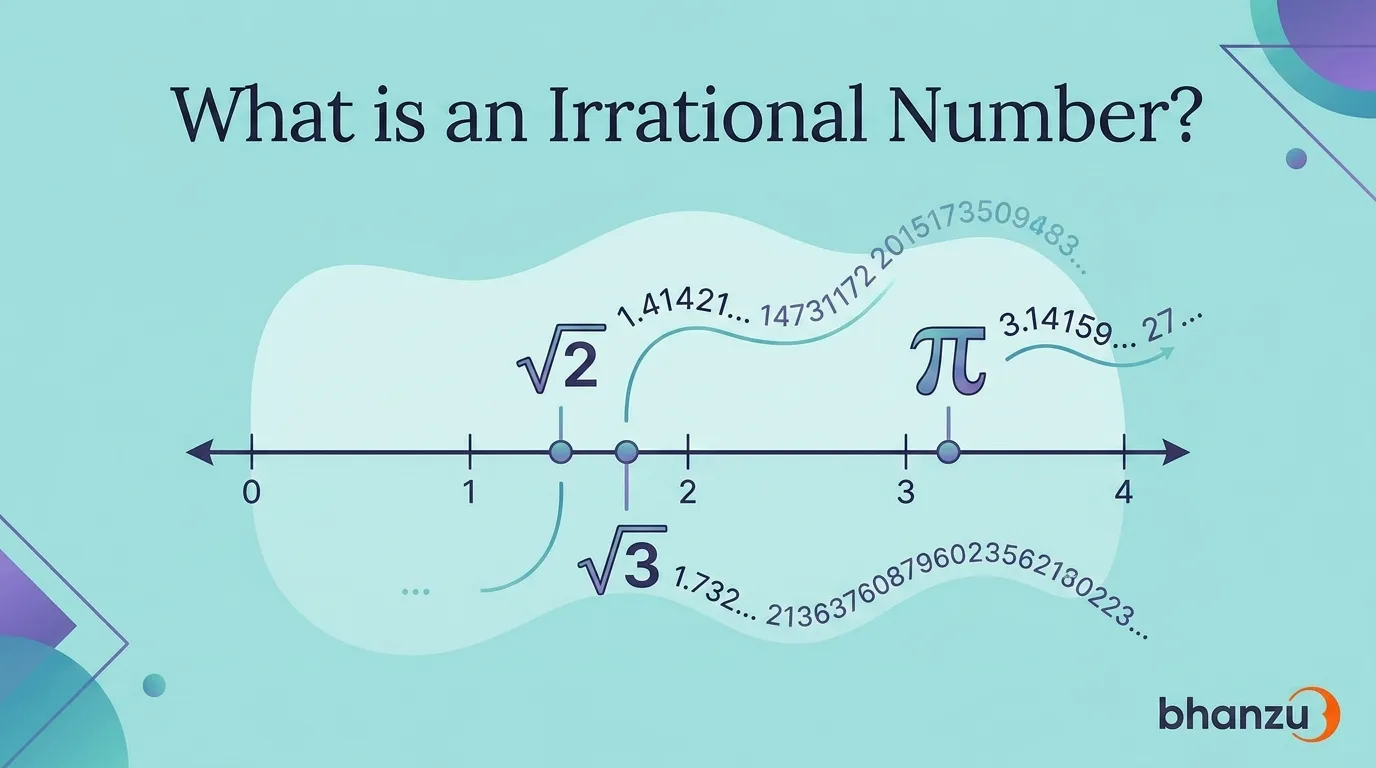
π (irrational)
The 3-Second Test: Is It a Natural Number?
Run any number through three checks. If it passes all three, it's a natural number.
Is the number positive?
Is it whole — no decimal, no fraction?
Is it 1 or greater? (Or 0 or greater, if your textbook includes 0.)
Is 47 a natural number? Positive ✓. Whole ✓. Greater than 0 ✓. Yes.
Is −3 a natural number? Positive ✗. Stop at the first failed check. No.
Is 4.5 a natural number? Positive ✓. Whole ✗. No.
What Natural Numbers Are Used For
Natural numbers play three different roles. Most school textbooks cover only the first two; the third is just as common in everyday life.
Cardinal — Counting How Many
Cardinal use answers the question "how many?" There are 7 days in a week. There are 24 hours in a day. The number measures the size of a group.
Ordinal — Naming a Position
Ordinal use answers "which one?" Tuesday is the 2nd day of the week. The 5th student in a queue. The 21st century. The number marks a position in an ordered sequence.
Nominal — Using a Number as a Label
Nominal use is the role most pages skip. A footballer wearing jersey number 10 doesn't have ten of anything, and isn't ranked tenth. The number is a label — an identifier, like a name. House numbers, phone numbers, and bus route numbers all work the same way.
Is Zero a Natural Number?
The honest answer: it depends on which convention you're following — and the convention is regional, not arbitrary.
Convention | Includes 0? | Where you'll see this |
|---|---|---|
NCERT (India), CCSS (US), most K–12 curricula | No | School textbooks, board exams |
ISO 80000-2 (international standard) | Yes | Computer science, engineering |
Peano axioms (modern formulation) | Yes | University set theory and logic |
If you're a school student, follow your textbook. NCERT and most US K–12 curricula say 0 is not a natural number — it's a whole number. The set of whole numbers is W = {0, 1, 2, 3, ...}, which is the natural numbers plus 0.
Properties of Natural Numbers
Natural numbers behave predictably under addition and multiplication. Under subtraction and division, they don't always.
Property | Addition | Multiplication | Subtraction | Division |
|---|---|---|---|---|
Closure | Yes (2 + 3 = 5) | Yes (2 × 3 = 6) | No (2 − 5 = −3) | No (2 ÷ 5 = 0.4) |
Commutative | Yes (a + b = b + a) | Yes (a × b = b × a) | No | No |
Associative | Yes | Yes | No | No |
Distributive | — | a × (b + c) = (a × b) + (a × c) | — | — |
Closure means: when you apply an operation to two natural numbers, the result is also a natural number. Addition and multiplication never break closure. Subtraction breaks it whenever the second number is larger (5 − 9 = −4). Division breaks it whenever the result has a remainder (5 ÷ 2 = 2.5).
When Closure Fails: Why Whole, Integer, and Rational Numbers Exist
The closure failures are not a limitation. They're the reason the rest of the number system exists.
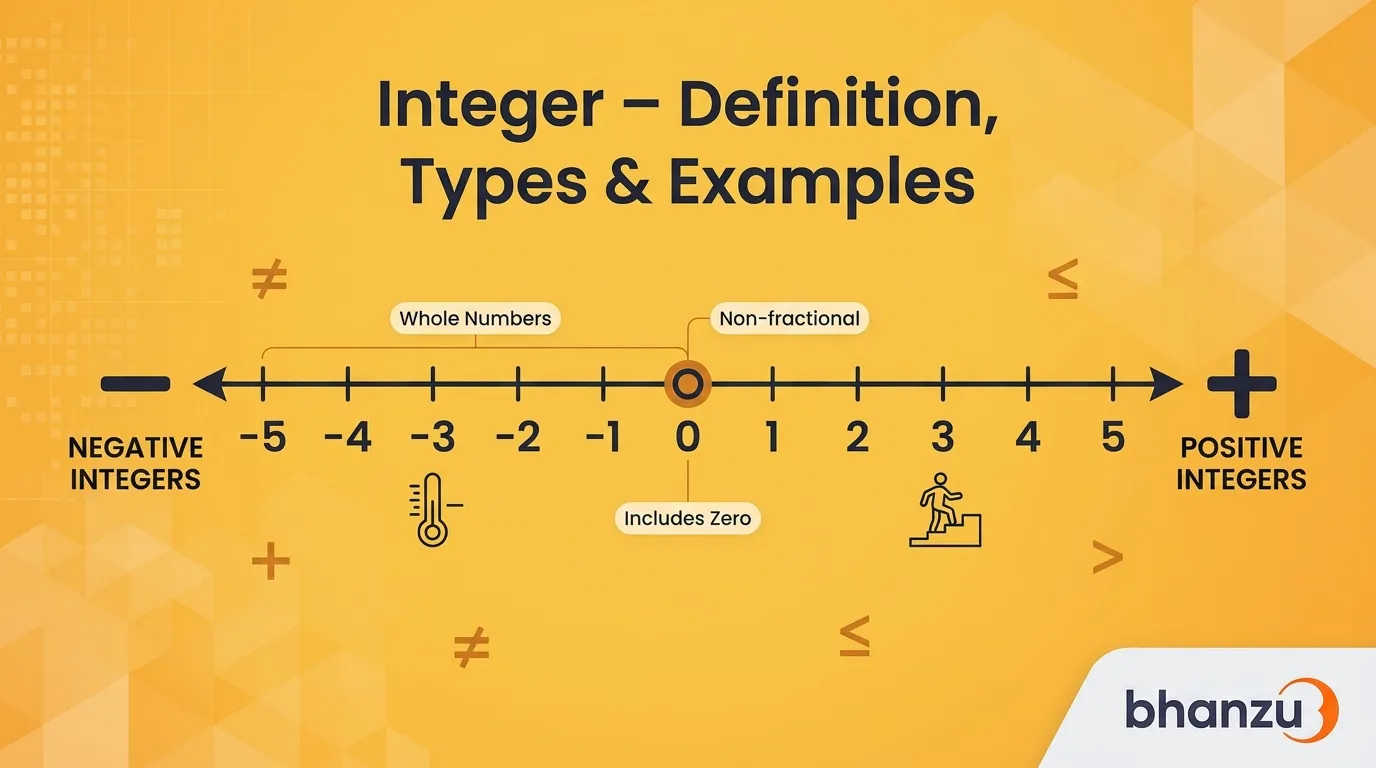
5 − 9 = −4 isn't a natural number. To accommodate answers like this, mathematicians extended the set to include negatives. The result is the integers, Z = {..., −2, −1, 0, 1, 2, ...}.
5 ÷ 2 = 2.5 isn't a natural number either. To accommodate fractional results, the set was extended again — to the rational numbers, written as p/q where p and q are integers and q ≠ 0.
5 − 5 = 0 sits in another gap entirely. That's why whole numbers exist as a separate named set: natural numbers plus 0.
Each new number system was built to plug a hole the natural numbers couldn't fill on their own.
Natural Numbers on the Number Line
On a number line, natural numbers appear as evenly spaced points to the right of 0, starting at 1 and continuing in the positive direction.
Where the Word "Natural" Comes From
French mathematician Nicolas Chuquet first described the sequence 1, 2, 3, 4, ... as "progression naturelle" — natural progression — in 1484. English mathematician William Emerson used "natural number" in English in his 1763 book The Method of Increments. The term stuck because these are the numbers humans counted with before any other kind of number was invented. In 1889, Italian mathematician Giuseppe Peano wrote the first formal definition of the natural numbers using just one starting number and a rule for finding the next one — the Peano axioms.
Related Terms
Term | Meaning | How It Relates to Natural Numbers |
|---|---|---|
Whole numbers | The set {0, 1, 2, 3, ...} | Natural numbers plus 0 |
Integers | The set {..., −2, −1, 0, 1, 2, ...} | Includes negatives — closes subtraction |
Rational numbers | Any number written as p/q (q ≠ 0) | Includes natural numbers as a subset |
Real numbers | All numbers on the number line | Natural numbers are a small slice |
Prime numbers | Naturals divisible only by 1 and themselves | Subset of natural numbers (2, 3, 5, 7, ...) |
Composite numbers | Naturals with more than two factors | Subset of natural numbers (4, 6, 8, 9, ...) |
Cardinal number | A number used to count (how many) | A use of natural numbers |
Ordinal number | A number used to rank (which position) | A use of natural numbers |
Common Confusions
The only difference between natural and whole numbers is whether 0 is in the set. Whole numbers include it; natural numbers (under the standard K–12 convention) don't.
The smallest natural number is 1 under the standard convention. In systems that include 0, the smallest is 0. Always check which one your textbook uses.
Not every positive number is natural. 2.5 and 1/2 are positive but not natural — they're not whole.
5 (the count) and 5th (the position) are both natural numbers, but they answer different questions: cardinal vs ordinal.
Was this article helpful?
Your feedback helps us write better content