What Is An Inverse Function?
The inverse function of , written , is the function that reverses : if sends to , then sends back to . The defining relationship is the pair of compositions:
In words: do then (or the reverse), and you are back where you started. Applying a function and then its inverse is the identity function — the do-nothing map.
The inverse also swaps the roles of domain and range: the domain of becomes the range of , and the range of becomes the domain of . This is the function-level version of the inverse relation, which reverses every ordered pair.
Which Functions Have An Inverse?
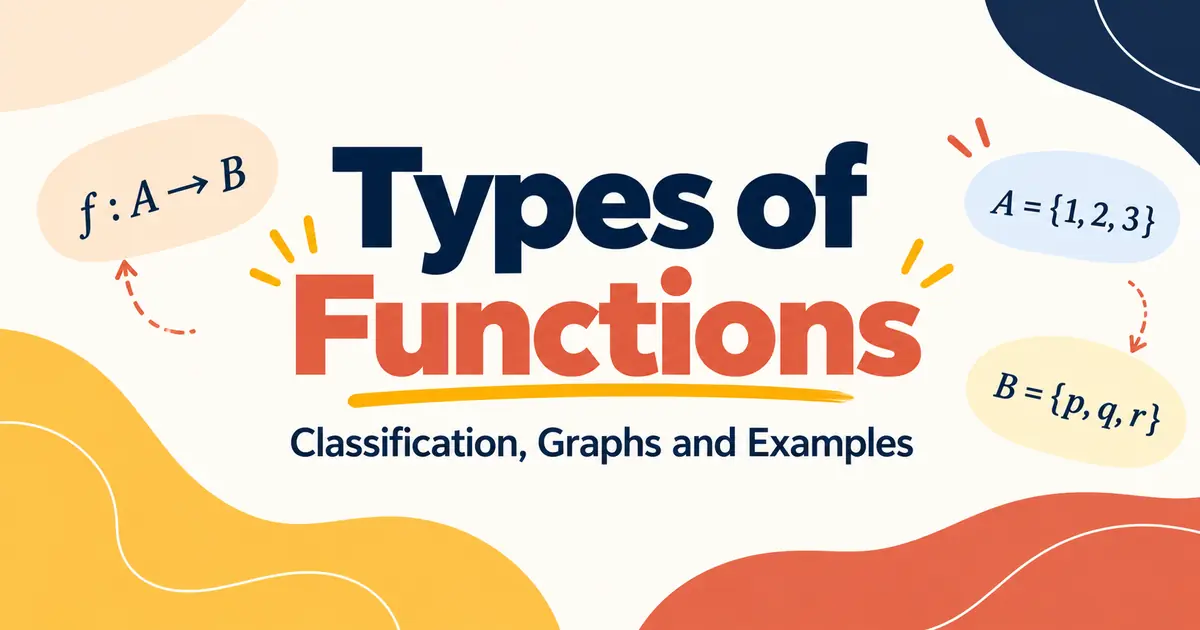
A high-frequency search is does every function have an inverse? The answer is no, and the reason is precise: a function has an inverse if and only if it is bijective — both one-one and onto.
It must be one-one (injective). If two inputs share an output, the reverse map can't decide which input to return. See the one-to-one function.
It must be onto (surjective) its codomain, so every value you might feed to actually came from somewhere.
Together, those are the conditions for a bijective function. When a function isn't one-one — like over all reals — we often restrict the domain (to ) so that the restricted piece is bijective and an inverse exists.
How Do You Find The Inverse Of A Function?
The standard method has four steps. How do you find the inverse of a function algebraically? is one of the most-searched phrasings, so here it is in full:
Replace with .
Swap and everywhere.
Solve the new equation for .
Rename as .
The swap in step 2 is the heart of it — it encodes "outputs become inputs." Each worked example below runs these four steps.
What Does The Graph Of An Inverse Function Look Like?
The graph of is the reflection of the graph of across the line . Because the inverse swaps each point into , the whole curve flips over that diagonal. This gives a fast visual check: if you fold the paper along and the two graphs land on each other, they are inverses. It also explains why a function passes the horizontal line test exactly when its inverse passes the vertical line test — reflection turns one test into the other.
Examples Of Inverse Functions
The six examples build from a clean line to a rational function and a restricted-domain case, with one deliberate wrong turn.
Example 1
Find the inverse of .
Replace with : .
Swap and : .
Solve for : , so .
Rename: .
Example 2
Find the inverse of , then verify it.
The tempting wrong move is to read as a reciprocal and write .
Test that against the definition: should return , but does not simplify to . The reciprocal is not the inverse.
Run the four steps instead.
.
Swap: .
Solve: , so .
Rename: .
Verify: . Correct. The first instinct to treat as is exactly where this one goes wrong.
Example 3
Find the inverse of .
.
Swap: .
Clear the denominator: .
.
Gather the terms: .
Factor: .
Solve: .
Rename: .
Example 4
Verify that and are inverses.
Compose one way: .
Compose the other way: .
Both compositions return , so and are inverses.
Example 5
Find the inverse of on the restricted domain .
On all reals, is not one-one, so it has no inverse. Restrict to , where it is bijective onto .
.
Swap: .
Solve, keeping : .
Rename: , with domain .
The restriction is what makes the inverse exist.
Example 6
A temperature converter sends Celsius to Fahrenheit by . Find the inverse that converts back.
.
Swap the roles (call the input ): .
Solve for : , so .
The inverse is — the familiar Fahrenheit-to-Celsius formula.
Why Inverses Matter: "An Inverse Is The Mathematics Of Undoing"
Inverse functions exist because almost every useful process needs to be reversible — and mathematics needed a precise object for "go back."
They solve equations. Solving is the act of applying to both sides. Logarithms invert exponentials, roots invert powers, inverse trigonometric functions invert sine and cosine.
They reverse transformations. A coordinate change, a currency conversion, or an encryption step is only useful if it can be undone — and the undo is an inverse function.
They define new operations. The logarithm was defined by John Napier (1550–1617, Scotland) in 1614 as the inverse of exponential growth, turning multiplication into addition and saving astronomers years of hand calculation.
The destination this opens is the whole world of "solving for the input." Once you see logarithms, roots, and arc-trig as inverses of functions you already know, an entire layer of equations becomes a single move: apply the inverse.
Where Inverses Trip Students Up
Three mistakes account for most wrong inverse answers.
Mistake 1: Reading as a reciprocal
Where it slips in: the instant the notation appears.
Don't do this: write .
The correct way: is the reverse map, found by swapping and and solving — not by flipping a fraction. The reciprocal of is ; its inverse is . They are different functions. The memorizer who reads every as "one over" lands wrong here.
Mistake 2: Forgetting to check the function is one-one first
Where it slips in: parabolas, even powers, and any many-to-one function.
Don't do this: "invert" over all reals and report as a function.
The correct way: isn't a function (two outputs per input). Restrict the domain to first, then the inverse exists and is single-valued. The rusher who jumps straight to algebra without checking bijectivity produces a non-function.
Mistake 3: Swapping in the wrong place
Where it slips in: rational and multi-step functions where the swap gets applied to only part of the expression.
Don't do this: swap and on one side of the equation but not the other.
The correct way: replace every with and every with in one clean move, then solve. The second-guesser who edits the equation piece by piece introduces errors here.
Conclusion
An inverse function undoes : and .
Find it by swapping and and solving — never by taking a reciprocal.
Only bijective functions are invertible; non-bijective ones need a restricted domain.
The graph of an inverse function is the reflection of the original across .
Inverses are how we solve equations and reverse transformations — logarithms, roots, and arc-trig are all inverses.
To master inverses with a teacher who explains the reasoning behind each step, explore Bhanzu's algebra tutor, find help with algebra, or browse math tutoring. Want a live Bhanzu trainer to walk through inverse-function problems with your child? Book a free demo class.
Read More
Was this article helpful?
Your feedback helps us write better content
Frequently Asked Questions
Is the same as ?
Does every function have an inverse?
How do you find inverse functions algebraically?
How can you tell two functions are inverses from their graphs?
Why does the inverse swap domain and range?