What Is a Multiple?
A multiple of a number is the product of that number and any integer. For two numbers and , we say is a multiple of when for some integer . The integer is the multiplier.
So is a multiple of because . It is also a multiple of , of , of , of , and of itself. The plain-English test: a number is a multiple of if dividing it by leaves no remainder. The numbers on any times table are exactly the multiples of that number.
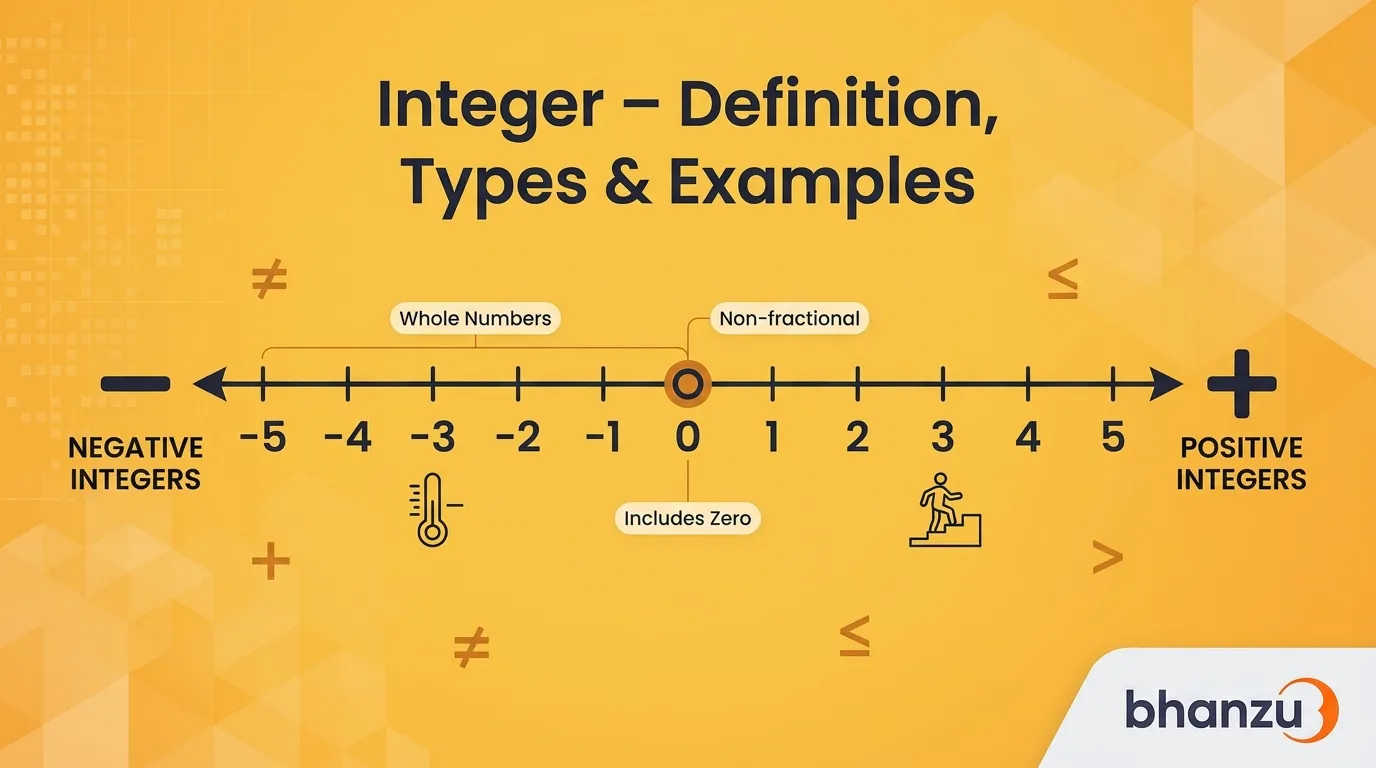
A multiple is always a whole-number jump, never a fraction. does not make a multiple of , because is not an integer. Multiples live on the integer grid.
List of Multiples
The clearest way to see multiples is to list a few:
Number | First six multiples |
|---|---|
Read across each row and you are reading that number's times table. How do you find the multiples of a number? Start at the number itself and keep adding the number to the running total — that is all a times table is. Multiples of go ; each is the previous one plus .
Multiples vs Factors
This is the split that confuses students more than any other, so it is worth slowing down. What is the difference between a multiple and a factor? They are opposite directions of the same relationship.
A factor of a number divides it exactly, with no remainder. The factors of are .
A multiple of a number is the result of multiplying it by an integer. The multiples of are .
Here is the cleanest way to hold them apart: in , the numbers and are factors of , and is a multiple of both and . A factor is never bigger than the number; a multiple is never smaller. And the counts differ sharply — a number has a finite list of factors but an infinite list of multiples.
Students often meet multiples first (the times tables in early grades) and don't meet factors until later, which is part of why the two get tangled. The relationship is so tight that students assume they're the same word for the same thing — they're not.
Properties of Multiples
A handful of properties cover almost every question:
Every number is a multiple of itself. , so is a multiple of .
Every number is a multiple of . Multiplying by changes nothing, so divides everything.
Zero is a multiple of every number. for any , so sits at the top of every multiple list (though we usually start listing from the number itself).
Multiples are infinite. You can always multiply by a bigger integer.
A multiple of is at least as big as (for positive multipliers) — never smaller.
Common Multiples and the LCM
When two numbers share a multiple, that shared value is a common multiple.
Look at the multiples of and :
Multiples of :
Multiples of :
Both lists contain and — these are common multiples of and . The smallest one, , is the least common multiple (LCM). The LCM is the workhorse behind adding fractions with unlike denominators: to add , you rewrite both over their LCM, . That single connection is why multiples matter long before students ever name them.
Examples of a Multiple
Example 1
Is a multiple of ?
Divide: , with no remainder. Since , yes.
Final answer: is a multiple of .
Example 2
Is a multiple of ?
Wrong attempt. A student notices and , sees that sits between them, and reasons "it's close enough — call it a multiple of ." The flaw: a multiple has to land exactly on a times-table step, not near one. Being between two multiples is the very thing that makes a number not a multiple.
The rescue. Divide and check the remainder: remainder . A nonzero remainder means is not a multiple of .
Final answer: is not a multiple of .
Example 3
List the first five multiples of .
Multiply by :
Final answer: .
Example 4
Find the least common multiple of and .
Multiples of : Multiples of : The first value in both lists is .
Final answer: LCM.
Example 5
A bus to the museum leaves every minutes; a bus to the zoo leaves every minutes. They just left together — in how many minutes do they leave together again?
This is the LCM of and . Multiples of : ; multiples of :
Final answer: minutes. They next depart together one hour later.
Example 6
The third multiple of a number is . What is the number, and what is its sixth multiple?
Third multiple means , so . The sixth multiple is .
Final answer: the number is ; its sixth multiple is .
Where Multiples Quietly Run the World
"Multiples are how we line things up that repeat on different clocks."
Anything that happens on a regular cycle is governed by multiples, and the moment two cycles coincide is a common multiple. The idea reaches further than the times table suggests:
Calendars and schedules. Leap years (every years), traffic-light cycles, shift rotations — each repeats on its own multiple, and overlaps happen at common multiples.
Music. Rhythms layer when their beat counts share multiples; a pattern of and a pattern of realign every beats.
Gears and machines. Two meshed gears return to their starting alignment after a number of turns set by the LCM of their tooth counts.
Fractions. Every time you add fractions with unlike denominators, you find a common multiple — usually the LCM — without calling it that.
The Greek mathematician Euclid studied multiples and divisibility in Book VII of the Elements (c. 300 BCE), where the groundwork for the greatest common factor and the LCM was first laid out formally. The same tools also underpin modern cryptography — a phantom of these humble times tables sits inside the encryption protecting online payments.
Where Students Trip Up on Multiples
Mistake 1: Swapping multiples and factors
Where it slips in: A question asks for the multiples of and the student lists .
Don't do this: Treat "multiples of " as "numbers that divide ."
The correct way: Multiples of are — they grow. Factors shrink (or stay equal); multiples grow (or stay equal). Check the direction before listing.
Mistake 2: Forgetting that a number is a multiple of itself
Where it slips in: Listing multiples of , a student starts at .
Don't do this: Skip the number itself, beginning the list at "two times the number."
The correct way: The first multiple is the number times — so the multiples of start at , not .
The rusher archetype hits this one — racing to the times table they know, they skip the step entirely.
Mistake 3: Calling a near-miss a multiple
Where it slips in: Deciding whether one number is a multiple of another by eyeballing rather than dividing.
Don't do this: Guess "close enough" the way the student did in Example 2.
The correct way: Divide. A zero remainder means it is a multiple; any other remainder means it is not.
Key Takeaways
A multiple of a number is that number multiplied by an integer — the multiples of are .
Multiples grow and are infinite; factors divide and are finite — they are opposite directions of one relationship.
Every number is a multiple of itself and of , and is a multiple of everything.
A shared multiple of two numbers is a common multiple; the smallest is the least common multiple (LCM).
The most common mistake is swapping multiples and factors — ask "bigger or smaller?" first.
Try It Yourself — Three Problems
List the first five multiples of .
Find the least common multiple of and .
Is a multiple of ? Divide to check.
If you listed numbers smaller than in problem 1, return to Mistake 1 above. Want a live Bhanzu trainer to walk your child through multiples, factors, and the LCM with number-line and times-table tools? Book a free demo class — online globally.
Was this article helpful?
Your feedback helps us write better content