What Are Interior Angles?
An interior angle is an angle that lies inside a polygon, formed by two of its sides meeting at a vertex. A triangle has three interior angles, a quadrilateral four, a pentagon five — one at every corner.
The same phrase has a second, related meaning. When two lines are crossed by a transversal, the angles in the strip between the two lines are also called interior angles. This article focuses on the polygon meaning, which is the more common search intent, and treats the parallel-lines meaning briefly near the end. Both share the idea of "inside": inside the shape, or inside the region between two lines.
The Sum of Interior Angles Formula
Here is the rule that powers almost every problem on this topic. The sum of the interior angles of any polygon with sides is:
The formula is not a fact to memorise — it is built from the triangle. Pick any vertex of an -sided polygon and draw diagonals from it to every other non-adjacent vertex. This slices the polygon into exactly triangles. Each triangle contributes , and together their angles make up all the polygon's interior angles, so the total is .
Run the formula across the common polygons:
Polygon | Sides () | Interior angle sum |
|---|---|---|
Triangle | 3 | |
Quadrilateral | 4 | |
Pentagon | 5 | |
Hexagon | 6 | |
Heptagon | 7 | |
Octagon | 8 |
A reader question that comes up constantly: what is the sum of the interior angles of a hexagon? From the formula, .
One Interior Angle of a Regular Polygon
A regular polygon has all sides equal and all interior angles equal; an irregular polygon does not. The total interior angle sum is the same for both — it depends only on the number of sides — but only in a regular polygon can you find a single angle by dividing.
For a regular polygon with sides, each interior angle is:
So a regular pentagon has each angle , and a regular hexagon has each angle . For an irregular polygon you cannot divide like this; you add up the angles you know and subtract from the sum to find a missing one.
There is also a quick link worth holding: each interior angle and its neighbouring exterior angle sit on a straight line, so interior angle + exterior angle = . That gives a second route to a regular polygon's angle — find the exterior angle () and subtract from .
Interior Angles Between Two Parallel Lines
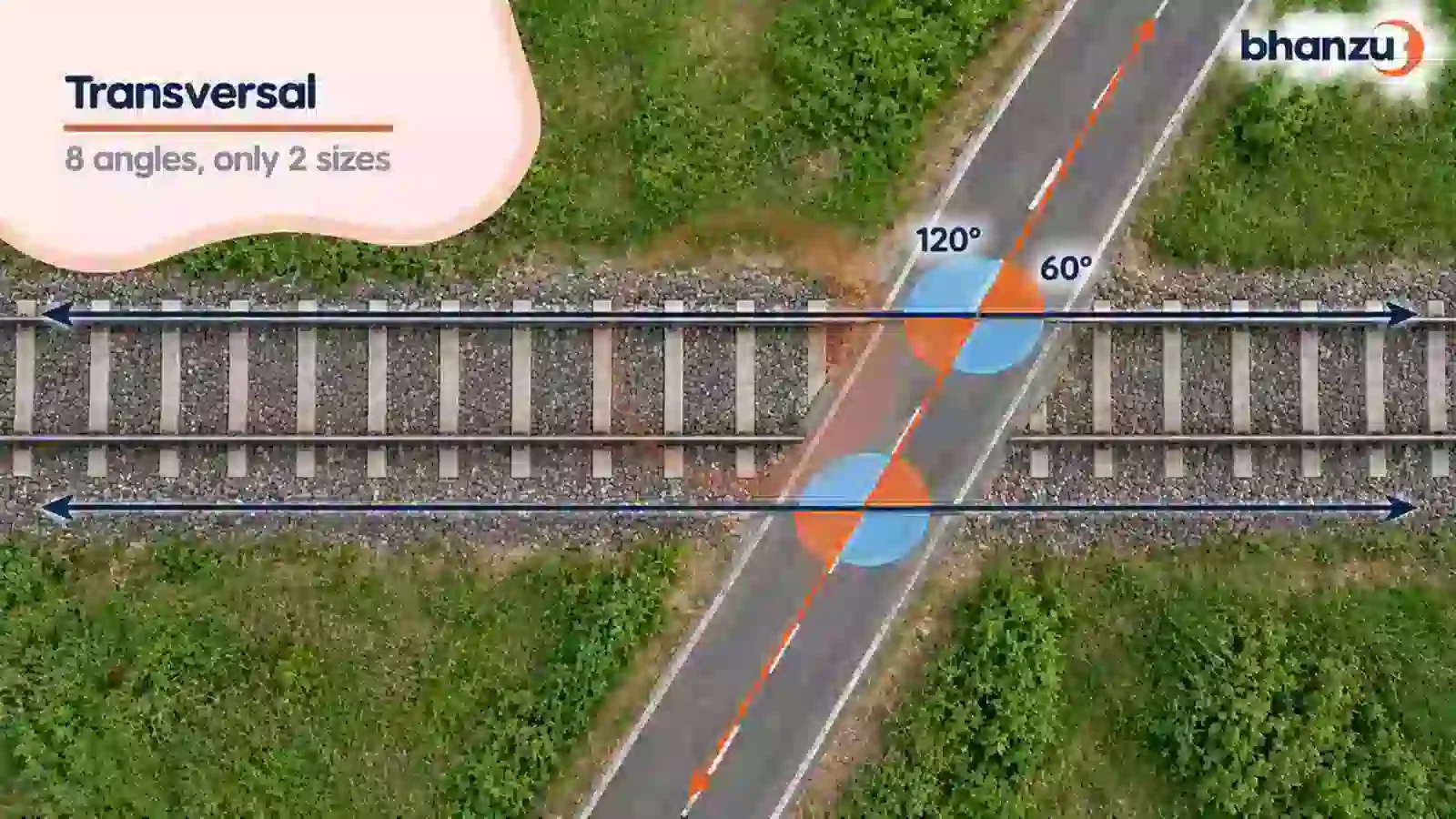
The other place "interior angles" appears: when a transversal crosses two parallel lines, the angles in the strip between the lines are interior angles. They split into two families.
Alternate interior angles are on opposite sides of the transversal and are equal when the lines are parallel.
Co-interior angles (same-side interior) are on the same side of the transversal and are supplementary — they add to .
A reader question — how do you solve same-side interior angles? — is answered by that supplementary rule: set the two same-side angles to sum to and solve. This is a sibling topic; for the full treatment see the alternate interior angles article.
Examples of Interior Angles
With the definition, the sum formula, and the regular-polygon rule in hand, here is the topic doing real work. The problems build from a direct sum up to a missing-angle solve.
Example 1 - Find the sum of the interior angles of an octagon
An octagon has sides: .
Example 2 - Find each interior angle of a regular hexagon
A first instinct is to take the sum, , and divide by the number of triangles (4) instead of the number of sides: , which would make each angle a straight line — clearly impossible for a closed hexagon. The flaw is dividing by the wrong count. You divide the sum by the number of sides, not the number of triangles.
The correct way:
Example 3 - Four interior angles of a pentagon are , , , and . Find the fifth
The pentagon's sum is . Add the four known angles: . The fifth is .
Example 4 - A regular polygon has each interior angle equal to . How many sides does it have?
Each angle is . Solve: , so , giving and . It is a regular nonagon.
Example 5 - Find the sum of the interior angles of a polygon with sides (a dodecagon)
.
Example 6 - Two parallel lines are crossed by a transversal. A pair of co-interior (same-side interior) angles are and . Find
Co-interior angles are supplementary, so they sum to :
Why Interior Angles Matter Beyond the Classroom
The interior-angle sum is the rule that lets us build, tile, and fold the world out of flat shapes — because it tells us in advance whether shapes will fit.
Tiling and tessellation. Tiles cover a floor with no gaps only when the interior angles meeting at a point add to exactly . That is why regular hexagons (each , three meeting) tile perfectly and regular pentagons (each ) cannot.
Architecture and trusses. A roof truss or a geodesic dome is a network of polygons; their interior angles must sum correctly or the structure will not close.
Honeycombs and nature. Bees build hexagonal cells because the interior angle packs the most area for the least wax — geometry the hive solved long before humans did.
Game and screen design. Every polygon mesh in a 3D model relies on interior-angle sums to stay a closed surface as it is bent and rendered.
For a Grade 8 student, the interior-angle sum is the first formula that generalises — one rule covering every polygon from a triangle to a thousand-gon — which is the moment geometry starts to feel powerful rather than piecemeal.
Where Students Trip Up on Interior Angles
Mistake 1: Dividing the sum by the wrong count
Where it slips in: Finding one angle of a regular polygon, the student divides the sum by the number of triangles instead of the number of sides.
Don't do this: Compute for a regular hexagon.
The correct way: The sum uses triangles; one angle uses sides. Each angle of a regular hexagon is , not .
Mistake 2: Using the regular-polygon formula on an irregular polygon
Where it slips in: A problem gives an irregular quadrilateral and the student divides by to get "each angle ."
Don't do this: Assume every polygon's angles are equal.
The correct way: Only regular polygons have equal interior angles. For an irregular polygon, the sum is still , but you find a missing angle by subtracting the known ones from the sum. The memorizer who learned "divide by n" without the "regular" condition gets caught here.
Mistake 3: Confusing interior with exterior angles
Where it slips in: A question asks for an exterior angle, and the student gives the interior one (or vice versa).
Don't do this: Report when the exterior angle of a regular hexagon () was asked for.
The correct way: Interior + exterior = at each vertex. The exterior angle of a regular polygon is ; the interior angle is minus that. Check which one the problem wants.
Key Takeaways
Interior angles are the angles inside a polygon, one per vertex; their sum is .
The formula comes from slicing the polygon into triangles, each contributing .
A regular polygon's single interior angle is the sum divided by ; an irregular polygon's sum is the same but its angles differ.
Interior + exterior angle = at every vertex, giving a second route to the regular-polygon angle.
Between two parallel lines, alternate interior angles are equal and co-interior angles are supplementary.
Practice These Problems to Solidify Your Understanding
Find the sum of the interior angles of a decagon (10 sides).
Find each interior angle of a regular octagon.
A regular polygon has each interior angle . How many sides does it have?
Answer to Question 1: . Answer to Question 2: . Answer to Question 3: sides (a dodecagon). If Question 2 gave , you divided the sum by the triangle count instead of the side count (see Mistake 1).
Want a live Bhanzu trainer to walk your child through the interior angles formula and polygon problems? Book a free demo class — online globally.
Also Read:
Was this article helpful?
Your feedback helps us write better content