What Is A Degree?
A degree is a unit of measurement for the size of an angle. One degree, written 1°, is defined as of one full rotation around a point. So a complete turn measures 360°, half a turn measures 180°, and a quarter turn measures 90°.
The small raised circle, °, is the degree symbol. It is written immediately after the number with no space: 45°, 90°, 360°. The symbol matters — "45°" means an angle, while "45" alone is just a count.
Degrees measure how open an angle is, not how long its arms are. An angle of 30° stays 30° whether its arms are two centimetres long or two kilometres long. The arm length is irrelevant; only the amount of turn between the arms counts.
The degree symbol and its subdivisions
For measurements finer than a whole degree, each degree splits further:
1 degree = 60 minutes of arc, written 60′.
1 minute = 60 seconds of arc, written 60″.
So a precise bearing might read 23° 30′ 15″. These subdivisions matter most in navigation, astronomy, and surveying, where a fraction of a degree can mean kilometres on the ground.
How Do Degrees Relate To Radians?
Degrees are not the only way to measure angles — radians are the other main unit, and the two are linked by one anchor fact below:
From this single equivalence, every conversion follows. To go from degrees to radians, multiply by . To go from radians to degrees, multiply by .
A radian is the angle you get when the arc length along a circle equals the circle's radius. One full turn contains radians, which is why radians.
Degrees are intuitive for everyday measurement; radians are the natural unit for higher mathematics, because they make the formulas of trigonometry and calculus come out clean.
If you need the full method both ways, see radians to degrees. For where degree measures live on a circle in trigonometry, see the unit circle.
Examples of Degrees
Example 1
How many degrees are there in three straight angles laid in a row?
A straight angle is 180°. Three of them:
Final answer: .
Example 2
Convert 60° to radians.
Multiply by :
radians
Final answer: radians. (See the worked method at 60 degrees to radians.)
Example 3
A student converts 90° to radians and writes "90° = 90π radians." Where did it go wrong?
Wrong attempt. The student remembers radians involve π and simply tacks π onto the number: .
Why it breaks. That answer is enormous — about 283 radians, more than 45 full turns — for an angle that is only a quarter turn. The error is skipping the conversion factor entirely.
Correct. Multiply by , do not just attach π:
radians
Final answer: radians — a quarter turn, which matches a 90° angle.
Example 4
Two angles measure 47° 30′ and 12° 45′. Add them.
Add minutes and degrees separately, carrying 60′ into 1°:
Minutes:
Degrees:
Final answer: .
Example 5
A clock's minute hand moves from 12 to 3. Through how many degrees does it turn?
The clock face is a full turn, 360°, split into 12 equal hour marks. From 12 to 3 is three marks:
Final answer: — a quarter turn, which is why 3 o'clock makes a right angle.
Example 6
Convert radians to degrees.
Multiply by :
Final answer: .
Why We Measure Angles In Degrees At All
"1/360 of a turn — the most-divisible slice of a circle."
The degree is so familiar that its usefulness is easy to overlook. Naming what it does shows why it has survived for thousands of years.
It makes angles comparable. Without a shared unit, "a sharp angle" and "a wide angle" are just opinions. Degrees turn them into 30° and 150° — values you can add, subtract, and reason about precisely.
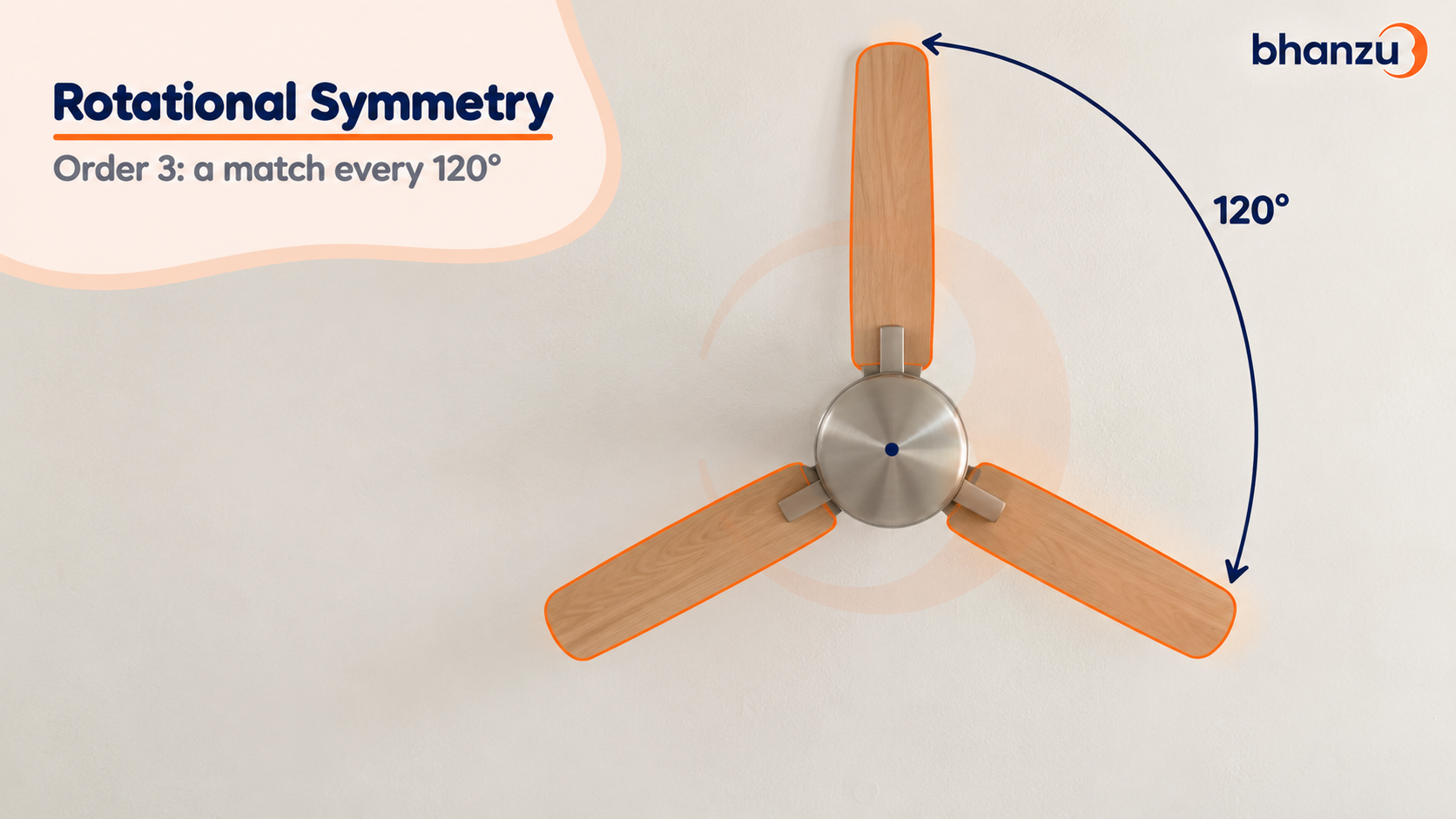
360 was chosen for its divisibility. Because 360 splits evenly into 2, 3, 4, 5, 6, 8, 9, 10, 12, 15, 18, 20, 24, 30, 36, 45, 60, 72, 90, and 180, fractions of a circle land on whole numbers. A third of a turn is a clean 120°; a fifth is 72°. A base of 100 would give ugly fractions for most of these.
It runs the physical world. Compass bearings, the tilt of a roof, the steering lock of a car, the slice of a pie chart, the field of view of a camera lens — all are quoted in degrees. The destination beyond the classroom is everywhere a direction or rotation has to be communicated exactly.
It is the bridge to higher math. Degrees connect to radians through , and that one link carries you into trigonometry, the reference angle, and eventually calculus.
Where Students Trip Up With Degrees
Mistake 1: Converting to radians by just attaching π
Where it slips in: Any degrees-to-radians conversion.
Don't do this: Writing "60° = 60π" by tacking π onto the number.
The correct way: Multiply by the conversion factor , so .
The first instinct, once a student knows "radians use π," is to insert π without the scaling — producing an answer dozens of times too large. The fix is to treat as a single inseparable conversion factor, never just π on its own.
Mistake 2: Dropping or misplacing the degree symbol
Where it slips in: Mixed problems where some quantities are angles and others are plain numbers.
The rusher writes "the angle is 45" without the °, then loses track of whether 45 is an angle, a length, or a count.
Don't do this: Omitting the ° symbol on an angle measure, or writing it with a space ("45 °").
The correct way: Attach ° directly to every angle value: 45°, 90°, 360°. The symbol is what marks the number as an angle.
Mistake 3: Confusing arm length with angle size
Where it slips in: When a diagram draws one angle with much longer arms than another.
The silent understander can compute angles correctly but quietly assumes the angle "with the bigger arms" is larger, then second-guesses a correct answer.
Don't do this: Judging which angle is larger by how long its arms are drawn.
The correct way: The degree measure depends only on how open the angle is. Arm length is decoration; it never changes the number of degrees.
Conclusion
A degree (°) is a unit of angle measure equal to of a full turn.
A full circle is 360°, a straight angle 180°, and a right angle 90° — and 360 was chosen because it divides so cleanly.
The degree measure of an angle depends only on how open it is, never on the arm length.
Degrees convert to radians by multiplying by , anchored on radians.
The most common mistake is converting to radians by attaching π without the factor.
Practice These To Solidify Your Understanding
Work through these, then check the examples above.
Convert 45° to radians. (Answer to Question 1: radians.)
Through how many degrees does a clock's minute hand turn from 12 to 6? (Answer to Question 2: 180°.)
Convert radians to degrees. (Answer to Question 3: 120°.)
If you get stuck on Questions 1 or 3, return to Examples 2 and 6 — multiply by going in, and by coming out.
Want a live Bhanzu trainer to walk through more degrees problems? Book a free demo class.
For specific common angles, see the 45 degree angle, the 90 degree angle, and the full chart of types of angles.
Was this article helpful?
Your feedback helps us write better content
Frequently Asked Questions
What is a degree in geometry?
What is 1 degree in radians?
What tool is used to measure angles in degrees?
How many degrees are in a half turn and a full turn?
Why is a full circle 360 degrees?
What does the small circle symbol mean?