Algebra is the part of mathematics that handles unknown numbers. Instead of working with a specific number — like 47 or 3.14 — algebra uses a letter to stand in for any number, then writes rules that hold for all of them at once. The letter in "" is not a mystery; it's a number whose specific value we are trying to find. The whole subject is the toolkit for finding that value, and for working with relationships between unknown quantities.
That move — replacing a specific number with a letter — is what makes algebra one of the most powerful languages ever invented. It turned mathematics from a collection of clever tricks into a system that could describe almost any pattern.
The Core Concepts of Algebra
Five concepts carry the entire subject. Get these and the rest of algebra falls into place.
Variables
A variable is a letter that stands for a number whose value can change or is unknown. The most common letters are , , , , , , and — but any letter works.
Constants
A constant is a fixed number whose value does not change. In the expression , the numbers and are constants. The letter is the variable.
Coefficients
A coefficient is the constant that multiplies a variable. In , the coefficient is . In , the coefficient is . The coefficient tells you how many of the variable you have.
Expressions
An algebraic expression is a combination of variables, constants, and operations (, , , ) with no equals sign. Examples:
Equations
An equation is two expressions connected by an equals sign — a claim that the two sides have the same value.
The difference between an expression and an equation is the equals sign. Expressions can be simplified; equations can be solved — you find the value of the variable that makes the claim true.
Where Algebra Came From — Why It Exists
Algebra was not always part of mathematics. Before the 9th century, mathematicians used geometry and arithmetic — but they had no systematic way to handle problems where the unknown was tangled inside an equation.
That changed around 820 CE in Baghdad. A scholar named Muhammad ibn Musa al-Khwarizmi — working at the House of Wisdom, the great library of the Abbasid Caliphate — wrote a book titled Al-Kitāb al-Mukhtaṣar fī Ḥisāb al-Jabr wal-Muqābala — "The Compendious Book on Calculation by Completion and Balancing." In English, two words from that title became the names of the foundational ideas of mathematics:
Al-jabr ("completion" or "restoration") — became the word algebra.
Al-Khwarizmi himself — became the word algorithm.
Al-Khwarizmi's book did something nobody before him had done systematically: it presented step-by-step procedures for solving linear and quadratic equations. He did this without modern symbolic notation — he wrote everything out in words, with geometric arguments to justify the steps. The symbolic and we use today came later, refined by mathematicians like François Viète in the 16th century and René Descartes in the 17th.
The reason this matters: nearly every quantitative profession invented since — from engineering to economics to data science — runs on algebra. When NASA computed the launch trajectory for the Apollo missions, when a bank prices a mortgage, when a video game calculates where a projectile lands — the underlying math is algebra applied at scale. Al-Khwarizmi gave the world a tool; the world has been using it for twelve hundred years.
The Main Topics of Algebra
Algebra splits into a small number of major topics. Each one is its own article in this collection — the links below take you to the deep version.
1. Sets
A set is a well-defined collection of objects, written with curly braces. Sets are the foundation underneath all of algebra — every variable is implicitly chosen from a set of allowed values (real numbers, integers, etc.). Cantor's 1874 work on set theory made this foundation explicit.
2. Algebraic Expressions
An algebraic expression combines variables, constants, and operations without an equals sign. Examples include , , and . Expressions can be simplified, expanded, or factored — but not solved (because there's nothing to solve for without an equals sign).
3. Linear Equations
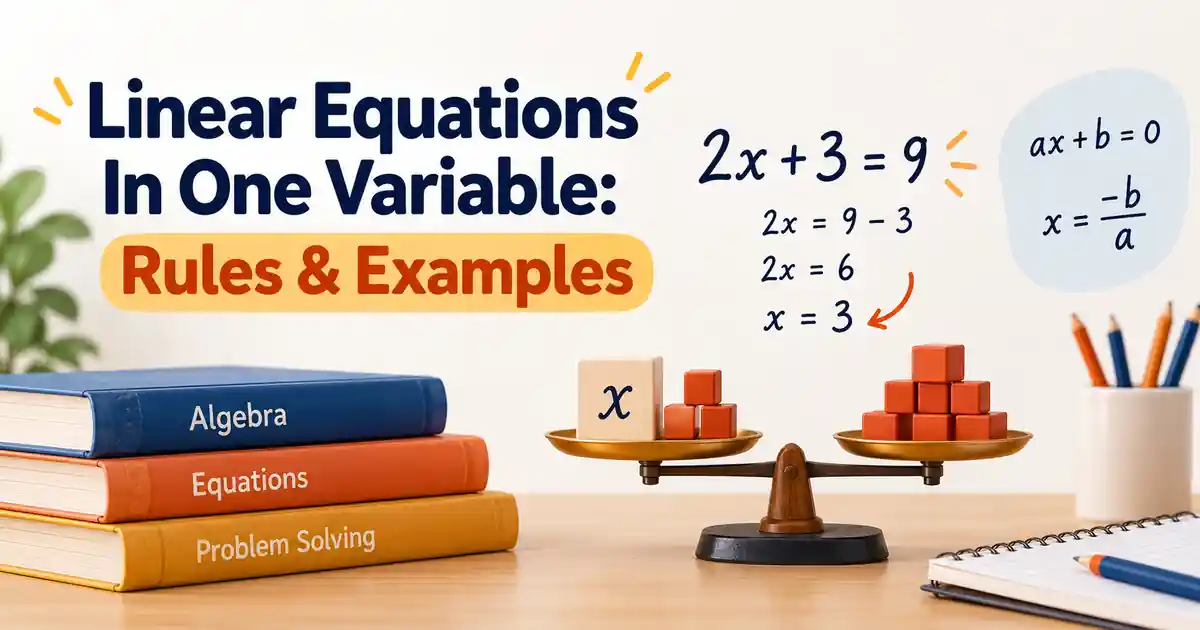
A linear equation has variables raised to the first power only — no squares, no cubes. The general form is:
When graphed, a linear equation in two variables () becomes a straight line. These are the simplest equations to solve and underlie most introductory algebra.
4. Quadratic Equations
A quadratic equation has a variable raised to the second power. The general form is:
The two solutions come from the quadratic formula:
When graphed, a quadratic becomes a parabola — the shape of a thrown ball's trajectory, an arch bridge, or a satellite dish.
5. Sequences
A sequence is an ordered list of numbers following a pattern. The most common are arithmetic sequences (add the same number each time) and geometric sequences (multiply by the same number each time).
6. Logarithms
A logarithm answers the question "to what power must I raise this base to get this number?" If , then . Logarithms compress huge ranges of numbers into manageable scales — the Richter scale for earthquakes and the decibel scale for sound both use logarithms.
7. Matrices
A matrix is a rectangular array of numbers arranged in rows and columns. Matrices encode systems of linear equations, computer graphics transformations, and the math behind machine learning.
8. Polynomials and Perfect Squares
A polynomial is an expression with one or more variable terms with non-negative integer exponents: . Perfect squares are integers that are squares of other integers: 1, 4, 9, 16, 25, 36, … and they show up everywhere — including in the discriminant of the quadratic formula above.
The Basic Algebra Formulas Everyone Should Know
A small number of formulas carry most of school algebra. These are the ones worth memorising.
1. Identities (Always True)
2. The Quadratic Formula
For with :
3. Exponent Rules
4. Logarithm Rules
A Worked Example — Wrong Path First
Solve: .
The intuitive (wrong) approach. A student in a hurry might try to "solve like a linear equation" — move the across and divide by something. The work goes nowhere because the term refuses to cooperate; you cannot isolate with a single inverse operation.
Why it fails. A quadratic has two solutions in general. Trying to treat it like a linear equation forces a single answer that doesn't exist.
The correct method — factoring. Find two numbers that multiply to and add to . They are and .
A product equals zero only when one of the factors is zero. So or , giving:
Check: ✓ and ✓.
At Bhanzu, our trainers walk through this wrong-path-first sequence deliberately — the student feels why the linear approach fails before the factoring method is introduced. The reasoning sticks because the gap was felt, not described.
Common Mistakes in Algebra
Three failure modes dominate classroom errors in early algebra. Each one is small; each one changes the answer.
Mistake 1: Treating as a negative number
Where it slips in: Substituting a negative value for . If , then , not .
Don't do this: Writing .
The correct way: is the opposite of . If is negative, is positive. The memorizer who learned " is negative" without the underlying logic hits this constantly.
Mistake 2: Distributing carelessly across a minus sign
Where it slips in: Subtracting a parenthesised expression. is not .
Don't do this: .
The correct way: . The minus sign in front flips the sign of every term inside the parentheses. The rusher who skips the parenthesis-flip step is the most common offender.
Mistake 3: Cancelling terms instead of factors
Where it slips in: Simplifying fractions like . Students cross out the 's and write .
Don't do this: ✗
The correct way: You can only cancel factors, not terms. does not simplify — the numerator and denominator share no common factor. The second-guesser who doubts whether to cancel often has the right instinct (don't) but cancels anyway because the answer "looks cleaner."
The Mathematicians Who Shaped Algebra
Muhammad ibn Musa al-Khwarizmi (c. 780–c. 850, Persia/Baghdad) — Father of algebra. His 9th-century book Al-Jabr wal-Muqābala gave the world both the word algebra (from al-jabr) and the word algorithm (from the Latinised form of his name). His method for solving quadratic equations by "completing the square" — derived geometrically — remains the foundation of how it's taught today.
Diophantus of Alexandria (c. 200–c. 284 CE, Greece) — Often called the "father of algebra" in the Greek tradition, predating al-Khwarizmi by six centuries. His Arithmetica introduced symbolic notation for unknowns and powers, though without al-Khwarizmi's systematic procedural approach.
François Viète (1540–1603, France) — Introduced the modern convention of using letters for unknown values — vowels for unknowns, consonants for knowns. His symbolic algebra made it possible to write general formulas like the quadratic formula in compact form rather than in lengthy prose.
René Descartes (1596–1650, France) — Standardised the notation that became modern algebra: , , for unknowns; , , for constants; superscript exponents like . Also invented analytic geometry, connecting algebra to geometry through the coordinate plane.
These four — separated by more than 1,800 years — built the language that today's students inherit.
Was this article helpful?
Your feedback helps us write better content