What Does Coplanar Mean in Geometry?
Coplanar points are points that all lie on the same plane. A plane is a flat, two-dimensional surface that extends without end in every direction, like an infinitely large sheet of paper with no thickness. If you can lay one such sheet so that it passes through every point in a set, those points are coplanar.
The word breaks apart cleanly: co- means "together" and -planar means "in a plane." Points sitting together in one plane are coplanar; an object that strays off that plane is non-coplanar. The same logic extends to lines and to whole figures, not just to points.
Coplanar and Non-Coplanar Points
Any two points are always coplanar, and so are any three points, as long as a plane can be drawn through them, which it always can. Three points are the magic number: three points that are not all on one line fix exactly one plane, the way a tripod fixes one resting surface. That is why three legs never wobble.
The interesting case starts at four points. A fourth point may land on the plane the first three define, making all four coplanar, or it may sit above or below that plane, making the set non-coplanar.
The four corners of a tabletop are coplanar; they share the flat top.
Three corners of a tabletop plus a point on the ceiling are non-coplanar; no single flat sheet reaches all four.
Coplanar vs Collinear: What Is the Difference?
This is the comparison readers ask about most, so it is worth pinning down before going further. Collinear points lie on the same straight line; coplanar points lie on the same flat plane. A line lives inside a plane, which means the two ideas are nested, not separate.
Are collinear points always coplanar? Yes. Any points that share a single line automatically share a plane, because a line can always be drawn inside infinitely many planes. So collinearity is the stricter, narrower condition.
Are coplanar points always collinear? No. Three corners of a triangle drawn on a sheet of paper are coplanar, but they are not collinear: they spread out across the plane instead of lining up. The three corners of any triangle are the cleanest counterexample.
Feature | Collinear | Coplanar |
|---|---|---|
Lie on the same | straight line | flat plane |
Dimension involved | one (a line) | two (a plane) |
How restrictive | stricter, narrower | broader |
Triangle's three corners | not collinear | coplanar |
Relationship | all collinear points are coplanar | not all coplanar points are collinear |
Coplanar and Non-Coplanar Lines
Two or more lines are coplanar lines when a single plane contains all of them. In a plane, two lines have only two ways to behave, which keeps the picture simple:
Intersecting lines cross at one point and are always coplanar; the point and the two directions fix one plane.
Parallel lines never meet but still lie flat in one shared plane, so they are coplanar too.
Lines that cannot share any single plane are non-coplanar lines. In three dimensions, two lines that are neither parallel nor intersecting must live in different planes, and those are exactly the skew lines you meet in solid geometry. Picture one edge on the front face of a room and a different edge on the back wall running a different direction: they never meet, never run parallel, and no flat sheet holds both.
How Do You Determine Whether Four Points Are Coplanar?
Three points are always coplanar, so the real test begins with four. The most direct approach uses vectors. Pick one point as a base, form three vectors to the other three points, and check whether those vectors stay flat or break out of the plane.
The tool for that check is the scalar triple product. For four points , , , , build the three vectors , , and , then compute:
Here is what the value tells you, and why:
The cross product gives a vector perpendicular to both and , that is, perpendicular to the plane those two span.
Dotting with that perpendicular asks: does also lie flat in the same plane?
If lies in the plane, it is perpendicular to the cross-product vector, so the dot product is 0, and the four points are coplanar.
If the result is non-zero, pokes out of the plane, so the four points are non-coplanar.
The triple product also equals the volume of the parallelepiped (a slanted box) built on the three vectors. A flat box has zero volume, which is the same statement: scalar triple product = 0 means coplanar.
Examples of Coplanar
With the definition, the coplanar-versus-collinear distinction, and the triple-product test in place, here is the concept doing real work. The problems build from naming everyday coplanar sets up to a full four-point coordinate test.
Example 1 - The minute hand and the hour hand of a clock both sweep across the clock face. Are they coplanar?
Both hands move across the same flat dial, so a single plane (the clock face) contains both. They are coplanar lines, and they happen to intersect at the centre.
Final answer: yes, coplanar.
Example 2 - A student is asked whether three points that are coplanar must also be collinear, and answers "yes, because they share a plane."
A common first read is that "coplanar" and "collinear" describe the same thing, so any coplanar set must line up. Test that read against a triangle: its three corners share one plane (your sheet of paper), yet they clearly do not sit on a single straight line. So sharing a plane does not force points onto a line.
Done correctly: coplanar means same plane; collinear means same line. Three points are always coplanar, but they are collinear only when they happen to lie on one line. The student's "yes" should be "no."
Example 3 - Are the points , , and coplanar?
Any three points are coplanar, so the answer is yes without computation; these three even sit in the familiar xy-plane. They are not collinear, though, since they form a right triangle.
Final answer: yes, coplanar (and non-collinear).
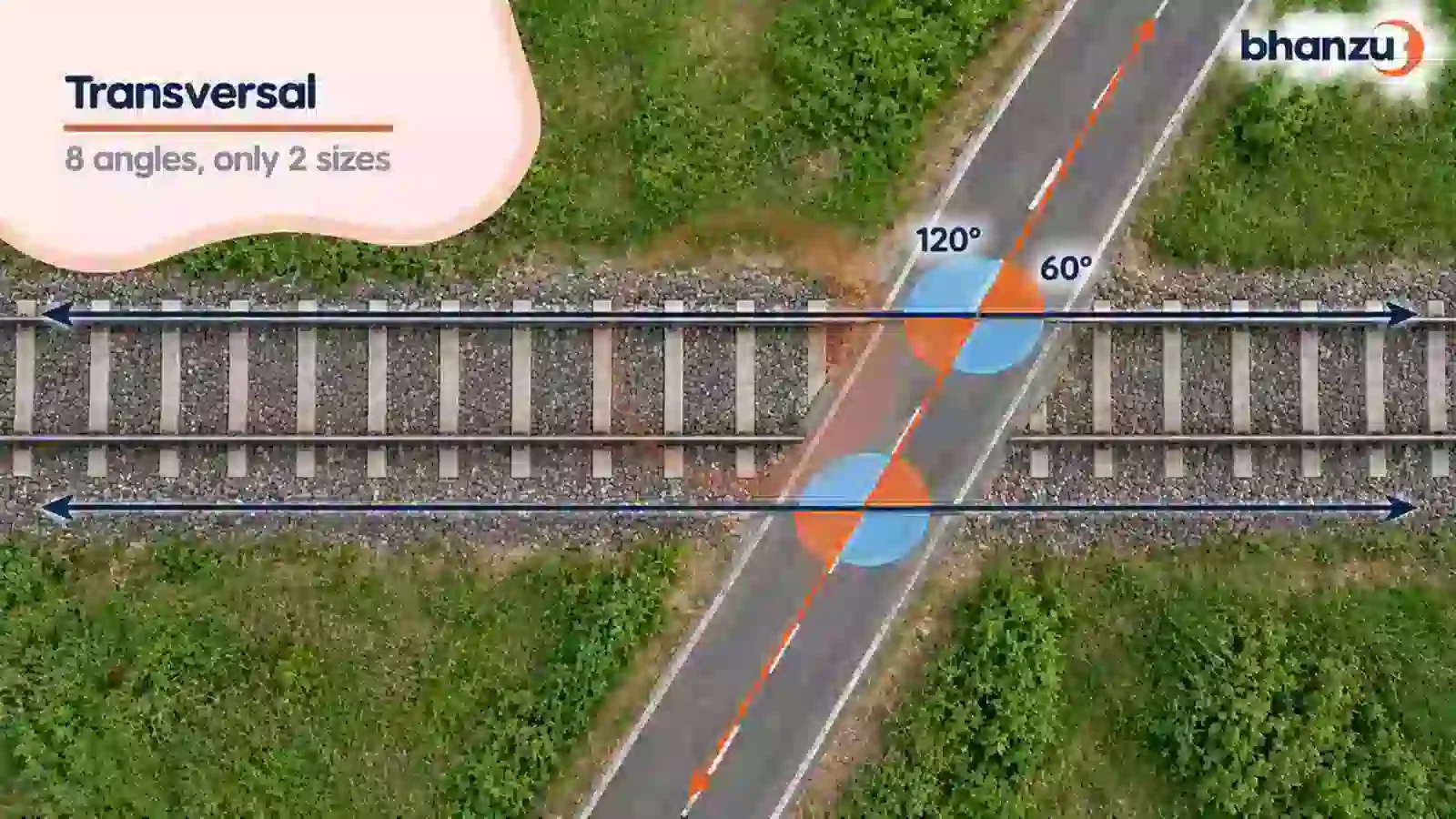
Example 4 - Two parallel railway tracks run along flat ground. Are the two rails coplanar?
Parallel lines always share one plane, and here that plane is the ground. The rails are coplanar lines.
Final answer: yes, coplanar.
Example 5 - Test whether , , , and are coplanar.
Form the vectors from : , , .
Cross product :
Dot with :
The result is , not , so the four points are non-coplanar.
Final answer: non-coplanar.
Example 6 - A box-shaped room has four points: three on the floor and one on the ceiling directly above the room's center. Are all four coplanar?
The three floor points fix the floor plane. The ceiling point sits well above that plane, so no single flat surface reaches all four.
Final answer: non-coplanar.
Where Coplanarity Shows Up
Coplanarity is the quiet rule behind anything that has to sit flat, line up, or share one surface, which is why engineers and designers reach for it constantly.
Stable supports. Three-legged stools, camera tripods, and survey instruments use exactly three feet because three points are always coplanar with the ground, so they never rock. A fourth foot would need perfect alignment to stay flat.
Aircraft and bridge design. Engineers checking whether four mounting points, rivets, or load bearings share one plane run the coplanarity test; a part that should be flush but is slightly non-coplanar concentrates stress and can crack.
Computer graphics. Every flat surface a game or film renders is built from coplanar points grouped into polygons; testing coplanarity decides whether a set of vertices can be drawn as one flat face.
Circuit boards. The contact pads under a chip must be coplanar, or some pins miss the board during soldering, a defect testers screen for by measuring how far each pad strays from the shared plane.
The coordinate framework that lets us pin a point to and run these tests traces back to René Descartes and his 1637 marriage of algebra to geometry, the same framework you lean on whenever you graph in three dimensions.
Where Students Trip Up on Coplanar
Mistake 1: Treating coplanar and collinear as the same thing
Where it slips in: A question asks whether coplanar points must be collinear, and the student answers yes.
Don't do this: Assume that sharing a plane forces points onto a single line.
The correct way: Coplanar means same plane; collinear means same line. A triangle's three corners are coplanar but not collinear. Collinear points are always coplanar, but the reverse fails.
Mistake 2: Thinking four points are automatically coplanar
Where it slips in: A student knows three points are always coplanar and stretches the rule to four.
Don't do this: Skip the test and declare any four points coplanar.
The correct way: Three points fix a plane, but a fourth can sit off it. Run the scalar-triple-product test: a result of confirms coplanar, non-zero confirms non-coplanar.
Mistake 3: Calling two non-intersecting lines coplanar without checking direction
Where it slips in: Two lines do not cross, so a student labels them coplanar (parallel).
Don't do this: Assume "non-intersecting" means "parallel and coplanar."
The correct way: In 3D, two lines can miss each other without being parallel, which makes them skew, and skew lines are non-coplanar. Check whether they share a plane, not just whether they meet.
Key Takeaways
Coplanar points or lines lie on the same flat plane; non-coplanar objects do not fit on any single plane.
Any two or three points are always coplanar; four or more may or may not be, which is why the four-point test matters.
Coplanar is broader than collinear: all collinear points are coplanar, but coplanar points need not be collinear (a triangle's corners prove it).
Coplanar lines are either intersecting or parallel; lines that are neither are skew and non-coplanar.
The scalar triple product of three vectors equals zero exactly when four points are coplanar.
Practice These Problems to Solidify Your Understanding
Are the three points , , and coplanar, collinear, both, or neither?
Two lines in space never intersect and never run parallel. Are they coplanar?
Test whether , , , and are coplanar using the scalar triple product.
Answer to Question 1: both, since any three points are coplanar and these three lie on the line . Answer to Question 2: no; lines that neither meet nor run parallel are skew and therefore non-coplanar. Answer to Question 3: non-coplanar, since the triple product works out to . If Question 3 gave , recheck the cross product before the dot product.
Want a live Bhanzu trainer to walk your child through coplanarity, planes, and 3D geometry? Book a free demo class — online globally.
Also Read:
Was this article helpful?
Your feedback helps us write better content