What is an Odd Number?
An odd number is a whole number that cannot be divided into two equal groups — when you divide it by 2, there is always 1 left over. Examples of odd numbers include 1, 3, 5, 7, and 9.
Formal Definition
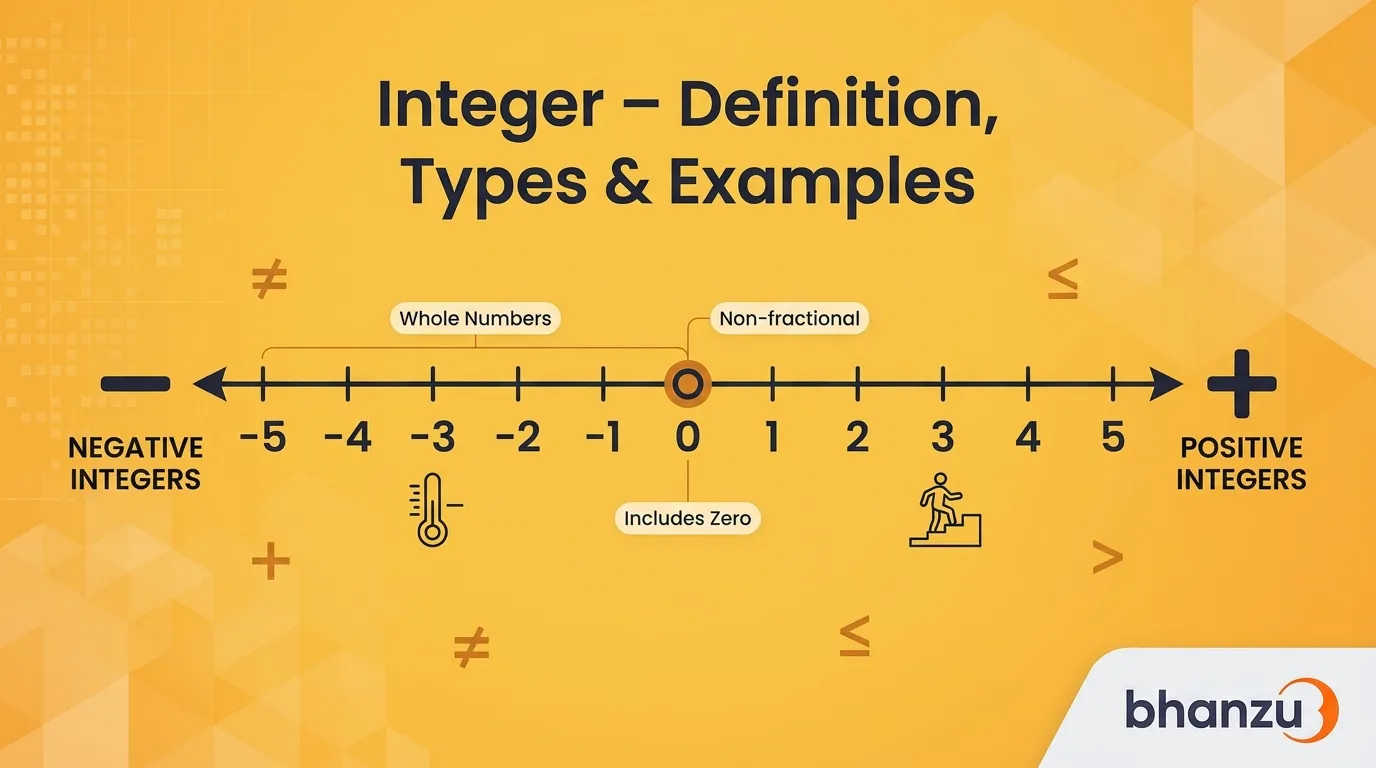
An odd number is any integer of the form 2n + 1, where n is any integer (positive, negative, or zero). This means odd numbers extend in both directions on the number line: ..., –5, –3, –1, 1, 3, 5, 7, ... — catalogued as OEIS sequence A005408.
Examples of Odd Numbers
7 is odd because 7 ÷ 2 = 3 with a remainder of 1.
9 is odd because it ends in 9 (one of the digits 1, 3, 5, 7, or 9).
–11 is odd. Negative integers can be odd too.
0.5 is neither odd nor even. The odd–even classification applies only to integers, not to fractions or decimals.
How to Identify an Odd Number
There are two reliable methods.
The first method is to check the last digit. If the number ends in 1, 3, 5, 7, or 9, it is odd. So 247 is odd. So is 1,683.
The second method is to divide by 2. If the remainder is 1, the number is odd.
The last-digit rule works because of place value. Every digit except the units digit represents a multiple of 10, and 10 is even. So only the units digit decides whether the whole number is odd or even.
List of Odd Numbers from 1 to 100
There are 50 odd numbers between 1 and 100.
1 | 3 | 5 | 7 | 9 | 11 | 13 | 15 | 17 | 19 |
21 | 23 | 25 | 27 | 29 | 31 | 33 | 35 | 37 | 39 |
41 | 43 | 45 | 47 | 49 | 51 | 53 | 55 | 57 | 59 |
61 | 63 | 65 | 67 | 69 | 71 | 73 | 75 | 77 | 79 |
81 | 83 | 85 | 87 | 89 | 91 | 93 | 95 | 97 | 99 |
Properties of Odd Numbers
Odd numbers behave predictably under the four basic arithmetic operations.
Operation | Rule | Example |
|---|---|---|
Odd + Odd | Even | 3 + 5 = 8 |
Odd + Even | Odd | 3 + 4 = 7 |
Odd − Odd | Even | 9 − 3 = 6 |
Odd − Even | Odd | 9 − 4 = 5 |
Odd × Odd | Odd | 3 × 5 = 15 |
Odd × Even | Even | 3 × 4 = 12 |
Odd ÷ 2 | Not a whole number | 7 ÷ 2 = 3.5 |
There is also a well-known identity: the sum of the first n odd numbers equals n². For example, 1 + 3 + 5 + 7 = 16 = 4², and 1 + 3 + 5 + 7 + 9 = 25 = 5². This identity connects odd numbers to gnomonic numbers — the L-shaped layers that build up a perfect square one odd number at a time.
Types of Odd Numbers
Consecutive Odd Numbers
Consecutive odd numbers are odd numbers that follow each other in order, with a difference of 2 between them. Examples: 1, 3, 5, 7 — or 21, 23, 25, 27.
If n is an odd number, the next consecutive odd number is n + 2. The Highest Common Factor (HCF) of any two consecutive odd numbers is always 1.
Composite Odd Numbers
A composite odd number is an odd number greater than 1 that has factors other than 1 and itself. Examples include 9 (= 3 × 3), 15 (= 3 × 5), 21 (= 3 × 7), 25, and 27.
The smallest odd composite number is 9.
Odd Numbers vs Even Numbers
Every integer is either odd or even — no integer is both.
Feature | Odd Numbers | Even Numbers |
|---|---|---|
Divisible by 2 | No | Yes |
Last digit | 1, 3, 5, 7, 9 | 0, 2, 4, 6, 8 |
Remainder when divided by 2 | 1 | 0 |
General form | 2n + 1 | 2n |
Examples | 1, 3, 5, 7, 9 | 0, 2, 4, 6, 8 |
First positive | 1 | 2 |
Common Confusions
Is 1 an odd number? Yes. 1 is the smallest positive odd number.
Is 0 an odd number? No. Zero is even — it divides by 2 with no remainder.
Are decimals and fractions odd? No. Odd and even apply only to integers, not to fractions or decimals.
Are odd numbers the same as prime numbers? No. All prime numbers except 2 are odd, but not every odd number is prime — for example, 9 and 15 are odd but composite.
Curriculum Reference
Odd and even numbers are introduced in CCSS 2.OA.C.3 (Grade 2, US Common Core) and in NCERT Class 3 within the Indian curriculum. The concept extends in later grades into number patterns, parity arguments, and arithmetic sequences.
Was this article helpful?
Your feedback helps us write better content