What is Square Root – Definition, Formula & Examples

#Math Terms
TL;DR
This article explains what square root means — the value that, multiplied by itself, gives the original number — and covers the square root formula, notation, and worked examples from perfect squares to estimating irrationals. You will understand the concept, the symbol, and the methods for finding square roots by hand and by calculator.
BT
Bhanzu TeamLast updated on May 12, 20263 min read

The square root of a number $n$ is the value that, when multiplied by itself, gives $n$ — written $\sqrt{n}$.

Quick Reference:

Definition: $\sqrt{n} = x$ means $x^2 = n$

Symbol: $\sqrt{\phantom{n}}$ (radical sign), introduced by Christoph Rudolff (c. 1525)

Principal root: The non-negative root (both $+3$ and $-3$ square to 9, but $\sqrt{9} = 3$ by convention)

Perfect squares: $\sqrt{1}=1$, $\sqrt{4}=2$, $\sqrt{9}=3$, $\sqrt{16}=4$, $\sqrt{25}=5$, ...

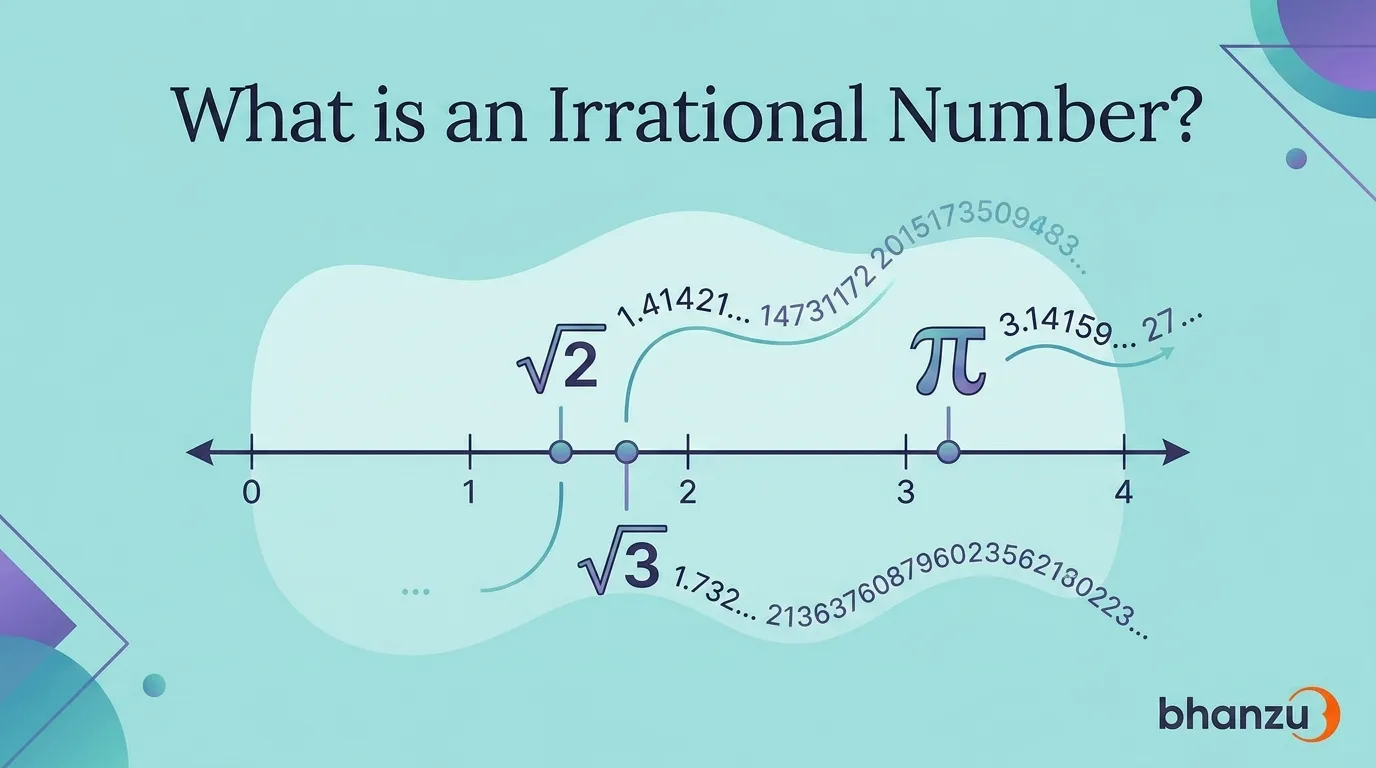
Irrational roots: $\sqrt{2} \approx 1.414$, $\sqrt{3} \approx 1.732$ — non-terminating, non-repeating decimals

Formula (Pythagorean use): $c = \sqrt{a^2 + b^2}$

Type: Arithmetic operation — inverse of squaring

Used in: Algebra, geometry, physics, statistics (standard deviation), engineering

Full Definition

The square root of $n$ is one of the two numbers whose square equals $n$. For any positive number $n$, there are two square roots: $+\sqrt{n}$ and $-\sqrt{n}$. By convention, the radical symbol $\sqrt{n}$ refers to the principal (positive) square root only.

Square roots are defined for all non-negative real numbers. The square root of a negative number is not a real number — it introduces imaginary numbers ($\sqrt{-1} = i$), studied in complex number theory.

Origin and History

The concept of square roots appears in ancient Babylonian mathematics (c. 1800 BCE) on clay tablets such as YBC 7289, which gives $\sqrt{2} \approx 1.41421$ to five decimal places — an approximation accurate to within 0.000006 of the true value. Christoph Rudolff (c. 1499–1543, Germany) introduced the modern radical symbol $\sqrt{}$ in his 1525 work Coss. The symbol was extended to $\sqrt[3]{}$, $\sqrt[4]{}$ etc. for cube and fourth roots by later mathematicians.

How To Find What is Square Root of Any Number

For perfect squares, square roots are exact whole numbers. For non-perfect-square integers, the square root is irrational — it never terminates or repeats as a decimal.

Three methods for finding square roots:

  1. Memorise perfect squares up to $\sqrt{225} = 15$ for quick calculation.

  2. Prime factorisation — factor the number and take one factor from each pair: $\sqrt{36} = \sqrt{2^2 \times 3^2} = 2 \times 3 = 6$.

  3. Long division method — a systematic algorithm for finding square roots to any decimal precision, taught in many curricula.

Worked Examples of Square Root

Example 1: Perfect square root

Find $\sqrt{144}$.

$12^2 = 144$, so $\sqrt{144} = 12$.

Final answer: $12$

Example 2: Using the Pythagorean theorem

A right triangle has legs $a = 3$ cm and $b = 4$ cm. Find the hypotenuse.

$$c = \sqrt{a^2 + b^2} = \sqrt{9 + 16} = \sqrt{25} = 5 \text{ cm}$$

Final answer: $c = 5$ cm

Example 3: Simplifying a surd

Simplify $\sqrt{72}$.

$$\sqrt{72} = \sqrt{36 \times 2} = \sqrt{36} \times \sqrt{2} = 6\sqrt{2}$$

Final answer: $6\sqrt{2}$

Common Confusions About Square Root

$\sqrt{n^2} = |n|$, not necessarily $n$. The square root always returns the non-negative value: $\sqrt{(-3)^2} = \sqrt{9} = 3$, not $-3$.

$\sqrt{a + b} \neq \sqrt{a} + \sqrt{b}$. This is one of the most common algebraic errors. $\sqrt{9 + 16} = \sqrt{25} = 5$, but $\sqrt{9} + \sqrt{16} = 3 + 4 = 7 \neq 5$.

$\sqrt{n}$ is not the same as $n^2$. Squaring and square-rooting are inverse operations. $\sqrt{4} = 2$; $4^2 = 16$ — these are entirely different.

Where Square Roots Appear Beyond Arithmetic

Square roots appear in the distance formula between two points: $d = \sqrt{(x_2-x_1)^2 + (y_2-y_1)^2}$, in the standard deviation formula in statistics ($\sigma = \sqrt{\frac{\sum(x-\mu)^2}{n}}$), and in the quadratic formula ($x = \frac{-b \pm \sqrt{b^2 - 4ac}}{2a}$). In physics, the period of a pendulum is $T = 2\pi\sqrt{L/g}$ — the square root of the length divided by gravitational acceleration. Every time a distance or spread is computed from squared values, a square root appears.

Was this article helpful?

Your feedback helps us write better content
Frequently Asked Questions

What is square root in simple terms?
What is square root? It is the value that, when multiplied by itself, produces a given number. $\sqrt{25} = 5$ because $5 \times 5 = 25$. It is the inverse operation of squaring.
What is the square root of 2?
$\sqrt{2} \approx 1.41421356...$ — an irrational number. It cannot be written as a simple fraction. It appears as the diagonal of a unit square (a square with side length 1).
Can a square root be negative?
The square root of a positive number has two roots — one positive and one negative. By convention, $\sqrt{n}$ refers to the positive root only (the principal root). $\sqrt{9} = 3$, not $\pm 3$.
What is the square root of 0?
$\sqrt{0} = 0$. Zero is a perfect square: $0^2 = 0$.
✍️ Written By
BT
Bhanzu Team
Content Creator and Editor
Bhanzu’s editorial team, known as Team Bhanzu, is made up of experienced educators, curriculum experts, content strategists, and fact-checkers dedicated to making math simple and engaging for learners worldwide. Every article and resource is carefully researched, thoughtfully structured, and rigorously reviewed to ensure accuracy, clarity, and real-world relevance. We understand that building strong math foundations can raise questions for students and parents alike. That’s why Team Bhanzu focuses on delivering practical insights, concept-driven explanations, and trustworthy guidance-empowering learners to develop confidence, speed, and a lifelong love for mathematics.
Related Articles
Book a FREE Demo ClassBook Now →