What Are Alternate Angles?
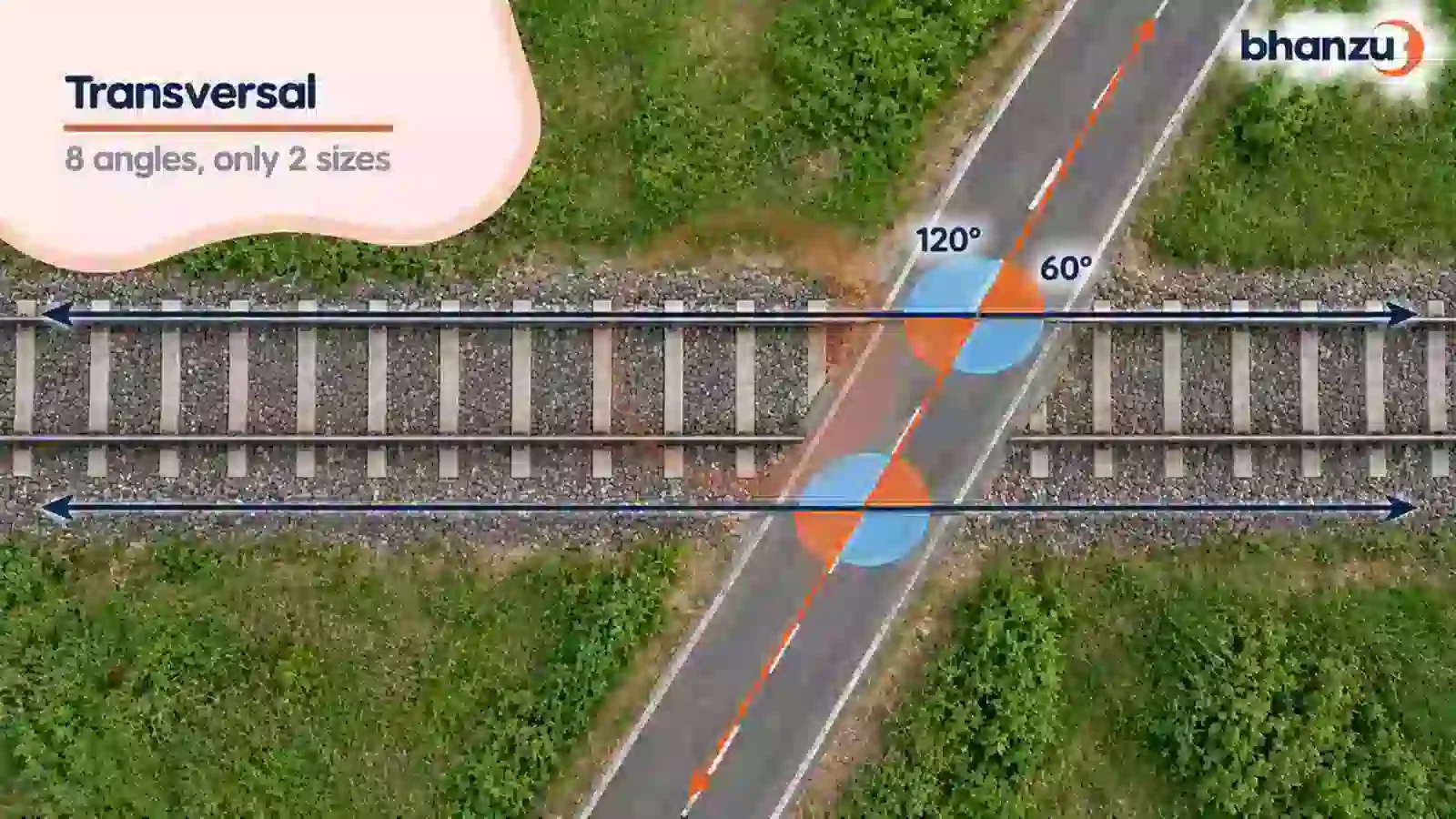
Alternate angles are pairs of angles that form on opposite sides of a transversal — a line that crosses two other lines — and have different vertices. When the two lines being crossed are parallel, each pair of alternate angles is equal (congruent).
Two conditions define the pair:
The angles sit on opposite sides of the transversal (this is the "alternate" part — they alternate across it).
They are at two different crossing points, never the same vertex.
A transversal is just a straight line that intersects two or more lines at distinct points. Where it crosses each line, it creates four angles, giving eight angles in total across the two crossings. The parallel lines cut by transversal setup is where every angle-pair name comes from.
The Types Of Alternate Angles
The transversal's eight angles split into an interior region (between the two lines) and an exterior region (outside them). That gives two kinds of alternate angle.
1. Alternate Interior Angles
Alternate interior angles lie between the two parallel lines, on opposite sides of the transversal. Using the numbering ∠1–∠8 in the diagram above, the alternate interior pairs are ∠3 and ∠6, and ∠4 and ∠5. When the lines are parallel, each pair is equal.
2. Alternate Exterior Angles
Alternate exterior angles lie outside the two parallel lines, on opposite sides of the transversal. The alternate exterior pairs are ∠1 and ∠8, and ∠2 and ∠7. Again, when the lines are parallel, each pair is equal. (See the dedicated pages on alternate interior angles and alternate exterior angles for more.)
The two share the same logic — opposite sides of the transversal, different vertices, equal when parallel. The only difference is whether the angles sit inside or outside the parallel lines.
What Does The Alternate Angles Theorem Say?
The alternate interior angles theorem states: if a transversal crosses two parallel lines, then each pair of alternate interior angles is equal. The matching exterior theorem says the same for alternate exterior pairs.
The reasoning is short, and it borrows from the corresponding angles fact rather than assuming the result:
Corresponding angles are equal across parallel lines, so ∠2 at the top crossing equals ∠6 at the bottom.
∠2 and ∠4 are vertical angles, so ∠2 = ∠4.
Chaining these gives ∠4 = ∠6 — and ∠4 and ∠6 are alternate interior angles.
So the equality is inherited, not assumed.
The theorem also runs both ways. The converse says: if a transversal makes a pair of alternate angles equal, the two lines must be parallel. That is what lets you prove lines parallel just by checking one angle pair.
Examples of Alternate Angles
Example 1
A transversal crosses two parallel lines. One alternate interior angle is 65°. What is its alternate interior partner?
By the alternate interior angles theorem, the pair is equal.
Final answer: .
Example 2
A student sees a transversal cross two parallel lines, with one angle marked 70°. They claim the alternate interior angle "adds up to 180°, so it's 110°." Where does this go wrong?
Wrong attempt. The student reasons: "Angles around the transversal are supplementary, so the partner is ." They write 110°.
Why it breaks. They have applied the co-interior (consecutive interior) rule — which is supplementary — to an alternate pair, which is equal. Co-interior angles sit on the same side of the transversal; alternate angles sit on opposite sides.
Correct. Alternate interior angles are equal, not supplementary:
Final answer: . The 110° angle is the co-interior partner, a different pair.
Example 3
Two parallel lines are cut by a transversal. An alternate exterior angle is 118°. Find its alternate exterior partner and the co-interior angle on its side.
The alternate exterior partner is equal: .
The consecutive interior angle on the same side is supplementary to the interior angle, so it pairs to 180°: an interior angle adjacent to the 118° exterior is , and its co-interior partner is .
Final answer: alternate exterior partner .
Example 4
A transversal cuts two parallel lines. An alternate interior pair is given as and . Find and the angle.
Alternate interior angles are equal, so set the expressions equal:
Substitute back: .
Final answer: , and each angle is .
Example 5
A transversal makes a pair of alternate exterior angles measuring 95° and . The lines are parallel. Find .
Equal alternate exterior angles:
Final answer: .
Example 6
A transversal crosses two lines. One alternate interior angle is 80° and the other is 84°. Are the lines parallel?
The converse of the theorem says alternate interior angles are equal only when the lines are parallel. Here , so the lines are not parallel — they would eventually meet.
Final answer: Not parallel, because the alternate interior angles are unequal.
Why Alternate Angles Matter Beyond The Textbook
"Equal angles that prove two lines never meet."
Alternate angles are not a memory exercise. They are the working tool behind anything that depends on lines staying parallel.
They prove parallelism without measuring the lines. You can never confirm two lines "never meet" by extending them forever. The converse of the alternate angles theorem lets you settle it from a single equal angle pair — finite, fast, certain.
They build the proof that a triangle's angles sum to 180°. Draw a line through one vertex parallel to the opposite side, and the alternate interior angles slot the triangle's three angles onto a straight line. That is the cleanest proof of the most-used fact about triangles.
They keep the built world straight. Carpenters checking that shelves are level, road engineers laying parallel lanes, and machinists aligning parts all use a crossing line and an angle check — the alternate-angle idea, applied with a square or a laser. The destination is everywhere two surfaces must run true to each other.
They generalise the whole angle family. Once alternate angles click, corresponding angles, co-interior angles, and vertical angles all fall into place as variations on the same transversal picture.
Where Students Trip Up On Alternate Angles
Mistake 1: Making alternate angles supplementary instead of equal
Where it slips in: Whenever co-interior (same-side) and alternate (opposite-side) pairs appear in the same diagram.
Don't do this: Writing the alternate partner as .
The correct way: Alternate angles are equal (). It is the co-interior angles — on the same side of the transversal — that are supplementary and sum to 180°.
This is the single most common confusion here: the first instinct is to reach for because so many angle relationships are supplementary. The fix is to read the side first — opposite sides means equal, same side means supplementary. Check the side before you choose the rule.
Mistake 2: Confusing alternate angles with corresponding angles
Where it slips in: Identifying which pair is which among the eight angles.
The memorizer learns "the Z-shape is alternate angles" and "the F-shape is corresponding angles," then freezes when the diagram is rotated and the letters no longer look like Z or F.
Don't do this: Relying only on the letter-shape trick on a rotated figure.
The correct way: Alternate angles are on opposite sides of the transversal at different vertices; corresponding angles are on the same side, in the same position at each crossing. Read position and side, not the visual letter.
Mistake 3: Applying the equality when the lines are not parallel
Where it slips in: Problems that do not actually state the lines are parallel.
The rusher sees a transversal and two lines and immediately sets the alternate angles equal — even when the figure never claims the lines are parallel.
Don't do this: Assuming alternate angles are equal in every transversal diagram.
The correct way: Alternate angles are equal only when the two lines are parallel. If parallelism is not given or proven, you cannot set them equal.
Conclusion
Alternate angles are pairs on opposite sides of a transversal, at different vertices, that are equal when the two lines are parallel.
They come in two types: alternate interior (between the lines) and alternate exterior (outside the lines).
The alternate angles theorem and its converse let you prove two lines parallel from a single equal angle pair.
The most common mistake is treating alternate angles as supplementary — that is the co-interior rule; alternate angles are equal.
Alternate angles underpin the proof that a triangle's interior angles sum to 180°.
Practice these to solidify your understanding
Work through these, then check the examples above.
Two parallel lines are cut by a transversal; one alternate exterior angle is 53°. Find its partner. (Answer to Question 1: 53°.)
An alternate interior pair is and on parallel lines. Find and the angle. (Answer to Question 2: , angle .)
A transversal makes alternate interior angles of 72° and 76°. Are the lines parallel? (Answer to Question 3: no — the angles are unequal.)
If you get stuck on Question 1, return to Example 1 — alternate angles on parallel lines are equal, never supplementary.
Want a live Bhanzu trainer to walk through more alternate angles problems? Book a free demo class.
Was this article helpful?
Your feedback helps us write better content