What is an Integer?
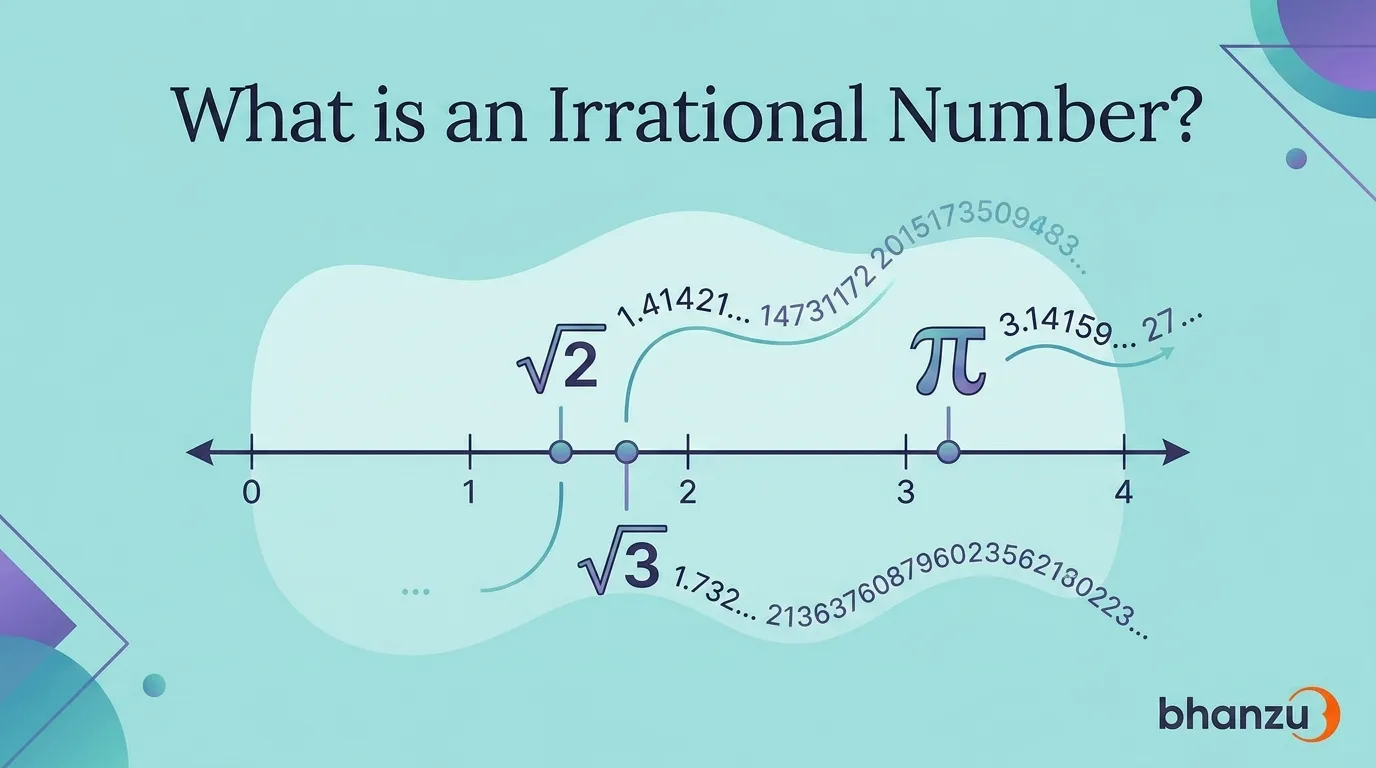
An integer is a whole number that can be positive, negative, or zero, with no fractional or decimal part. Examples of integers include −7, 0, 3, 42, and −1,058. Numbers like ½, 0.75, √2, and π are not integers because they contain fractional parts.
The word integer comes from the Latin word integer, meaning "whole" or "untouched." In mathematics, an integer represents a complete unit, never a part of one.
Set of Integers and Notation
The set of all integers is written as:
ℤ = {..., −3, −2, −1, 0, 1, 2, 3, ...}
The symbol ℤ comes from the German word Zahlen, meaning "numbers." Common subsets of ℤ are written using superscripts:
Symbol | Meaning |
|---|---|
ℤ⁺ | Positive integers: {1, 2, 3, ...} |
ℤ⁻ | Negative integers: {..., −3, −2, −1} |
ℤ* | Non-zero integers (excludes 0) |
ℤ⁰⁺ | Non-negative integers: {0, 1, 2, 3, ...} |
📜 Origin of the word integer
The word integer is Latin for "whole" or "untouched" — in- (not) plus tangere (to touch). The notation ℤ for the set of integers was attributed to David Hilbert and standardised through the Bourbaki text Algèbre in 1947. Augustin-Louis Cauchy, in 1821, was among the first to formally treat negative numbers as real numbers. Before that, many mathematicians regarded negatives with suspicion and called them "fictitious" quantities.
Types of Integers
Integers fall into three primary categories:
Positive integers. Integers greater than zero: 1, 2, 3, 4, ...
Negative integers. Integers less than zero: −1, −2, −3, −4, ...
Zero. Neither positive nor negative; the additive identity.
Other Common Integer Subtypes
Beyond positive, negative, and zero, integers are often classified into further subtypes depending on context:
Subtype | Definition | Examples |
|---|---|---|
Even integers | Integers divisible by 2 | ..., −4, −2, 0, 2, 4, ... |
Odd integers | Integers not divisible by 2 | ..., −3, −1, 1, 3, ... |
Consecutive integers | Integers that follow one another in order | 7, 8, 9 or −2, −1, 0 |
Non-negative integers | Integers ≥ 0 (zero is included) | 0, 1, 2, 3, ... |
Non-positive integers | Integers ≤ 0 (zero is included) | ..., −3, −2, −1, 0 |
Prime integers | Positive integers > 1 with exactly two divisors | 2, 3, 5, 7, 11, ... |
Integer vs Whole Number vs Natural Number vs Rational Number
Every natural number is a whole number, every whole number is an integer, and every integer is a rational number. The relationships are nested.
Number Type | Definition | Examples | Includes Negatives? |
|---|---|---|---|
Natural numbers | Counting numbers from 1 onward | 1, 2, 3, 4, ... | No |
Whole numbers | Natural numbers including zero | 0, 1, 2, 3, ... | No |
Integers | Whole numbers and their negatives | ..., −2, −1, 0, 1, 2, ... | Yes |
Rational numbers | Numbers of the form p/q where q ≠ 0 | −3, 0, ½, 7, 2.5 | Yes |
Integers on a Number Line
A number line is a horizontal line where every integer is plotted at an equally-spaced point. Zero sits at the centre. Positive integers extend infinitely to the right, and negative integers extend infinitely to the left.
The number line is the standard visual model for integer arithmetic. Adding a positive integer means moving right. Adding a negative integer means moving left.
For example, to evaluate −3 + 5: start at −3, then move 5 units right. The result is +2.
Properties of Integers
Integers obey six core properties under arithmetic operations.
Property | Statement | Example |
|---|---|---|
Closure | The sum, difference, or product of two integers is always an integer. (Division is not always closed.) | 4 + (−7) = −3 |
Commutative | Order does not affect addition or multiplication. | 5 + 3 = 3 + 5 |
Associative | Grouping does not affect addition or multiplication. | (2 + 3) + 4 = 2 + (3 + 4) |
Distributive | Multiplication distributes over addition. | 2 × (3 + 4) = 2 × 3 + 2 × 4 |
Identity | 0 is the additive identity. 1 is the multiplicative identity. | 7 + 0 = 7; 7 × 1 = 7 |
Additive Inverse | Every integer a has an inverse −a such that a + (−a) = 0. | 9 + (−9) = 0 |
The commutative and associative properties do not apply to subtraction or division of integers. Division is also not closed: 7 ÷ 2 = 3.5, which is not an integer.
Sign Rules for Integer Operations
For multiplication and division of integers, the sign of the result follows two simple rules:
× or ÷ | Positive | Negative |
|---|---|---|
Positive | + | − |
Negative | − | + |
Same signs produce a positive result. Different signs produce a negative result. Examples:
4 × 3 = 12
4 × (−3) = −12
(−4) × (−3) = 12
(−12) ÷ 3 = −4
For addition and subtraction, the result depends on both the signs and the magnitudes of the integers, so a single grid does not capture every case. The general rule: when adding integers with the same sign, add the magnitudes and keep the sign. When adding integers with different signs, subtract the smaller magnitude from the larger and keep the sign of the larger.
Common Confusions
Is −5 less than −2?
Yes. On the number line, −5 sits to the left of −2. The further a negative integer is from zero, the smaller its value. So −10 < −5 < −2 < 0 < 2 < 5.
The minus sign as subtraction vs negation
The "−" symbol serves two purposes. It can mark a number as negative (−5 means "negative five"), or it can indicate subtraction (8 − 3 means "eight minus three"). In the expression 8 − (−3), both uses appear: subtraction of a negative integer.
Zero is neither positive nor negative
Zero is an integer, but it is neither a positive integer nor a negative integer. Zero is the additive identity and the boundary between the two halves of the number line.
Fractions that simplify to integers
A fraction whose numerator is divisible by its denominator simplifies to an integer. For example, 8/4 = 2 is an integer. But 4/3 is not, because it does not simplify to a whole value.
Real-Life Examples of Integers
Integers describe quantities that vary above and below a reference point.
Temperature. A reading of 32°C is positive. −5°C is negative. 0°C is the reference.
Elevation. Mount Everest stands at +8,849 metres above sea level. The Dead Sea sits at −430 metres.
Bank balance. A deposit of ₹500 adds +500 to the balance. A withdrawal of ₹200 adds −200.
Building floors. A basement labelled −2 sits two floors below the ground floor (0). The fifth floor is +5.
Sports scores. In golf, −3 means three strokes under par. +2 means two strokes over par.
Related Terms
Term | Meaning | How It Relates |
|---|---|---|
Whole Number | Non-negative integers (0, 1, 2, 3, ...) | Subset of integers |
Natural Number | Counting numbers (1, 2, 3, ...) | Subset of whole numbers and integers |
Rational Number | Any number expressible as p/q, where q ≠ 0 | Every integer is rational |
Absolute Value | Distance of an integer from zero | Always non-negative; written |a| |
Additive Inverse | Number that sums with another to give zero | The additive inverse of a is −a |
Even Integer | Integer divisible by 2 | Subset of integers |
Odd Integer | Integer not divisible by 2 | Subset of integers |
Prime Number | Positive integer greater than 1 with exactly two divisors | Subset of positive integers |
Was this article helpful?
Your feedback helps us write better content