Should Kids Learn Math Tricks?
Yes — but not first, and not on their own. A trick speeds up arithmetic; understanding the trick teaches mathematics. The order is the whole game.
Math tricks earn their place in three spots: timed tests, quick mental estimation, and building a child's confidence with numbers. They cause harm in exactly one spot — when they stand in for understanding instead of riding on top of it.
Picture a child who learns the "multiply by 11" rule before they understand multiplication. They will get every two-digit answer right, then freeze the first time a three-digit number appears, because the recipe does not stretch. The understanding underneath it would have stretched. That gap — between a memorized routine and the idea it came from — is what this guide is built to close.
What Are the Few Ideas Behind All 20 Math Tricks?
Here is the part most "math tricks" lists skip, and it is the most useful part. The twenty tricks below are not twenty separate things to memorize. They are five ideas, reused. Learn the five, and the twenty become obvious — and your child can even invent their own.
Place value. Every number is built from ones, tens, and hundreds, so it can be split apart and recombined. This powers break-apart addition, left-to-right work, the ×11 rule, and cross-multiplication.
The distributive law. a × (b + c) = a × b + a × c — multiply the parts, then add. This is the engine behind ×9, ×5, ×25, and multiplying near 100.
Doubling and halving. Because 5 = 10 ÷ 2 and 25 = 100 ÷ 4, you can trade an awkward factor for a friendly one. This drives ×5, ×25, halve-and-double, ÷5, and ÷25.
The square identities. (a+b)2 = a2 + 2ab + b2 and (a+b)(a-b) = a2 - b2. These explain every squaring shortcut on the list.
Complements and distance. A number near a round one is just "the round number minus a little," and subtraction is the distance between two numbers. This is round-and-adjust, subtracting from a power of 10, and distance subtraction.
How Is This List of Math Tricks Organized?
The twenty tricks are grouped by operation: three for addition, two for subtraction, eight for multiplication, three for division, three for squaring and square roots, plus one bonus mnemonic. Each entry leads with the idea that makes it work, then the shortcut, a worked example, and — where it matters — the point where the shortcut stops being clean. A grade-level table near the end helps you pick the ones that fit your child right now.
Which Math Tricks Help With Addition?
Trick 1 — Round-And-Adjust
The idea: addition is associative, so you can nudge numbers to friendlier values and undo the nudge later. Round each number up to a tidy ten, add, then subtract what you added.
For 644 + 238: round to 650 + 240 = 890, then subtract the 6 + 2 = 8 you added. The answer is 882. Rounded numbers sit more comfortably in working memory than a carry-by-carry sum. (Grade 3+, ★)
Trick 2 — Left-To-Right Addition
The idea: place value lets you add the biggest parts first. School teaches right-to-left because it was built for pencil-and-paper columns; the mind estimates left-to-right.
For 345 + 627: 300 + 600 = 900, then 40 + 20 = 60, then 5 + 7 = 12, giving 972. The bonus is that you know roughly how big the answer is before you finish, so mid-calculation errors are easier to catch. (Grade 4+, ★)
Trick 3 — Break-Apart By Place Value
The idea: this is the distributive law in child-sized form — split each number into tens and ones, add the parts, recombine.
For 73 + 19: (70 + 10) + (3 + 9) = 80 + 12 = 92. Many curricula, including Singapore Math, teach this from Grade 1 using number bonds, long before the word "algebra" appears. (Grade 3+, ★)
Which Math Tricks Help With Subtraction?
Trick 4 — Subtract From A Power Of 10
The idea: a power of 10 is one more than a string of nines, so 1{,}000 = 999 + 1. Subtract every digit except the last from 9, and the last digit from 10.
For 1{,}000 - 648: 9-6=3, 9-4=5, 10-8=2, giving 352 — no borrowing. You will sometimes see this sold as a Vedic "sutra," but it is nothing more than that place-value fact, and it works for 100, 1,000, or any power of 10. (Grade 4+, ★★)
Trick 5 — Distance Subtraction
The idea: subtraction is the distance between two numbers, so you can slide either one to a round value and adjust. Round the number you are subtracting up to a ten, subtract, then add back what you adjusted.
For 76 - 13: round 13 up to 20 (that is +7), so 76 - 20 = 56, then add the 7 back to get 63. Rounding the larger number instead works just as well — pick whichever lands on a friendlier figure. (Grade 3+, ★)
Which Math Tricks Help With Multiplication?
Trick 6 — Multiply A 2-Digit Number By 11
The idea: 11 = 10 + 1, so 35 × 11 = 35 × 10 + 35 = 350 + 35. Written in columns, the tens digit of one copy lands beside the units of the other — which looks like "drop the digit sum in the middle."
For 35 × 11: between 3 and 5 goes 3+5=8, giving 385. If the middle sum passes 9, carry it left: 75 × 11 gives 7+5=12, so 825. It does not extend cleanly to three-digit numbers without extra carries — a sign that the idea (distribute the 10 and the 1) matters more than the finger-move. (Grade 4+, ★)
Trick 7 — Multiply By 5
The idea: 5 = 10 ÷ 2, so multiplying by 5 is multiplying by 10 and halving. Doubling the tens first keeps the numbers tidy.
For 38 × 5: 380 ÷ 2 = 190. (Grade 3+, ★)
Trick 8 — Multiply By 9
The idea: 9 = 10 - 1, so 23 × 9 = 23 × 10 - 23 = 230 - 23 = 207. This is the distributive law in the open, and naming it pays off: a child who sees why ×9 works can derive ×99 (×100 minus the number) and ×999 with no new teaching.
A built-in check comes free — the digits of any multiple of 9 add to a multiple of 9. For 207, 2+0+7=9, so the answer verifies itself. (Grade 3+, ★)
Trick 9 — Square A Number Ending In 5
The idea: any number ending in 5 is 10a + 5, and (10a+5)2 = 100 · a(a+1) + 25. So the answer is always "a times the next number, then 25 on the end."
For 352: 3 × 4 = 12, then 25, giving 1,225. For 752: 7 × 8 = 56, then 25, giving 5,625. This is the clearest case for understanding over memorizing — a child who knows the identity extends it to 1052 (10 × 11 = 110, then 25, so 11,025), while a child who memorized "two digits" cannot. (Grade 5+, ★★)
Trick 10 — Multiply Two Numbers Close To 100
The idea: the difference-of-parts identity (100-a)(100-b) = 10{,}000 - 100(a+b) + ab. The first part lives in the hundreds; the small product ab lives in the tens and units.
For 98 × 94: distances are 2 and 6; the front is 98 - 6 = 92 (or 94 - 2, same number), the back is 2 × 6 = 12, stitched to 9,212. It stops being clean once ab passes 99, because you then carry into the hundreds and lose the speed — for numbers below about 90 or above 110, use another method. (Grade 6+, ★★★)
Trick 11 — Halve And Double
The idea: multiplication is commutative, so halving one factor and doubling the other leaves the product unchanged — but can make it friendlier.
For 16 × 25: 8 × 50 = 400, or take it further to 4 × 100 = 400. The point is not the move; it is that a child who sees why it is allowed will reshape any product toward numbers they like. (Grade 4+, ★★)
Trick 12 — Multiply By 25 (Think In Quarters)
The idea: 25 = 100 ÷ 4, so multiplying by 25 is multiplying by 100 and dividing by 4.
For 17 × 25: 1{,}700 ÷ 4 = 425. A second way in is to count quarters — sixteen quarters make four whole dollars (400 cents), plus one more quarter is 425 cents. Same answer, different mental model, same underlying idea. (Grade 5+, ★★)
Trick 13 — Cross-Multiplication For 2-Digit Numbers
The idea: (10a+b)(10c+d) = 100 · ac + 10 · (ad+bc) + bd — the same expansion a Grade 7 student does with (x+2)(x+3), with x = 10. It is standard long multiplication compressed into one line, not the mystical thing its formal name suggests.
For 23 × 21: units 3 × 1 = 3, cross (2 × 1)+(3 × 2) = 8, hundreds 2 × 2 = 4, stitched to 483 (carry when any part passes 9). Recognizing that 23 × 21 has the same shape as (2x+3)(2x+1) is exactly the bridge from arithmetic to algebra. (Grade 7+, ★★★)
Which Math Tricks Help With Division?
Trick 14 — Divisibility Rules
The idea: you can often tell whether a number divides evenly without dividing, because divisibility lives in the digits. These recognition rules save more time than most computation tricks.
Divisor | Rule | Example |
|---|---|---|
2 | Last digit is even | 348 ✓ |
3 | Digit sum divisible by 3 | 522 → 5+2+2 = 9 ✓ |
4 | Last two digits divisible by 4 | 2,540 → 40 ✓ |
5 | Last digit is 0 or 5 | 9,905 ✓ |
6 | Passes both 2 and 3 | 408 ✓ |
8 | Last three digits divisible by 8 | 1,024 → 024 ✓ |
9 | Digit sum divisible by 9 | 6,390 → 18 ✓ |
10 | Last digit is 0 | 8,910 ✓ |
The everyday rules are 2, 3, 4, 5, 6, 8, 9, and 10. A rule for 7 exists, but it is fiddly enough that most people just divide. (Grade 3+, ★)
Trick 15 — Divide By 5
The idea: dividing by 5 is dividing by 10 and multiplying by 2, because 5 × 2 = 10. So double the number and shift the decimal one place left.
For 145 ÷ 5: 290 to 29. (Grade 4+, ★)
Trick 16 — Divide By 25
The idea: the same move scaled up — 25 × 4 = 100, so dividing by 25 is multiplying by 4 and shifting two places left.
For 350 ÷ 25: 1{,}400 to 14. (Grade 5+, ★★)
Which Tricks Help With Squaring And Square Roots?
Trick 17 — Square A 2-Digit Number Near 50
The idea: (50+d)2 = 100(25+d) + d2, because 502 = 2500 = 100 × 25. The 100(25+d) sits in the hundreds; d2 fills the tens and units.
For 532: d = 3, so (25+3) × 100 + 9 = 2{,}809. For 472: d = 3 below, so (25-3) × 100 + 9 = 2{,}209. (Grade 7+, ★★★)
Trick 18 — Estimate A Square Root Between Perfect Squares
The idea: a square root sits proportionally between the two perfect squares around it, so you can place it by distance.
For √(45): it lies between √(36)=6 and √(49)=7, and 45 is 9/13 of the way from 36 to 49, so √(45) approx 6.69 (the true value is 6.708). This is estimation for sanity checks, not exact work — reach for the real method when precision matters. (Grade 6+, ★★)
Trick 19 — Square A Number Near 100
The idea: (100 ± d)2 = 100(100 ± 2d) + d2. Adjust the number by its distance from 100, then tack on the square of the distance.
For 982: distance 2, so 98 - 2 = 96, then 22 = 04, giving 9,604. For 1022: 102 + 2 = 104, then 04, giving 10,404. Like Trick 10, it stops being clean once d2 runs past two digits. (Grade 7+, ★★★)
One Bonus: How Do You Remember Pi?
Trick 20 — A Sentence For Pi
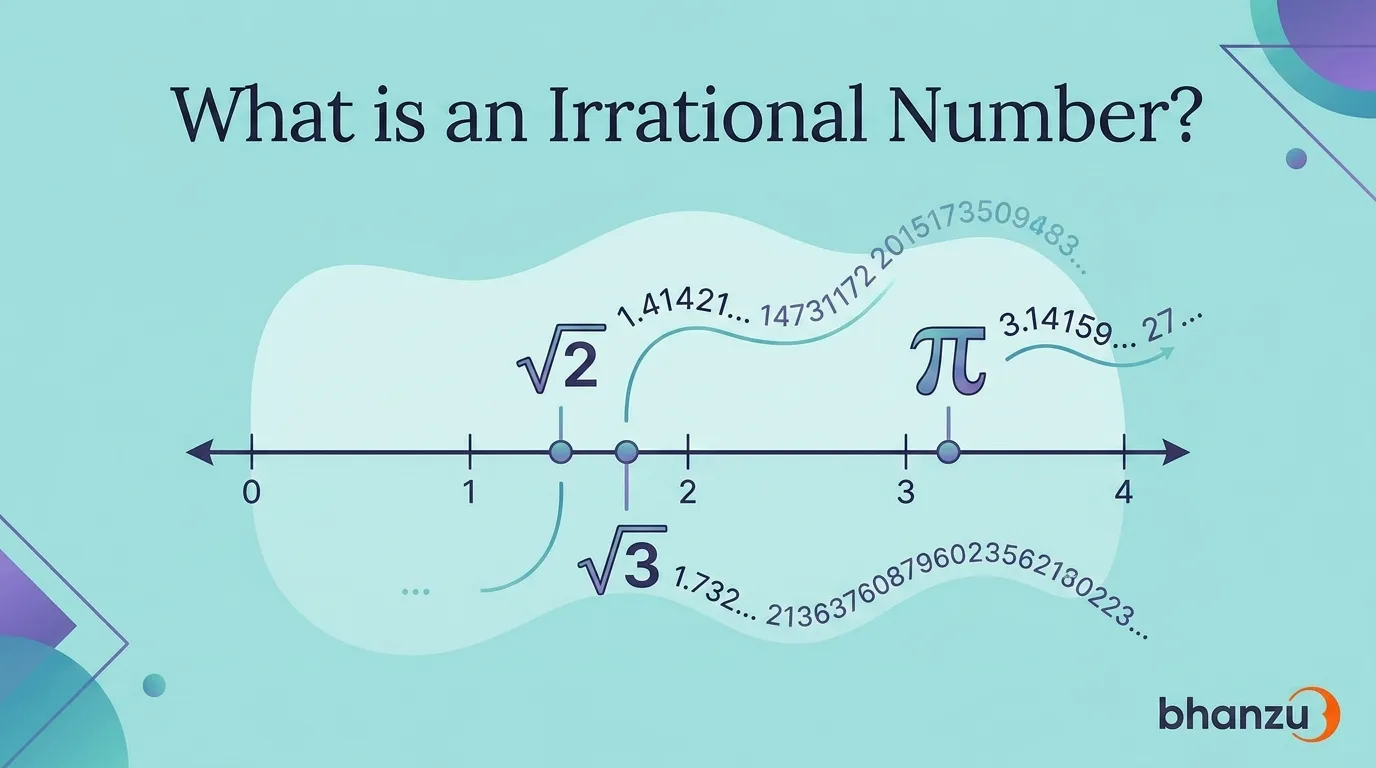
The idea: this one is memory, not math — but pi shows up often enough in middle-school geometry to earn a slot. Count the letters in each word of "How I wish I could calculate pi": 3, 1, 4, 1, 5, 9, 2 — that is 3.141592. (Grade 6+, ★)
Which Trick Should Your Child Learn At Which Grade?
# | Trick | Grade | Difficulty |
|---|---|---|---|
1 | Round-and-adjust addition | 3+ | ★ |
2 | Left-to-right addition | 4+ | ★ |
3 | Break-apart addition | 3+ | ★ |
4 | Subtract from a power of 10 | 4+ | ★★ |
5 | Distance subtraction | 3+ | ★ |
6 | ×11 (two-digit) | 4+ | ★ |
7 | ×5 | 3+ | ★ |
8 | ×9 | 3+ | ★ |
9 | Square numbers ending in 5 | 5+ | ★★ |
10 | × close to 100 | 6+ | ★★★ |
11 | Halve-and-double | 4+ | ★★ |
12 | ×25 (think in quarters) | 5+ | ★★ |
13 | Cross-multiplication | 7+ | ★★★ |
14 | Divisibility rules | 3+ | ★ |
15 | ÷5 | 4+ | ★ |
16 | ÷25 | 5+ | ★★ |
17 | Square numbers near 50 | 7+ | ★★★ |
18 | Estimate square roots | 6+ | ★★ |
19 | Square numbers near 100 | 7+ | ★★★ |
20 | Pi mnemonic | 6+ | ★ |
What Mistakes Do Kids Make With Math Tricks?
A trick learned the wrong way is just a faster way to be wrong. Four patterns show up again and again.
Using the trick before the standard method is fluent. A child who has not internalized why ×11 works cannot extend it, so they ace two-digit problems and break on the first three-digit one. The test is simple: ask them why the trick works, not what the steps are. If they can only recite steps, the foundation is not there yet.
Picking the wrong trick for the number. The near-100 method is fast for 98 × 94 and painful for 65 × 42. Every trick has a range, and knowing which one fits the problem in front of you is the hardest part to teach.
Confusing two similar tricks. The "ending in 5" square and the "near 50" square often get taught the same week, so a child applies the wrong one, gets a wrong answer, and decides the trick "doesn't work." It does — they used the other one. Most early errors here come from mismatching method to number, not from the algebra.
Rushing past the carry. Both ×11 and cross-multiplication need a carry when an intermediate result passes 9, and the fastest students are often the ones who drop it. Writing the carry above the digit before moving on costs half a second and saves the answer.
When Do Math Tricks Fail — And What Then?
Tricks fail in three predictable places, and none of them is a reason to avoid tricks — only a reason to keep them second.
They fail when the shape of the problem changes: ×11 for two digits is not ×11 for three, and squaring near 100 stops being clean past 110. Recognizing the boundary is the real skill, and most trick lists never show where it is.
They fail when the work has to be shown. A child who reaches the right answer by a one-line shortcut but cannot reconstruct the standard steps can lose marks for "no method shown" — many school and board exams require the working, not just the result.
And they fail when the child does not recognize which trick applies — the deepest failure mode, and one no shortcut can fix. That recognition comes from doing many problems the standard way first, then layering tricks on top. The fix in every case is the same: build the standard method to fluency, and use the trick as an accelerator on top of it, never as a replacement.
How Does Bhanzu Teach Mental Math?
Bhanzu does not lead with tricks. It leads with the handful of ideas that generate them — place value, the distributive law, doubling and halving, and the (a+b)2 and (a+b)(a-b) identities — because a child who owns the idea gets the trick for free.
A student who genuinely understands that 9 = 10 - 1 can derive the ×9 shortcut themselves, and then ×99, ×999, and ×19, without being taught each one. That is the difference between memorizing twenty tricks and understanding the four or five ideas underneath all of them: the tricks become by-products, and the speed arrives on its own.
That is the whole method in one line — why before what and how. Every Bhanzu student starts at Level 0, the level where their understanding genuinely sits rather than their grade label, and builds up from there in live, small-group classes led by trained instructors. To see how it looks for your child, you can book a free demo class and watch the ideas taught before any shortcut.
Conclusion
Math tricks are shortcuts built on number patterns, and the twenty here are really five ideas — place value, the distributive law, doubling and halving, the square identities, and complements — reused.
Taught idea-first, each trick is a window into a concept a child can extend and even reinvent; taught as a recipe, it breaks the moment the numbers change.
Tricks help most on timed tests, estimation, and confidence, and hurt only when they replace the standard method instead of riding on top of it.
Build fluency with the standard method first, add two or three grade-appropriate tricks at a time, and always ask "why does this work?" before "what are the steps?"
To build the understanding that makes every shortcut make sense, explore Bhanzu's math programs for kids or a math tutor who teaches the idea before the shortcut.
Was this article helpful?
Your feedback helps us write better content