A rational number is any number that can be written as p/q, where p and q are integers and q ≠ 0. Examples include 1/2, -3/4, 0.75, 5, and 0. The set of all rational numbers is denoted by the symbol Q.
Where the word came from
"Rational" entered mathematical English in 1570 — almost a century before "ratio" took its modern meaning in 1660. The word came from translations of Euclid, where the Greeks used ἄλογος ("not to be spoken about") for irrational lengths the Pythagoreans refused to call numbers. So the etymology runs the opposite way to what most people assume: ratio came from rational, not the other way around.
Formal Definition and Notation
A rational number is a number of the form p/q, where p and q are integers and q is not equal to zero.
p/q, where p and q ∈ Z and q ≠ 0
Symbol | Meaning |
|---|---|
p | Numerator (any integer) |
q | Denominator (any non-zero integer) |
Q | The set of all rational numbers |
Z | The set of all integers |
≠ | Not equal to |
The denominator cannot be zero. Division by zero is undefined in mathematics, so any expression with zero in the denominator has no value.
Examples of Rational Numbers
Rational numbers appear in several familiar forms:
Whole numbers and integers
5 = 5/1
-3 = -3/1
0 = 0/1
Common fractions
1/2, -3/4, 7/9
Terminating decimals
0.75 = 3/4
2.5 = 5/2
0.125 = 1/8
Repeating decimals
0.333... = 1/3
0.272727... = 3/11
0.142857142857... = 1/7
Every integer, every terminating decimal, and every repeating decimal is a rational number.
Types of Rational Numbers
Rational numbers split into four basic categories:
Positive rational numbers — numerator and denominator share the same sign. Examples: 4/7, -3/-5 (which equals 3/5).
Negative rational numbers — numerator and denominator have opposite signs. Examples: -2/5, 7/-9.
Zero — neither positive nor negative. Zero can be written as 0/n for any non-zero integer n: 0/1, 0/2, 0/-7. Zero is rational.
Standard form — a rational number is in standard form when its numerator and denominator share no common factor other than 1, and the denominator is positive. Example: 18/-24 simplifies to -3/4 in standard form.
How to Identify a Rational Number: The Decimal Test
A number is rational if it can be written as p/q with integers and q ≠ 0. For numbers given in decimal form, three rules cover every case:
If the number is already a fraction with an integer numerator and a non-zero integer denominator — it's rational.
If the decimal terminates (ends after a finite number of digits, like 0.75 or 2.125) — it's rational.
If the decimal goes on forever but repeats a fixed pattern (like 0.333... or 0.272727...) — it's rational.
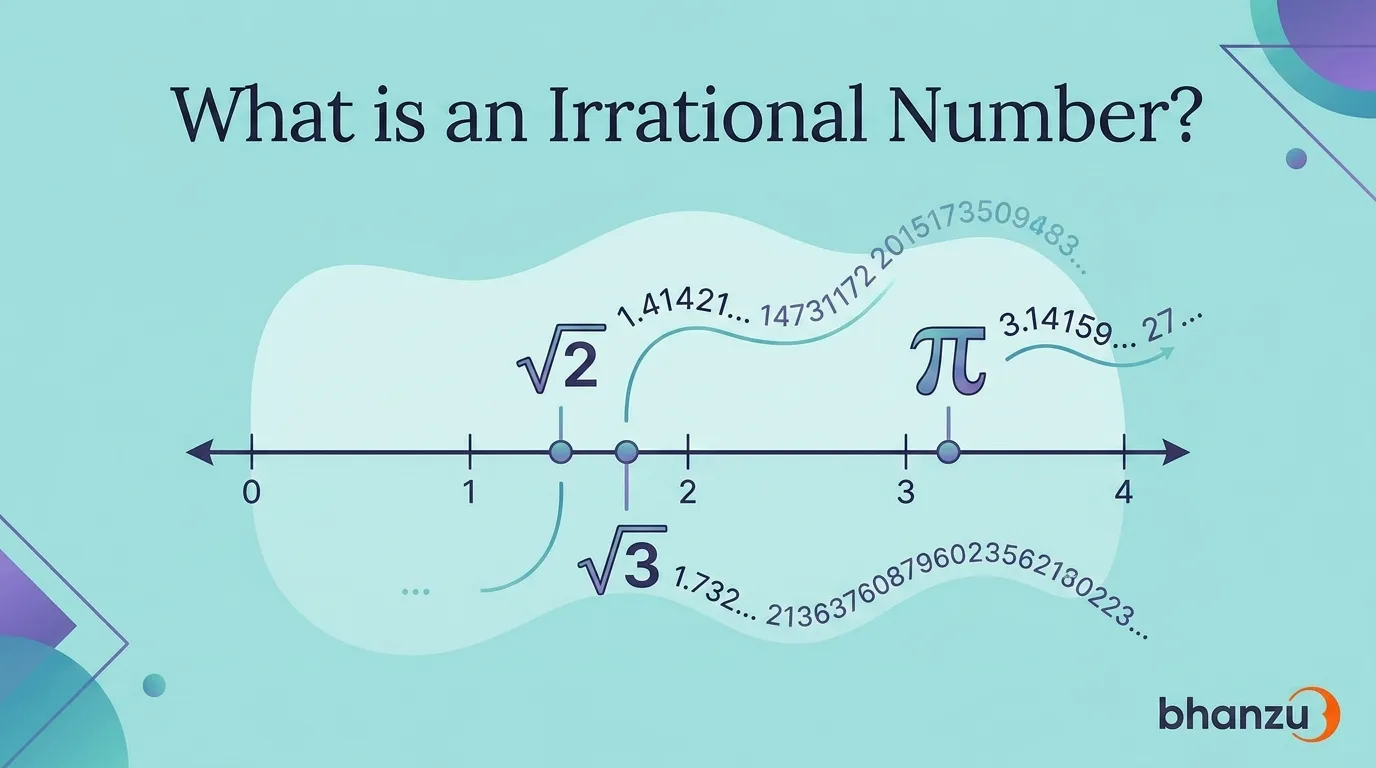
If the decimal goes on forever with no repeating pattern — like π = 3.14159265... or √2 = 1.41421356... — the number is irrational, not rational.
Worked example: convert 0.272727... to a fraction.
Let x = 0.272727...
Multiply both sides by 100 (the repeating block is 2 digits): 100x = 27.272727...
Subtract the original equation: 100x − x = 27.272727... − 0.272727... 99x = 27 x = 27/99 = 3/11
So 0.272727... = 3/11, confirming it is rational.
Rational Numbers vs Other Number Types
Rational numbers contain several smaller number sets and sit inside a larger one. The relationships are summarised below:
Number Type | Definition | Examples | Is It Rational? |
|---|---|---|---|
Natural numbers | Counting numbers from 1 onward | 1, 2, 3, 4… | Yes |
Whole numbers | Natural numbers and 0 | 0, 1, 2, 3… | Yes |
Integers | Whole numbers and their negatives | …−2, −1, 0, 1, 2… | Yes |
Fractions | Whole-number numerator over whole-number denominator | 3/4, 5/8 | Yes (subset) |
Rational numbers | Any p/q with p, q integers and q ≠ 0 | 1/2, −3/4, 0.75, 0.333… | Yes (by definition) |
Irrational numbers | Cannot be written as p/q | π, √2, e | No |
Real numbers | Rational and irrational together | All numbers on the number line | Includes rationals |
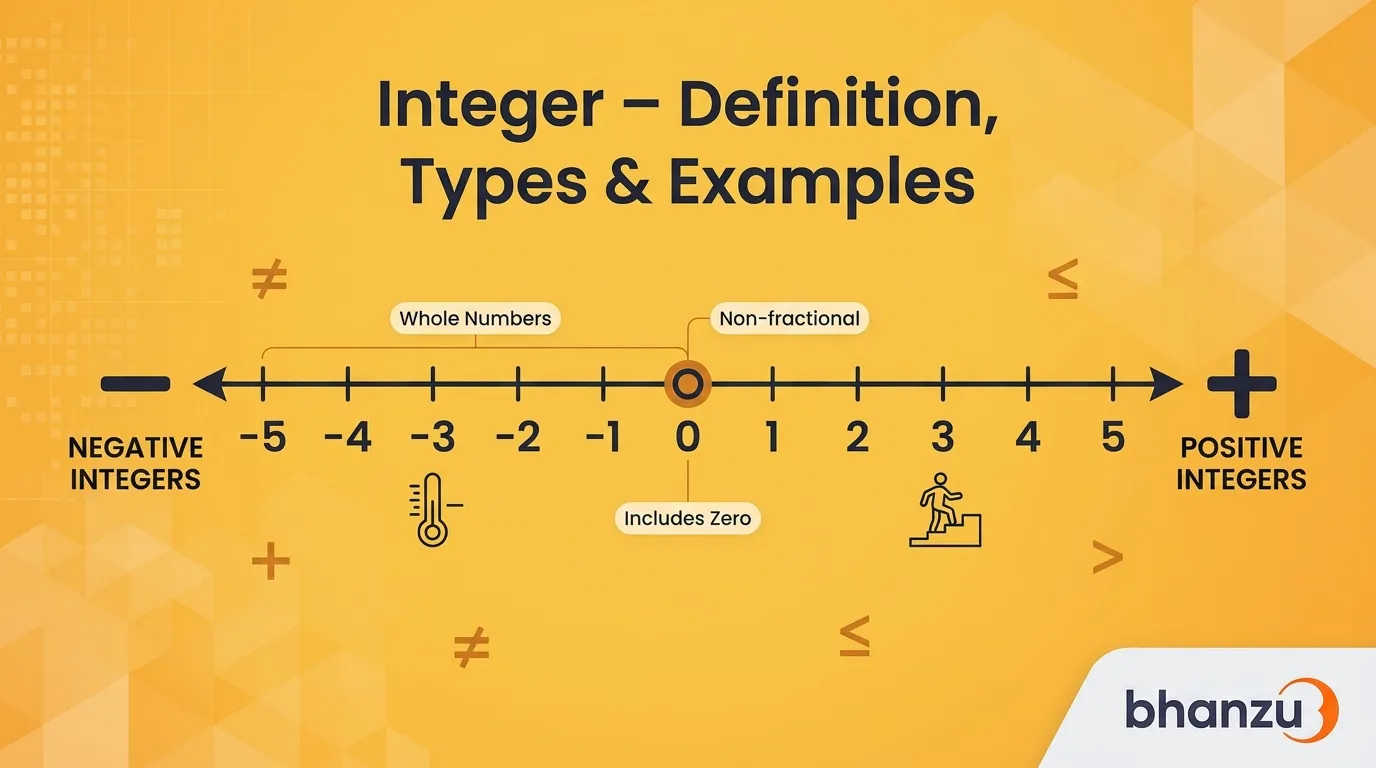
Every natural number is whole. Every whole number is an integer. Every integer is rational. The reverse is not true: not every rational number is an integer, and not every real number is rational.
Properties of Rational Numbers
Rational numbers behave consistently under the four arithmetic operations.
Closure properties
Operation | Closed? | Example |
|---|---|---|
Addition | Yes | 1/2 + 1/3 = 5/6 |
Subtraction | Yes | 1/2 − 1/3 = 1/6 |
Multiplication | Yes | 1/2 × 1/3 = 1/6 |
Division (by non-zero) | Yes | 1/2 ÷ 1/3 = 3/2 |
The result of any of these four operations on two rational numbers is always another rational number — provided the divisor is not zero.
Other key properties
Commutative under addition and multiplication
Associative under addition and multiplication
Additive identity: 0 (since p/q + 0 = p/q)
Multiplicative identity: 1 (since p/q × 1 = p/q)
Additive inverse: −p/q for every p/q
Multiplicative inverse: q/p for every non-zero p/q
Density property: Between any two rational numbers, there are infinitely many rational numbers. This is why the rationals feel like they fill the number line — though they do not. Irrational numbers fill the gaps that rationals leave behind.
Rational vs Irrational Numbers
Feature | Rational Numbers | Irrational Numbers |
|---|---|---|
Form | Can be written as p/q | Cannot be written as p/q |
Decimal expansion | Terminates or repeats | Never terminates and never repeats |
Examples | 1/2, 0.75, 0.333…, 5 | π, √2, √3, e |
Symbol | Q | Real numbers minus Q |
A common point of confusion: students often assume any number under a radical sign is irrational. But √4 = 2, which is rational. √9 = 3 is rational. The radical sign is not the test. The decimal expansion is. For more on numbers like π and √2, see the Wolfram MathWorld entry on irrational numbers.
Common Confusions
Four mix-ups appear regularly when students first work with rational numbers:
"All fractions are rational, so all rational numbers are fractions." Not quite. Fractions in school texts traditionally use whole numbers in the numerator and denominator. Rational numbers allow integers — including negatives. So −3/4 is rational, but it is not always classified as a fraction in elementary materials.
"A radical sign means the number is irrational." Wrong. √4 = 2 is rational. √9 = 3 is rational. Only roots of non-perfect squares (like √2, √3, √5) are irrational.
"All decimals are rational numbers." Wrong. Terminating and repeating decimals are rational. Non-terminating, non-repeating decimals (like π = 3.14159265…) are irrational.
"Zero is not rational because zero cannot be a denominator." Zero cannot be a denominator. But zero can be a numerator: 0 = 0/1, 0/2, 0/-7. Zero is rational.
For practice problems on rational numbers — including addition, subtraction, multiplication, division, and number-line representation — the topic is covered in NCERT Class 8 Chapter 1 and Common Core State Standards 6.NS.C.6.
Was this article helpful?
Your feedback helps us write better content