What Is an Equation in Math?
An equation in math is a mathematical statement that two expressions have the same value, written with an equals sign () between them. The expression on the left is the left-hand side (LHS); the one on the right is the right-hand side (RHS).
$$\underbrace{3x + 5}{\text{LHS}} ;=; \underbrace{14}{\text{RHS}}$$
An equation is a claim — it says these two things are equal. Solving the equation means finding the value (or values) of the variable that make the claim true. In , the variable must equal — because . Any other value of makes the claim false.
The defining feature of an equation is the equals sign. Drop it, and you have an expression, not an equation — and expressions can be simplified, but cannot be solved.
The Parts of an Equation
Every equation is built from the same small set of pieces. Once you can name each piece, every equation looks the same regardless of how complex it gets.
Take this equation:
The parts are:
Variable — the letter standing for an unknown number. Here, .
Constant — a fixed number with no variable attached. Here, the on the left and on the right are constants.
Coefficient — the number multiplying a variable. In , the coefficient is . In , the coefficient is .
Term — each separate piece added or subtracted. The LHS has three terms: , , and . The RHS has one term: .
Operators — the symbols indicating operations: , , , , exponents.
Equals sign — the separating the two sides. Without it, the line is an expression, not an equation.
Left-hand side (LHS) — everything to the left of the equals sign. Here, .
Right-hand side (RHS) — everything to the right. Here, .
Solution — the value(s) of the variable that make the LHS equal the RHS. Solving this equation requires moving everything to one side and applying the quadratic formula.
The Seven Main Types of Equations
Equations get classified by what kinds of operations and powers appear in them. Here are the seven types every algebra student should be able to recognise.
1. Linear Equation
A linear equation has the variable raised only to the first power. General form in one variable:
Example: . The graph is a straight line. Linear equations have exactly one solution.
2. Quadratic Equation
A quadratic equation has the variable raised to the second power as its highest term. General form:
Example: . The graph is a parabola. Quadratic equations have up to two solutions.
3. Polynomial Equation
A polynomial equation has the variable raised to non-negative integer powers, with the highest power being any positive integer. General form (degree ):
Linear and quadratic equations are special cases of polynomial equations (degree 1 and 2). Cubic () and quartic () equations also have closed-form solution formulas; degree-5 and higher generally do not.
4. Rational Equation
A rational equation has variables in the denominator of a fraction. Example:
Solve by multiplying through by the common denominator. Watch for extraneous solutions — values that make a denominator zero must be excluded.
5. Radical Equation
A radical equation has the variable inside a square root, cube root, or higher root. Example:
Solve by isolating the radical and then raising both sides to the appropriate power. Always check the answer — squaring both sides can introduce solutions that don't satisfy the original equation.
6. Exponential Equation
An exponential equation has the variable in the exponent. Example:
Here, because . For more complex cases, take the logarithm of both sides.
7. Logarithmic Equation
A logarithmic equation has the variable inside a logarithm. Example:
Here, . Logarithmic and exponential equations are inverses of each other.
What Is the Difference Between an Equation and an Expression?
An equation has an equals sign. An expression doesn't. That's the whole distinction — but it has consequences students miss.
Feature | Expression | Equation |
|---|---|---|
Equals sign? | No | Yes |
Example | ||
What you can do | Simplify, evaluate, factor | Solve for the unknown |
Result | Another expression | A value (or set of values) |
Reads as | A phrase in math language | A sentence in math language |
Worked comparison.
Expression: . You can evaluate it at to get . You can simplify if combined with another expression. You cannot "solve" it — there's nothing to solve for.
Equation: . You can solve it: , . The equation makes a claim about ; the expression doesn't.
Common confusion. Students often try to "solve" — but there's no equation to solve. To solve, you need a second expression on the other side of an equals sign. Simplify an expression; solve an equation. Different verbs for different objects.
The same distinction in plain English: "the cost of three pencils plus a five-rupee notebook" is an expression. "The cost of three pencils plus a five-rupee notebook equals fourteen rupees" is an equation — and now you can ask what a pencil costs.
How Do You Solve an Equation?
Solving an equation means finding the value (or values) of the unknown that make the equation true. The general process boils down to four moves, repeated until the unknown sits alone on one side.
The four legal moves — each preserves equality:
Add the same quantity to both sides.
Subtract the same quantity from both sides.
Multiply both sides by the same non-zero quantity.
Divide both sides by the same non-zero quantity.
That's it. Every algebraic solving step is one of these four — or a combination.
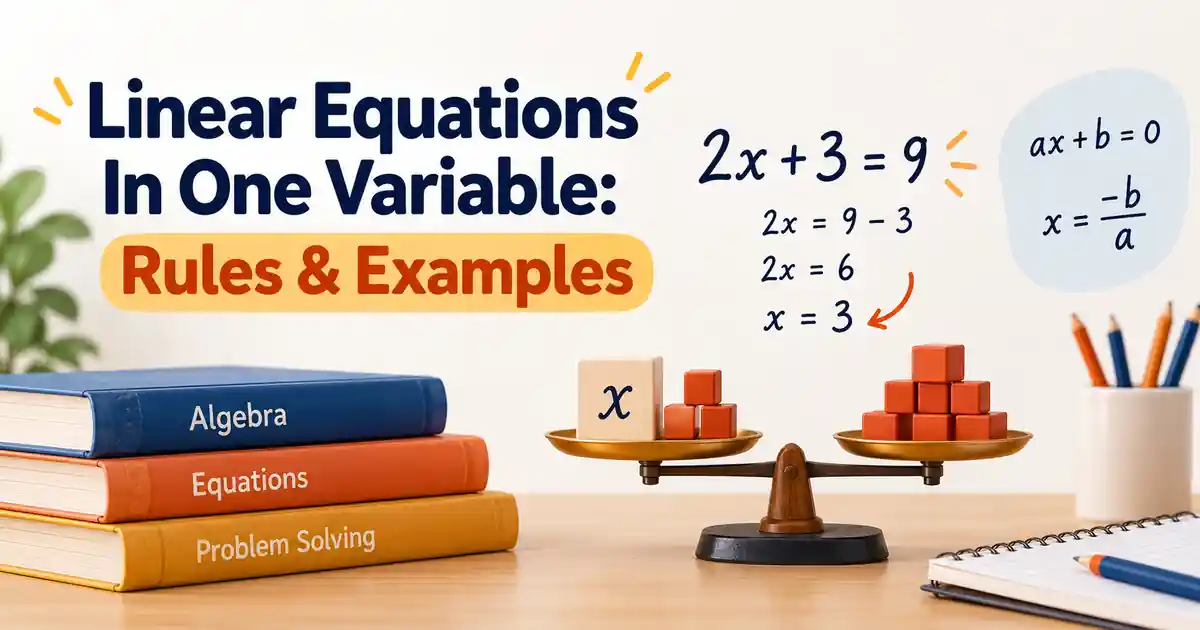
Worked example. Solve .
Step 1: Subtract from both sides → . Step 2: Add to both sides → . Step 3: Divide both sides by → . Step 4: Check. and ✓.
The order rule. Work from the outside in — undo the operations in the reverse of the order they were applied. If the unknown was first multiplied, then had a constant added, undo the addition first, then the multiplication. PEMDAS in reverse.
For non-linear equations. Quadratic equations use factoring, completing the square, or the quadratic formula. Logarithmic equations use the log properties to combine terms before applying the inverse. Radical equations require isolating the radical and squaring both sides (then checking for extraneous roots). The four moves above still apply — they just sit inside a longer procedure for the specific equation type.
A Worked Example — Wrong Path First
Solve: .
The intuitive (wrong) approach. A student in a hurry sees and tries to "deal with the first" — dividing both sides by before doing anything else.
The work goes nowhere useful — the equation isn't simpler, and the fractions make the next step harder.
Why it fails. Order of operations on the LHS is: multiply by , then add . To undo, reverse the order: subtract first, then divide by . This is the "wrap and unwrap" principle — the last thing done on the variable's side is the first thing you undo.
The correct method.
Step 1: Subtract from both sides.
Step 2: Divide both sides by .
Check: ✓.
The principle that matters across every equation in algebra: whatever you do to one side, you must do to the other. The equation is a balance scale — the moment the two sides stop being equal, you've lost the solution. At Bhanzu, our trainers walk through this wrong-path-first sequence intentionally, so the student feels the inefficiency before the correct order is introduced. The reasoning sticks because the alternative was tried.
Common Mistakes Solving Equations
Three failure modes dominate classroom errors when solving equations.
Mistake 1: Doing the same operation to only one side
Where it slips in: Multi-step solving where the student forgets that both sides must be treated identically.
Don't do this: , then writing (only subtracting from the LHS).
The correct way: Subtract from both sides: , giving . The rusher who skips writing out both sides often hits this mistake.
Mistake 2: Confusing equation with expression
Where it slips in: Treating as something to "solve" when there's no equals sign.
Don't do this: Asked to simplify , writing . There's no equation here — only an expression. Nothing to solve.
The correct way: Expressions get simplified, expanded, or factored. Equations get solved. If there's no equals sign, the answer is the simplified expression itself, not a value for . The memorizer who learned "x always has a value" often makes this slip.
Mistake 3: Squaring or multiplying out without checking
Where it slips in: Radical and rational equations, where squaring both sides or multiplying through can introduce false solutions.
Don't do this: , then squaring to get . But , not — the original equation has no real solution.
The correct way: After squaring (or any non-reversible operation), substitute every candidate back into the original equation and discard any that don't check. The second-guesser who senses something is off should trust that instinct and verify.
The Mathematicians Who Shaped the Equation
Diophantus of Alexandria (c. 200–c. 284 CE, Egypt/Greece) — The "father of algebra" in the Greek tradition. His thirteen-volume Arithmetica posed problems requiring the discovery of unknown numbers and developed the first systematic algebraic notation — though much of it was still written in words.
Muhammad ibn Musa al-Khwarizmi (c. 780–c. 850, Persia/Baghdad) — Gave the world the first systematic procedures for solving linear and quadratic equations, in his 9th-century book Al-Jabr wal-Muqābala. The word algebra comes from his title.
Robert Recorde (1510–1558, Wales) — Invented the equals sign in 1557, writing "a pair of parallels, or gemowe lines of one length, because no 2 things can be more equal." Before Recorde, mathematicians wrote "is equal to" in words every time.
René Descartes (1596–1650, France) — Standardised the modern notation for equations in his 1637 book La Géométrie — letters near the start of the alphabet () for constants, letters near the end () for unknowns, with superscript exponents like .
Four people across roughly 1,400 years built the compact, balanced statement we now call an equation.
A Practical Next Step
Try these three problems before going deeper into specific equation types.
Solve . (Linear; one step at a time.)
Solve by factoring. (Quadratic; find two numbers that multiply to 12 and add to .)
Solve . (Radical; isolate the root, then square — and check.)
If problem 2 felt tough, head to the Quadratic Equations article for the full solving toolkit. If problem 3 was tricky because of the check step, the Radical Equations section above is the part to re-read. Want to work through these with a live Bhanzu trainer? Book a free demo class — online globally.
Was this article helpful?
Your feedback helps us write better content