What Are Supplementary Angles?
Two angles are supplementary when their measures add to 180°:
When two supplementary angles share a side and a vertex, they form a straight line — and the pair is called a linear pair. When they don't share anything, they're still supplementary as long as their measures sum to 180° — they just don't look connected on a diagram.
For example:
and are supplementary (since ).
and are supplementary (two right angles).
and are supplementary.
alone is not supplementary to anything until you name a second angle.
The Four Properties of Supplementary Angles
Their sum is always exactly . This is the defining property. If the sum is anything else, the angles are not supplementary.
They can be adjacent or non-adjacent. Adjacent supplementary angles share a vertex and one side (they form a linear pair). Non-adjacent ones are simply two separate angles whose measures add to .
At least one of the two must be either obtuse or right. Because the two have to sum to :
Two acute angles can't reach (each is < , so sum < ).
The only ways to make : acute + obtuse, right + right, or — in a degenerate edge case — straight + zero.
Congruent Supplements Theorem. If two angles are each supplementary to the same third angle, then they are congruent to each other. In symbols: if and , then .
The Two Types of Supplementary Angles
Type 1 — Adjacent Supplementary Angles (Linear Pair)
When two supplementary angles share a vertex and one side, they sit next to each other and their outer rays form a straight line. This special arrangement is called a linear pair.
Every linear pair is supplementary. The converse isn't quite true — two supplementary angles drawn in separate places aren't a linear pair, even though they're still supplementary.
Real-world example: the two angles formed by an opening door against the doorframe. One side of the door and the doorframe form a straight line, and the door's interior angles on each side sum to .
Type 2 — Non-Adjacent Supplementary Angles
Two angles drawn anywhere — different corners of a figure, different problems on a worksheet, different sides of a transversal — are supplementary as long as their measures sum to .
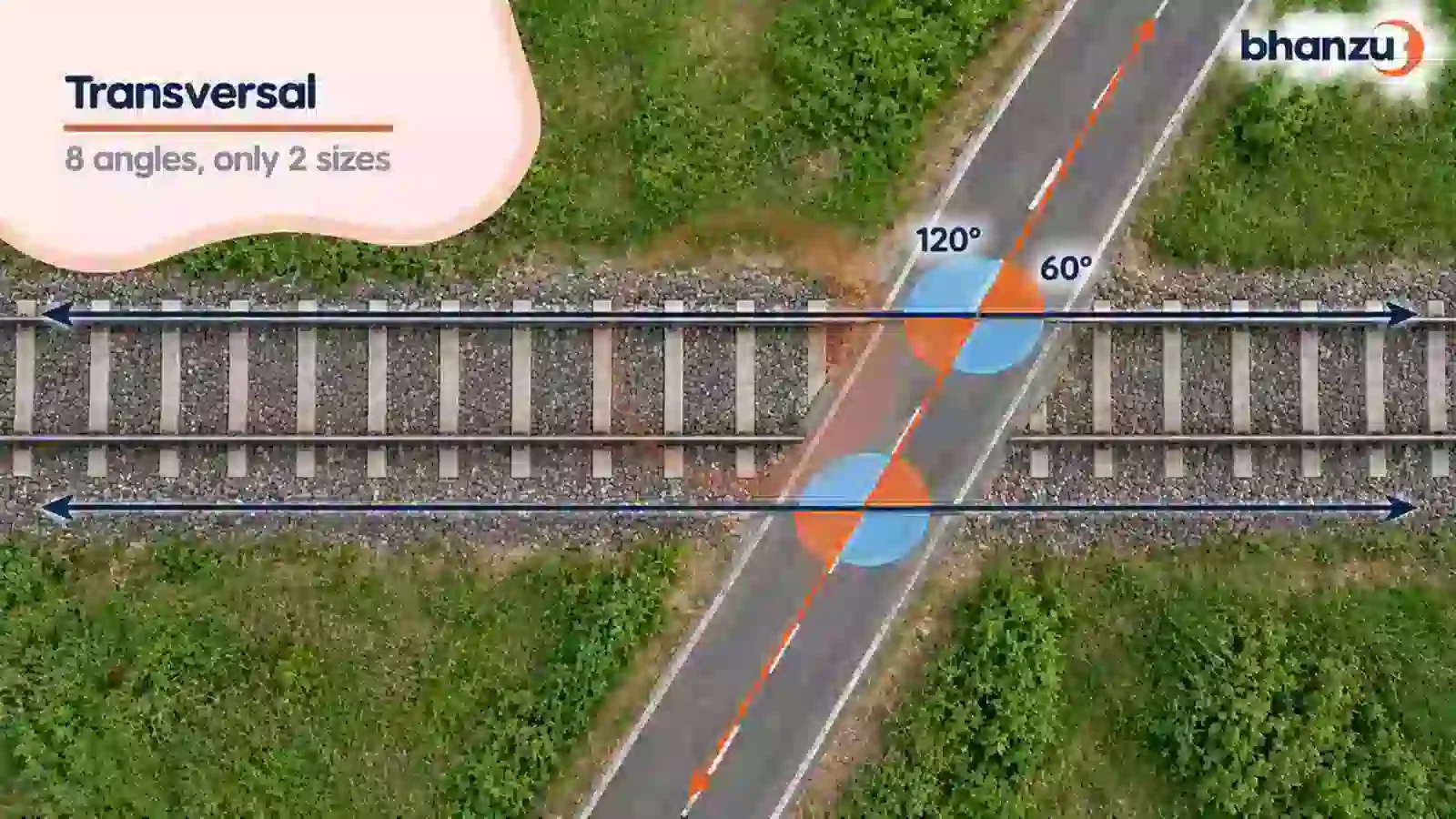
Common example: co-interior angles (also called consecutive interior angles) formed when a transversal crosses two parallel lines are always supplementary, even though they're not adjacent.
How to Find the Supplement of an Angle
Subtract the given angle from .
Given angle | Supplement |
|---|---|
An angle of exactly has no useful supplement (the "supplement" would be , which isn't a real angle). An angle greater than doesn't have a supplement at all in standard Euclidean geometry.
Three Worked Examples, From Quick to Stretch
Quick — Find the supplement
Find the supplement of .
Answer: the supplement is . Verify: ✓.
Standard — Algebraic supplement (Wrong Path Shown First)
Two supplementary angles have measures and . Find and both angles.
Wrong path. A student in a hurry sets the two expressions equal — "because both are angles in the same pair" — getting , which solves to . Plugging back gives both angles as — but , not . The setup was wrong.
Right path. Supplementary means the sum equals , not that the angles are equal:
So the first angle is and the second is . Verify: ✓.
Answer: ; the two supplementary angles are and .
Stretch — Linear pair with a perpendicular condition
Two angles form a linear pair. The larger angle is more than three times the smaller. Find both angles.
Let the smaller angle be . Then the larger is . Since they form a linear pair, they're supplementary:
So the smaller is and the larger is . Verify: ✓.
Answer: the two angles are and .
Where Supplementary Angles Show Up
Supplementary angles aren't just textbook geometry — they're everywhere two surfaces meet.
A door swinging open. The interior angle the door makes with the wall and the exterior angle on the other side are supplementary at every position of the swing.
Scissors and pliers. When the blades or jaws open, the two angles formed at the pivot — one above the pivot and one below — are supplementary.
Parallel-line geometry. When a transversal crosses two parallel lines, co-interior angles (on the same side of the transversal, between the parallel lines) are supplementary.
Polygon interior + exterior angle. At every vertex of a convex polygon, the interior angle and the exterior angle are supplementary — they form a linear pair along the side of the polygon.
Roof carpentry. A roof gable's interior angle and the angle between the roof slope and the horizontal (the eave angle) sum to when measured as a linear pair.
Hand position on a clock. The angle between the hour hand and 12 + the angle between the same hour hand and 6 always sums to — the hour hand splits the vertical diameter into a supplementary pair.
Common Errors When Working With Supplementary Angles
Mistake 1: Confusing supplementary with complementary.
Where it slips in: the two terms sound similar and are introduced together. Students mix them up under exam pressure.
The fix: memory anchor — S for Supplementary and S for Straight line (). C for Complementary and C for Corner (). Letter-to-shape mnemonic.
Mistake 2: Assuming supplementary angles must be adjacent.
Where it slips in: a problem gives two angles in different parts of a figure with measures and , and the student dismisses them as "not supplementary" because they aren't next to each other.
The fix: the only rule is sum equals . Location doesn't matter. Adjacent supplementary angles get a special name (linear pair), but the supplementary relationship holds for non-adjacent angles too.
Mistake 3: Setting two supplementary angles equal to each other.
Where it slips in: in algebraic problems where two angles are given as expressions in . Students set the expressions equal instead of setting their sum to .
The fix: supplementary means the sum is . Write the sum equation, not the equality. (See the Standard worked example above.)
Mistake 4: Forgetting that two acute angles cannot be supplementary.
Where it slips in: a problem says "both angles are acute and supplementary" — and the student tries to find values without recognising the contradiction.
The fix: two acute angles each measure < , so their sum < . They cannot be supplementary. A supplementary pair always has at least one angle that's .
Key Takeaways
Supplementary angles are two angles whose measures sum to exactly .
They can be adjacent (forming a linear pair — a straight line) or non-adjacent (anywhere on the page, as long as the sum is ).
At least one angle in any supplementary pair must be — two acute angles can't be supplementary.
The Congruent Supplements Theorem says angles supplementary to the same third angle are equal.
Real-world places: doors, scissors, parallel-line transversals, polygon vertices, clock hands.
Try It Yourself — Three Problems
Find the supplement of .
Two supplementary angles are given as and . Find and both angles.
In a linear pair, the larger angle is less than twice the smaller. Find both angles.
If problem 2 returned — two angles and , sum ✓ — you've got it. Want a Bhanzu trainer to walk through more angle-relationship problems? Book a free demo class — online globally.
Also Read:
Was this article helpful?
Your feedback helps us write better content
Frequently Asked Questions
What is the supplementary angle of ?
Can two angles be supplementary if both are obtuse?
Are all linear pairs supplementary?
Are all supplementary angles linear pairs?
What's the difference between supplementary and complementary angles?
Can three angles be supplementary?