What is a Whole Number?
A whole number is any number from the set W = {0, 1, 2, 3, ...}. The set includes zero and all positive integers, and excludes negative numbers, fractions, and decimals.
The smallest whole number is 0. There is no largest whole number, since the set extends without end. Every whole number has an immediate successor (the next whole number), and every whole number except 0 has an immediate predecessor.
A few quick examples:
Whole numbers: 0, 5, 28, 100, 9,999
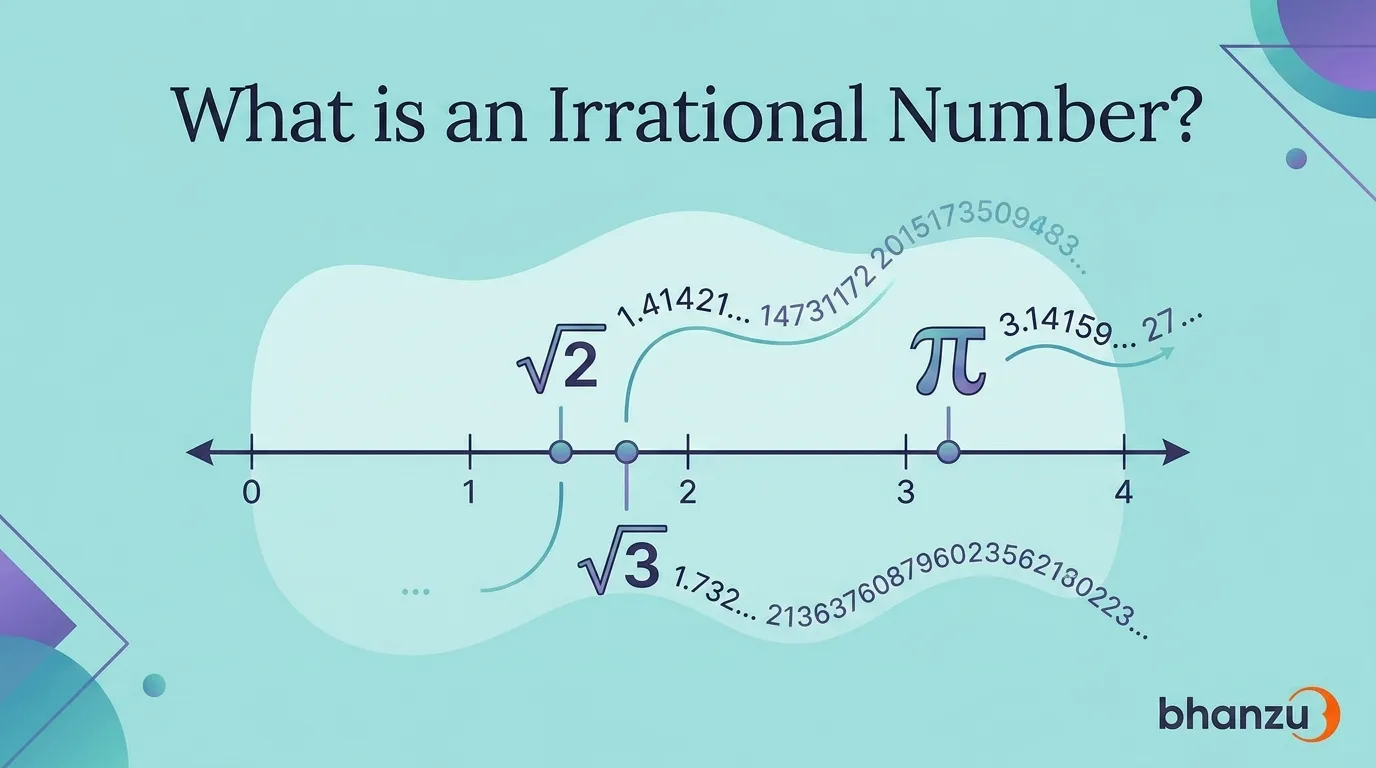
Not whole numbers: −7 (negative), 3/4 (fraction), 2.5 (decimal), √2 (irrational)
Symbol of Whole Numbers
W = {0, 1, 2, 3, 4, 5, ...}
The symbol W represents the set of all whole numbers. The three dots indicate that the set continues without end.
Whole Numbers on the Number Line
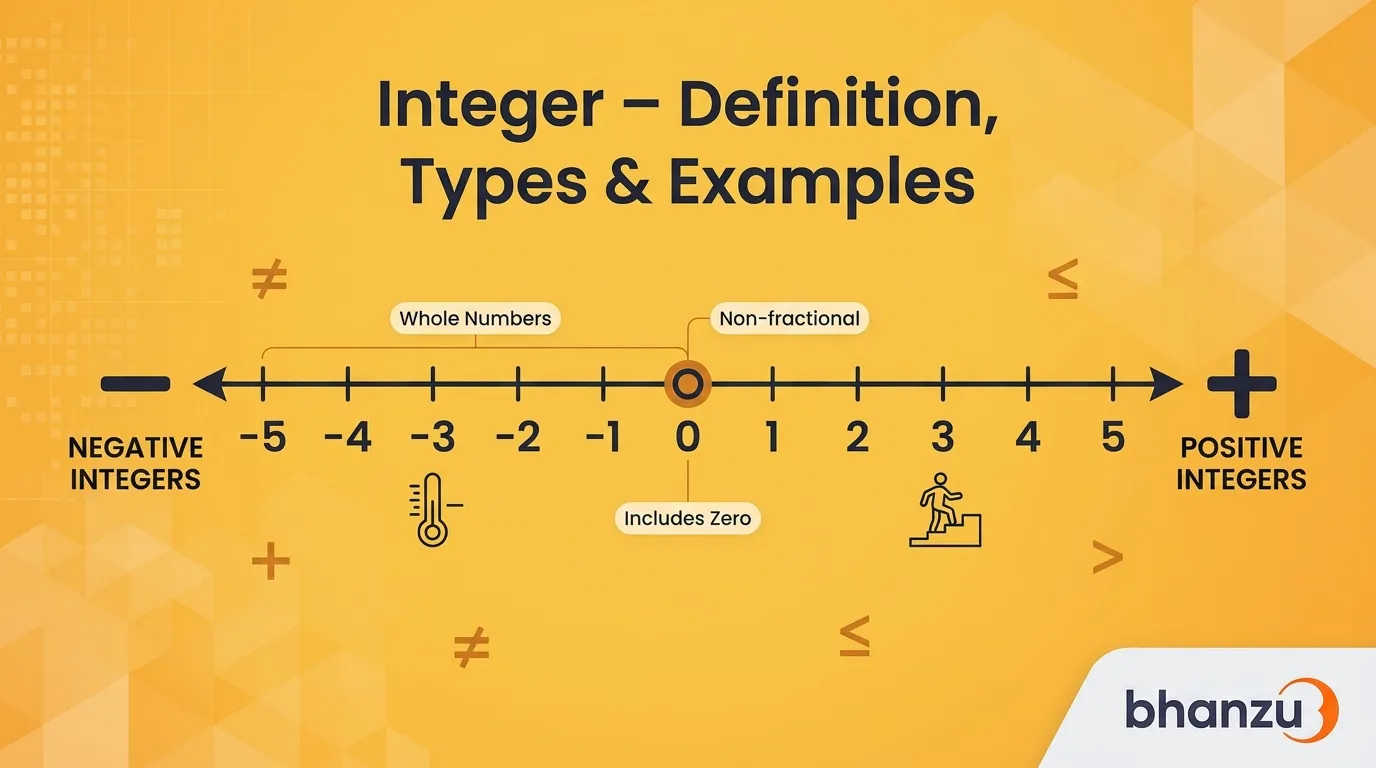
On a standard number line, whole numbers appear as evenly spaced points starting from 0 and moving rightward. Each successive point is one unit greater than the previous one. There are no whole numbers to the left of 0; that region of the number line contains negative integers.
A point on the number line is greater than every point to its left and smaller than every point to its right.
Whole Numbers vs Natural Numbers vs Integers vs Real Numbers
Whole numbers are one of several named number sets in mathematics. The four most commonly compared sets are listed below.
Set | Symbol | Includes | Excludes | Example Members |
|---|---|---|---|---|
Natural Numbers | N | 1, 2, 3, ... | 0, negatives, fractions, decimals | 1, 7, 42 |
Whole Numbers | W | 0, 1, 2, 3, ... | Negatives, fractions, decimals | 0, 7, 42 |
Integers | Z | ..., −3, −2, −1, 0, 1, 2, 3, ... | Fractions, decimals | −7, 0, 42 |
Real Numbers | R | All rational and irrational numbers | None on the standard number line | −3, 0, 1/2, π, √2 |
The four sets are nested. Every natural number is a whole number. Every whole number is an integer. Every integer is a real number. The reverse is not true: 0 is a whole number but not a natural number, and −5 is an integer but not a whole number.
Properties of Whole Numbers
Whole numbers obey five core properties under arithmetic operations: closure, commutativity, associativity, distributivity, and identity.
Closure Property
The sum or product of any two whole numbers is also a whole number. If a and b are whole numbers, then a + b and a × b are whole numbers.
For example, 4 + 9 = 13 and 6 × 7 = 42. Both are whole numbers.
Whole numbers are not closed under subtraction or division. 5 − 8 = −3, which is not a whole number. 7 ÷ 2 = 3.5, which is not a whole number either.
Commutative Property
The order of two whole numbers does not change the result of addition or multiplication. For any two whole numbers a and b, a + b = b + a, and a × b = b × a.
For example, 3 + 8 = 8 + 3 = 11, and 4 × 5 = 5 × 4 = 20.
Commutativity does not hold for subtraction or division. 9 − 4 ≠ 4 − 9, and 12 ÷ 3 ≠ 3 ÷ 12.
Associative Property
The grouping of whole numbers does not change the result of addition or multiplication. For any three whole numbers a, b, and c, (a + b) + c = a + (b + c), and (a × b) × c = a × (b × c).
For example, (2 + 3) + 4 = 2 + (3 + 4) = 9, and (5 × 2) × 6 = 5 × (2 × 6) = 60.
Associativity does not hold for subtraction or division.
Distributive Property
Multiplication distributes over addition (and over subtraction). For any three whole numbers a, b, and c, a × (b + c) = (a × b) + (a × c).
For example, 6 × (4 + 5) = (6 × 4) + (6 × 5) = 24 + 30 = 54.
This property is the basis for many mental-math shortcuts.
Identity Property
The additive identity for whole numbers is 0. The multiplicative identity is 1. For any whole number a, a + 0 = a, and a × 1 = a.
For example, 17 + 0 = 17, and 17 × 1 = 17.
Properties Summary
Property | Holds for + | Holds for × | Holds for − | Holds for ÷ |
|---|---|---|---|---|
Closure | Yes | Yes | No | No |
Commutative | Yes | Yes | No | No |
Associative | Yes | Yes | No | No |
A note on division by zero: division by 0 is undefined for whole numbers. 5 ÷ 0 has no defined value.
Examples of Whole Numbers
Whole numbers:
0
7
42
1,000
250,000
Not whole numbers, with reason:
−3 (negative)
1/2 (fraction)
0.7 (decimal)
π (irrational)
A note on trailing zeros: 5.000 equals 5, which is a whole number. Trailing zeros after a decimal point don't change the value of the number. By contrast, 5.0001 is not a whole number, because the 1 in the fourth decimal place gives it a non-zero fractional component.
First 20 Whole Numbers
0, 1, 2, 3, 4, 5, 6, 7, 8, 9, 10, 11, 12, 13, 14, 15, 16, 17, 18, 19
The set continues without end. There is no largest whole number.
Common Confusions
Three errors appear repeatedly in how whole numbers get described.
The first: that whole numbers are the same as integers. They aren't. Integers include negative numbers; whole numbers don't. Whole numbers are a subset of integers. Every whole number is an integer, but not every integer is a whole number.
The second: that 0 is not a whole number. This appears in some older US textbooks but is not the modern standard. NCERT, the Common Core State Standards, and ISO 80000-2 all define 0 as a whole number. The modern global definition includes 0.
The third: that 5.000 is not a whole number because it has decimal places. 5.000 equals 5. Trailing zeros after a decimal point don't change the value. 5.000 is a whole number. 5.0001 is not.
Where Whole Numbers Appear in the Curriculum
Whole numbers are introduced early in most curricula and revisited as the foundation for arithmetic operations and the integer set.
NCERT Class 6, Chapter 2 introduces whole numbers formally in the Indian curriculum, covering definition, the number line, properties, predecessor, and successor.
CCSS K.CC.A.3 covers counting and writing whole numbers up to 20 (US, kindergarten).
CCSS 6.NS.B.4 covers finding GCF and LCM of whole numbers and applying the distributive property (US, Grade 6).
The whole-number set underpins place value, the standard arithmetic operations, and the introduction of integers in later grades.
A Brief Note on the History of Zero
The concept of zero as a number, not just a placeholder, was formalised in India around the 5th century. The mathematician Brahmagupta, writing in the 7th century, recorded the first known rules for arithmetic with zero, including the rule that any number multiplied by zero is zero.
Before zero was treated as a number, the set {1, 2, 3, ...} was sufficient for counting. Adding zero to this set gave mathematicians a way to express "nothing" as a quantity. That set, the natural numbers plus 0, is what we now call the whole numbers.
Related Mathematical Terms
Term | Meaning | Relationship to Whole Numbers |
|---|---|---|
Natural Numbers | The counting numbers: 1, 2, 3, ... | All natural numbers are whole numbers. 0 is not a natural number. |
Integers | All positive numbers, negatives, and 0 | All whole numbers are integers. Integers also include negatives. |
Even Whole Numbers | Whole numbers divisible by 2 | A subset: 0, 2, 4, 6, 8, ... |
Odd Whole Numbers | Whole numbers not divisible by 2 | A subset: 1, 3, 5, 7, 9, ... |
Successor | The whole number immediately after a given one | The successor of n is n + 1 |
Predecessor | The whole number immediately before a given one | The predecessor of n is n − 1. 0 has no predecessor in W. |
Was this article helpful?
Your feedback helps us write better content