Solving an equation is just nine rules applied in sequence — and the same nine rules underpin every algebraic proof ever written.
The properties of equality are the formal rules that govern what you can do to an equation while keeping the equation true. There are nine of them — three relational properties (reflexive, symmetric, transitive), six operational properties (addition, subtraction, multiplication, division, substitution, and the square-root property).
Every algebra step you have ever taken — "add 3 to both sides", "divide by 2" — is one of these properties being applied. They are the axioms that make algebra trustworthy.
The Nine Properties — Definitions and Symbolic Statements
1. Reflexive Property of Equality. Any quantity equals itself.
2. Symmetric Property of Equality. If , then .
If , then . Sounds trivial — it is the rule that lets you flip an equation around.
3. Transitive Property of Equality. If and , then .
This is the rule that lets you chain steps: if and , then .
4. Addition Property of Equality. If , then .
Add the same number to both sides — equation stays balanced.
5. Subtraction Property of Equality. If , then .
Subtract the same number from both sides.
6. Multiplication Property of Equality. If , then .
Multiply both sides by the same number.
7. Division Property of Equality. If and , then .
Divide both sides by the same non-zero number. The clause matters — divide by zero and the rule fails.
8. Substitution Property of Equality. If , then can replace (and vice versa) in any expression without changing the value.
If and we know , then . This is the rule that powers every "plug in" step.
9. Square Root Property of Equality. If , then (for real numbers).
The is essential — squaring loses sign information, so taking the root must recover both possibilities. This is also a one-way property when working with positive numbers only.
Three Problems, One Method
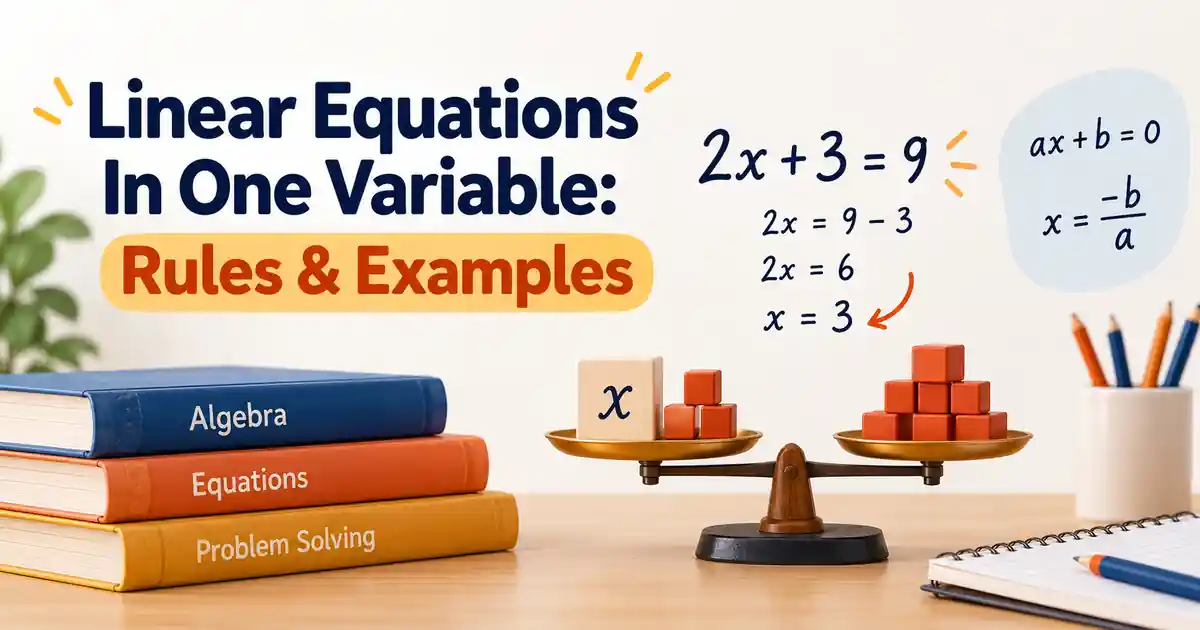
Quick. Solve and name the property used.
Subtract 5 from both sides:
Final answer: , by the Subtraction Property of Equality.
Standard (Wrong-Path-First). Solve .
Wrong path: the rusher divides everything by 3 first to "get rid of the coefficient":
Now subtract : .
The answer is correct. But the division step was applied to all terms — and the wrong-path version only divided some, leaving the equation as , which would give , a different (wrong) equation. The slip happens when "divide by 3" is applied to the leading term only, not to every term.
Correct path. Apply the Subtraction Property first, then the Division Property:
Step 1 — subtract 7 from both sides: .
Step 2 — divide both sides by 3: .
Final answer: .
In our Grade 7 cohort, the most common error on two-step equations is partial application of a property — students subtract 7 from the left side only, or divide just the term. The fix is to write the property as "do this to both sides" before applying any step.
Stretch. Use the properties of equality to prove: if , then .
Step 1 — Subtract from both sides (Subtraction Property):
Step 2 — Add 9 to both sides (Addition Property):
Step 3 — Divide both sides by 3 (Division Property):
Step 4 — By the Symmetric Property of Equality, . Final answer: .
The Quiet Reach of the Equality Properties
"Every line of algebra is one of nine moves."
The properties of equality are why algebra is trustworthy — they are the underlying axioms that justify every manipulation.
Computer algebra systems apply the properties as proof steps when verifying an identity. SymPy and Mathematica both store the property name alongside each step in their simplification logs.
Geometric proofs use the Reflexive, Symmetric, and Transitive properties as named reasons in two-column proofs — high school geometry courses require explicit citation of each property.
Engineering equation-solving. When a structural engineer solves a statics equation, the formal justification of every step traces back to these nine properties. The NIST Engineering Statistics Handbook explicitly references them in error-propagation derivations.
Programming languages. The equality operator in any language assumes the Reflexive, Symmetric, and Transitive properties — a language where could fail would be unusable.
The reason these axioms matter is that they license every algebraic move. Without them, "do the same thing to both sides" is a vague rule. With them, every step in every algebraic proof carries a named justification.
Common Errors When Applying Equality Properties
Mistake 1: Applying a property to only one side of the equation.
Where it slips in: multi-term equations where one side is more complex than the other.
Don't do this: "subtract 7" from by removing the from only the left side, writing .
The correct way: every property of equality says "do the operation to both sides". If you subtract 7 from the left, you must subtract 7 from the right. The result is , not .
Mistake 2: Dividing by zero or by an unknown that could be zero.
Where it slips in: equations with variables in the divisor, like .
Don't do this: divide both sides by to get . That loses the solution .
The correct way: the Division Property has a non-zero clause. If could be zero, the move is invalid. Solve by moving everything to one side: , factor , then or . The second-guesser will sometimes catch this; the rusher rarely does.
Mistake 3: Forgetting the when applying the Square Root Property.
Where it slips in: solving quadratics like .
Don't do this: write as the only answer.
The correct way: has two solutions: or . The Square Root Property says . The memorizer who learned "square root is the inverse of squaring" applies the inverse blindly and loses the negative solution. Same kind of slip that caused a missile guidance system in 1991 to lose 0.34 seconds of accumulated time — one missing sign or root in a long calculation, real-world consequences downstream.
Properties of Equality — Full Comparison Table
The nine properties of equality, side-by-side. Use this as a one-page reference when you need to name the property behind a step in a proof or a solve.
# | Property | Symbolic Statement | What It Lets You Do | Worked Snippet |
|---|---|---|---|---|
1 | Reflexive | State that any quantity equals itself. | ; . | |
2 | Symmetric | If , then | Reverse an equation without changing it. | If , then . |
3 | Transitive | If and , then | Chain equalities through a middle term. | If and , then . |
4 | Addition | If , then | Add the same number to both sides. | . |
5 | Subtraction | If , then | Subtract the same number from both sides. | . |
6 | Multiplication | If , then | Multiply both sides by the same number. | . |
7 | Division | If and , then | Divide both sides by the same non-zero number. | . |
8 | Substitution | If , then may replace in any expression | "Plug in" a known value anywhere it appears. | If and , then . |
9 | Square Root | If , then (reals) | Take the square root of both sides — recover both signs. | . |
How to use the table in practice. When justifying a step in a proof, point at the table — "divide both sides by 3, by the Division Property" — and the reader can verify the move against the formal statement without a digression. The table is also the structure to memorise; rote-learning the nine names without their symbolic statements is half-learning.
Two pairings worth noting: Addition and Subtraction are the same property in disguise (subtracting is adding ); Multiplication and Division are also a pair (dividing by is multiplying by ). Many textbooks collapse them to seven properties. Substitution is the most powerful of the nine — every "plug in" step in every algebra problem is the Substitution Property doing work.
Key Takeaways
The properties of equality are nine rules: reflexive, symmetric, transitive, addition, subtraction, multiplication, division, substitution, square-root.
Every algebraic move you make on an equation is one of these nine properties being applied to both sides.
The Division Property requires the divisor to be non-zero.
The Square Root Property always produces — squaring loses sign, so taking the root must recover both signs.
Real-world reach: computer algebra systems, geometric proofs, engineering derivations, the equality operator in every programming language.
Take the Equality Properties for a Test Drive
Solve and name the properties used at each step.
Use the properties of equality to prove: if , then .
Solve and state which property of equality justifies the in the answer.
If you get stuck on problem 2, distribute the on the left side first using the Distributive Property, then apply the equality properties to isolate . For more on the surrounding theory.
Was this article helpful?
Your feedback helps us write better content