A Quiet Rule That Holds a Bridge Together
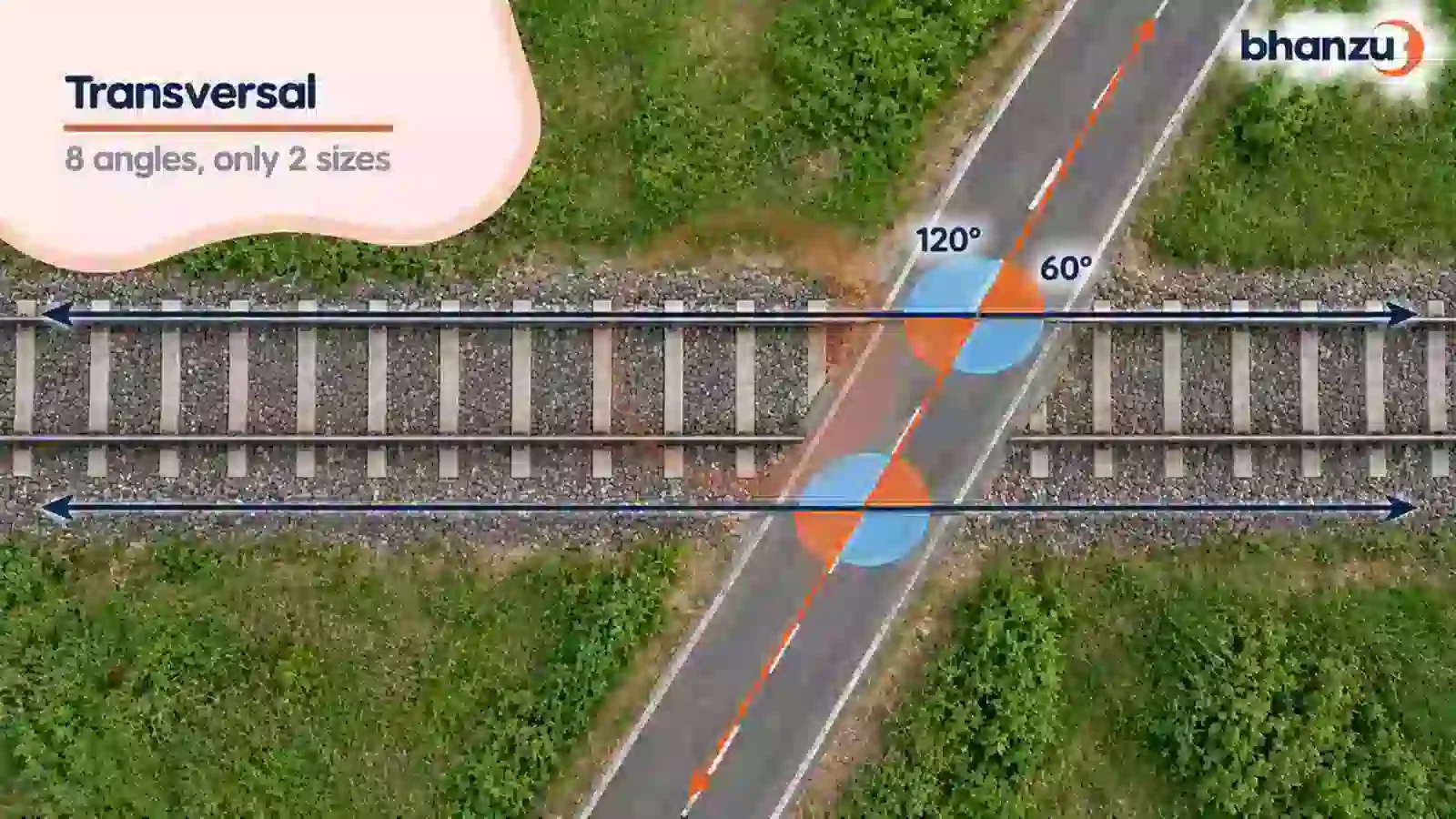
Two steel beams run dead parallel across a bridge deck, and a single diagonal brace cuts across both. The angle that brace makes with the top beam is copied, exactly, where it crosses the bottom one, even though the two crossings are metres apart. Nobody measured the second angle. A rule about alternate interior angles guaranteed it before a single bolt went in.
Once you see which angles count as alternate interior, the equality stops being a fact to memorise and becomes something you can read straight off the figure.
What Are Alternate Interior Angles?
Alternate interior angles are a pair of angles formed when a transversal crosses two lines, where both angles lie between the two lines (the interior region) and on opposite sides of the transversal. A transversal is simply a line that crosses two or more other lines at distinct points.
Two conditions have to hold together. Interior means the angle sits in the strip between the two lines, not above the top one or below the bottom one. Alternate means the two angles are on different sides of the transversal, one to its left and one to its right. Drop either condition and the pair is something else.
In the figure above, the two alternate interior pairs are ∠3 and ∠5, and ∠4 and ∠6. They form a recognisable Z-shape: trace the transversal and the two lines and a "Z" (or its mirror, "S") falls out, with the alternate interior angles tucked into the two inner corners.
The Alternate Interior Angles Theorem
Here is where the angle pair earns its keep. The Alternate Interior Angles Theorem states that if a transversal crosses two parallel lines, then each pair of alternate interior angles is congruent (equal in measure).
The parallel condition is not optional. If the two lines are not parallel, the alternate interior angles are generally unequal, and the theorem says nothing. This is the most important caveat in the whole topic, and it is the one students forget first.
A short proof makes the equality feel inevitable. When the lines are parallel, corresponding angles are equal (the same-position angles at each crossing). One of those corresponding angles is also vertically opposite an alternate interior angle, and vertical angles are equal. Chain the two equalities and the alternate interior pair must match.
The Converse — Using Equal Angles to Prove Lines Are Parallel
The theorem runs backwards too, and the reverse is genuinely useful. The converse states: if a transversal crosses two lines and a pair of alternate interior angles is equal, then the two lines are parallel.
So the angle pair is a two-way tool. Going forward, parallel lines give equal angles. Going backward, equal angles prove the lines are parallel. Carpenters, surveyors, and drafters lean on the converse constantly: measure two alternate interior angles, and if they match, the edges are parallel without ever extending them to check whether they meet.
How Do You Find Alternate Interior Angles?
A reader on a homework thread asked it plainly: how do you solve for alternate interior angles? The method is short.
Confirm the two lines are parallel (look for matching arrowheads on the figure, or it will be stated).
Locate the interior region, the strip between the two lines.
Find the two angles in that strip that sit on opposite sides of the transversal. That is your pair.
Set them equal and solve.
If the figure gives one angle as a number and the other as an expression in , the equation writes itself. Say one alternate interior angle is and its partner is . Because the lines are parallel:
Alternate Interior vs Co-Interior Angles
Both pairs live in the same interior strip, so they get confused, but they behave oppositely. Co-interior angles (also called same-side interior or consecutive interior angles) lie between the two lines on the same side of the transversal, and when the lines are parallel they are supplementary, they add to , they do not match.
Feature | Alternate interior angles | Co-interior angles |
|---|---|---|
Position | Between the lines, opposite sides of transversal | Between the lines, same side of transversal |
When lines parallel | Equal (congruent) | Supplementary (sum to 180°) |
Visual cue | Z-shape | C-shape or U-shape |
A reader question that comes up again and again: are alternate interior angles supplementary? No. When the lines are parallel they are equal, not supplementary. The supplementary pair is co-interior. Mixing the two is the single most common slip on this topic, and it has its own entry in the mistakes section below.
Examples of Alternate Interior Angles
With the definition, the theorem, and the co-interior contrast in place, here is the rule doing real work. The problems build from a direct read-off up to a converse check.
Example 1: Two parallel lines are cut by a transversal. One alternate interior angle measures . What is the measure of its alternate interior partner?
By the theorem, the lines are parallel, so the pair is equal. The partner measures .
Example 2: In a figure with two parallel lines and a transversal, one alternate interior angle is and its partner is . Find and the angle.
A first instinct is to set the two expressions to add to , treating them like the supplementary co-interior pair: , giving and . Check that against the rule. These are alternate interior angles, on opposite sides of the transversal, so they should be equal, not supplementary. The supplementary set-up is the wrong tool here.
The correct way sets them equal:
Each angle is . In Bhanzu's Grade 8 cohort at the McKinney TX center, this equal-versus-supplementary mix-up shows up in roughly four out of ten first attempts, almost always because the student did not first ask which side of the transversal each angle sits on.
Example 3: Lines and are parallel. An alternate interior angle is and the angle vertically opposite its partner is . Find .
Vertical angles are equal, so the partner alternate interior angle is also . Then , so and .
Example 4: Two alternate interior angles are and . The lines are not stated to be parallel. Can you find ?
No single value of follows unless the lines are parallel. If the problem intends them to be parallel, set the angles equal: , so and each angle is . Without the parallel condition, the theorem does not apply.
Example 5: A transversal cuts two lines. The alternate interior angles measure and , and the lines are parallel. Find each angle.
Set them equal: , so and . Each angle is .
Example 6 (converse): A transversal crosses lines and . Two alternate interior angles both measure . Are and parallel?
Yes. By the converse, equal alternate interior angles force the lines to be parallel. The equal pair is the proof; no further measurement is needed.
Why Alternate Interior Angles Show Up Everywhere
The reason this small rule keeps appearing is that parallelism is everywhere in built and natural structures, and the angle pair is the cheapest way to detect or guarantee it.
Proving lines parallel without extending them. Two lines might only meet kilometres away, or never. The converse lets a surveyor confirm parallelism from a single pair of measured angles on the ground.
Bridges and trusses. Diagonal braces cross parallel chords; the repeated equal angle keeps load paths predictable. An engineer one degree off on a brace angle changes how force travels through the whole frame.
Geometry proofs. Alternate interior angles are a workhorse step in proving the angle sum of a triangle is : drop a line through one vertex parallel to the opposite side, and the base angles reappear inside as alternate interior angles.
Drafting and design. Parallel rulers, set squares, and CAD constraints all encode the same equal-angle relationship so that parallel features stay parallel as a drawing is scaled.
For a Grade 8 student, this is the first place a theorem and its converse both pay off, which is why it anchors the parallel-lines unit before any harder proof arrives.
Where Students Trip Up on Alternate Interior Angles
Mistake 1: Treating the angles as supplementary instead of equal
Where it slips in: The student sees two angles in the interior strip and reaches for the "add to 180°" rule.
Don't do this: Write for an alternate interior pair.
The correct way: Check the side of the transversal first. Opposite sides means alternate interior, so the angles are equal. Same side means co-interior, so they are supplementary. The position decides the rule.
Mistake 2: Applying the theorem when the lines are not parallel
Where it slips in: A figure shows two lines that look roughly parallel but carry no parallel marks, and the student sets the alternate interior angles equal anyway.
Don't do this: Assume "looks parallel" means "is parallel."
The correct way: The theorem needs parallel lines. If the figure does not mark them parallel or state it, you cannot set the angles equal. The rusher, who skips straight to the equation, loses marks here more than anywhere else.
Mistake 3: Confusing alternate interior with corresponding or alternate exterior
Where it slips in: Four named angle pairs come from the same diagram, and the labels blur together.
Don't do this: Pick any two equal-looking angles and call them alternate interior.
The correct way: Alternate interior = between the lines, opposite sides of the transversal (Z-shape). Corresponding = same position at each crossing (F-shape). Alternate exterior = outside the lines, opposite sides. Read both conditions before naming the pair.
Key Takeaways
Alternate interior angles sit between two lines and on opposite sides of the transversal — the Z-shape pair.
When the two lines are parallel, alternate interior angles are equal; when the lines are not parallel, the theorem says nothing.
The converse runs backward: equal alternate interior angles prove the two lines are parallel.
Co-interior (same-side) angles are the supplementary pair that adds to — don't confuse it with the equal alternate pair.
Always confirm the lines are parallel and check which side of the transversal each angle sits on before writing an equation.
Practice These Problems to Solidify Your Understanding
Two parallel lines are cut by a transversal. One alternate interior angle is . Find its partner.
Lines are parallel; alternate interior angles measure and . Find and each angle.
A transversal cuts two lines and both alternate interior angles measure . Are the lines parallel? Why?
Answer to Question 1: . Answer to Question 2: , each angle . Answer to Question 3: Yes, by the converse, equal alternate interior angles force the lines to be parallel. If Question 2 gave a sum near , you used the co-interior rule by mistake (see Mistake 1).
Want a live Bhanzu trainer to walk your child through parallel lines and the alternate interior angles theorem? Book a free demo class — online globally.
Also Read:
Was this article helpful?
Your feedback helps us write better content