What Are the Five Types of Angles?
Angles are classified by how wide they open. The measurement runs from (no opening) to (a full turn). Five named regions partition that range:
Type | Measure | Quick visual | Real-world example |
|---|---|---|---|
Acute | A narrow wedge | Slice of pizza, half-open scissors | |
Right | exactly | An L-shape | Corner of a book, the letter T |
Obtuse | A wide wedge | Open laptop at reading angle | |
Straight | exactly | A flat line | A flat horizon, a fully opened book lying flat |
Reflex | The "outside" of a wedge | Hands of a clock at 7:00 reading the long way round |
Two more named values appear in textbooks as edge cases:
Zero angle — . The two rays sit on top of each other.
Full angle (complete angle) — . The two rays again sit on top of each other after one full turn.
These two are rarely the subject of a problem, but they make the classification complete.
How to Read an Angle Measurement
Every angle has two rays sharing a common endpoint, called the vertex. The measurement is how far one ray must rotate — counterclockwise, by convention — to land on the other.
A few habits make the reading reliable:
A right angle is the only angle marked with a small square at the vertex rather than an arc. If you see the square, the measure is exactly .
An arc with a single mark across it is the universal "this is an angle, measure me" symbol.
A reflex angle is usually drawn with the arc going the long way round — past . The same two rays can show an acute angle (the small arc) or a reflex angle (the large arc), depending on which arc the diagram marks.
The Five Types in More Detail
Acute Angle ()
An angle whose measure is strictly less than a right angle. Examples: , , , , .
Acute angles appear in equilateral triangles (every angle is ), in the steepness of a steep stair, and in the V-shape of a slightly opened pair of scissors. A line tilted just off vertical makes an acute angle with the floor.
Right Angle ( exactly)
The hinge angle of a doorframe, the corner of a square, the angle between the wall and the floor in any room built by code. The right angle is the most-used reference angle in geometry — it defines perpendicularity, drives the Pythagorean theorem, and anchors every coordinate system.
Obtuse Angle ()
Wider than a right angle, narrower than a straight line. Examples: , , , .
The roof pitch of a low-slope building, the angle between the legs of a "V" pose, the open-book angle when you're reading comfortably — all obtuse.
Straight Angle ( exactly)
When the two rays of the angle lie on a straight line, pointing in opposite directions, the angle is straight. A straight angle is exactly half a full turn.
A flat horizon at sea, the angle between the two halves of a fully opened book lying flat on a table, the angle marked at a point on a number line — all straight angles.
Reflex Angle ()
Reflex angles open more than half a full turn but less than a complete turn. Examples: , , , .
Reflex angles are easiest to spot as the "outside" of a more familiar angle: if an acute angle measures , the reflex angle on the other side of the same two rays measures . The pair always adds to .
Three Worked Examples, From Quick to Stretch
Quick. Classify the angle that measures .
is greater than and less than , so it is an .
Standard (Wrong path first). An angle and its reflex partner together complete a full turn. If the smaller angle of a pair measures , what is the measure of its reflex partner?
Wrong path. A first reaction is to subtract from : "well, supplementary angles add to , so ." But is acute — not a reflex angle. The smaller angle was already obtuse (), so its partner around the full turn must be more than . The error was reaching for supplementary (sum ) when the question is about reflex partner (sum ).
Correct path. The reflex partner is . Check: . The two angles together complete a full turn. Since , it is correctly a reflex angle.
Stretch. A clock reads 4:00 exactly. (a) What is the smaller angle between the hour hand and the minute hand? (b) What is its reflex partner? (c) Classify each.
The clock face is divided into hours, so each hour spans . At 4:00, the hour hand is on and the minute hand is on — a separation of hours.
(a) Smaller angle: . This is obtuse ().
(b) Reflex partner: . This is reflex ().
Check: . ✓
So at 4:00, the obtuse-and-reflex pair are and .
How Angle Types Combine — Pair Relationships
Two angles are often classified by what they add up to. These pair-names sit on top of the five types:
Complementary angles add to . Both must be acute (since two angles summing to are each less than ).
Supplementary angles add to . One is acute and one is obtuse; or both are right (). Never one straight and one zero — that is a degenerate edge case.
Linear pair — supplementary angles that share a side. The non-shared rays form a straight line.
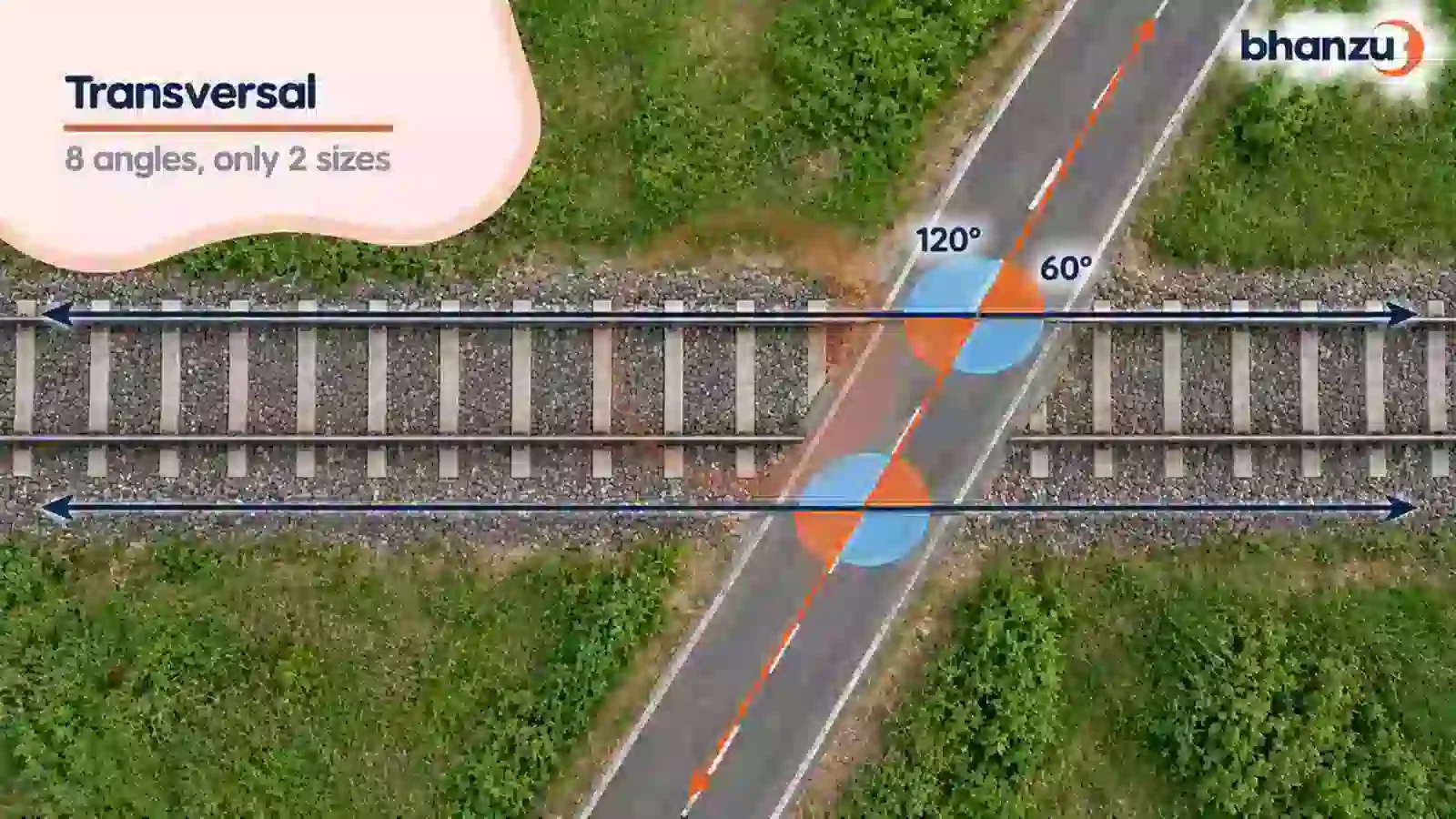
Vertical angles — opposite angles formed when two lines cross. Always equal in measure; their type depends on what they measure.
These pair names get a deeper treatment in our companion articles on complementary, supplementary, and vertical angles.
Where Each Angle Type Shows Up in the Real World
Acute — the keenest of the wedges. Pizza slices, the V of a bird's wing-tip, the steep face of a mountain ridge.
Right — every wall-floor join in standard construction, the corners of windows, screens, and most cards.
Obtuse — open laptops at reading position, a generous V-pose, the dihedral angles in many pavilion roofs.
Straight — horizons, the unfolded angle of a hinged plank lying flat.
Reflex — the angle a swinging door has gone past if it has swung beyond the wall behind it; the long-way-round arc between a clock's hands at, say, 7:00.
The right angle and the straight angle are the two most-cited because they appear in formulas — the Pythagorean theorem, supplementary-angle relationships, the angle sum of a triangle (which is exactly one straight angle, ).
Tripping Points to Avoid
1. Confusing acute with small.
Where it slips in: A student calls a tiny angle of "an acute angle" and a slightly opened angle of also "an acute angle" — and then assumes the two behave the same way in problems.
Don't do this: Treat acute as a synonym for tiny. An angle is acute by classification but is almost a right angle in feel.
The correct way: Acute is a range ( to ), not a size. Two angles can both be acute and still differ enormously.
2. Calling a angle "acute" or "obtuse."
Where it slips in: The strict inequalities matter. is not acute (acute is strictly less than ). is not obtuse (obtuse is strictly more than ).
Don't do this: Lump into the closer-feeling category.
The correct way: is a right angle. It is its own category, not an extreme of acute or obtuse.
3. Confusing reflex with obtuse — or with supplementary.
Where it slips in: A reflex angle is wider than . An obtuse angle is between and . The supplementary partner of an obtuse angle is the acute on the same side, not the reflex the long way around.
Don't do this: Subtract from when the question asks for the reflex partner. The reflex partner subtracts from .
The correct way: For complement → . For supplement → . For reflex partner → .
The Bhanzu Grade 5 cohort's most-frequent slip is the reflex–supplementary mix. The trainer's standard fix is to ask the student to draw the full circle before answering anything — the visual gap between and then shows itself.
Bhanzu's Approach to Angle Classification
In a Bhanzu Grade 5 geometry session, angle classification begins with a paper protractor activity, not a definition. Students place the protractor over a printed angle, read the measurement, and then place the angle in the right type bucket. Across cohorts since 2023, this measure-first habit cuts the misclassification rate by roughly half — students who first learn " is a right angle" by definition keep forgetting; students who first learn it by feel of the protractor remember.
Conclusion
The five named angle types — acute (), right (), obtuse ( and ), straight (), and reflex ( and ) — partition every angle from to .
A right angle is marked with a small square; every other type is marked with an arc.
Complementary angles sum to , supplementary to , reflex partners to .
The most common slip is treating as either acute or obtuse — it is its own category.
Acute angles include , , , , and any other measure strictly between and .
Practice These Three Before Moving On
Classify each: , , , , . (Answers, in order: acute, right, obtuse, straight, reflex.) Then draw each on paper, marking the arc. The drawing is the part that locks the type into memory.
Want a Bhanzu trainer to walk through more angle-classification problems with your child? Book a free demo class — live online globally.
Also Read:
Was this article helpful?
Your feedback helps us write better content
Frequently Asked Questions
What is the difference between an acute angle and a right angle?
Can an angle be both acute and obtuse?
How many degrees does an acute angle have?
What is the reflex of a right angle?
Are obtuse angles ever found in real triangles?
Why do we need so many angle types?
Is an angle?