What Are Adjacent Angles?
Two angles are adjacent when all three of the following are true:
They share a common vertex (the same corner point).
They share a common side (one of their rays is the same ray).
They do not overlap — their interiors don't share any area.
If any one of those three conditions fails, the two angles are not adjacent.
For example, when you open a pair of scissors, the two angles formed between the blades and the handles share a vertex (the pivot screw), share a side (the handle going up to the screw), and don't overlap — they are adjacent.
When the hour hand and minute hand both point to 12, then the minute hand moves to point at 3 — the angle between the two hands and the angle between the minute hand and the next reference are adjacent.
The Three Defining Properties of Adjacent Angles
Reading them as a test you can apply to any pair of angles:
1. Shared Vertex
Both angles must come from the same single point. If the angles are at different points on the page, they're not adjacent — even if they look related.
2. Shared Side (Common Arm)
The angles must share exactly one ray — the common arm. The other two rays (one for each angle) point in different directions.
3. No Overlap
The interiors of the two angles must not share any area. One angle lies entirely on one side of the common arm; the other lies entirely on the other side.
Test | If yes... | If no... |
|---|---|---|
Same vertex? | continue | NOT adjacent |
Share one side (ray)? | continue | NOT adjacent |
No overlapping interior? | ADJACENT | NOT adjacent (overlapping) |
All three boxes must check. Two boxes is not enough.
How to Identify Adjacent Angles
In a diagram with many angles, scan systematically.
Step 1. Find the vertex of the first angle.
Step 2. Look at the two sides (rays) of that angle.
Step 3. For each of those sides, ask: "Is there another angle that uses this ray AND has the same vertex AND lies on the other side of this ray?" If yes, that angle is adjacent to the first.
Worked observation. If three rays come out of a single vertex, you get two adjacent-angle pairs automatically — one on each side of the middle ray. If four rays come out, you get three adjacent-angle pairs (each adjacent to its neighbour on either side).
The Three Special Types of Adjacent Angles
Adjacent angles can be any size and don't have to sum to a specific value — but when they do sum to a special value, they get a special name.
Type 1 — Adjacent Complementary Angles
Two adjacent angles whose measures sum to . Together they fill a right angle (a corner).
Example. A angle and an adjacent angle. Sum: . The two together form a right-angle corner.
Type 2 — Adjacent Supplementary Angles (Linear Pair)
Two adjacent angles whose measures sum to . Together they form a straight line. This special arrangement is called a linear pair — every linear pair is adjacent, and every linear pair is supplementary.
Example. A angle and an adjacent angle. Sum: . The two outer rays form a straight line.
Type 3 — Adjacent Angles with No Special Sum
Most adjacent angles aren't complementary or supplementary — they just sit next to each other. There's no requirement for adjacent angles to sum to anything in particular.
Example. A angle and an adjacent angle. Sum: . Still adjacent — they share a vertex, share a side, don't overlap.
Three Worked Examples, From Quick to Stretch
Quick — Identify whether two angles are adjacent
In a diagram, and . They share vertex and side , and they don't overlap. Are they adjacent?
All three conditions met — shared vertex, shared side, no overlap. Yes, they are adjacent. Additionally, , so they're also adjacent complementary angles.
Standard — Find the unknown adjacent angle (Wrong Path Shown First)
Two adjacent angles together form a straight line. One measures . Find the other.
Wrong path. A student in a hurry concludes both angles are equal: " and " — because that's a habit from vertical-angles problems. Check: , not . The two angles don't form a straight line.
Right path. Adjacent angles forming a straight line are a linear pair — they are supplementary, summing to :
Answer: the other angle is . Verify: ✓ (linear pair).
Stretch — Algebraic adjacent angles
Two adjacent angles together form a right angle. One angle is and the other is . Find and both angles.
The two adjacent angles together fill a right angle (the right-angle corner), so they sum to — adjacent complementary angles:
So the first angle is and the second is . Verify: ✓ (adjacent complementary).
Answer: . The two adjacent angles are and .
When Adjacent Angles Are NOT What They Seem
Three configurations that look like adjacent angles but fail one of the three rules.
Case 1 — Same vertex, no shared side
Two angles at the same point, but their rays don't share. For example, two rays at and a separate two rays at , both pivoting around the same vertex but pointing in different directions. They're at the same vertex but they don't share a side. Not adjacent.
Case 2 — Shared side, no shared vertex
Two angles whose arms lie along the same line, but whose vertices are at different points. The "shared side" is really just two collinear rays starting at different points. Not adjacent.
Case 3 — Shared vertex AND side, but overlapping
Two angles at the same vertex sharing one ray, but the second angle lies inside the first — its other ray is between the two arms of the first angle. The angles overlap. Not adjacent.
Where Adjacent Angles Show Up
Pizza slices. Two slices placed side by side share the centre point (vertex) and one straight cut (side). They're adjacent — by far the most common real-world image.
Clock hands. When the hour, minute, and second hands of a clock are all visible and spread apart, the angles between consecutive hands are adjacent — sharing the centre vertex and the rays formed by the hands.
A swinging door. As a door opens, the angle the door makes with the wall on one side and the angle it makes with the wall on the other side are adjacent — sharing the hinge as vertex and the door itself as the common side.
Polygon vertices. At every vertex of a polygon, the interior angle and the exterior angle are adjacent (and supplementary — they form a linear pair along the polygon's side).
Folding a paper fan. Each pleat creates an adjacent-angle pair with its neighbours along the spine of the fan.
The hands on a steering wheel. Many driving instructors teach the "9-and-3" hand position — the angles between the hands and the top of the wheel are adjacent at the steering-column vertex.
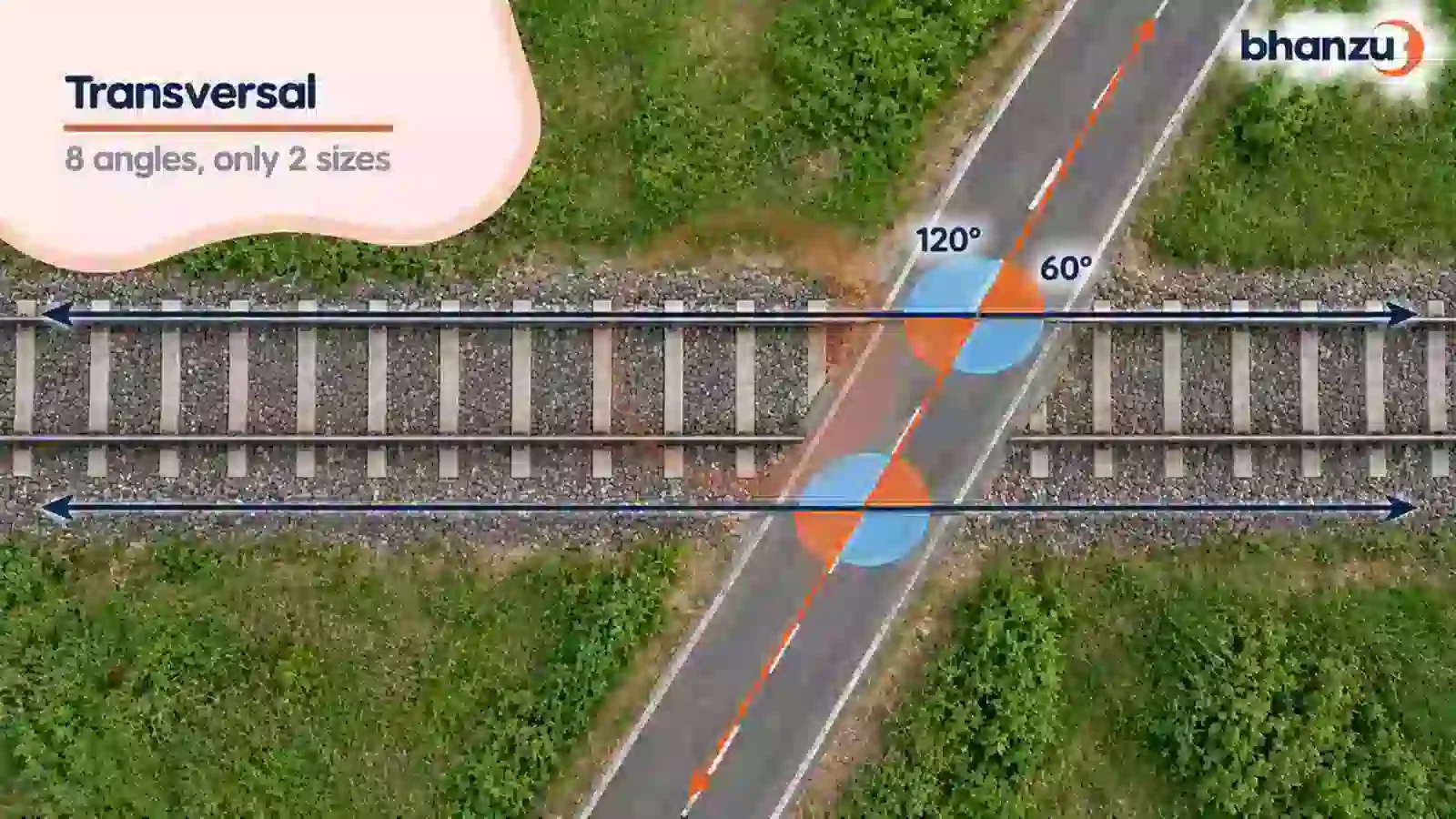
A railroad crossing sign (the X-shape). Each pair of adjacent angles at the crossing forms a linear pair — supplementary by design.
Architecture — staircase corner trim. Where the tread meets the riser and the riser meets the next tread, you find adjacent angles at the carpentry corner.
Common Errors When Working With Adjacent Angles
Mistake 1: Calling vertical angles "adjacent".
Where it slips in: in an intersection of two lines, students point to a vertical-angle pair and call them adjacent.
The fix: vertical angles share only the vertex — they do not share a side. Adjacent angles must share both a vertex and a side. The two terms are mutually exclusive: an angle pair can be adjacent OR vertical, never both.
Mistake 2: Assuming adjacent angles must sum to or .
Where it slips in: students learn linear pairs (sum ) and adjacent complementary angles (sum ) and over-generalise — assuming every pair of adjacent angles has a special sum.
The fix: adjacent angles can be any size. They might happen to sum to or (giving them an additional name), but the adjacency rule itself has no sum requirement.
Mistake 3: Calling angles "adjacent" just because they're nearby.
Where it slips in: two angles in different corners of a figure that look related to each other.
The fix: the dictionary meaning of adjacent (just near each other) is broader than the geometric meaning. In geometry, adjacency requires the strict three-condition test — vertex, side, no overlap. Two angles can be visually close on a diagram and still not be adjacent.
Mistake 4: Counting overlapping angles as adjacent.
Where it slips in: in a complex diagram with many rays from one point, students sometimes mark two angles as adjacent even though one is contained inside the other.
The fix: the no overlap rule. If one angle's interior lies inside the other's, they overlap — they are not adjacent. Two adjacent angles always sit on opposite sides of their shared ray.
Key Takeaways
Adjacent angles share a common vertex, share a common side, and do not overlap. All three rules must hold.
They can be any size — there's no required sum.
Three named special cases: adjacent complementary ( sum), adjacent supplementary ( sum, the linear pair), and adjacent with no special sum.
Adjacent angles are not vertical angles — vertical angles share only the vertex; adjacent angles share both vertex and side.
Adjacent angles appear in pizza slices, clock hands, polygon vertices, swinging doors, paper fans, staircases — anywhere two angles meet at a shared edge.
Tripping Points to Avoid — Three Problems to Test Yourself
Two adjacent angles together form a right angle. One angle is . Find the other.
Two adjacent angles together form a straight line. One angle is given as and the other as . Find and both angles.
Look at a diagram of two intersecting lines. Identify which pairs of the four angles are adjacent and which pair is vertical. How many adjacent pairs are there at the intersection?
If problem 3 returned four adjacent pairs and two vertical pairs — you've got it. Want a Bhanzu trainer to walk through more angle-relationship problems? Book a free demo class — online globally.
Also Read:
Was this article helpful?
Your feedback helps us write better content
Frequently Asked Questions
What are adjacent angles?
Are adjacent angles always supplementary?
Can adjacent angles be complementary?
What's the difference between adjacent angles and vertical angles?
Are linear pairs adjacent angles?
Can three or more angles be adjacent?
What is a common arm in adjacent angles?
Can adjacent angles be measured separately?
Can opposite rays form an adjacent angle pair?
Do adjacent angles appear in polygons?