Pi (π) is the ratio of a circle's circumference to its diameter, approximately equal to 3.14159. It's a mathematical constant — meaning the value never changes, no matter how big or small the circle.
Pi (π) at a Glance
Definition: The ratio of a circle's circumference to its diameter
Symbol: π (lowercase Greek letter pi, the 16th letter of the Greek alphabet)
Approximate value: 3.14159
Common fractional approximation: 22/7
Formula: π = C / d
Type: Irrational, transcendental constant
Key Facts About Pi
Pi has been studied for nearly 4,000 years across Babylonian, Egyptian, Greek, Indian, and Chinese mathematics
The symbol π was first used by William Jones in 1706 and popularised by Euler in 1737
Irrational: pi's decimal expansion never ends and never enters a repeating pattern
Transcendental: pi is not the root of any polynomial equation with integer coefficients
Pi Day is celebrated on March 14 (3/14) every year
Pi has been calculated to over 100 trillion digits — but NASA uses only 15
The Symbol π
The symbol π is the lowercase Greek letter "pi," used in mathematics to represent the ratio of a circle's circumference to its diameter. It is pronounced "pie" (/paɪ/).
The letter comes from the Greek word periphery (περιφέρεια) — the older term for what we now call a circle's circumference. Welsh mathematician William Jones first used π for this ratio in 1706. Leonhard Euler adopted it in 1737, and from there it became standard across mathematics.
A quick distinction worth catching now (we'll come back to it):
Lowercase π is the constant ≈ 3.14159. Uppercase Π is something else entirely — it represents the product of a sequence in the same way Σ represents a sum.
What is the Value of Pi?
The value of pi is approximately 3.14159, but its exact decimal expansion never ends and never repeats. For most calculations, 3.14 is precise enough. For more precision, mathematicians use 3.14159 or 3.14159265.
Pi Value in Decimal
Pi to 50 decimal places:
3.14159 26535 89793 23846 26433 83279 50288 41971 69399 37510
Most school-level problems use 3.14 or 3.14159. Engineering and physics problems usually use anywhere from 6 to 15 digits depending on the precision required. NASA's Jet Propulsion Laboratory uses pi to only 15 decimal places for all interplanetary navigation — including landing rovers on Mars.
Pi Value in Fraction
The most common fractional approximation of pi is 22/7.
There's a precision detail most textbooks skip — 22/7 is not equal to pi. It's slightly larger:
Value | Diverges from pi at... | |
|---|---|---|
Pi (π) | 3.14159 26… | — |
22/7 | 3.14285 71… | 3rd decimal place |
A much closer fraction is 355/113, which matches pi correctly to six decimal places (3.14159 29…). It was discovered by the Chinese mathematician Zu Chongzhi around 480 CE.
For everyday school calculations, 22/7 is fine. Just don't write π = 22/7 with an equals sign — write π ≈ 22/7 with the approximation symbol.
Pi in Degrees and Radians
In trigonometry, π radians = 180°. That is, pi radians is exactly half a turn around a circle.
A full revolution is 2π radians = 360°.
Why? A radian is defined as the angle made when the arc length of a circle equals its radius. A full circle of radius 1 has a circumference of 2π. So one full revolution covers 2π units of arc — which means 2π radians.
The Pi Formula and How to Calculate Pi
The pi formula is π = C / d, where C is the circumference of a circle and d is its diameter.
Variable | Meaning |
|---|---|
π | Ratio of circumference to diameter (≈ 3.14159) |
C | Circumference (the distance around the circle) |
d | Diameter (the distance across the circle through its centre) |
If you measure any circle's circumference and divide it by its diameter, you'll get pi. Try it with a plate, a coin, a bicycle wheel — the ratio comes out to 3.14… every time. This is why pi is a constant and not just one specific circle's number.
Historically, pi has been calculated in two main ways. Around 250 BCE, Archimedes used inscribed and circumscribed polygons — drawing 96-sided polygons inside and outside a circle and measuring their perimeters. He proved that pi sits between 223/71 and 22/7. Modern computation uses infinite series — formulas like the Gregory-Leibniz series and the rapidly converging series developed by Srinivasa Ramanujan in the early 1900s. Today's algorithms can compute trillions of digits in days.
Worked Example: Calculating Circumference Using Pi
A bicycle wheel has a diameter of 70 cm. Find its circumference.
Using C = π × d:
C = 3.14 × 70 = 219.8 cm
So the wheel rolls forward 219.8 cm — about 2.2 metres — for every full rotation.
Why is Pi an Irrational Number?
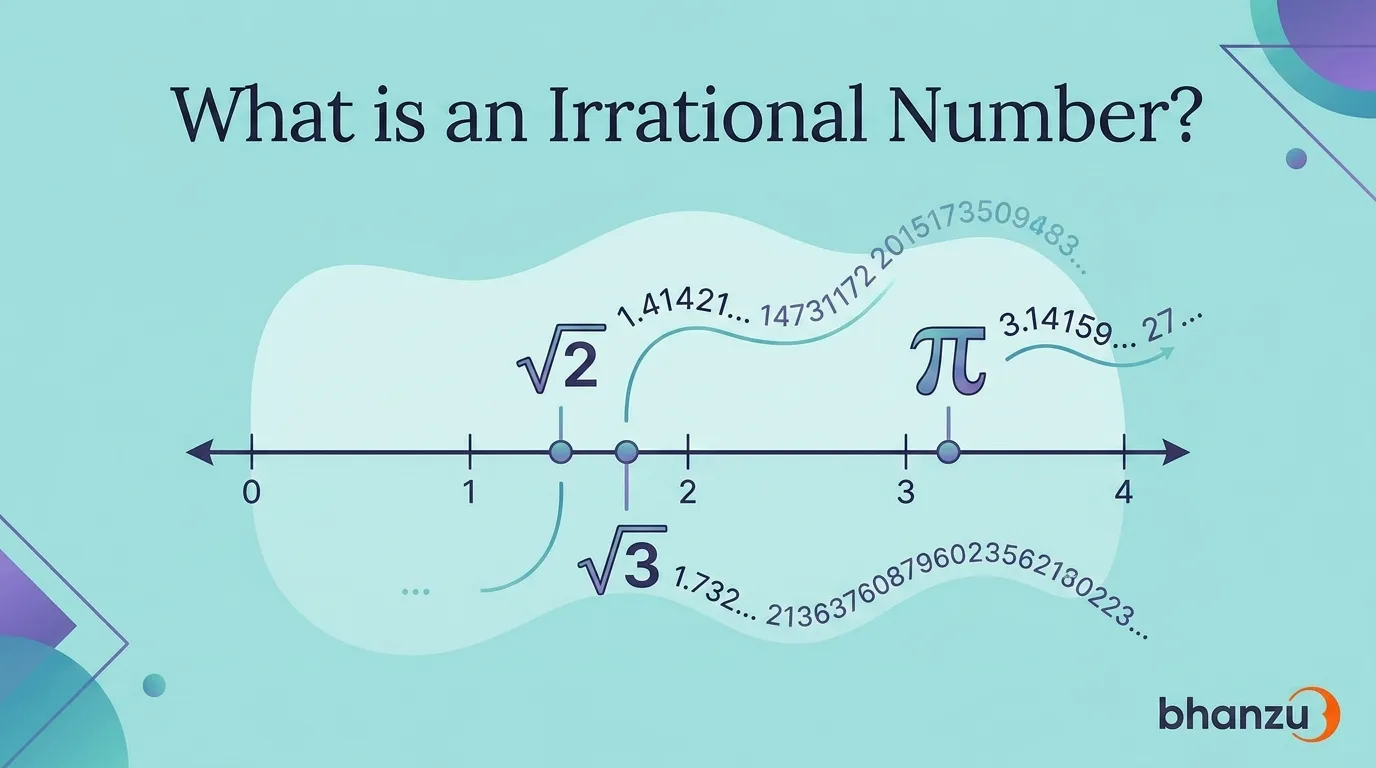
Pi is irrational because it cannot be expressed as a fraction of two whole numbers — its decimal expansion never ends and never enters a repeating pattern.
To see why this matters, compare pi to two rational numbers:
1/2 = 0.5 (terminates)
1/3 = 0.333… (repeats forever, but in a fixed pattern)
Pi does neither. Its digits keep going, and no matter how far you compute, no repeating block ever appears. Johann Heinrich Lambert proved this in 1761 using the continued-fraction expansion of the tangent function.
This is the reason we approximate pi as 3.14 or 22/7 — pi's exact value can never be written as a finite decimal or as a simple fraction. It can only be written as the symbol π, or as an infinite series.
Why is Pi Called a Transcendental Number?
Pi is transcendental, which means it is not the root of any polynomial equation with integer coefficients.
In plain language: pi cannot be built from whole numbers using only addition, subtraction, multiplication, division, and root operations like square roots. Numbers like √2 are irrational but not transcendental — √2 is the solution to x² − 2 = 0, which is a polynomial with integer coefficients. Pi has no such equation. It sits outside the algebraic numbers entirely.
Ferdinand von Lindemann proved this in 1882. His proof settled an ancient Greek problem called squaring the circle — the challenge of constructing a square with the same area as a given circle, using only a compass and straightedge. Lindemann's proof showed it's impossible. Forever. The transcendence of pi is the reason.
Where is Pi Used in Real Life?
Pi shows up almost everywhere there is a circle, a wave, or a rotation — and a few places where there isn't an obvious circle at all.
Geometry: Circumference (C = πd), area (A = πr²), surface area, and volume of every circular and spherical shape
Engineering: Wheels, gears, pipes, bridges — any rotational or circular structure
Physics: Einstein's field equations of general relativity, Maxwell's equations of electromagnetism, and Heisenberg's uncertainty principle in quantum mechanics
Statistics: The formula for the normal distribution (the bell curve) contains pi
GPS and satellite navigation: Position calculations on a spherical Earth depend on pi
Medical imaging: MRI and CT reconstruction algorithms use pi-based signal processing
Surprise application: The average sinuosity of a river — its bendiness — has been claimed to be roughly π. The math comes from how rivers meander over time.
There's an even stranger appearance. The infinite sum 1 + 1/4 + 1/9 + 1/16 + … (the sum of reciprocals of all square numbers) equals π² / 6. No circle in sight. This connection, proven by Euler in 1735, hints at how deeply pi is woven into mathematics.
A Brief History of Pi
Year | Who | Contribution |
|---|---|---|
~2000 BCE | Babylonians | Approximated pi as 25/8 (3.125) |
~1650 BCE | Egyptian Rhind Papyrus | Approximated pi as 256/81 (≈ 3.16) |
~250 BCE | Archimedes (Greece) | Bounded pi between 223/71 and 22/7 using 96-sided polygons |
~480 CE | Zu Chongzhi (China) | Approximated pi as 355/113 (correct to 6 decimal places) |
1706 | William Jones (Wales) | First used the symbol π |
1737 | Leonhard Euler (Switzerland) | Popularised the symbol π globally |
1761 | Johann Lambert (Switzerland) | Proved pi is irrational |
1882 | Ferdinand Lindemann (Germany) | Proved pi is transcendental |
Early 1900s | Srinivasa Ramanujan (India) | Developed rapidly converging series for pi |
2024 | StorageReview team | Calculated pi to 105 trillion digits |
Common Confusions About Pi
Pi (π) vs capital pi (Π): Lowercase π is the constant ≈ 3.14159. Uppercase Π is unrelated — it represents the product of a sequence (just as Σ represents a sum). Different symbol, different meaning.
Pi is exactly 22/7: False. 22/7 ≈ 3.142857 is slightly larger than pi; they diverge at the third decimal place. 22/7 is an approximation, not the value.
Radius vs diameter when using pi: The circumference formula C = πd uses the diameter. The area formula A = πr² uses the radius. Substituting the wrong one is the most common pi-related mistake in school exams.
Pi is "infinity": Pi is a finite, well-defined number between 3 and 4. Only its decimal representation is infinite — and that's a very different thing from the number itself being infinite.
Quick Facts About Pi
Pi Day is celebrated worldwide on March 14 (3/14) every year, often with actual pie
The current Guinness world record for memorising pi is 70,030 digits, set by Suresh Kumar Sharma of India in 2015
Pi has been calculated to over 100 trillion digits using modern algorithms — though no practical use requires more than about 40
The mnemonic "How I wish I could calculate pi" gives 3.141592 — count the letters in each word
NASA uses pi to 15 decimal places for all interplanetary calculations. That's enough precision to compute the circumference of the observable universe to within the width of a hydrogen atom
Tau Day (June 28) is celebrated by mathematicians who argue τ = 2π would be a more natural circle constant
When You'll See Pi in School
Pi is introduced when students begin studying circles — usually in upper elementary or early middle school. By high school, it appears in nearly every topic involving circles, waves, or angles.
Curriculum references:
CCSS (USA): 7.G.B.4 — circumference and area of a circle (Grade 7)
NCERT (India): Class 6 Chapter 14 (Practical Geometry — circles); Class 9 Chapter 12 (Heron's Formula and circles); Class 10 Chapter 12 (Areas Related to Circles)
UK National Curriculum: Key Stage 3 (Years 7–9) — circumference and area; Key Stage 4 (GCSE) — surface area, volume, and arc length
Students continue applying pi through trigonometry (radians), calculus (integration of circular regions), and physics (oscillations, waves, rotational motion).
Related Terms
Term | Meaning | How It Relates to Pi |
|---|---|---|
Circumference | Distance around a circle | The numerator in the pi ratio (π = C/d) |
Diameter | Distance across a circle through its centre | The denominator in the pi ratio |
Radius | Distance from centre to any point on the circle | Half the diameter; appears in A = πr² |
Irrational number | A number that cannot be written as a fraction of two whole numbers | Pi is one of the most famous examples |
Transcendental number | A number that's not the root of any integer-coefficient polynomial | Pi is transcendental; e is the other most famous example |
Tau (τ) | A constant equal to 2π | Some mathematicians argue τ is more natural for circle math |
Was this article helpful?
Your feedback helps us write better content