What is an Equiangular Triangle
An equiangular triangle is a triangle in which all three interior angles are equal. Because the three angles of any triangle add to 180°, three equal angles must each measure . So every equiangular triangle is also a 60°–60°–60° triangle.
The word breaks down cleanly: equi- means "equal" and -angular means "angles." A triangle that is equal in its angles is equiangular. The single most important fact follows directly — in a triangle, equal angles force equal sides, so an equiangular triangle is exactly the same shape as an equilateral triangle. One name describes the angles; the other describes the sides; for a triangle they point to the identical figure.
This equivalence is special to triangles. A rectangle, for instance, is equiangular (four 90° corners) without being equilateral, and a rhombus is equilateral without being equiangular. Only in the triangle do "all angles equal" and "all sides equal" always travel together — a point worth holding onto, because it is exactly where the types of triangle classification turns.
Why Does Equal Angles Mean Equal Sides?
This is the question that decides whether the rest of the topic makes sense. The answer comes from a result built into every triangle: the side opposite a larger angle is longer, and sides opposite equal angles are equal. If all three angles are equal, then no side can be opposite a "bigger" angle than another — so all three sides must match. That single rule is why we never need to measure the sides of an equiangular triangle separately; the angles already settle it.
Properties of An Equiangular Triangle
An equiangular triangle carries every property of an equilateral triangle, plus the angle facts that name it. The core properties:
Every interior angle is 60°. This is fixed; it can never be anything else.
All three sides are equal in length. Equal angles force equal sides.
It is always an acute triangle. Since the largest angle is only 60°, no angle reaches 90°, so the triangle can never be right-angled or obtuse.
Each exterior angle is 120°. An interior angle of 60° leaves on the outside.
The centre points coincide. The centroid, orthocentre, circumcentre, and incentre all land on the same single point — a level of symmetry no other triangle has.
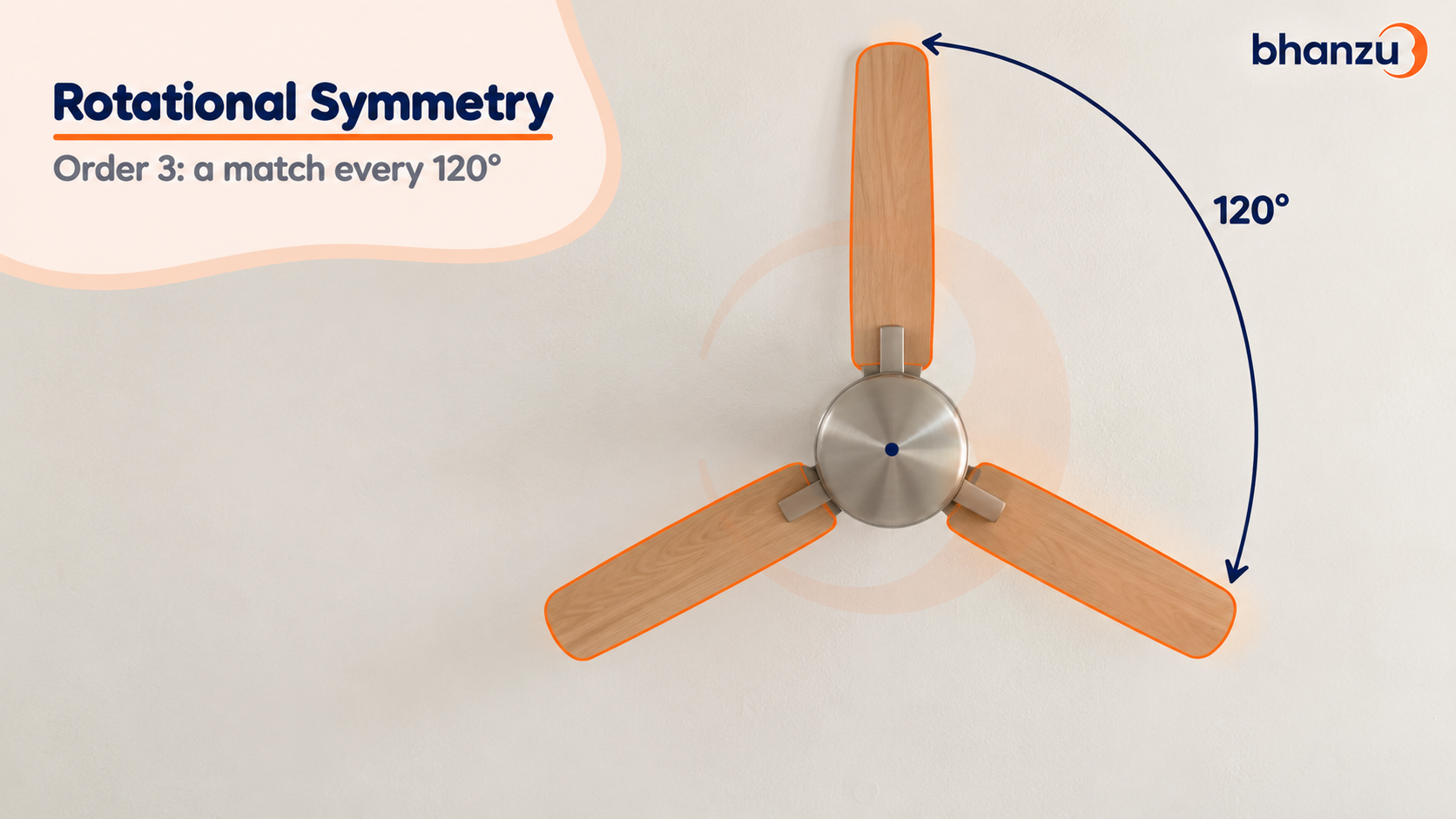
It has three lines of symmetry, one through each vertex and the midpoint of the opposite side.
These properties are not separate facts to memorise. They all flow from the one defining condition — three equal angles — through the triangle sum theorem, which guarantees the angles add to 180° and therefore each lands on 60°.
The Formulas for An Equiangular Triangle
Because an equiangular triangle is fully determined by a single side length , every measurement follows from that one number. Here is what each formula means and where it comes from.
Quantity | Formula | What it gives you |
|---|---|---|
Perimeter | Three equal sides, so just add one side three times | |
Area | The space enclosed | |
Height (altitude) | The straight-line drop from a vertex to the opposite side |
Here is the length of one side. The perimeter is plain: three equal sides give .
The area formula is worth deriving once, so it is never just a string of symbols. Drop a height from the top vertex to the base, which splits the triangle into two right triangles, each with base and hypotenuse .
By the Pythagoras theorem, the height is .
Then area . The is not arbitrary; it is the fingerprint of that 60° angle.
Examples of Equiangular Triangles
The examples below build from a quick angle check to a full area calculation, then to a reverse problem where you work backward from the area.
Example 1
An equiangular triangle has one side measuring 8 cm. Find its perimeter.
All three sides of an equiangular triangle are equal, so each side is 8 cm.
cm.
Final answer: The perimeter is 24 cm.
Example 2
A triangle has angles 60°, 60°, and 60°. A student claims you cannot find the third side without measuring it. Is the student right?
Here is the tempting wrong path. The student treats the triangle like any other and assumes the three sides could be different lengths, so without a ruler the third side is unknown.
Watch where that breaks. If the sides were different, the angles opposite them would be different too — the larger side would sit opposite the larger angle. But all three angles are equal at 60°, so no side can be opposite a bigger angle than another.
The correct reading: equal angles force equal sides. If one side is known, all three are known. The student does not need to measure anything beyond a single side.
Final answer: No, the student is wrong. In an equiangular triangle, knowing one side determines all three.
Example 3
Find the area of an equiangular triangle with side length 6 cm.
Use the area formula with .
Final answer: The area is .
Example 4
One exterior angle of an equiangular triangle is given. What is its measure, and what is the sum of all three exterior angles?
Each interior angle is 60°, so each exterior angle is .
The three exterior angles add to , which matches the rule that the exterior angles of any triangle sum to 360°.
Final answer: Each exterior angle is 120°, and the three together total 360°.
Example 5
Find the height (altitude) of an equiangular triangle whose side is 10 cm.
Use the height formula with .
Final answer: The height is .
Example 6
The area of an equiangular triangle is . Find the length of one side.
Start from the area formula and solve backward for .
Divide both sides by .
Final answer: Each side is 8 cm.
Where The Equiangular Triangle Earns Its Place
The equiangular triangle exists because nature and engineering keep reaching for the most stable, most balanced triangle there is. When every angle and every side is identical, the figure distributes force evenly in all three directions — there is no weak corner.
That balance shows up in real structures and real materials:
Warning signs. A yield sign is an equiangular (equilateral) triangle, chosen because its symmetry reads the same from any approach angle on the road.
Crystals and molecules. Many crystal lattices and molecular arrangements settle into 60° triangular patterns because that geometry packs most efficiently.
Trusses and frameworks. Triangular bracing in bridges and roofs often uses the equiangular form, because equal angles spread load evenly across all three members.
The reason these all land on the same 60° shape is not coincidence. It is the Pythagoras theorem and the triangle angle sum working together: 60° is the unique angle that lets three equal corners close up into a triangle. No other equal-angle value works. You can read more on how the right-angle case differs in the right triangle formulas reference.
The Mistakes Students Make Most Often
Three errors trip up students learning equiangular triangles, and each one comes from forgetting that the angles and sides are locked together.
Mistake 1: Treating equiangular and equilateral as different shapes
Where it slips in: When a problem says "equiangular" and a student looks for a side condition, or says "equilateral" and a student looks for an angle condition, as if they were two separate triangles.
Don't do this: Assume an equiangular triangle might have unequal sides, or that you need extra information to connect the angles to the sides.
The correct way: For a triangle, equiangular and equilateral are the same figure. Equal angles guarantee equal sides and vice versa. The moment you know it is one, you know it is the other.
Mistake 2: Assuming "equiangular" extends to all polygons the same way
Where it slips in: Carrying the triangle rule over to squares, rectangles, and other shapes.
Don't do this: Conclude that any equiangular polygon must also be equilateral.
The correct way: This equivalence is unique to triangles. A rectangle is equiangular (four right angles) but not equilateral. The angle–side lock only holds for the triangle, so keep the rule scoped to triangles. A common first instinct is to generalise the rule the moment it is learned, and that is exactly where it goes wrong.
Mistake 3: Misusing the area formula by squaring the wrong quantity
Where it slips in: In the area calculation , students sometimes multiply by instead of , or forget the entirely.
Don't do this: Write or drop the radical and use .
The correct way: Square the side first, then multiply by . The is essential; it carries the 60° geometry. The error that costs the most marks is leaving out the radical, because the number comes out looking reasonable while being wrong.
Conclusion
An equiangular triangle has three equal interior angles, each measuring exactly 60°.
Equal angles force equal sides, so an equiangular triangle is the same figure as an equilateral triangle.
It is always an acute triangle, with each exterior angle equal to 120°.
Its area is and its perimeter is , both set by a single side length .
The angle–side equivalence is unique to triangles and does not extend to other polygons.
For students building a firm grip on triangle classification and proofs, working with a teacher speeds up the moment it clicks. Explore Bhanzu's geometry tutor, our middle school math tutor sessions, or math classes online to practise these ideas live.
A Practical Next Step
Practice these problems to solidify your understanding:
Find the perimeter and area of an equiangular triangle with side 12 cm.
Reverse it: given an area of , find the side length.
If you get stuck on the area step, return to the derivation in the formulas section. Want your child to build this reasoning with a live trainer? Book a free demo class.
Read More
Was this article helpful?
Your feedback helps us write better content
Frequently Asked Questions
Is an equiangular triangle the same as an equilateral triangle?
What is the measure of each angle in an equiangular triangle?
Can an equiangular triangle be a right triangle?
How many equiangular triangles exist?
Is every equiangular polygon also equilateral?