A Symbol That Stands for an Idea
Hold up three fingers. You've just done what every number system since cuneiform has done — used a symbol to stand for a quantity.
A number is a value that tells you how many (counting), how much (measuring), which position (ordering), or which item (labelling). The squiggle on the page — "" — is the numeral; what it stands for is the number. The two are related but different.
The Definition of Number
A number is an abstract mathematical object used to represent quantity, position, or label. Different types of numbers — natural, integer, rational, real, complex — extend this idea to handle different kinds of measurement.
The numerals we use () are part of the Hindu-Arabic numeral system — developed by Indian mathematicians between the st and th centuries CE and spread to Europe via Arab scholars by the th century. It replaced Roman numerals because it has place value — the symbol means or or depending on where it sits.
Quick reference.
Definition: an abstract value representing quantity, position, or label.
Numeral: the written symbol for a number (, VII, ).
Numeral system: the rules for writing numerals. Hindu-Arabic is the global standard.
Eight major number sets: Natural (), Whole, Integer (), Rational (), Irrational, Real (), Imaginary, Complex ().
Grade introduced: CCSS-M 2.NBT (number and operations in base ten); NCERT Class 6 — Knowing Our Numbers.
Types of Numbers — Eight Families That Nest
Each family contains the one below it. Counting up from the innermost set:
1. Natural Numbers ()
The counting numbers. Used for counting objects you can point at. Some sources include ; the more common convention starts at .
2. Whole Numbers
Natural numbers plus zero. Used when "none" is a legal count.
3. Integers ()
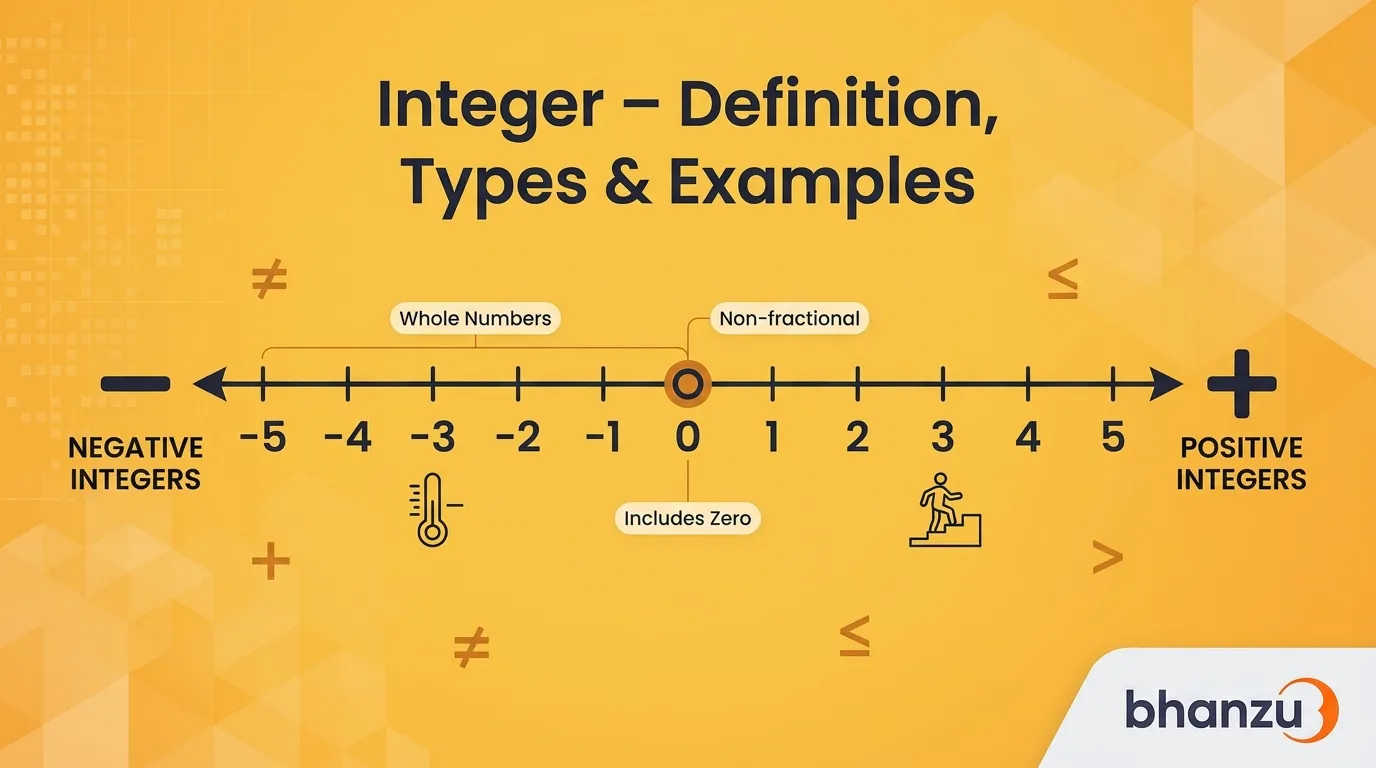
Whole numbers plus their negatives. Used for temperature below zero, debts, depths below sea level.
4. Rational Numbers ()
Any number expressible as where and are integers and . Includes , , (which is ), and any terminating or repeating decimal.
5. Irrational Numbers
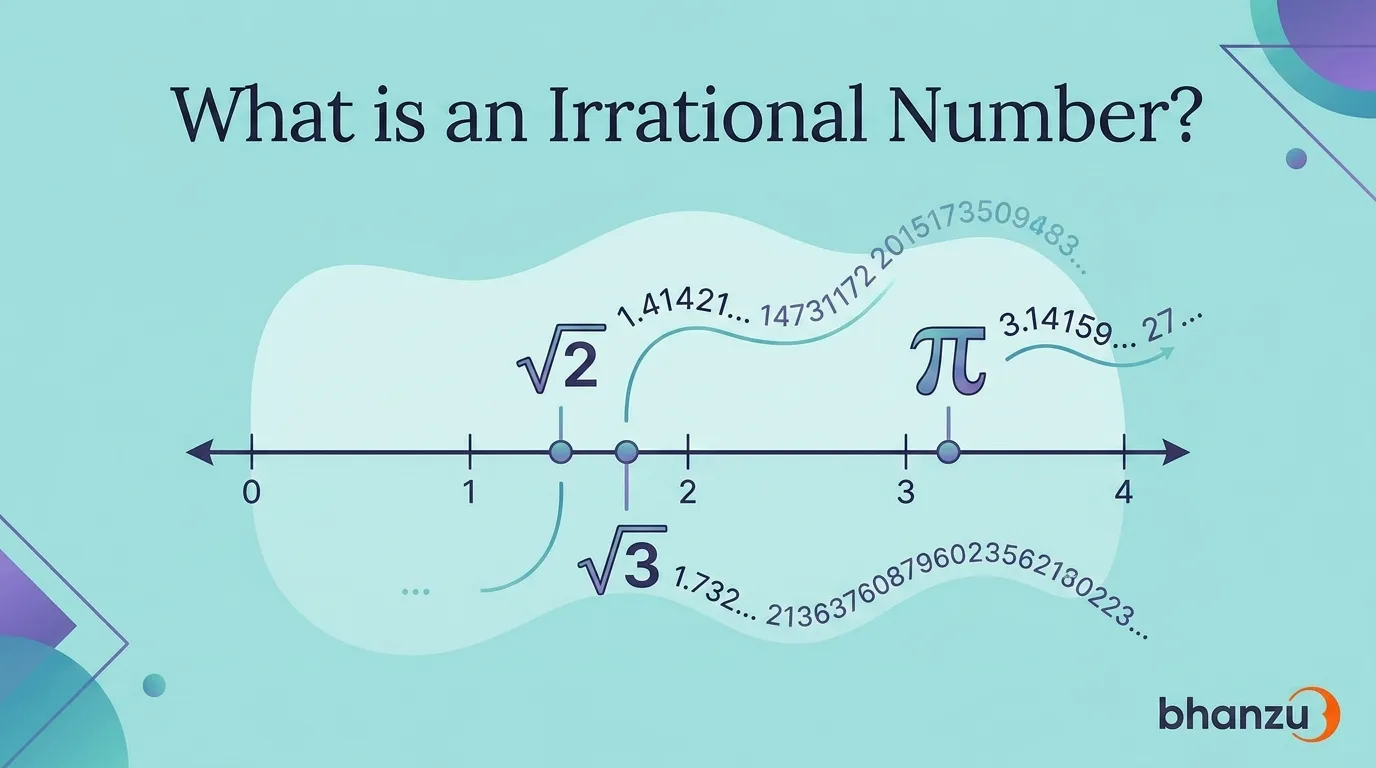
Numbers that cannot be written as . Their decimal expansion never terminates and never repeats. Examples: . The proof that is irrational dates to the ancient Greek school of Pythagoras and supposedly cost the discoverer his life.
6. Real Numbers ()
Every rational and every irrational. Equivalently, every point on the number line.
7. Imaginary Numbers
Numbers of the form , where . The square root of has no real value, so was invented to handle it. Used in electrical engineering and quantum mechanics.
8. Complex Numbers ()
Sums of a real and an imaginary number: . Every algebraic equation has its roots inside — this is the Fundamental Theorem of Algebra, proven by Carl Friedrich Gauss (1777–1855, Germany) in his 1799 doctoral thesis.
A few subtypes worth knowing:
Even numbers. Integers divisible by .
Odd numbers. Integers not divisible by .
Prime numbers. Natural numbers divisible only by and themselves:
Composite numbers. Natural numbers with more than two divisors:
Cardinal numbers. Tell you "how many" — apples.
Ordinal numbers. Tell you "which position" — the th student.
How Place Value Works in the Hindu-Arabic System
Every digit in a multi-digit numeral carries a value equal to the digit times its place's power of .
Numeral | Thousands | Hundreds | Tens | Units |
|---|---|---|---|---|
Total |
The genius of the system is the zero as a placeholder — has no tens, and the in the tens column makes the and keep their correct places. Roman numerals had no zero and no place value, which is why no Roman general ever divided one number by another on the back of an envelope.
Three Worked Examples — Quick, Standard, Stretch
Quick. Is an integer, a whole number, both, or neither?
Integers include all negatives of natural numbers, so is an integer. Whole numbers are — only zero and positives — so is not a whole number.
Final answer: is an integer, not a whole number.
Standard (Wrong Path First — Where Number Sense Slips). Is (zero-point-three-repeating) a rational number or an irrational number?
The wrong path. A student reasons: "The decimal goes on forever, so it must be irrational like ."
The flaw: irrational numbers have non-terminating and non-repeating decimals. A decimal that goes on forever but repeats in a pattern is rational. The phrase "decimal never ends" alone isn't enough to call a number irrational.
The rescue. is the decimal expansion of . Since is a ratio of two integers (and ), is rational. Therefore is rational.
Final answer: is rational (it equals ).
The lesson — the difference between rational and irrational is "repeats vs doesn't," not "ends vs doesn't." Every repeating decimal hides a fraction.
Stretch. Classify each of these numbers using every set it belongs to: , , , , .
Number | Natural? | Whole? | Integer? | Rational? | Irrational? | Real? |
|---|---|---|---|---|---|---|
No | No | ✓ | ✓ | – | ✓ | |
✓ | ✓ | ✓ | ✓ | – | ✓ | |
– | – | – | – | ✓ | ✓ | |
– | – | – | ✓ | – | ✓ | |
– | ✓ | ✓ | ✓ | – | ✓ |
Final answer: see table.
The trick on — a square root looks irrational but isn't. , an integer. Only square roots of non-perfect-squares () are irrational.
Where Numbers Appear — Beyond Counting
Numbers do more than count.
Integers. Bank balances (positive, zero, negative), temperatures, elevation, ranks, sports scores.
Rational numbers. Recipes, percentages, fractions of fractions, prices, time-and-distance problems.
Irrationals. Geometry ( appears in every circle), physics ( in growth/decay), the diagonal of a unit square ().
Complex numbers. Alternating current circuits, quantum mechanics state vectors, fractal geometry (the Mandelbrot set lives in ).
Prime numbers. Modern internet security (RSA encryption) relies on the difficulty of factoring large numbers into primes.
Tripping Points to Avoid While Working With Number
Mistake 1: Calling every never-ending decimal irrational
Where it slips in: Student sees and says "irrational."
Don't do this: Use "decimal never ends" as the test for irrationality.
The correct way: The test is "never repeats and never ends." is rational because the pattern repeats forever.
Mistake 2: Treating zero as a natural number (or refusing to)
Where it slips in: A textbook says "natural numbers start at " and a student treats as a natural number on the next page.
Don't do this: Switch conventions mid-problem.
The correct way: Pick the convention the textbook uses. NCERT defines natural numbers as ; some U.S. textbooks include . Whole numbers natural numbers; integers whole numbers negatives.
Mistake 3: Confusing the numeral with the number
Where it slips in: "Roman numeral VII is a different number from ."
Don't do this: Treat the symbol as the thing.
The correct way: VII, , , (Hindi for ) all name the same number. The numeral is the label; the number is the abstract value behind it.
A real-world version of the mistake. In Y2K (the year-2000 problem), countless legacy computer systems stored dates with only two digits for the year — for , for . When arrived, those systems read it as and crashed or computed wildly wrong results. The fix cost an estimated $300 billion globally. The root mistake: conflating the numeral "" with the number "the year nineteen-ninety-eight," when the numeral was actually only the last two digits.
Conclusion
A number is an abstract value used to count, measure, order, or label — distinct from the numeral that writes it.
The eight major number families nest: natural whole integer rational real complex.
Irrational numbers (like and ) cannot be written as ; rationals can.
Real numbers fill the number line; complex numbers extend it to a plane.
The Hindu-Arabic numeral system's place value is what makes everyday arithmetic possible.
Five Minutes of Practice
Is a natural, whole, integer, or rational number? (Pick every label that applies.)
Classify — irrational or rational?
The numeral CCXLV stands for which number?
If you wrote "irrational" for in problem 2, return to Mistake 1 above.
Want a live Bhanzu trainer to walk your child through the number system from naturals through complex numbers? Book a free demo class — online globally.
Was this article helpful?
Your feedback helps us write better content