What Is a Hexagon?
A hexagon is a closed two-dimensional polygon with six sides, six vertices, and six interior angles.
The name comes from Greek: hexa (six) + gonía (corner / angle) — literally "six corners".
A hexagon is a polygon — specifically the one with the smallest number of sides whose interior angles each equal in the regular case. It sits between the pentagon (5 sides) and the heptagon (7 sides) in the polygon family.
The Five Types of Hexagons
Hexagons are classified by two independent dimensions: whether all sides and angles are equal (regular vs irregular) and whether all interior angles are less than (convex vs concave). A complex hexagon — one where sides cross each other — is a separate category.
1. Regular Hexagon
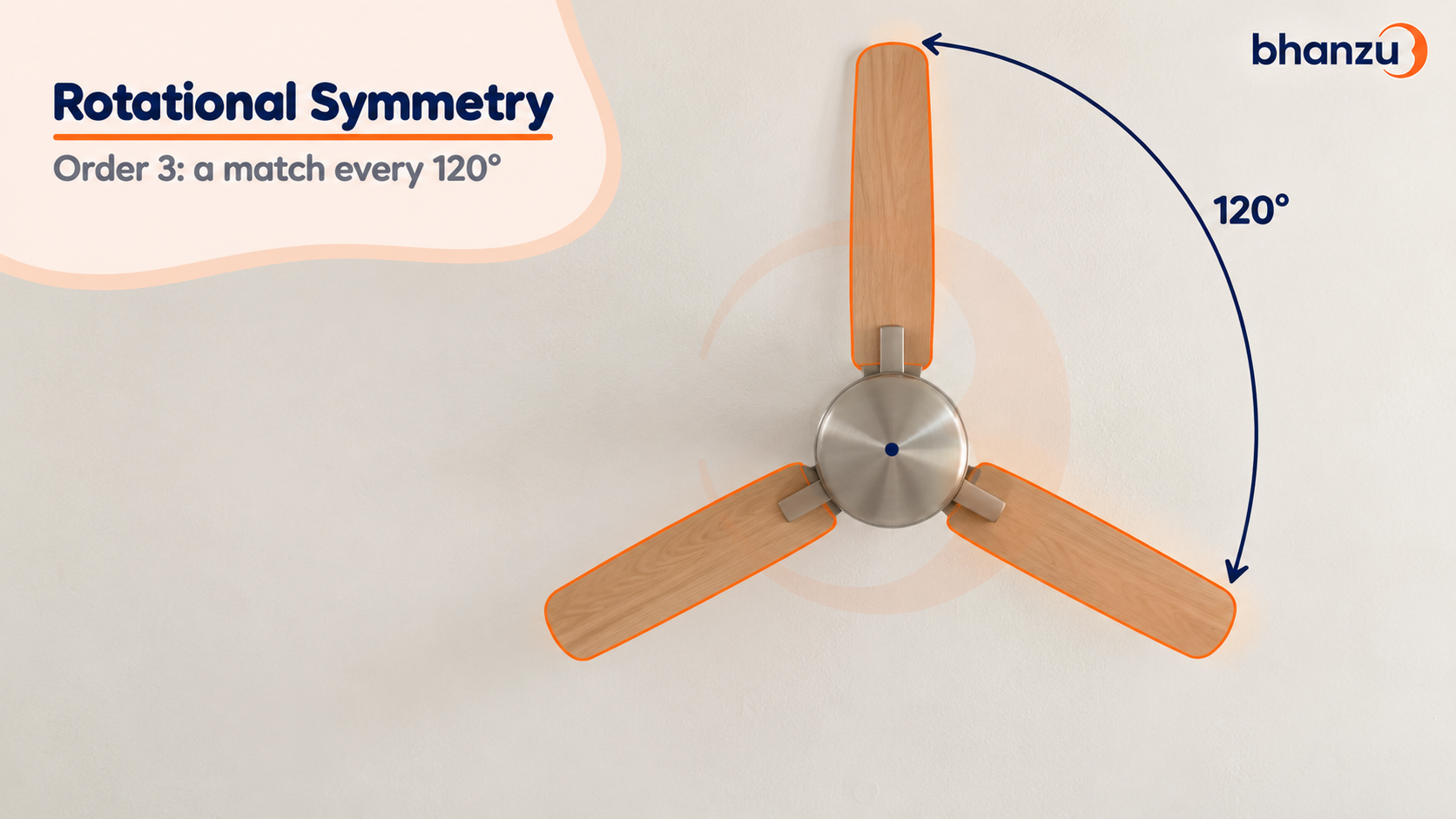
All six sides equal, all six interior angles equal ( each). The most-pictured kind. Has the maximum symmetry possible for a hexagon: six lines of symmetry and rotational symmetry of order 6.
2. Irregular Hexagon
A hexagon where the sides are not all equal, or the angles are not all equal (or both). Still has six sides and six interior angles summing to .
3. Convex Hexagon
All six interior angles are strictly less than . Every diagonal stays inside the hexagon. A regular hexagon is always convex.
4. Concave Hexagon
At least one interior angle is greater than — this creates an inward dent in the shape. At least one diagonal exits the hexagon and re-enters.
5. Complex (Self-Intersecting) Hexagon
The sides cross each other — looks like a six-sided star or a tangled hexagon. Less common in school geometry; appears in advanced contexts.
The Properties of a Hexagon
These properties apply to all hexagons (regular and irregular) unless noted.
Property | Value |
|---|---|
Number of sides | |
Number of vertices | |
Number of interior angles | |
Sum of interior angles | |
Sum of exterior angles | (always — true for every polygon) |
Number of diagonals | |
Each interior angle (regular only) | |
Each exterior angle (regular only) | |
Lines of symmetry (regular only) | |
Rotational symmetry (regular only) | Order ( rotation) |
Sum of Interior Angles — Why ?
The formula for the sum of interior angles of any polygon with sides:
For a hexagon, :
In a regular hexagon, the divides equally across the six angles:
Exterior Angles
The exterior angles of any polygon (hexagon or otherwise) sum to exactly . In a regular hexagon, that divides evenly across the six exterior angles:
And interior + exterior at each vertex = (a linear pair).
Number of Diagonals
The general formula for the number of diagonals of an -sided polygon:
For a hexagon:
These nine diagonals divide a regular hexagon into smaller triangles — six congruent equilateral triangles when you draw all three "long" diagonals through the centre.
Area of a Hexagon
Regular Hexagon — The Direct Formula
For a regular hexagon with side length :
This is the formula you'll use 90% of the time in school problems.
Quick numerical reference:
Side length | Area |
|---|---|
unit | |
units | |
units | |
units |
Regular Hexagon — The Apothem Method
The apothem is the perpendicular distance from the centre of the hexagon to the midpoint of a side. For any regular polygon:
For a regular hexagon with side , the apothem is , so:
Same formula — different derivation. The apothem method generalises to any regular polygon, which is why it's worth knowing.
Regular Hexagon — The Six-Equilateral-Triangle Method
A regular hexagon can be divided into six congruent equilateral triangles by drawing the three long diagonals through the centre. Each equilateral triangle has side and area . The hexagon's area is the total:
Three derivations, one answer. This third method is the most visually intuitive — and it's why honeycomb's hexagonal cells tile the plane so efficiently (next section).
Irregular Hexagon — No Single Formula
For an irregular hexagon, there is no single area formula. Three common methods:
Decompose into triangles. Split the hexagon into triangles using diagonals, find each triangle's area, sum.
Decompose into rectangles + triangles. If the hexagon has any parallel sides, this often produces cleaner arithmetic.
Coordinate (shoelace) formula. If the six vertices have known coordinates, use the shoelace formula:
Perimeter of a Hexagon
Regular Hexagon
All six sides equal, so:
Irregular Hexagon
Sum of the six (different) side lengths:
Three Worked Examples — Quick, Standard, Stretch
Quick — Area of a regular hexagon
A regular hexagon has side length cm. Find its area.
Answer: the area is cm².
Standard — Area from perimeter (Wrong Path Shown First)
The perimeter of a regular hexagon is cm. Find its area.
Wrong path. A student substitutes the perimeter directly into the area formula: . That treats the side length as 30 — but 30 is the perimeter, not the side. The student has multiplied the side by 6 and then squared the result.
Right path. First find the side length:
Then apply the area formula:
Answer: the area is cm².
Stretch — Find the apothem and use it
A regular hexagon has area cm². Find its side length, perimeter, and apothem.
Start from the area formula and solve for :
Now perimeter and apothem:
Perimeter: cm.
Apothem: cm.
Verify the apothem-method area: ✓.
Answer: cm, cm, apothem cm.
Why Hexagons Show Up Everywhere
The hexagon is one of three shapes (with the equilateral triangle and the square) that tiles the plane — covers a flat surface with no gaps and no overlaps. Of those three, the hexagon is the most efficient: it encloses the most area per unit perimeter. This is the geometric reason hexagons appear so often in nature.
Honeybee combs. Bees build hexagonal cells because they enclose the most honey per unit of wax. The Honeycomb Conjecture — proved by mathematician Thomas C. Hales in 1999 — confirmed that regular hexagons are the most efficient way to tile a plane with equal-area regions.
Graphene and carbon nanotubes. The atomic structure of graphene is a perfect hexagonal lattice — each carbon atom bonded to three others at angles. This single-atom-thick hexagonal sheet is the strongest known material per weight.
Snowflakes. Snowflakes form with six-fold symmetry because of the molecular geometry of water — the angle between hydrogen bonds in ice crystals is approximately .
Basalt columns. The Giant's Causeway in Northern Ireland and the Devils Postpile in California feature thousands of hexagonal basalt columns — formed when slow-cooling lava cracks into the most-efficient tessellation.
Insect compound eyes. A housefly's compound eye contains thousands of hexagonal facets (ommatidia), tessellated for maximum light-gathering area.
Nuts, bolts, and Allen keys. Hexagonal heads on bolts give wrenches six grip points at apart — enough for solid torque, not so many that the head becomes a circle.
Soccer balls. The traditional (Telstar 1970) football pattern is a truncated icosahedron — 20 hexagons + 12 pentagons.
The board games Settlers of Catan, Hex, and Civ V. Hexagonal grids give six neighbours per cell (vs four for a square grid), modelling distance and adjacency more naturally.
Aramid fibres (Kevlar). The molecular structure includes hexagonal benzene rings that give Kevlar its extreme tensile strength.
Spot the Trap Before You Fall In
Mistake 1: Using the side length when the apothem is given (and vice versa).
Where it slips in: a problem gives the apothem but the student plugs it into as if it were the side length.
The fix: the apothem is not the side length. For a regular hexagon, , which means . Convert before applying the area formula, or use the alternative apothem-method formula .
Mistake 2: Forgetting that the area formula applies only to regular hexagons.
Where it slips in: the formula is taught as "the hexagon area formula" but it only works when all six sides are equal.
The fix: for an irregular hexagon, decompose into triangles or use the shoelace formula. The single-formula approach is regular hexagons only.
Mistake 3: Misremembering the interior angle as instead of .
Where it slips in: the exterior angle of a regular hexagon is and students sometimes confuse the two.
The fix: interior angle + exterior angle = . For a regular hexagon, interior is and exterior is . Memory anchor: 120 inside, 60 outside.
Mistake 4: Treating perimeter as side length.
Where it slips in: a problem states the perimeter and the student plugs it directly into the area formula. (See the Standard worked example above.)
The fix: perimeter divided by 6 gives the side length for a regular hexagon. Always identify what's given before applying a formula.
Key Takeaways
A hexagon is a six-sided polygon with six vertices, six interior angles, and an interior-angle sum of .
A regular hexagon has all sides equal, all angles equal (), six lines of symmetry, and rotational symmetry of order 6.
The area of a regular hexagon with side is — derivable three different ways (direct, apothem method, six-equilateral-triangle decomposition).
A hexagon has 9 diagonals and 6 exterior angles (each in a regular hexagon).
Hexagons tile the plane efficiently — the geometric reason they appear in honeycomb, graphene, snowflakes, basalt columns, and bolt heads.
Five Minutes of Practice
Find the area of a regular hexagon with side length cm.
A regular hexagon has perimeter cm. Find its side length, area, and apothem.
Find the sum of interior angles of a hexagon (verify with the formula).
How many diagonals does a hexagon have? Show your work using the formula.
A regular hexagon has area cm². Find its side length.
If problem 5 returned cm — you've got it. Want a Bhanzu trainer to walk through more polygon problems? Book a free demo class — online globally.
Also Read:
Was this article helpful?
Your feedback helps us write better content
Frequently Asked Questions
What is a hexagon?
What is the sum of interior angles of a hexagon?
What is each interior angle of a regular hexagon?
How many diagonals does a hexagon have?
What is the area of a regular hexagon with side ?
What's the difference between regular and irregular hexagons?
Why are honeycomb cells hexagonal?
Can a hexagon have a right angle?
Is a hexagon always convex?