What Are Vertical Angles?
When two straight lines intersect at a single point, they form exactly four angles arranged in two pairs of vertical angles.
Vertical angles are the two angles that sit opposite each other across the intersection point. They:
Share a vertex (the intersection point), and
Do not share a side — their arms point in opposite directions.
The four angles in any intersection break down as:
Two pairs of vertical angles — opposite angles across the X-shape
Four linear pairs — each pair of adjacent angles that together form a straight line (each summing to )
The word "vertical" here doesn't mean upright. It comes from vertex (Latin for summit or highest point) — the angles share a vertex. Vertically opposite means opposite-through-the-vertex, not opposite vertically.
The Vertical Angles Theorem
The Vertical Angles Theorem: When two straight lines intersect, the resulting vertical angles are congruent.
In symbols: if and are vertical angles, then
This holds regardless of the angle at which the lines cross — vertical angles formed by a near- crossing are equal to each other, and so are vertical angles formed by a crossing.
Proof of the Vertical Angles Theorem
The proof is short — three lines once you have the linear-pair property.
Two lines crossing form four angles. Call them in order around the intersection. Each adjacent pair sits on one of the two straight lines, so each adjacent pair is a linear pair — supplementary, summing to .
Step 1. and form a linear pair on one of the lines:
Step 2. and form a linear pair on the other line:
Step 3. Setting the two equations equal:
Subtract from both sides:
The same argument shows . Both pairs of vertical angles are congruent. The theorem is proved.
Properties of Vertical Angles
Property | Value / Statement |
|---|---|
Number of vertical pairs at an intersection | |
Share a vertex? | Yes |
Share a side? | No — vertical angles are never adjacent |
Sum of vertical angles | (twice either angle — no fixed value) |
Are vertical angles always equal? | Yes — by the Vertical Angles Theorem |
Are vertical angles always supplementary? | No — only if both equal (i.e., the lines are perpendicular) |
Are vertical angles always complementary? | No — only if both equal |
What's congruent to what | Each angle is congruent to the angle directly opposite it |
Vertical Angles vs Adjacent Angles
These two terms describe different roles the same intersection's angles play.
Vertical angles are opposite — share a vertex only.
Adjacent angles are next to each other — share a vertex AND a side.
The same intersection produces both at once. and are vertical. and are adjacent (and form a linear pair). One angle can be in many relationships at once.
A pair of angles cannot be both vertical and adjacent — those are exclusive categories. Vertical pairs always skip a side; adjacent pairs always share one.
Three Worked Examples, From Quick to Stretch
Quick — Use the theorem directly
Two lines cross. One of the four angles measures . Find its vertical angle.
By the Vertical Angles Theorem, the opposite angle equals the given angle.
Answer: the vertical angle is .
Standard — Find all four angles (Wrong Path Shown First)
Two lines cross. One angle measures . Find all four angles at the intersection.
Wrong path. A student in a hurry writes: "all four angles are , because vertical angles are equal." That applies the theorem to all four angles instead of to the opposite pairs. Sanity check: , but four angles around a point on two crossing lines must sum to . The wrong answer fails the sum check.
Right path. Use both the vertical-angle and the linear-pair relationships.
(given)
(vertical angle to )
(linear pair with )
(vertical angle to )
Answer: the four angles are — in order around the intersection. Sum check: ✓.
Stretch — Algebraic vertical angles
Two intersecting lines form vertical angles measured as and . Find and all four angles.
By the Vertical Angles Theorem, the two expressions are equal:
Substitute to find the vertical-angle value:
The vertical pair is . The other pair (adjacent — linear pair with ):
So the other pair is .
Answer: . The four angles are . Sum check: ✓.
Where Vertical Angles Show Up in the Real World
Vertical angles appear anywhere two straight things cross — which is more places than you'd think.
Scissors and shears. As the blades open, the two angles at the pivot above the pivot are vertical to the two angles below. When one pair opens by , the opposite pair also opens by .
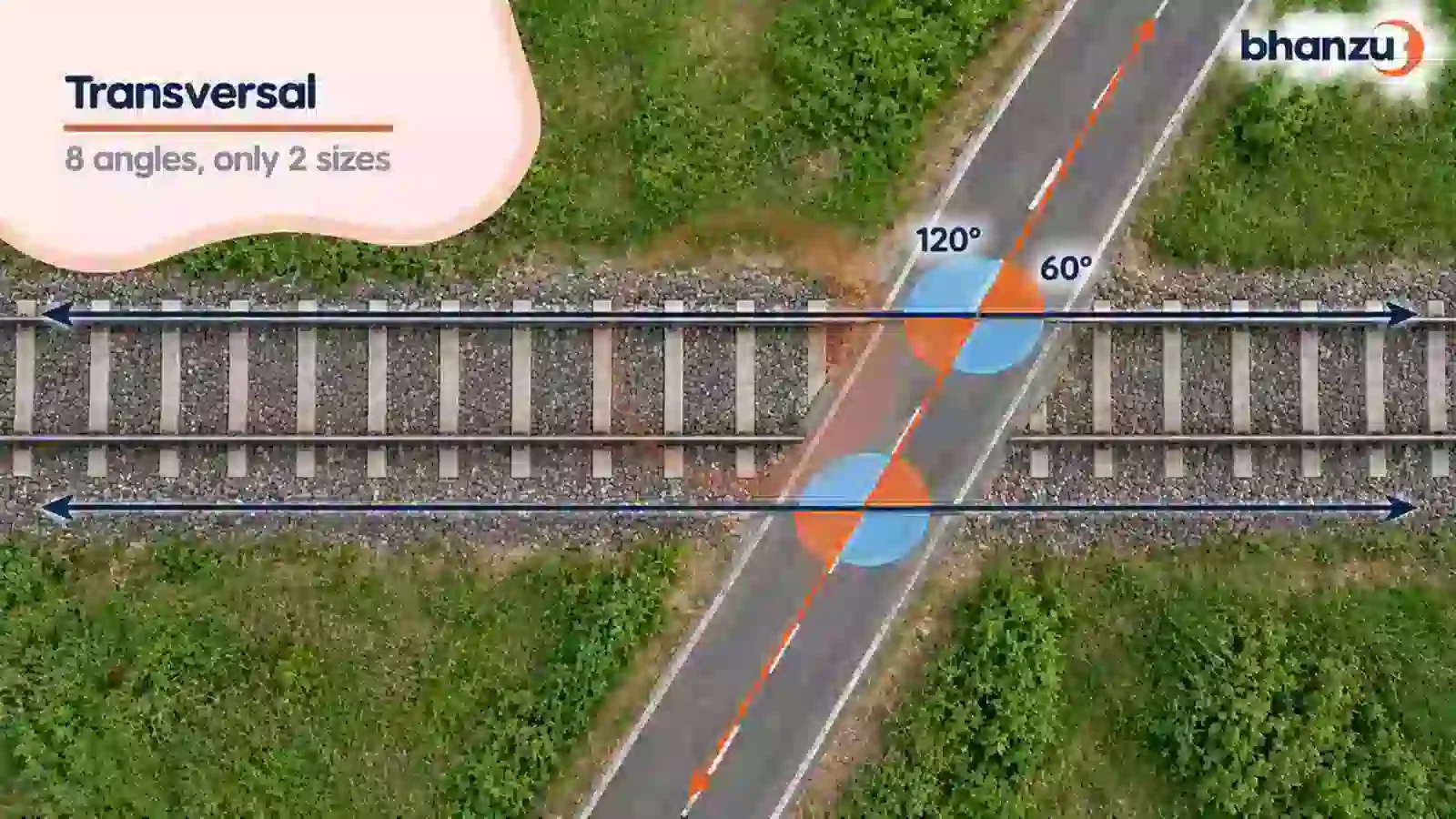
Railway crossings (especially X-crossings). The two acute angles where the rails cross are vertical to each other; same for the two obtuse angles.
Crossing road intersections. A "Y" or "X" intersection of roads creates vertical-angle pairs at the crossing. Surveyors and traffic engineers compute one and reproduce its vertical pair without re-measuring.
Folding ladders and scissor lifts. Every pivot point creates two pairs of vertical angles whose changes are mechanically linked.
Stretched rubber bands. When two stretched bands cross, the four angles formed include two vertical pairs. Tightening one band changes both equally.
Pythagorean theorem proofs. Many geometric proofs (including Euclid's I.47) use the equality of vertical angles as a step.
Surveying with a Roman groma. A 2,000-year-old instrument designed around the fact that vertical angles are equal — measure once, reproduce four directions accurately.
Crystal lattices. When atoms in a crystal form intersecting bonds, the bond angles on opposite sides are vertical pairs and must be equal — a structural constraint.
Common Errors When Working With Vertical Angles
Mistake 1: Calling adjacent angles "vertical".
Where it slips in: a student labels two next-to-each-other angles (sharing a side) as a vertical pair.
The fix: vertical angles never share a side. If two angles share a side, they're a linear pair — supplementary, not vertical. Memory anchor: vertical = opposite (across the X); adjacent = next to (sharing a ray).
Mistake 2: Treating all four angles as equal.
Where it slips in: a problem gives one angle and the student concludes all four are equal because "vertical angles are equal."
The fix: vertical angles come in pairs. There are two pairs at every intersection. Within a pair, the two angles are equal. Between pairs, the two angles are supplementary (linear pair). So at an intersection with angles , you have and — but unless the lines are perpendicular.
Mistake 3: Confusing the Vertical Angles Theorem with the Vertical Line Test.
Where it slips in: the words "vertical" in both names — students sometimes think the Vertical Angles Theorem has to do with vertical lines.
The fix: the Vertical Angles Theorem is about opposite angles formed by intersecting lines (any orientation). The Vertical Line Test is about whether a graph represents a function — completely different concept, just shares the word vertical.
Mistake 4: Using vertical angles for non-intersecting situations.
Where it slips in: a student tries to apply the theorem to parallel lines crossed by a transversal — but the corresponding-angle relationships there are not vertical angles.
The fix: vertical angles exist only when two lines actually cross at a single point. Parallel-line + transversal situations have corresponding angles and alternate interior angles, which are different relationships.
Key Takeaways
Vertical angles are the two pairs of opposite angles formed when two straight lines cross at a single point.
They share a vertex but never a side — so they're never adjacent.
The Vertical Angles Theorem states that vertical angles are always congruent (equal) — proved in three lines using the linear-pair property.
An intersection has two pairs of vertical angles (and four linear pairs). Within a pair, the angles are equal; between pairs, the angles are supplementary.
Vertical angles appear in scissors, road crossings, ladders, surveying, crystal lattices — anywhere two straight things cross.
Quick Self-Check — Try These
Two lines cross. One angle measures . Find the other three angles at the intersection.
Two intersecting lines form vertical angles and . Find and the value of each vertical angle.
At a perpendicular intersection (two lines meeting at ), what are the four angles, and what's the relationship between each vertical pair?
If one of the four angles formed by two intersecting lines is , sketch the intersection and label all four angles.
If problem 3 returned all four angles as (vertical pairs equal AND supplementary because ) — you've got it. Want a Bhanzu trainer to walk through more angle-relationship problems? Book a free demo class — online globally.
Also Read:
Was this article helpful?
Your feedback helps us write better content
Frequently Asked Questions
Are vertical angles always equal?
Why are they called "vertical"?
Can vertical angles be supplementary?
Can two angles be both vertical and adjacent?
How many vertical-angle pairs do two intersecting lines form?
Do vertical angles sum to anything specific?
What's the difference between vertical angles and a linear pair?
Does the Vertical Angles Theorem need a proof, or is it obvious?