Key Points
- Regrouping hundreds tens and ones renames a number without changing its value, so 352 is also 35 tens and 2 ones.
- Trades swap 1 of a place for 10 of the next place down, because 1 hundred is 10 tens and 1 ten is 10 ones.
- The tens digit of 352 is 5, yet 352 holds 35 tens, because its 3 hundreds count as 30 more tens.
Same 352 stickers, packed three ways
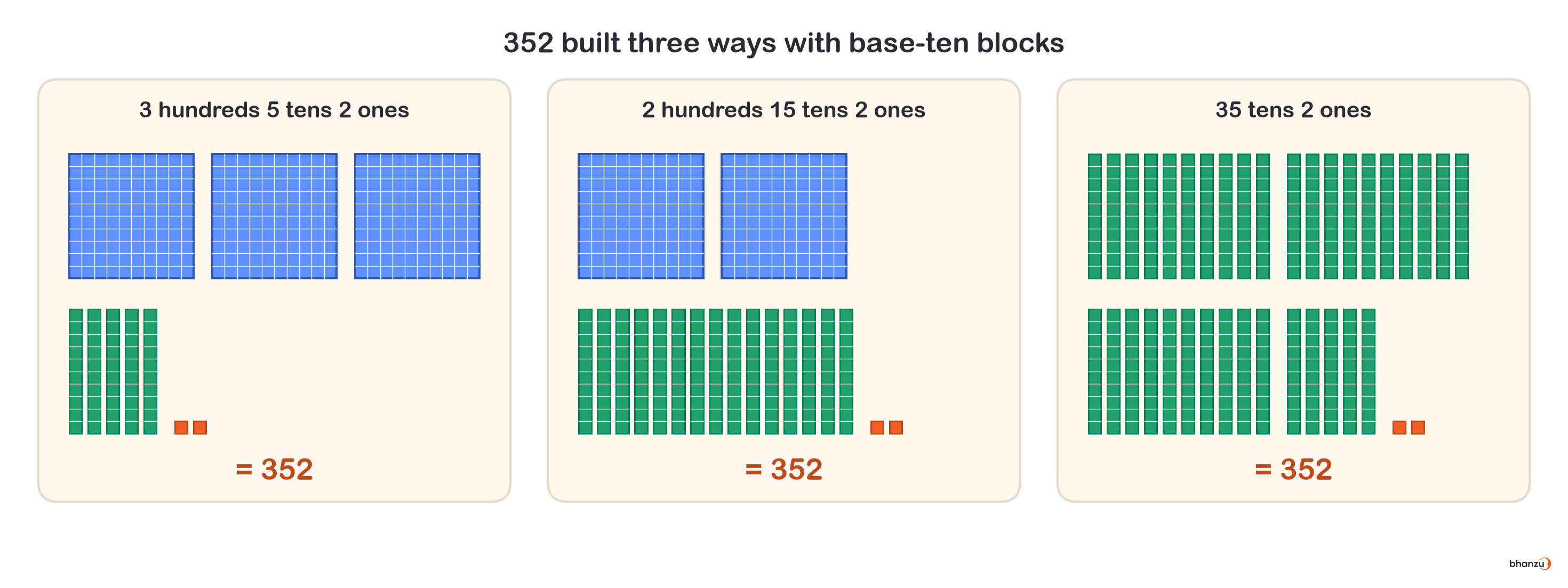
A sticker shop has 352 stickers and three ways to pack them. Some come on sheets of 100, some on strips of 10, and the rest are singles. Right now the shop holds 3 sheets, 5 strips and 2 singles.
Cut one sheet into its 10 strips, and the shop holds 2 sheets, 15 strips and 2 singles, with not one sticker missing. That swap has a name: regrouping. Later in 2nd grade, you'll make these trades when you add or subtract three-digit numbers.
What is regrouping hundreds tens and ones?
Regrouping hundreds tens and ones is a swap between places that changes how a number is built but never how much it is. Base-ten blocks show the swap.
- A flat is 100 small cubes, or 1 hundred.
- A rod is 10 cubes in a row, or 1 ten.
- A small cube is 1 one.
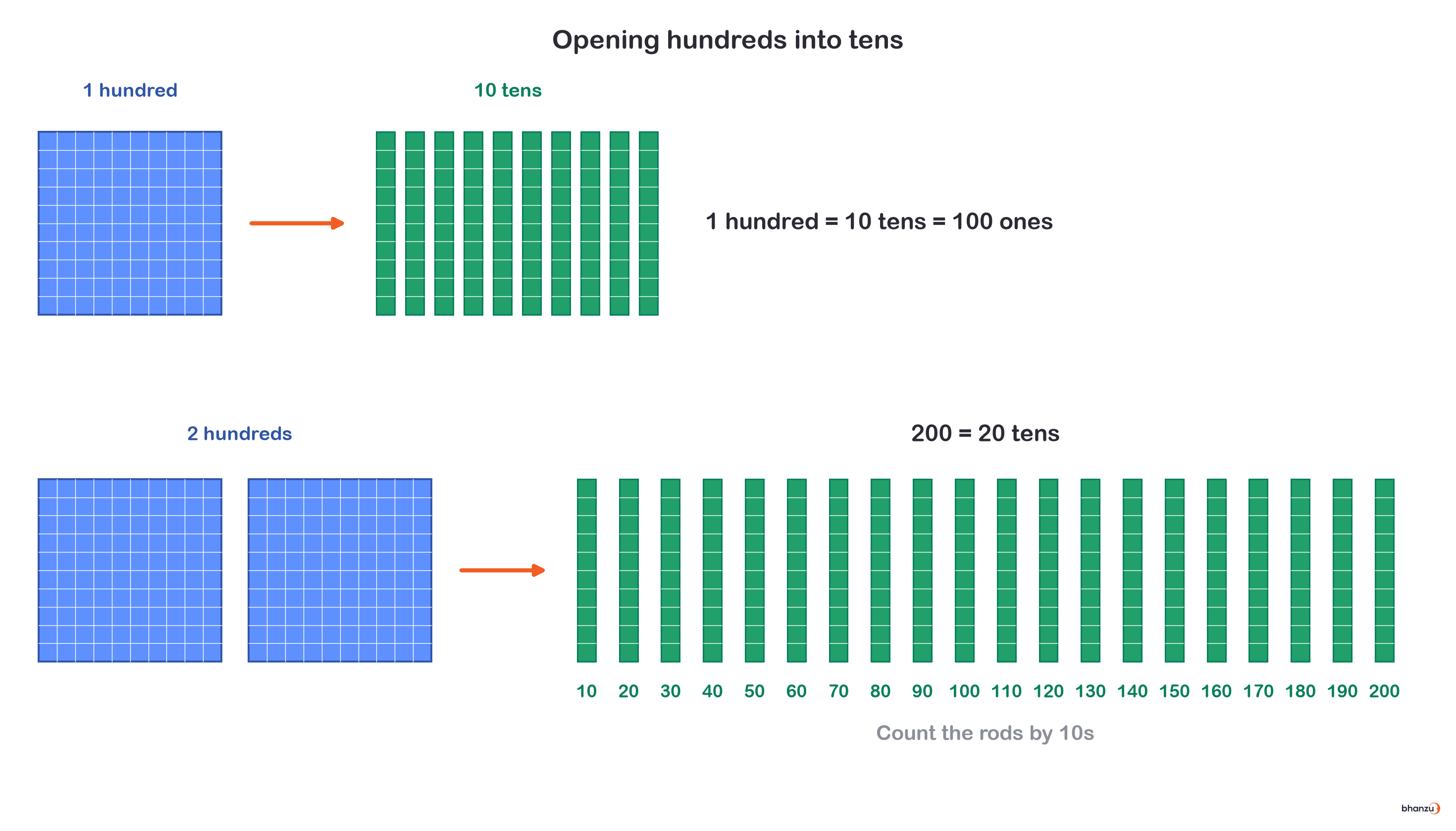
Open 1 flat and you get 10 rods, one step up from making a new ten in 1st grade. Ten tens bundled into a hundred is part of Common Core standard 2.NBT.A.1. Standard 2.NBT.B.7 then has you compose (put together) or decompose (break apart) tens or hundreds to add or subtract within 1000.
This year, your child renames numbers up to 1,000 with blocks and drawings, then uses those trades to add and subtract. Place value takes time to settle. In a 2022 study of 205 second graders in Turkey, place value scored lowest of three skills checked.
How do you regroup hundreds as tens?
To regroup a hundred as tens, take 1 away from the hundreds and add 10 to the tens.
- Build 352 with blocks, or write it in a place value chart (hundreds, tens and ones columns).
- Open 1 hundred, so 3 hundreds become 2.
- Add its 10 tens to the 5 tens, making 15 tens.
- Check by adding the parts, .
That check is a stretched cousin of expanded form, . Trading up runs backward, so 10 of the 15 tens become 1 hundred again. With 0 tens, as in 402, open a hundred to get 3 hundreds, 10 tens and 2 ones.
| Hundreds | Tens | Ones | Check |
|---|---|---|---|
| 3 | 5 | 2 | |
| 2 | 15 | 2 | |
| 1 | 25 | 2 | |
| 0 | 35 | 2 |
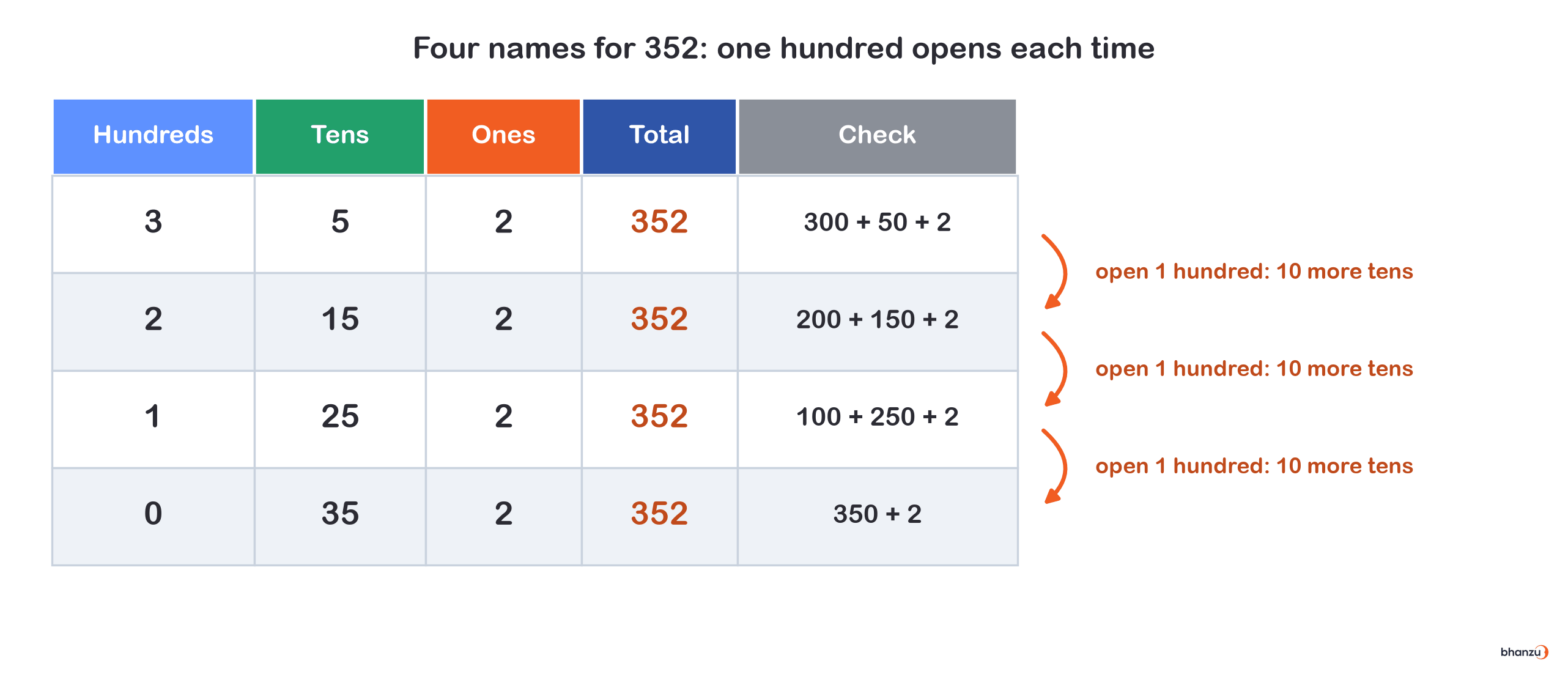
In a 2016 study, first graders built numbers such as 28 and 61 with the most ten-blocks possible on 90% of tries. Kindergartners did so on 56%. Adding and subtracting need the other names too, like 2 hundreds and 15 tens.
Opening flats one at a time gets slow for all 35 tens in 352. Once you know 1 hundred is 10 tens, count the 3 hundreds as 10, 20, 30 tens and add the 5 tens to reach 35.
Try It Yourself
Tap Break to swap 1 hundred for 10 tens or 1 ten for 10 ones, and Bundle to trade back. The value stays the same after every trade and changes only when plus or minus adds or removes a block. Then tap New target and build a number with exactly the tens or hundreds it names.
How many tens are in 200?
There are 20 tens in 200, because each of its 2 hundreds is 10 tens. Lay out the rods from 2 flats and use skip counting by 10s up to 200, and you say 20 numbers, one per rod.
The same count finds 35 tens in 350. Ten tens make 1 hundred, and that hundred holds 100 ones, since each ten is 10 ones. Money trades the same way.
So $3.52 is 3 dollars, 5 dimes and 2 pennies, or 35 dimes and 2 pennies.
The tens digit and how many tens sound alike (grown-ups mix them up too), but they ask different questions. A child who rushes to the answer often reads the 5 straight off 352 and stops.
In 4th grade, the same counting renames 3,400 as 34 hundreds.
Examples of regrouping hundreds tens and ones
Example 1
Rename 1 hundred, 4 tens and 6 ones using only tens and ones.
1 hundred is 10 tens.
The number is 14 tens and 6 ones.
Check: .
Example 2
How many tens are in 352?
The tempting answer is 5, the digit in the tens place.
But 5 tens is only 50, and , nowhere near 352. The 3 hundreds were left out.
Each hundred is 10 tens, so 3 hundreds are 30 tens.
352 holds 35 tens and 2 ones.
Check: .
Example 3
How many tens go with 2 hundreds and 7 ones to make 347?
347 is 3 hundreds, 4 tens and 7 ones.
With only 2 hundreds, 1 hundred was opened into 10 tens.
The answer is 14 tens.
Check: .
Example 4
Leo builds a number with 4 hundreds, 13 tens and 5 ones. What number is it?
13 tens is 1 hundred and 3 tens.
Moving that hundred over makes 5 hundreds, 3 tens and 5 ones.
Leo's number is 535.
Check: .
Example 5
Priya has 3 one-dollar bills, 5 dimes and 2 pennies. Sam has 35 dimes and 2 pennies. Who has more money?
Priya has cents.
Sam's 35 dimes are 350 cents, and cents.
Neither. Both have $3.52, because Priya's 3 dollars and 5 dimes make 35 dimes.
Example 6
A sticker shop has 4 sheets of 100 stickers, 2 single stickers and no strips of 10. Mei wants 3 strips of 10. How many stickers are left after she gets them?
The shop has 402 stickers.
Cut 1 sheet into 10 strips, so the shop has 3 sheets, 10 strips and 2 singles.
Give Mei 3 strips, leaving strips.
That is 3 sheets, 7 strips and 2 singles, or 372 stickers.
Check: .
Why does trading 10 for 1 work?
Trading works because 1 hundred is exactly 10 tens and 1 ten is exactly 10 ones, so 1 out and 10 in keeps the total.
- It makes adding work. When adding three-digit numbers gives 13 tens, 10 of them become 1 more hundred.
- It makes taking away work. Subtraction needs a trade only when a place has too few, so in subtracting three-digit numbers such as 402 take away 30, you start by opening a hundred.
- It makes mental math easier. 352 take away 30 is 35 tens take away 3 tens, leaving 32 tens and 2 ones, or 322.
A Karnak carving from about 1500 BC shows 276 as 15 symbols in Egyptian numerals, 2 hundreds, 7 tens and 6 ones. Adding with these symbols means swapping ten copies of a symbol for one symbol of the next value, just as you swap 10 rods for a flat.
The part of regrouping nobody explains
A place on a mat can hold 15 tens, or even 25 (the mat doesn't mind), while you trade. Only the written number needs one digit per place, so trade back to 3 hundreds and 5 tens before writing 352. A child who second-guesses a right answer may undo a correct trade because 15 tens looks like it breaks a rule.
For parents, renaming settles over years. In the national Early Childhood Longitudinal Study (ECLS-K), by the spring of 2002, when most of the children were finishing 3rd grade, 42% showed place value understanding to the hundreds. Blocks and drawings all through 2nd grade are a normal part of getting there.
The mistakes kids make most often with regrouping
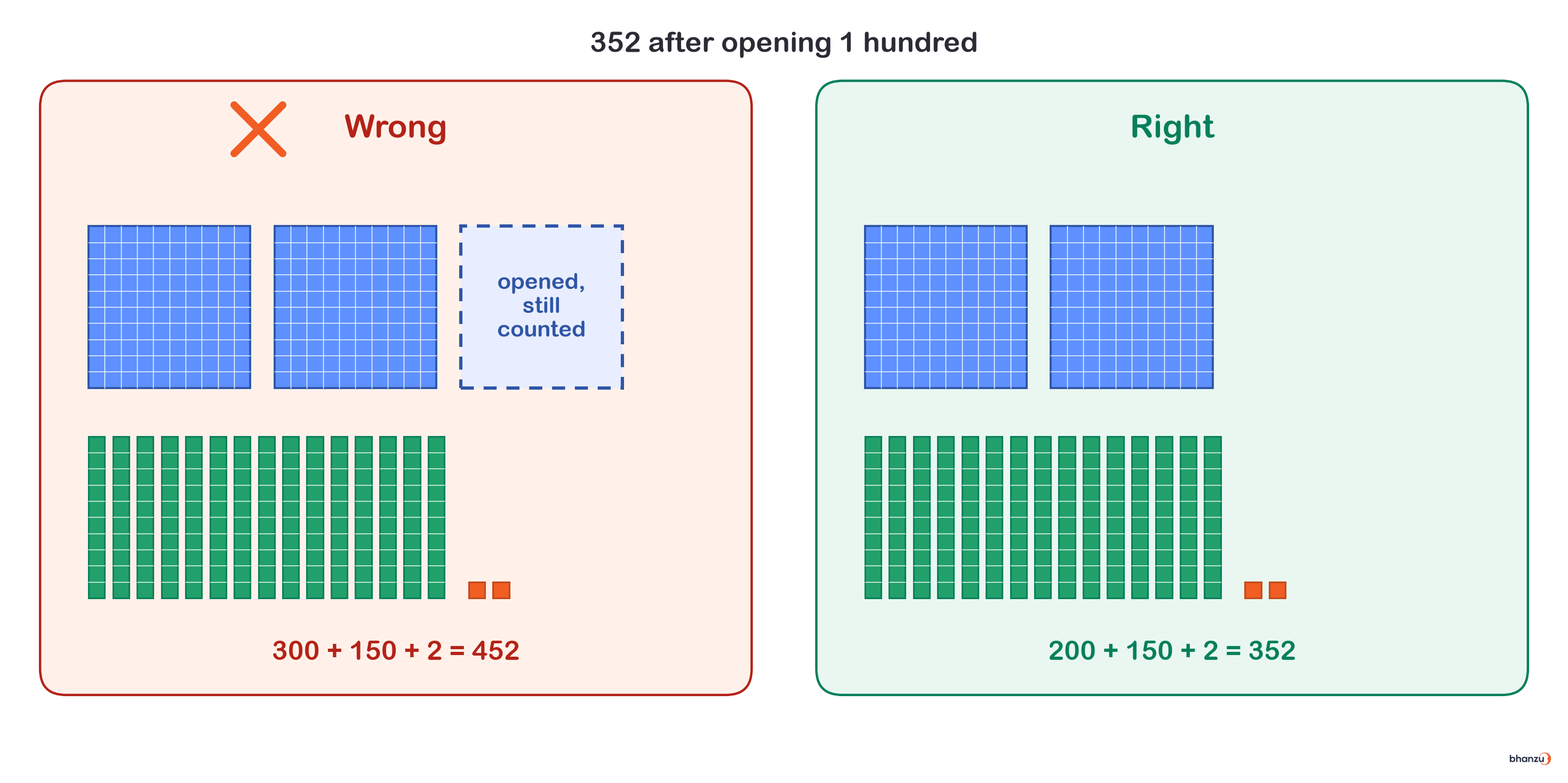
Mistake 1: Opening a hundred but still counting it
Where it slips in: Renaming with fewer hundreds, as in Example 3. Children see 10 new tens arrive and forget that the flat they came from has left the mat.
Don't do this: Rewriting 352 as 3 hundreds, 15 tens and 2 ones, which makes .
The correct way: Write 2 hundreds, 15 tens and 2 ones, so .
On a real mat, the opened flat often stays in the hundreds column while its 10 rods land beside it.
Mistake 2: Squeezing two digits into one place
Where it slips in: Writing the number after trading up, as in Example 4, when each pile gets read as its own number.
Don't do this: Writing 4 hundreds, 13 tens and 5 ones as 4135.
The correct way: Trade 10 of the 13 tens for 1 hundred first, which gives 535.
Children often say it aloud as "four hundred thirteen five". A size check catches it, because 4 hundreds and 13 tens is less than 600.
Mistake 3: Trading a hundred for only 10 ones
Where it slips in: Making extra ones out of 352. A child who repeats "10 ones make a ten" may not yet know that a hundred holds 10 tens.
Don't do this: Rewriting 352 as 2 hundreds, 5 tens and 12 ones, which is only 262.
The correct way: For more ones, open a ten instead, giving 3 hundreds, 4 tens and 12 ones, since .
Key Takeaways
- Trade back until every place holds one digit before you write the number.
- When you open a hundred, take its flat away before laying down 10 rods.
- Regrouping hundreds tens and ones gives a number new names that all add back to the same total.
- For practice opening hundreds with a teacher who spots the forgotten flat, explore Bhanzu's 2nd grade math curriculum or math classes for kids.
Read More
- Comparing and Ordering Three-Digit Numbers
- Adding Two-Digit Numbers With Regrouping
- Subtracting Two-Digit Numbers With Regrouping
- Regrouping Whole Numbers
- Whole Numbers
Research Behind This Article
- Common Core State Standards Initiative, Grade 2: Number and Operations in Base Ten (2010). thecorestandards.org
- Birgin, Gurbuz and Memis, Performance of Second-Grade Elementary School Students on Counting, Place Value Understanding, and Addition Operation in Natural Numbers (2022). eric.ed.gov
- Laski, Vasilyeva and Schiffman, Longitudinal Comparison of Place-Value and Arithmetic Knowledge in Montessori and Non-Montessori Students (2016). eric.ed.gov
- O'Connor and Robertson, MacTutor History of Mathematics, Egyptian numerals (2000). mathshistory.st-andrews.ac.uk
- National Center for Education Statistics, From Kindergarten Through Third Grade: Children's Beginning School Experiences (2004). nces.ed.gov
Quick Quiz: Check Yourself
Three levels, new numbers every time: rename hundreds as tens, then count, fill in or build with tens, then solve money and sticker problems.
Was this article helpful?
Your feedback helps us write better content
Frequently Asked Questions
Is regrouping the same as renaming?
Is regrouping and borrowing the same thing?
What does regroup mean in 2nd grade math?
How do I teach regrouping in 2nd grade at home?
What is 10 hundreds?