Key Points
- Comparing three-digit numbers starts at the hundreds digit and moves right to the tens or ones only after a tie.
- The hundreds decide first because the greatest number with just 1 hundred is 199, still 1 less than 200.
- A frequent error lets the biggest digit win, yet 479 is less than 502 because 4 hundreds is fewer than 5 hundreds.
- A two-digit number has 0 hundreds, so 98 is less than 120 even though 9 is bigger than 1.
The biggest planet loses the moon count
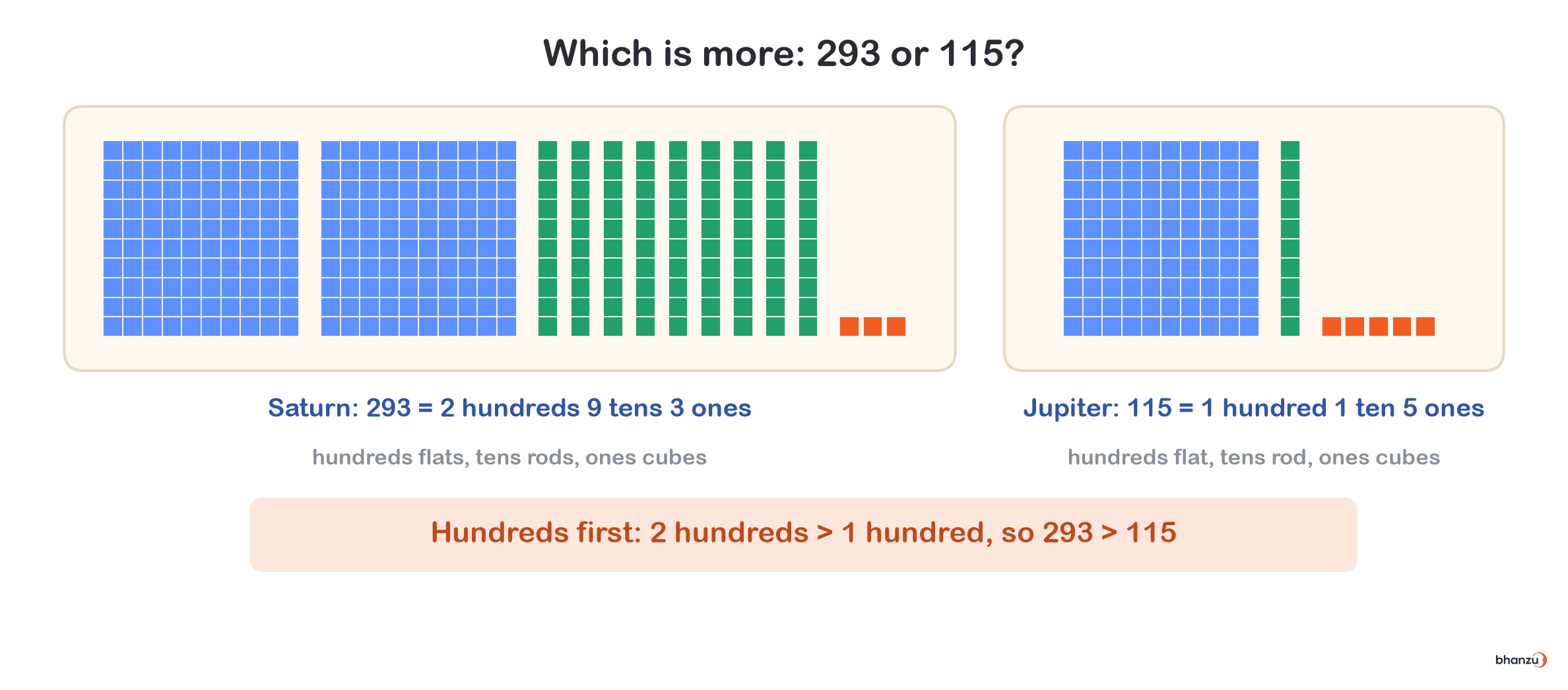
Jupiter is the biggest planet, yet Saturn has more moons. NASA counts 293 confirmed moons around Saturn as of August 2026. NASA's Jupiter page, updated in November 2026, lists 115.
You can tell which count is bigger without counting a single moon. One digit in each number settles it. Soon the same look helps you round 293 to about 300 and spot an adding answer that cannot be right.
How do you compare three-digit numbers?
Comparing three-digit numbers uses place value, the value a digit gets from where it sits, so you check the hundreds first and move right only after a tie. Base-ten blocks show the places: flats for hundreds, rods for tens and cubes for ones.
A three-digit number is any of the whole numbers from 100 to 999, and expanded form splits it into places.
| Number | Hundreds, tens, ones | Expanded form |
|---|---|---|
| 293 | 2 hundreds, 9 tens, 3 ones | |
| 115 | 1 hundred, 1 ten, 5 ones |
NASA's count of 293 confirmed moons has 2 hundreds, and Jupiter's 115 has just 1, so Saturn wins.
The sign means "is greater than," means "is less than," and the wide-open side always faces the greater number. So is the same fact, and fits only when every place matches.
In 2nd grade, your child is expected to compare two three-digit numbers by their hundreds, tens and ones and record the result with , or , which is Common Core standard 2.NBT.A.4.
Hundreds, then tens, then ones
Compare one place at a time, starting with the hundreds on the left.
- Compare the hundreds digits.
- If they differ, more hundreds means greater. Stop there.
- If they match, compare the tens.
- If the tens match too, compare the ones.
- If every place matches, the numbers are equal.
The hundreds go first because the greatest number with 1 hundred is 199, still 1 short of 200. A place holding 10 or more, like 14 tens, needs regrouping hundreds, tens and ones first.
In a place value chart, a table with one column per place, 381 and 347 both show 3 hundreds. The job then shrinks to comparing two-digit numbers, and 81 against 47 gives .
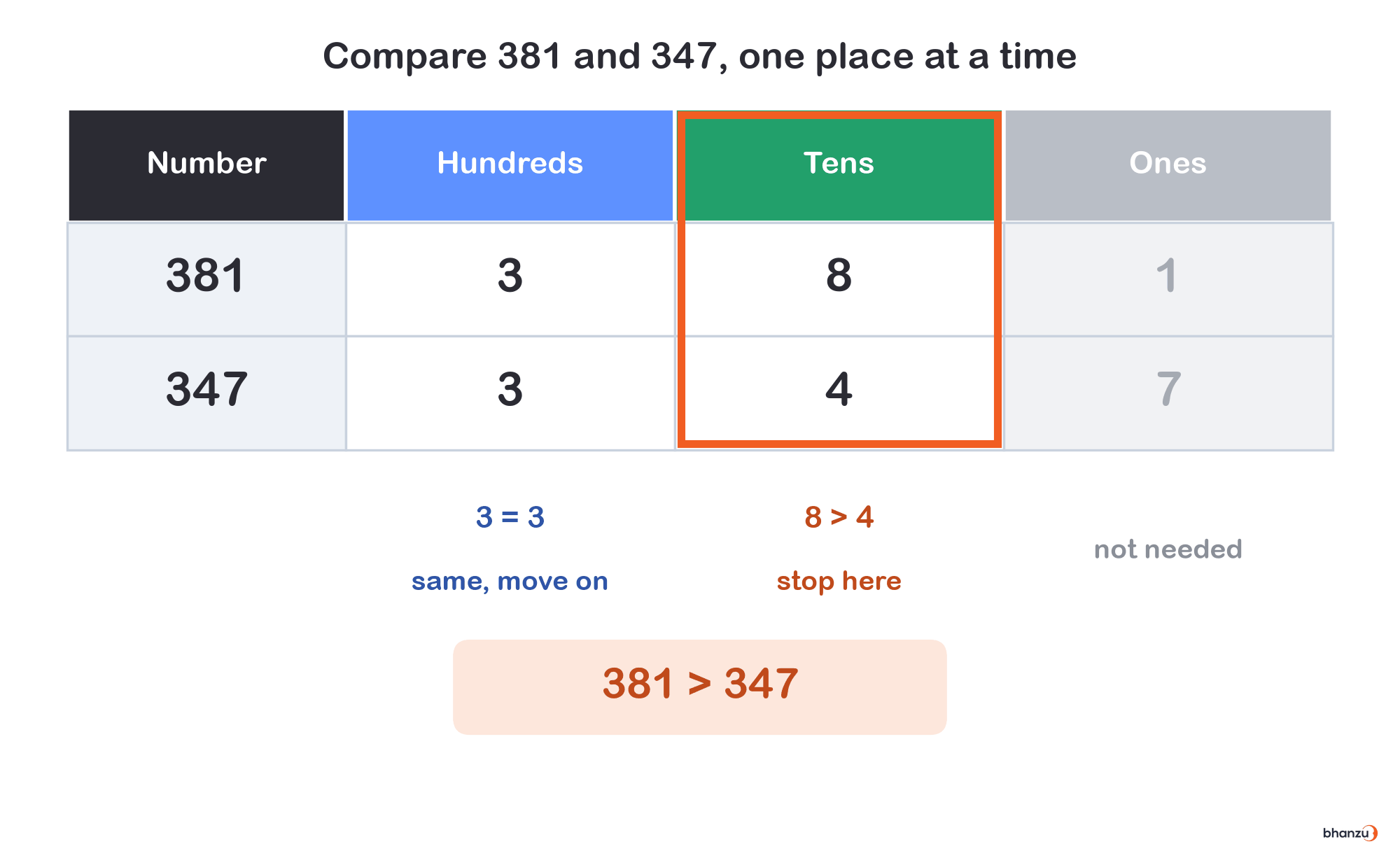
The ones decide only when the hundreds and tens both tie, as with 526 and 529.
After a hundreds tie, a child sometimes stops and guesses, since "look at the hundreds" was the first rule learned. A tie means move one place right.
Try It Yourself
Build a number on each mat with flats, rods and cubes, then tap which number is greater, or Same. The readout checks the hundreds first and moves right only after a tie. Pile up 10 ones or 10 tens, then trade them and watch the number stay the same.
How do you compare a three-digit and a two-digit number?
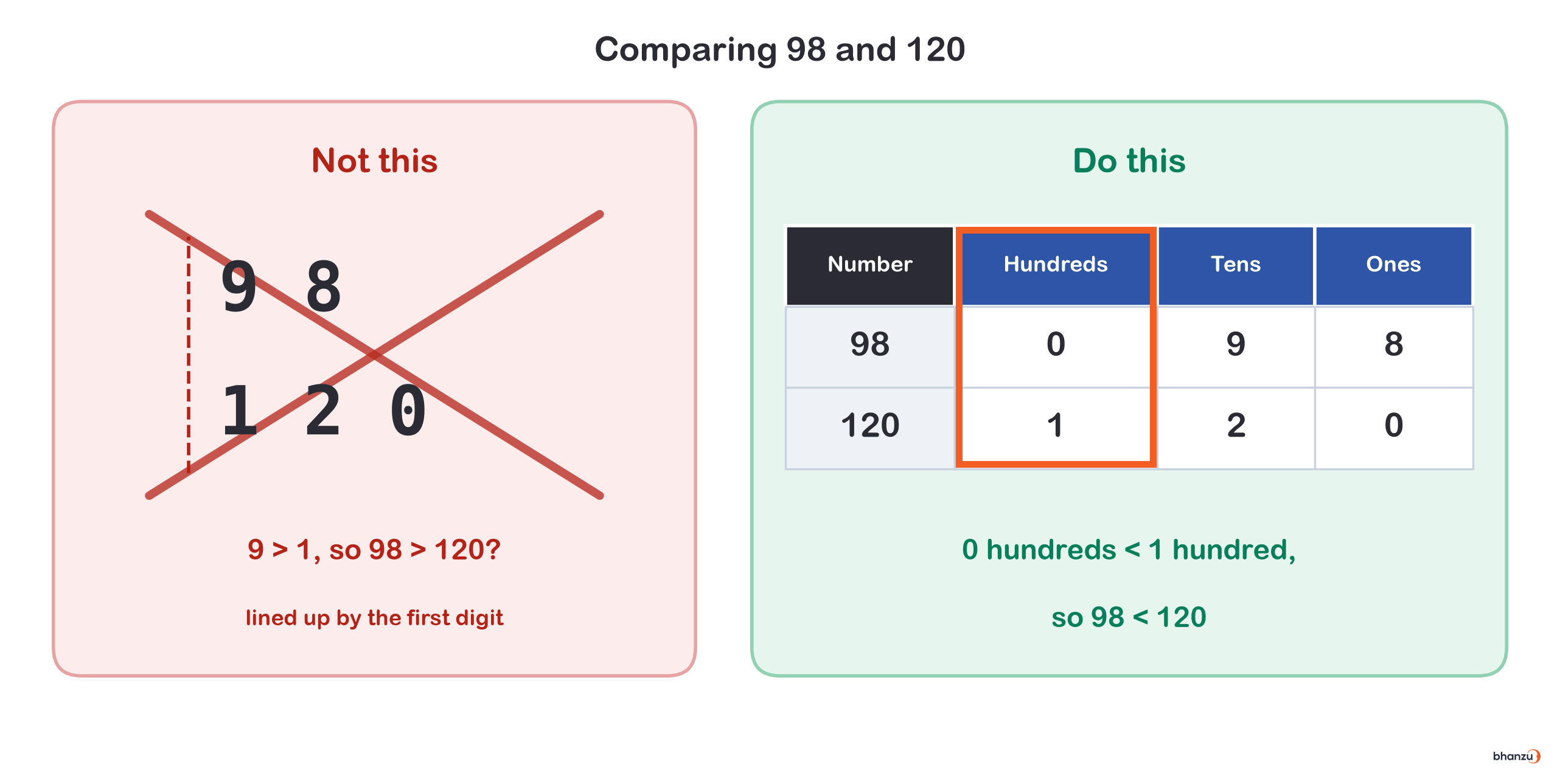
Every three-digit number is greater than every two-digit number, because a two-digit number has 0 hundreds. Even 100 beats 99 (the smallest three-digit number against the greatest two-digit one). Line the numbers up by place, not by their left edges.
| Number | Hundreds | Tens | Ones |
|---|---|---|---|
| 85 | 0 | 8 | 5 |
| 112 | 1 | 1 | 2 |
The hundreds differ, 0 against 1, so even though 8 is bigger than 1. More digits means greater for whole numbers, but once decimals arrive in later grades, a longer number can be smaller.
How do you order three-digit numbers?
Ordering three-digit numbers from least to greatest puts the smallest first, and the hundreds sort the list. It is the same two-number check, repeated pair by pair.
Comparing numbers on a number line
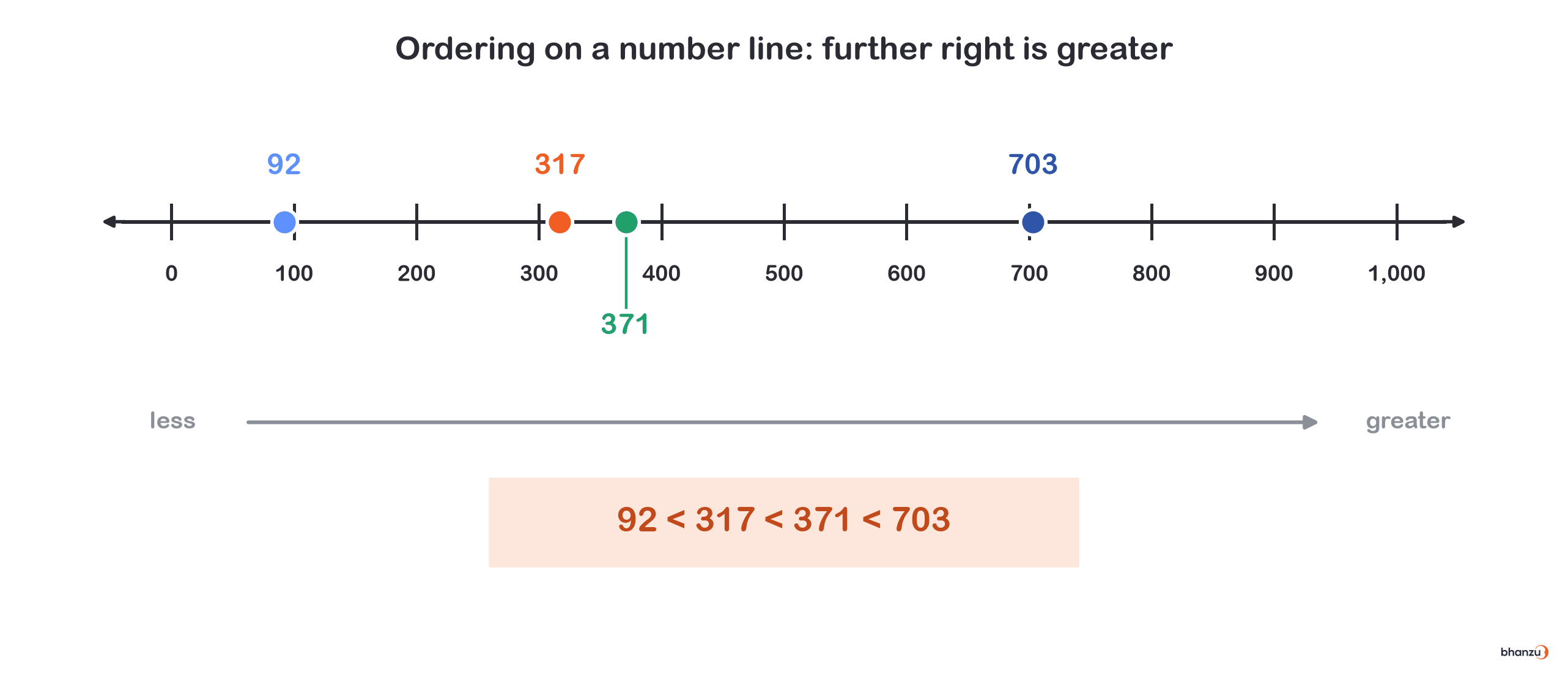
On a number line from 0 to 1,000, a number further right is greater, the same order you meet when counting within 1,000. Place each one by its hundreds first (317 and 371 both land between 300 and 400), then by its tens.
Ordering a list step by step
- Sort by the hundreds digits, giving a two-digit number 0 hundreds.
- Break a hundreds tie with the tens, and a tens tie with the ones.
- For greatest to least, read the list backward.
Try 371, 92, 703 and 317. The hundreds put 92 first and 703 last. Then 1 ten against 7 tens puts 317 before 371, so the order is 92, 317, 371, 703.
Examples of comparing three-digit numbers
Example 1
Compare 614 and 389 using , or .
614 has 6 hundreds and 389 has 3 hundreds, so the hundreds decide.
Example 2
Compare 752 and 728, then write the comparison two ways.
The hundreds tie at 7, and 5 tens beat 2 tens.
Read from the other side, it is .
Example 3
Compare 607 and 670.
Both use the digits 6, 0 and 7, so it is tempting to write .
That cannot be right. 670 has 7 tens, which is 70, while 607 has only 7 ones. On a number line, 670 sits 63 steps to the right of 607.
Compare by place instead. The hundreds tie at 6, and 0 tens is less than 7 tens.
Example 4
Leo has 8 hundred-dollar bills and 5 ten-dollar bills. Mei has $835. Who has more money?
Leo's bills make 8 hundreds and 5 tens, or $850. The hundreds tie at 8, and 5 tens beat 3 tens.
$$$850 > $835$$
Leo has more money.
Example 5
Put 640, 604, 446 and 99 in order from greatest to least.
The hundreds are 6, 6, 4 and 0, since 99 has 0 hundreds. The tens break the tie between 640 and 604, 4 against 0.
Example 6
Maya read 452 pages, Leo read 437 and Aisha read 398. Who read the most, who read the fewest, and what is the order from least to greatest?
The hundreds are 4, 4 and 3, so Aisha read the fewest. Maya and Leo tie at 4 hundreds, and 5 tens beat 3 tens, so Maya read the most.
What makes comparing three-digit numbers worth learning?
Comparing tells you which amount is bigger without counting every single thing.
- It answers counts too big to line up. Two hundreds against one hundred decides Saturn against Jupiter in one look.
- It puts things in order. Page 245 comes before page 254 because 4 tens is less than 5 tens.
- It checks your adding. 312 plus 345 must land above 600, since 3 hundreds and 3 hundreds make 6 hundreds.
- It starts estimating. 293 sits much closer to 300 than to 200, the first step in rounding.
In a 2014 study of 1,391 children in grades 1 to 6, picking the bigger of two written numbers best predicted arithmetic in grades 1 and 2. Judging whether numbers were in order kept gaining until it was the strongest predictor by grade 6.
The part of comparing three-digit numbers nobody explains
A zero in the middle of a number has a job: it holds a place open. In 607, the 0 keeps the 6 in the hundreds place (and the 7 in the ones). Drop it and 607 shrinks to 67.
| Number | Hundreds | Tens | Ones |
|---|---|---|---|
| 607 | 6 | 0 | 7 |
| 67 | 0 | 6 | 7 |
That job is old. The oldest dated zero in India that historians agree is genuine was carved in 876 on a stone in Gwalior, inside the numbers 270 and 50. The stone describes a garden 187 by 270 hastas (an old unit of length), and the hundreds alone show 270 is longer.
Tripping points to avoid with comparing three-digit numbers
Mistake 1: Letting the biggest digit win
Where it slips in: Pairs where the smaller number holds the biggest digit, like 479 and 502.
Don't do this: Spotting the 9 and writing .
The correct way: Check the hundreds first. 4 hundreds is less than 5 hundreds, so .
Adding starts at the ones column, so a child who adds well is used to reading from the right. A child who rushes in from that end sees 9 ones beat 2 ones and stops, though the ones are the smallest place.
Mistake 2: Flipping the sign after a hundreds tie
Where it slips in: Pairs that tie in the hundreds, such as 836 and 831, after the comparison is already right.
Don't do this: Deciding 836 is greater, then writing .
The correct way: Say "836 is greater than 831" first, then write with the wide side facing 836.
Tracking two matching places uses up attention, so the sign comes from a remembered picture. This part really is confusing, because one sign reads "greater than" from the left and "less than" from the right.
Mistake 3: Lining up a two-digit number by its first digit
Where it slips in: Lists that mix two-digit and three-digit numbers, such as 98 and 120.
Don't do this: Writing because 9 is bigger than 1.
The correct way: Give 98 a 0 in the hundreds place. 0 hundreds is less than 1 hundred, so .
The eye compares left edges, but the 9 in 98 is a tens digit.
Key Takeaways
- When comparing three-digit numbers, a difference in the hundreds ends the job, and a tie sends you one place right.
- Give a two-digit number 0 hundreds before lining it up with a three-digit number.
- Swapping digits makes a new number, so 607 and 670 are not equal.
- To order a list, sort by hundreds, then settle ties with the tens and ones.
- For practice with a teacher who spots the biggest-digit trap, explore Bhanzu's 2nd grade math tutor or math programs for kids.
Read More
- Adding Two-Digit Numbers With Regrouping
- Estimating to the Nearest Ten and Hundred
- Comparing and Ordering Multi-Digit Numbers
- How to Teach Math to Kids
- Math Skills for Kids
Research Behind This Article
- NASA Science, Saturn Moons (2026). science.nasa.gov
- NASA Science, Jupiter Moons (2026). science.nasa.gov
- Common Core State Standards Initiative, Grade 2 Number and Operations in Base Ten (2010). thecorestandards.org
- Lyons, Ian M. and others, Numerical Predictors of Arithmetic Success in Grades 1-6 (2014). eric.ed.gov
- MacTutor History of Mathematics, A history of Zero (2000). mathshistory.st-andrews.ac.uk
Quick Quiz: Check Yourself
Three levels, new numbers every time. Easy asks for the sign when the hundreds differ, and Medium adds ties, swapped digits, two-digit numbers and numbers given as hundreds and tens or ones. Hard asks for the greatest, the least or the second number from least to greatest in a set of 3 or 4.
Was this article helpful?
Your feedback helps us write better content
Frequently Asked Questions
What is the greatest 3-digit number?
What is ascending order and descending order?
How do you remember greater than and less than?
Is comparing three-digit numbers taught in 2nd grade?
How do you teach comparing numbers to a 2nd grader?