Key Points
- Skip counting within 1000 means saying only the landing numbers of equal hops, so a count by 100s from 140 lands on 240, 340, 440.
- Counting by ones past a hundred works because 10 ones make a ten and 10 tens make a hundred, so 200 follows 199.
- In a 2018 study, children and adults marked pairs like 698 and 701 in clearly different number line spots, pulled by the hundreds digit.
- Common Core lists counting within 1000 and skip counting by 5s, 10s and 100s as 2nd grade standard 2.NBT.A.2.
Three digits that change at once
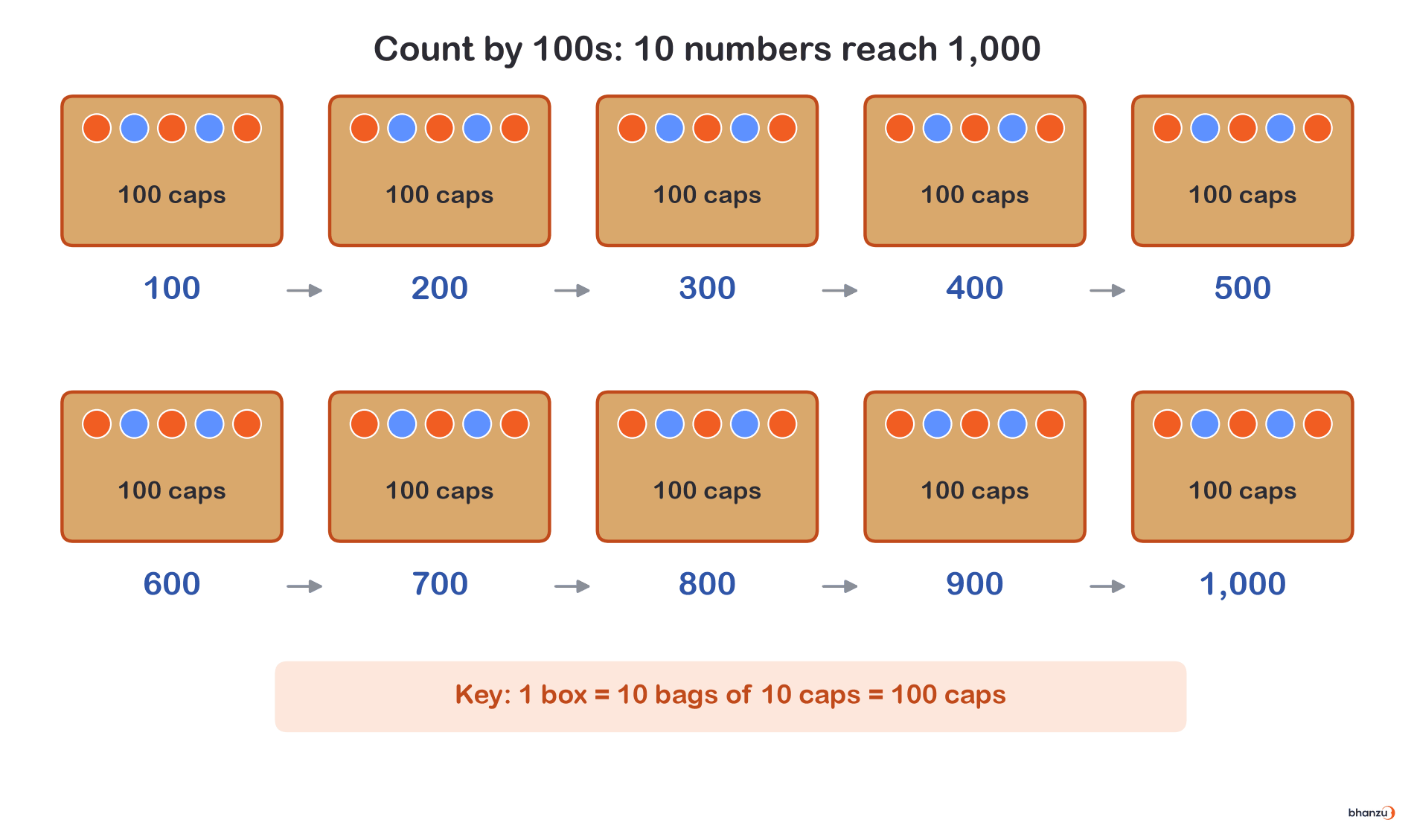
Counting to 1,000 by 100s takes only ten numbers, and they all end in 00. Leo's class is collecting 1,000 bottle caps for an art wall, in boxes of 100 and bags of 10. The boxes count fast (100, 200, 300 and on up).
The loose caps hold the surprise. Count 197, 198, 199, and the next number changes all three digits at once. Soon, these same equal jumps become the first steps of multiplication.
What does skip counting within 1000 mean?
Skip counting within 1000 means adding one fixed jump, such as 5, 10 or 100, over and over, and saying only the landing numbers. On a number line, a line with numbers spaced evenly in order, those jumps are equal hops.
Counting within 1,000 also means counting by ones from any number. Common Core standard 2.NBT.A.2 joins both skills as "Count within 1000; skip-count by 5s, 10s, and 100s" for 2nd grade. In 1st grade your child learned counting to 120, and 2nd grade stretches that count to 1,000.
| Jump | Count from 340 |
|---|---|
| 1 | 340, 341, 342 |
| 5 | 340, 345, 350 |
| 10 | 340, 350, 360 |
| 100 | 340, 440, 540 |
How do you count past a hundred?
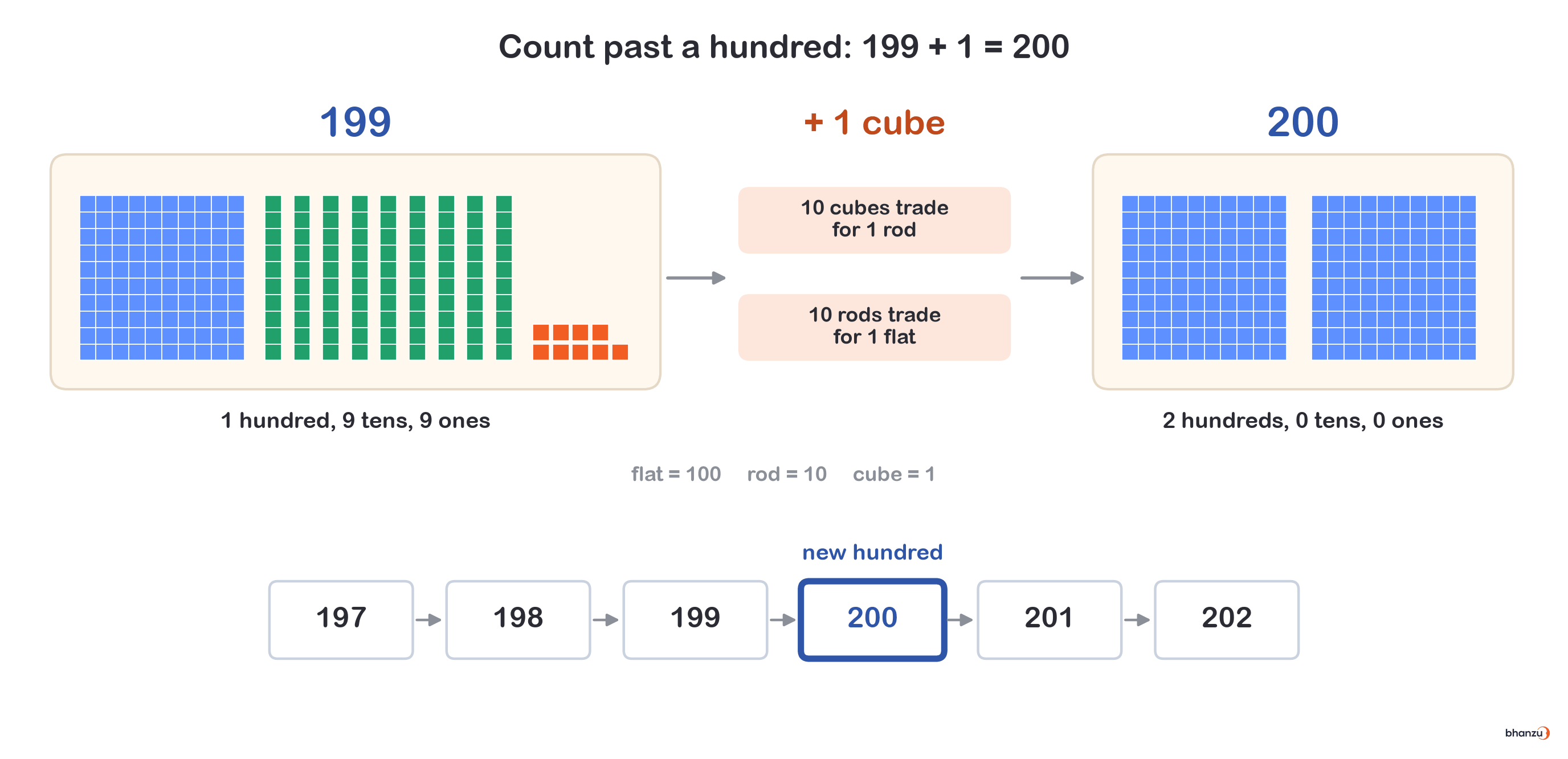
The count 197, 198, 199 turns into a new hundred at 200, because ten ones make a ten and ten tens make a hundred.
What number comes after 199?
Base-ten blocks show why. In these blocks a cube is 1, a rod is 10 and a flat is 100 (ten rods side by side). The number 199 is 1 flat, 9 rods and 9 cubes.
One more cube makes 10 cubes, which trade for a rod, and then 10 rods trade for a flat. That leaves 2 flats, which is 200. The trade is called regrouping hundreds, tens and ones.
A child who reaches 199 often stops, then says "one hundred ninety-ten" instead of 200. The guess makes sense, because in every count the child knows, ten comes after nine. (The same turn comes back at 9,999 in later grades.)
Counting back runs the trade in reverse.
This direction is genuinely harder. Going back, 0s turn into 9s, because a hundred has to break into tens and ones first.
How do you skip count by 5s, 10s and 100s?
To skip count, add the same jump to each number you say.
- Pick the jump, 5, 10 or 100.
- Say any start number, such as 347.
- Add the jump to get the next number.
- Keep the same jump at a new hundred.
Your child may have met skip counting by 2s, 5s and 10s up to 120 in 1st grade. Now the count adds 100s.
| Jump | Example count | Digit that changes |
|---|---|---|
| 100 | 140, 240, 340, 440 | Hundreds only |
| 10 | 180, 190, 200, 210 | Tens, plus the hundreds at 200 |
| 5 | 385, 390, 395, 400 | Ones switch between 5 and 0, tens every second hop, hundreds at 400 |
Skip counting by 10s from any number keeps the ones digit still, so 347 goes to 357, 367, 377. Each hop is one step of adding and subtracting 10 and 100 mentally.
How do you count backward from 1,000? Take the jump away each time, so by 100s you say 1,000, 900, 800.
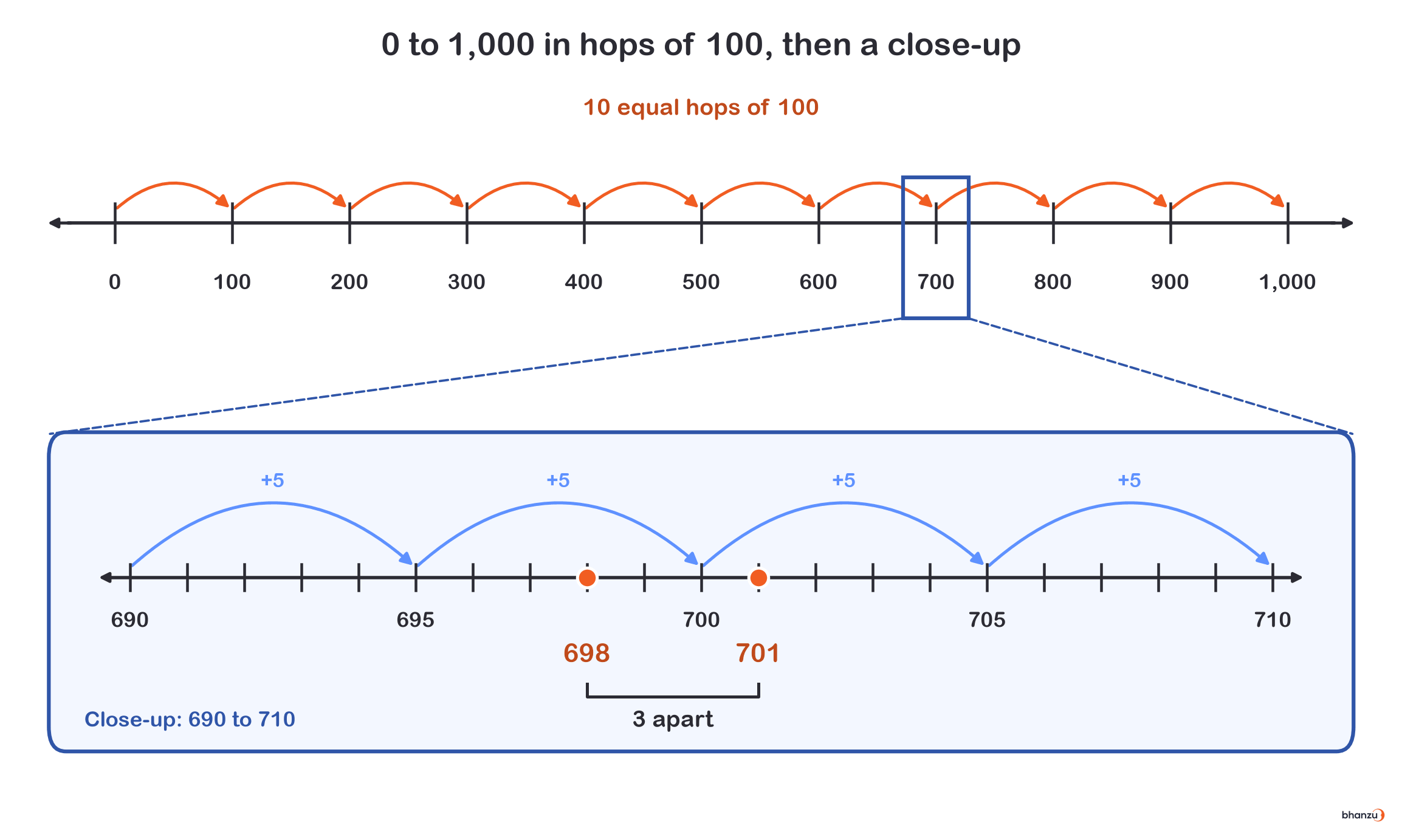
A 2018 study of 262 children and adults asked people to mark numbers on a 0 to 1,000 number line. Children aged 7 to 11 and adults placed pairs such as 698 and 701 in clearly different spots. The hundreds digit pulled the marks, though they are only 3 apart.
Counting by 5s gets slow over a long way. For a big gap, use the biggest jump that fits first, so 235 to 980 takes 12 hops instead of 149.
| Hops | Jump | You land on |
|---|---|---|
| 7 | 100 | 935 |
| 4 | 10 | 975 |
| 1 | 5 | 980 |
Try It Yourself
Pick a jump of 1, 5, 10 or 100, set a start, and press Hop forward or Hop back along the number path. The hundreds, tens and ones boxes light up any digit that changes, and each new hundred gets a label. Press Guess next to pick where the next hop lands.
Examples of skip counting within 1000
Example 1
Count by 100s from 300 to 1,000.
Add 100 each hop, so the hops land on 400, 500, 600, 700, 800, 900, 1,000.
That is 7 hops.
Example 2
A count by 10s goes 170, 180, 190, then two hidden numbers, then 220. Find them.
The tempting move restarts the tens at 0, giving 170, 180, 190, 100, 110, 220. That cannot be right, because a count forward never goes down, and 110 to 220 is a jump of 110.
Add 10 to 190 instead, since 19 tens and 1 more ten make 20 tens, or 2 hundreds.
The hidden numbers are 200 and 210.
Example 3
Leo's class has 597 bottle caps, and 5 more come in one at a time. How many caps are there now?
Count on by ones from 597, saying 598, 599, 600, 601, 602.
The class has 602 caps.
Example 4
Count back by 5s from 415 for five hops. Where does the hundreds digit change?
The count goes 410, 405, 400, 395, 390.
The hundreds digit drops from 4 to 3 between 400 and 395.
Example 5
Mei has 245 cents. She drops in 6 dimes, then 3 nickels. How many cents does she have now?
A dime is 10 cents, so count on by 10s from 245, saying 255, 265, 275, 285, 295, 305.
A nickel is 5 cents, so keep going by 5s, saying 310, 315, 320. Mei has 320 cents.
Why does skip counting matter in real life?
Big amounts are easier to count in equal groups, and a count in groups is quicker to check.
- It counts money fast. Each dime adds 10 cents, so 14 dimes make 140 cents, the same skill behind counting money.
- It reads a clock. Each number on a clock face marks 5 more minutes, so the minute hand on the 9 means 45 minutes past the hour.
- It keeps long lists in order. Tickets numbered 895 to 905 cross a new hundred at 900.
- It leads to multiplication. Counting by 5s from 0 to 50 says the 5 times table answers in order. A 2026 article for math teachers describes children growing from skip counting into thinking in groups of groups.
Counting one at a time works for a handful. Equal jumps work for a pile.
The pattern hiding inside counting to 1000
The hard spots in counting to 1,000 are the turns, where a new ten or hundred begins. A 2024 study of 279 US kindergartners looked at patterns in children's place value errors, which the researchers call smart errors. Children who made only "invented" counting errors, like invented spelling, did better at multidigit math in 2nd grade than children who made neither smart error.
For your child, the lesson is to practice the turns themselves, because a full count to 1,000 meets a new hundred only once every 100 numbers. Researchers Douglas Clements and Julie Sarama call this level Counter Beyond 100, where a child sees the patterns of ones, tens and hundreds.
Skip counting to 1000: spot the trap before you fall in
Mistake 1: Rolling over the wrong place after a 9
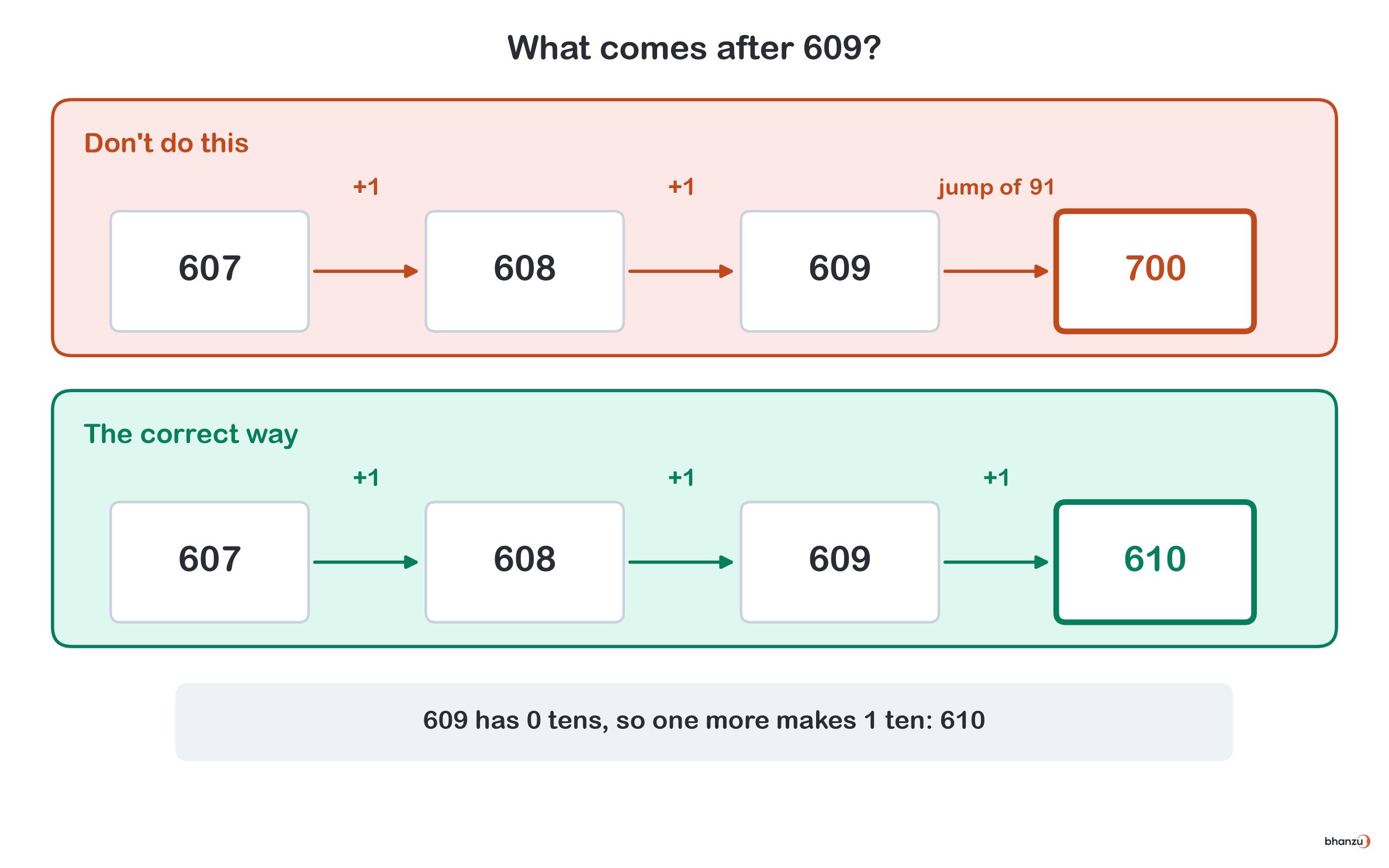
Where it slips in: Counting on by ones past a 9 that is not a hundred turn, such as the 9 in 609.
Don't do this: 607, 608, 609, 700.
The correct way: 607, 608, 609, 610, because 609 has 0 tens and one more makes 1 ten.
Right after practicing turns like 199 to 200, every 9 starts to feel like the end of a hundred.
Mistake 2: Dropping the hundreds partway through a count
Where it slips in: Counting on in the middle of a hundred, right after a number such as 349.
Don't do this: 347, 348, 349, 50.
The correct way: 347, 348, 349, 350, saying "three hundred" again.
Most children have said "forty-nine, fifty" many times while counting to 100. That pair comes out on its own, without its hundred.
Mistake 3: Snapping back to the round tens
Where it slips in: Skip counting by 10s from a start that does not end in 0, such as 625.
Don't do this: 625, 635, 645, 650, 660.
The correct way: 625, 635, 645, 655, 665, because each hop adds one ten and the 5 stays.
A child who rushes slides into the round tens they know best and stops hearing the ones digit.
Key Takeaways
- Keep every hop the same size at a new hundred, so 190 is followed by 200 in a count by 10s.
- In a count by ones, 609 rolls into a new ten at 610, while 199 rolls into a new hundred at 200.
- Skip counting within 1000 can start anywhere, and a count by 10s from 625 keeps its 5.
- For more practice crossing each new hundred without losing the count, explore Bhanzu's 2nd grade math curriculum or an elementary math tutor.
Read More
- Standard, Word and Expanded Form
- Comparing and Ordering Three-Digit Numbers
- Rounding to the Nearest 10 or 100
- Adding Within 1,000
- How to Teach Math to Kids
Research Behind This Article
- NGA Center and CCSSO, Common Core State Standards for Mathematics: Grade 2 Number and Operations in Base Ten (2010). thecorestandards.org
- Lai, M., Zax, A., and Barth, H., Digit Identity Influences Numerical Estimation in Children and Adults (2018). pubmed.ncbi.nlm.nih.gov
- Kling, G., and others, Intuitive Multiplication Fact Strategies (2026). eric.ed.gov
- Bower, C. A., and others, Smart Errors in Learning Multidigit Number Meanings (2024). eric.ed.gov
- Clements, D. H., and Sarama, J., Learning and Teaching with Learning Trajectories: Counter Beyond 100 (2019). learningtrajectories.org
Quick Quiz: Check Yourself
Three levels, new numbers every time: the next number in a count, a missing number where a count crosses a hundred, then counting stories.
Was this article helpful?
Your feedback helps us write better content
Frequently Asked Questions
Is skip counting useful for mathematical learning?
What comes after 999?
Can you skip count by 25 to 1000?
When homework says "start at 1, skip count by 2," is it 1, 3, 5 or 2, 4, 6?
What is the best way to teach skip counting at home?