Key Points
- Adding three-digit numbers works one place at a time, so in 285 + 346 the hundreds make 5, the tens 12 and the ones 11.
- Ten ones trade for 1 ten and ten tens trade for 1 hundred, so 5 hundreds, 12 tens and 11 ones become 631.
- The column method starts with the ones because each trade sends a 1 left, though trading at the end lets any order work.
- Common Core places adding within 1,000 with blocks and drawings in 2nd grade, and 3rd graders build fluency with the same sums.
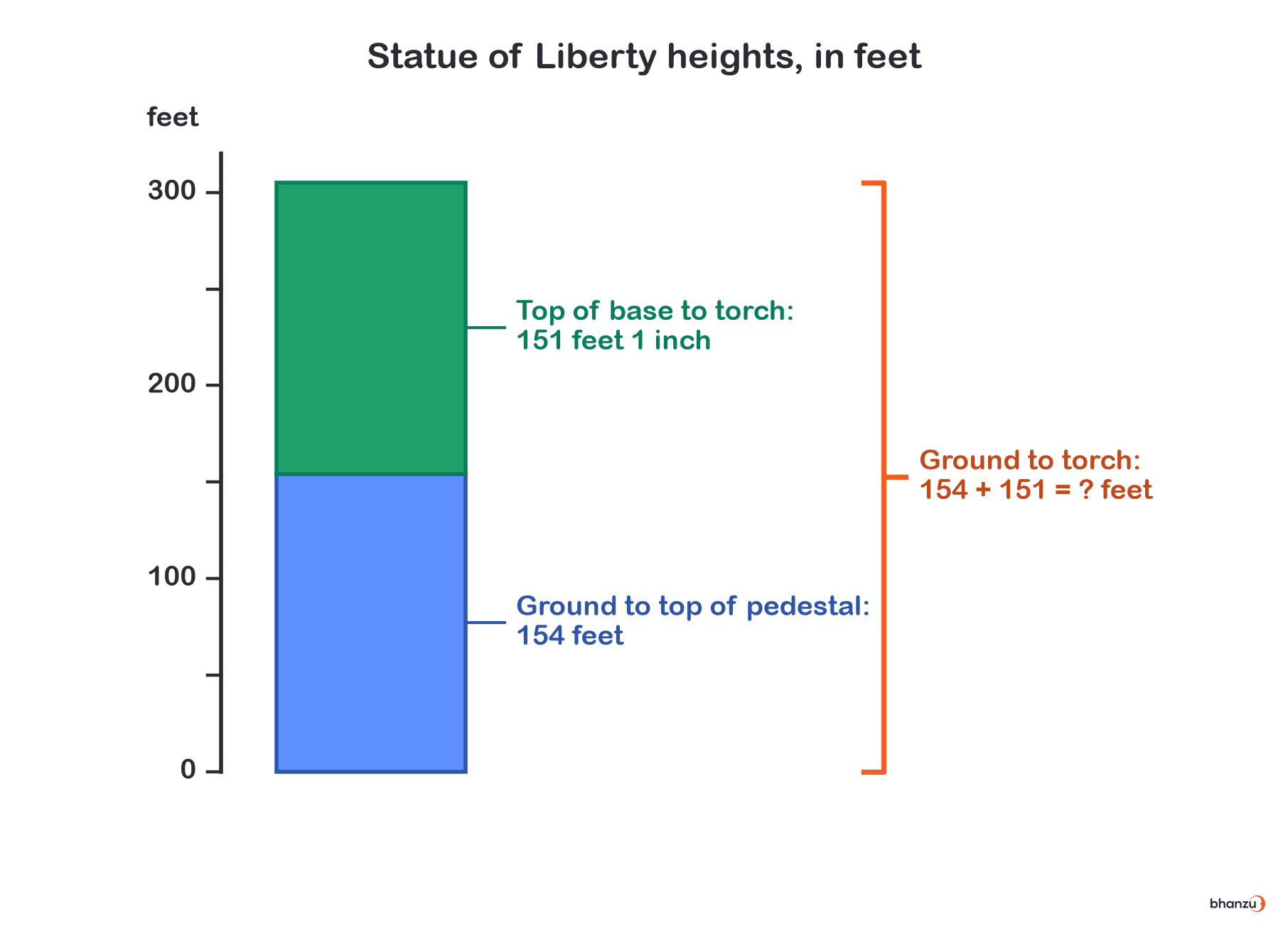
The base that stands taller than the statue
The Statue of Liberty stands on a base that is taller than the statue. The National Park Service's statue statistics, updated in 2024, list 154 feet from the ground to the top of the pedestal. The copper statue adds 151 feet 1 inch from the base to the torch.
Both heights are three-digit numbers, and Example 5 adds them. In 4th grade, the same steps will add numbers in the thousands.
How do you add three-digit numbers?
Adding three-digit numbers with base-ten blocks means putting each kind of block with its own kind and trading whenever 10 of a kind pile up. A cube is 1, a rod is 10 and a flat is 100 (ten rods side by side).
For , put 2 flats, 8 rods and 5 cubes with 3 flats, 4 rods and 6 cubes.
| Step | Hundreds | Tens | Ones |
|---|---|---|---|
| Put together | 5 | 12 | 11 |
| Trade 10 ones for 1 ten | 5 | 13 | 1 |
| Trade 10 tens for 1 hundred | 6 | 3 | 1 |
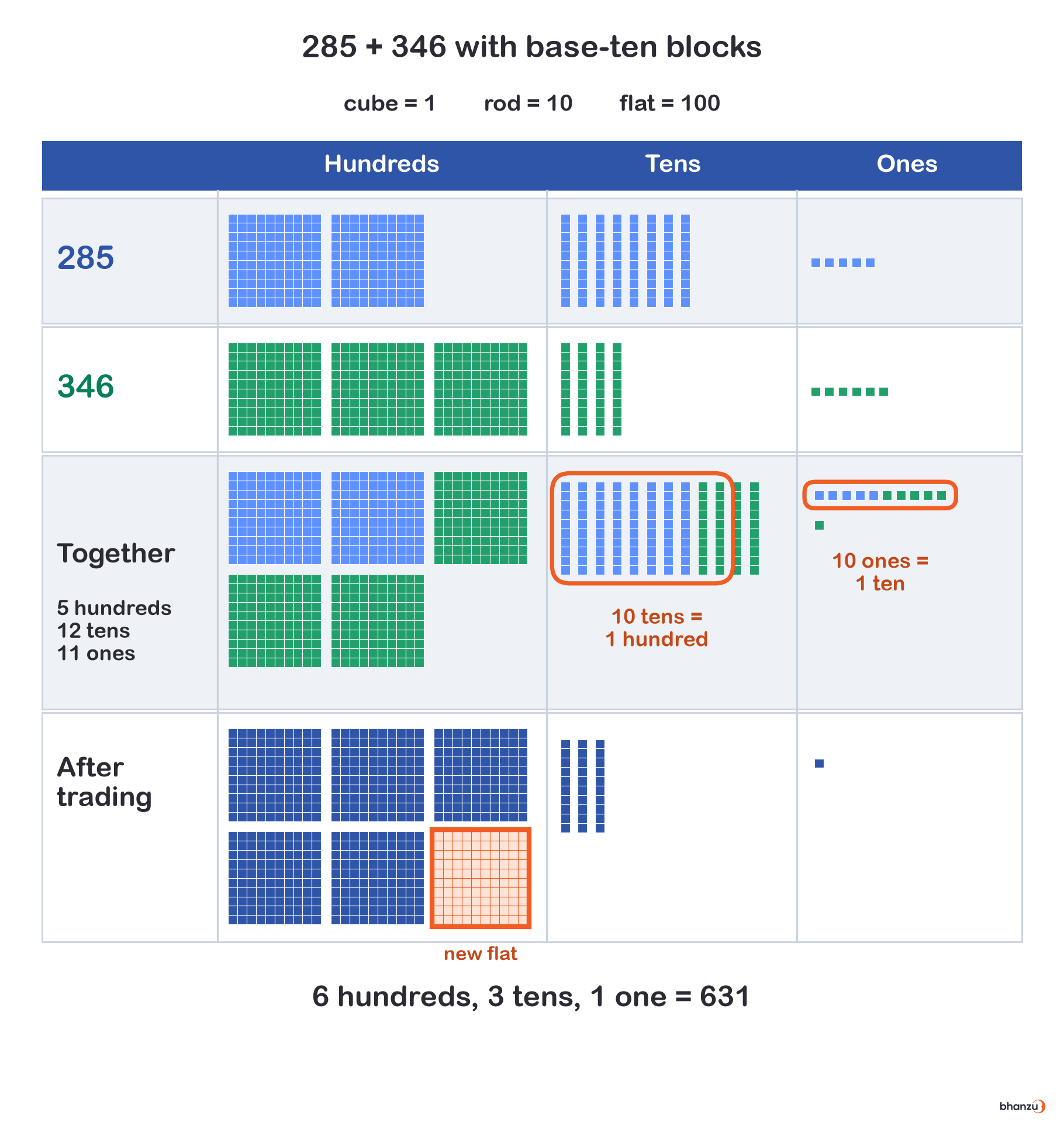
Regrouping means trading 10 of one place for 1 of the next place. The ones trade is the move you made when adding two-digit numbers with regrouping. Ten tens for a flat is the idea behind regrouping hundreds, tens and ones.
This skill is Common Core standard 2.NBT.B.7, and 2.NBT.B.9 asks children to explain why each strategy works. This year your child is expected to show each trade with blocks or a drawing and then connect that trade to a written method, such as columns.
How does expanded form help you add?
Writing each number in expanded form splits it into hundreds, tens and ones, so each place can be added on its own.
The totals 500, 120 and 11 are partial sums. Splitting works because numbers can be added in any order or grouping without changing the total. Expanded form takes six lines where columns take one, so columns win on speed.
In a 2020 study of 270 second graders in Florida, children who mixed their own strategies with the written method outscored, on average, children who stuck to the written method. The study shows a link, not a cause.
How do you add three-digit numbers with regrouping?
Write the numbers in columns, start with the ones, and trade whenever a place makes 10 or more.
- Line up hundreds, tens and ones.
- Add the ones. , so write 1 and a small 1 above the tens.
- Add the tens. , so write 3 and a small 1 above the hundreds.
- Add the hundreds. , so .
An older name for this trade is carrying. The column method is an algorithm, a set of steps that works the same way for any numbers. Sums come in four kinds.
| Problem | Ones | Tens with new ten | Trades | Sum |
|---|---|---|---|---|
| 7 | 6 | none | 867 | |
| 13 | 8 | ones | 383 | |
| 7 | 13 | tens | 537 | |
| 11 | 13 | both | 631 |
A child who trades the ones often freezes at 13 tens. Ten tens simply make a new hundred, the same move one place left.
A two-digit number starts under the tens. Three numbers can share the columns too, as in . Within 1,000, a trade in every place, as in , can only land on 1,000.
How do you add on an open number line?
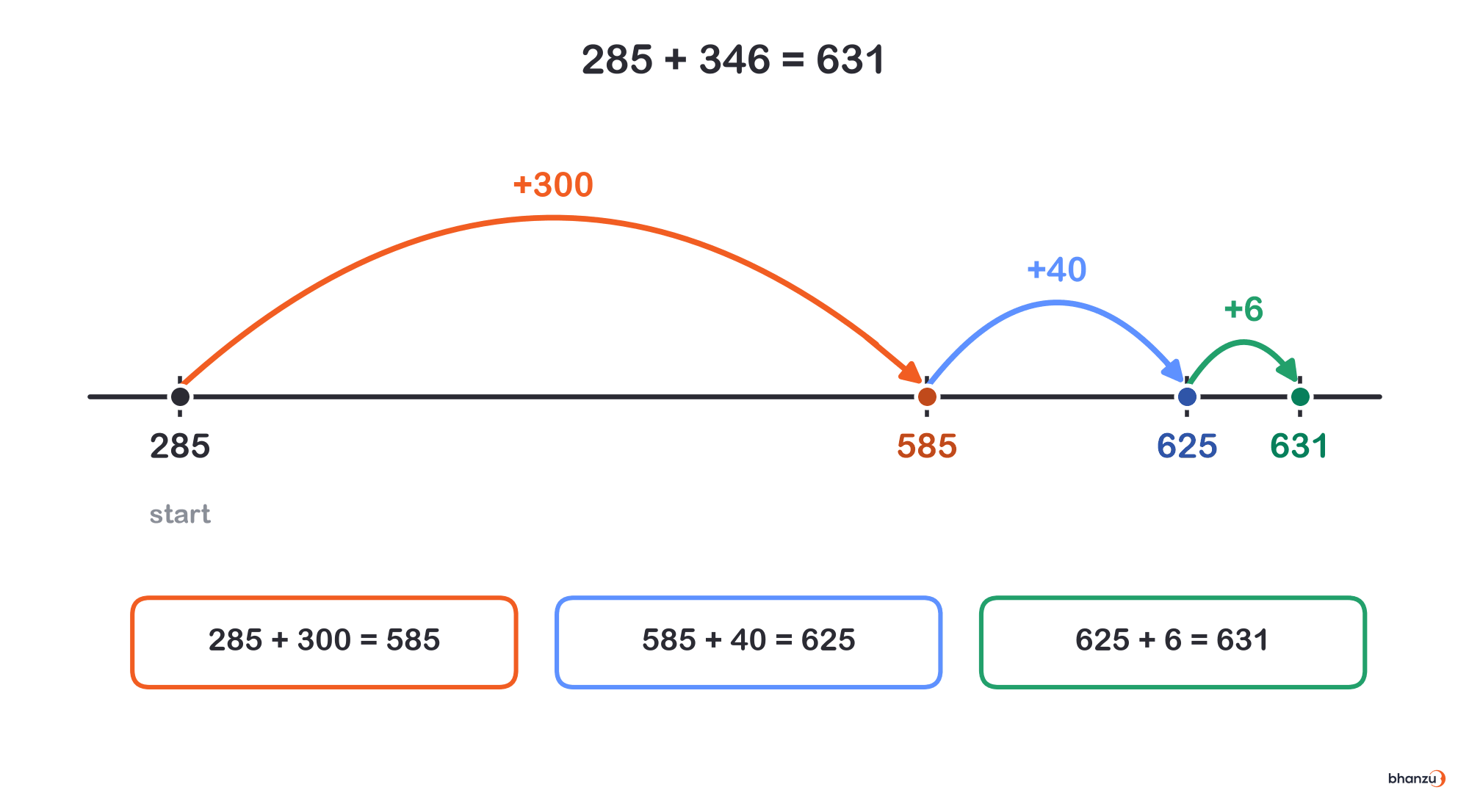
Start at one number and jump by the other number's hundreds, tens and ones. For , start at 285.
An open number line has no evenly spaced ticks, only the jumps you choose. They are the hops from adding and subtracting on a number line, made bigger. Jumps of 100 use adding and subtracting 10 and 100 mentally.
How do you add 3-digit numbers in your head?
Jump the hundreds first when adding mentally, then the tens and ones. Near a hundred, round and fix. For , add 400 and then step back 2.
When a 2016 study gave 78 fourth graders eight three-digit sums to add in their heads, about half used one strategy every time.
Adding 3-digit numbers on a number line also finds a missing part. In , the box stands for the number still needed. Jump 80 to 800 and 200 more to 1,000, so the box is 280.
| Words in the problem | Math it means |
|---|---|
| "both cost" | add the prices |
| "ground to the torch" | add the heights |
| "how many more to reach" | find the missing part |
| "in all" | add every amount |
Try It Yourself
Press the plus and minus buttons to build two three-digit numbers, then press Put together. When a place holds 10 or more, its Trade button turns 10 cubes into a rod or 10 rods into a flat. The expanded form and column steps change with every trade.
Examples of adding three-digit numbers
Example 1
What is 413 + 265?
So .
Example 2
True or false: 438 + 257 = 685.
The sum is 695, so the statement is false. The 685 left out the new ten.
Example 3
What is 256 + 179?
Adding each place and writing the totals side by side is tempting.
That gives 31215. Both numbers are less than 300, so their sum must be less than 600. Trade as you go instead.
So .
Example 4
A bike costs $189 and a helmet costs $47. How much do both cost?
Line up 47 under the 89.
Both cost $236.
Example 5
The Statue of Liberty's pedestal reaches 154 feet, and the statue adds 151 feet 1 inch. How tall is it from the ground to the torch?
Add the feet and keep the inch.
The height is 305 feet 1 inch, matching the park's total.
Example 6
Diego's class has read 465 pages. Their goal is 1,000 pages. How many more pages do they need?
The box stands for the pages still to read.
On a number line, 465 to 500 is 35, and 500 to 1,000 is 500.
Check in columns.
Diego's class needs 535 more pages.
Why does adding three-digit numbers matter?
Place value lets you add hundreds of things in a few moves instead of counting each one.
- It turns hundreds of counts into a few. Counting 631 cubes one by one takes 631 counts, while 6 flats, 3 rods and 1 cube are 10 pieces.
- It fits real measurements. Heights, distances and prices often land in the hundreds, like the park's 154 feet and 151 feet.
- It gives exact totals when "about" will not do. A class chasing a 1,000-page reading goal needs the exact number of pages left.
Without place value, every big total would mean one long count.
Adding three-digit numbers: common confusions cleared up
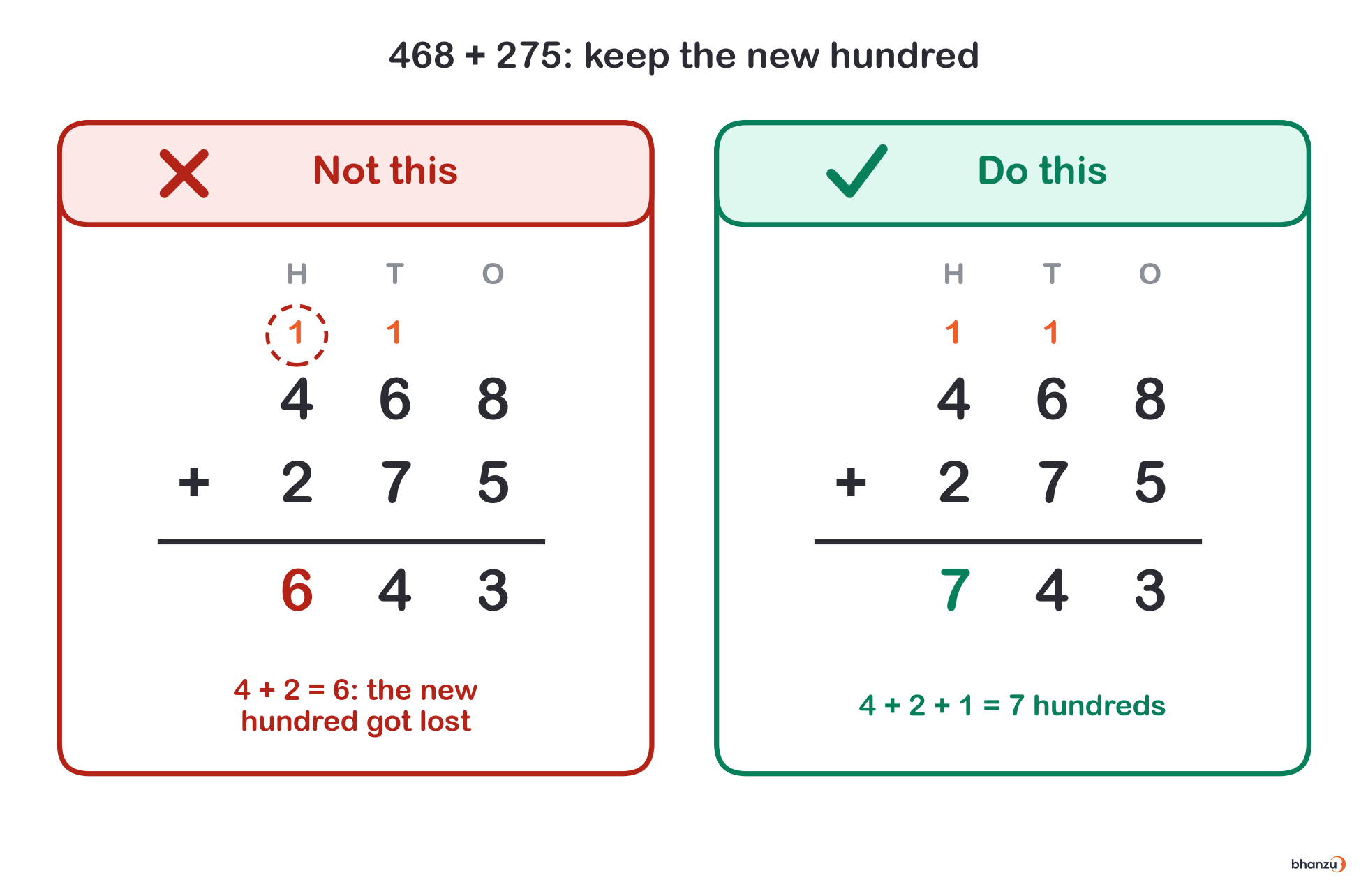
Mistake 1: Leaving out the new hundred
Where it slips in: The second trade, when the tens make 10 or more, as in .
Don't do this: Writing the small 1 above the hundreds, then adding only to get 643.
The correct way: Add the small 1 too, so and the sum is 743.
Children who get the first trade right often relax by the hundreds, so the answer lands exactly 100 too small.
Mistake 2: Starting a two-digit number under the hundreds
Where it slips in: A two-digit number added to a three-digit one, as in . A child who lines numbers up from the left, like a spelling list, puts 72 under the 35.
Don't do this: Working out .
The correct way: Write 72 under the 56, so the tens make 12 and the hundreds make , giving 428.
Mistake 3: Skipping the 0 that holds a place
Where it slips in: A number with 0 tens, such as . The 0 looks like nothing, yet it holds the 5 in the hundreds.
Don't do this: Dropping the 0, which works out .
The correct way: Keep the 0 in the tens column, so the tens make and the sum is 771.
The pattern hiding inside three-digit sums
The column method starts on the right because every trade sends a 1 to the left, into a column you have not added yet.
Adding from the left works if the trades come last, since the place totals for (untidy, but correct) still make 631.
Michelle Manes's University of Hawaii textbook for teachers teaches the same idea. The trap is writing those totals side by side, like 51211. The two small 1s in the column method look alike, which is genuinely confusing, yet the first is worth 10 and the second 100.
A hundreds check catches a lost trade. Add the hundreds digits, plus 1 if the tens and ones of both numbers make 100 or more.
So 643 cannot be right. In 3rd grade, rounding will give you another check.
Key Takeaways
- When adding three-digit numbers, ask "10 or more?" at each place, because only then does a trade happen.
- A new ten and a new hundred are the same move one place apart, so both small 1s get added.
- For help catching a lost new hundred in three-digit sums, explore Bhanzu's 2nd grade math tutor or its Common Core math curriculum.
Read More
- Subtracting Three-Digit Numbers
- Adding Up to Four Two-Digit Numbers
- Estimating to the Nearest Ten and Hundred
- Adding Within 1,000
- Multi-Digit Addition
- Common Core Math vs Traditional Math
Research Behind This Article
- National Park Service, Statue Statistics (2024). nps.gov
- Common Core State Standards Initiative, Grade 2 Number and Operations in Base Ten (2010). thecorestandards.org
- Sahin, Nesrin, Dixon, Juli K. and Schoen, Robert C., Investigating the Association between Students' Strategy Use and Mathematics Achievement (2020). eric.ed.gov
- Csíkos, Csaba, Strategies and Performance in Elementary Students' Three-Digit Mental Addition (2016). eric.ed.gov
- Manes, Michelle, Mathematics for Elementary Teachers: Addition, Dots and Boxes (2018). math.libretexts.org
Quick Quiz: Check Yourself
Three levels, new numbers every time: sums with no trades, then trades, trade counts and two-digit numbers, then height, price and page-goal stories.
Was this article helpful?
Your feedback helps us write better content
Frequently Asked Questions
What grade do kids learn 3-digit addition?
What is 3-digit addition without regrouping?
Can you add 3-digit numbers by drawing base ten blocks?
Which 3-digit addition strategy should my child use?
How do I teach 3-digit addition at home?