Key Points
- Making a ten to add takes just enough from the smaller number to finish the bigger number's ten, so becomes .
- Ten ones equal one ten, so 13 ones trade for 1 new ten and 3 ones, and the number of tens goes up by one.
- One slip to watch for is forgetting the new ten, as in writing 63 for .
The row that needs just two more
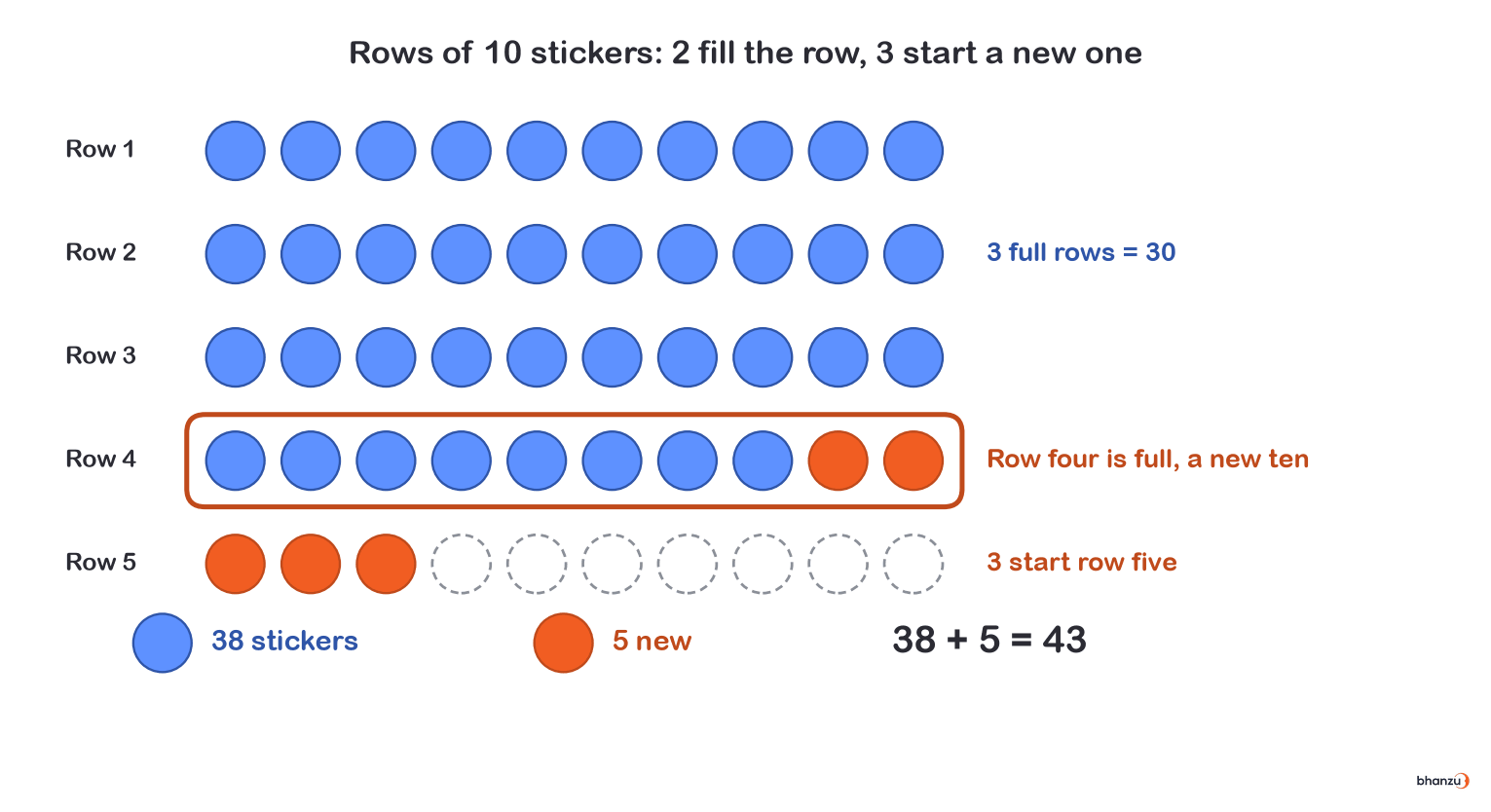
Maya's sticker book holds 10 stickers in every row, and row four is almost full. She has 38 stickers, so 3 rows are full and row four has 8 (room for exactly 2 more). Then Leo gives her 5 more.
Two of them finish row four, and the other 3 start row five. Now Maya has 4 full rows and 3 extra, or 43. In 2nd grade, you'll use this same new ten for adding two-digit numbers with regrouping.
What is making a ten to add?
Making a ten to add means splitting the smaller number so one part finishes the bigger number's ten, then adding the rest. For Maya, 38 needs 2 to reach 40, so her 5 stickers split into 2 and 3.
- Tens and ones are the parts of a two-digit number, so 38 is 3 tens and 8 ones.
- A number bond splits a number into two parts, like 5 into 2 and 3.
- A ten frame is a 2 by 5 box for exactly 10 counters, like one sticker row.
This is Common Core standard 1.NBT.C.4, which says "sometimes it is necessary to compose a ten," or build a new ten from ones. Your child first meets this move inside 20, then uses it past 20 later in 1st grade. When your child says something like "8 needs 2 more" before adding anything, that small sentence tells you the idea has landed, even if the final answer still takes a moment.
How do you make a ten to add within 100?
To make a ten to add within 100, fill the bigger number's next ten first, then add what is left.
- Find how many the bigger number needs to make its next ten. For , 38 needs 2.
- Split the smaller number to match, with a number bond. 5 is 2 and 3.
- Add the first part to reach the ten.
- Add the rest.
Written down, the sum turns into three numbers, the same find-a-ten idea as adding three numbers.
On a number line, that is a jump of 2 to 40, then a jump of 3 to 43.
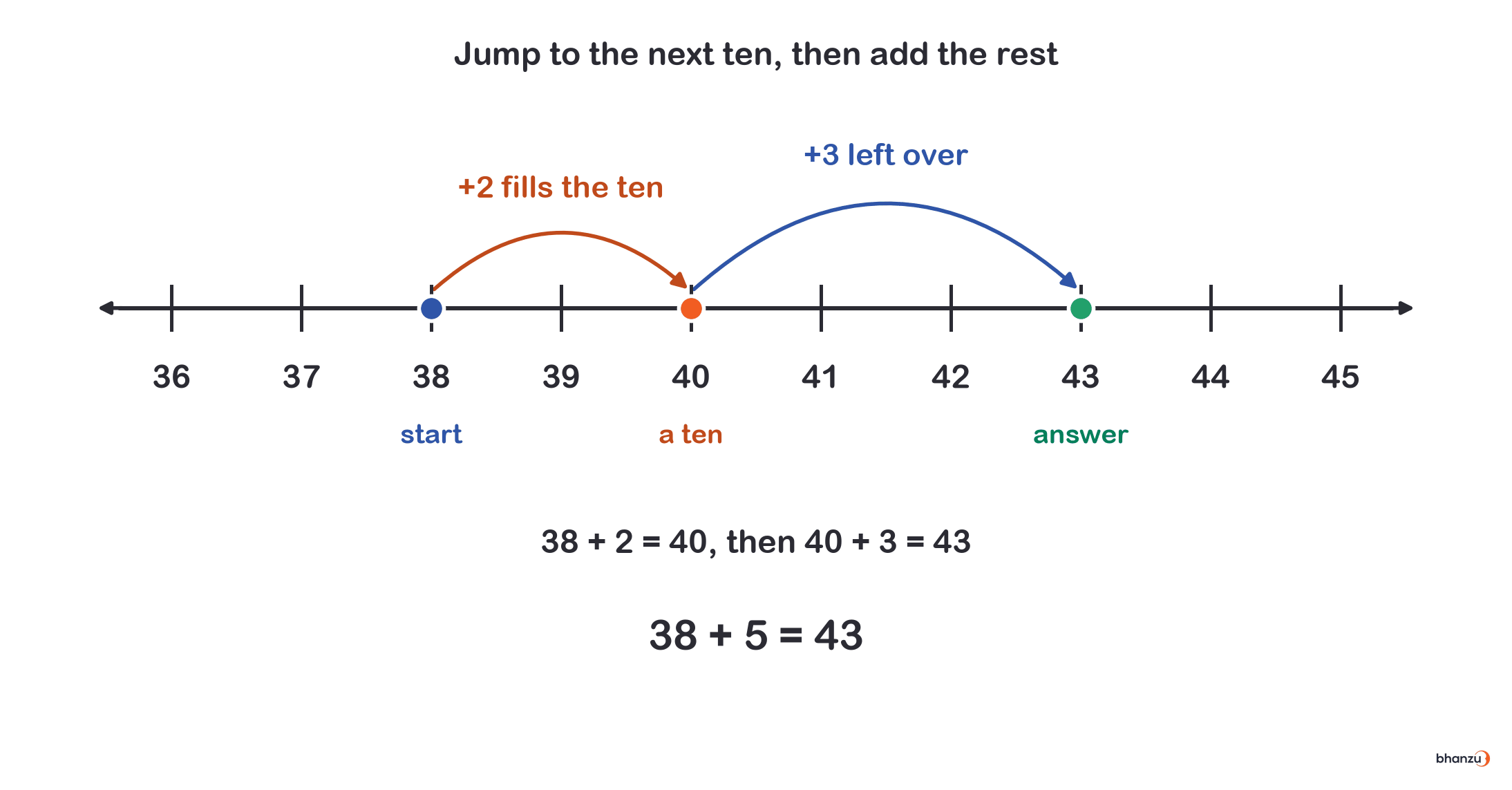
For , start from 38 anyway (adding works in either order). Counting on by ones also works, but a child counting 39, 40, 41, 42, 43 on fingers has five chances to lose track. Saying 38 as the first count lands on 42.
| Words in the problem | Math it means |
|---|---|
| gets 5 more | add 5 |
| puts in 8 more pennies | add 8 |
| How many now? | find the total |
| What number added to 57 makes 60? |
The box stands for the unknown number that fills the ten.
A 2023 study in Melbourne, Australia, watched how 166 Year 3 and 4 students solved the 10 hardest single-digit addition facts. Making a ten was their top strategy, at 26% of choices, so the move lasts past 1st grade. Just knowing the fact made up only 10%.
Try It Yourself
Drag or tap the orange counters into the ten frame, and press Make a ten when it is full. The ten bundles into a new rod, the number bond shows the split, and the two equations appear. Press New story for a fresh word problem.
Why do 13 ones become a new ten?
Each place in a number holds just one digit, 0 to 9. Ten ones are the same amount as one ten, so 13 ones trade for 1 ten and 3 ones.
Base-ten blocks show the trade. A ten rod is 10 cubes joined in a stick, and a ones cube is a single cube. Start with 38 as 3 rods and 8 cubes, then add 5 cubes.
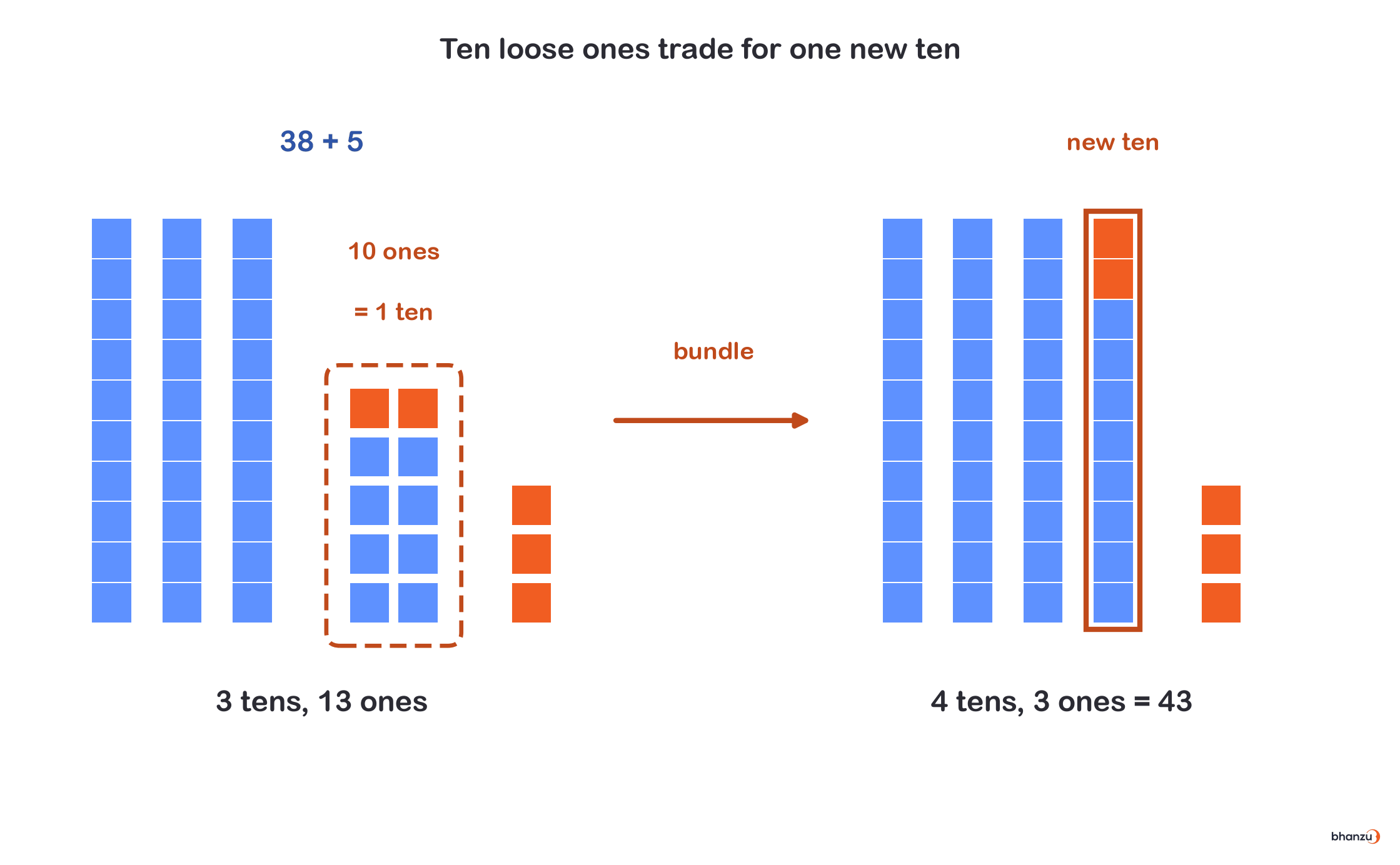
Writing 3 tens and 13 ones straight into the digits gives 313, more than three hundred. Regrouping means trading 10 ones for 1 ten (or 1 ten for 10 ones when you subtract), and it fixes that.
With a new ten, the number of tens goes up by one, the same jump as finding 10 more. The confusing part is that "10" the number and "a ten" the bundle are the same amount, yet a ten also counts as one thing.
When do the ones make a new ten?
Add the ones digits first. If they make 10 or more, a new ten appears. If they make 9 or less, the tens stay the same.
| Problem | Ones added | New ten? | Answer |
|---|---|---|---|
| No | 47 | ||
| Yes, with 0 ones left | 40 | ||
| Yes, with 3 ones left | 43 |
The first row is adding tens and ones without regrouping. A one-digit number can never make two new tens, since the ones reach at most.
When the first number ends in 0, like , there is no ten to fill, and the 7 just goes in the ones place. Sums past 100, like , wait for 2nd grade.
Examples of making a ten to add
Example 1
What is 29 + 4?
29 needs 1 to make 30, so split 4 into 1 and 3.
So .
Example 2
What is 46 + 7?
A tempting move is to fill the ten, then add the whole 7. That gives , then .
That can't be right, because even is only 56. The 4 that filled the ten came out of the 7, so only 3 are left. Split 7 into 4 and 3 instead.
So .
Example 3
What number do you add to 57 to make 60? Use it to find 57 + 9.
Seven ones need 3 more to make 10, so the box is 3. Then split 9 into 3 and 6.
The missing number is 3, and .
Example 4
Aisha has 85 cents in her piggy bank and puts in 8 more pennies. How many cents are in the bank now?
Each penny is 1 cent, so find . 85 needs 5 to make 90, so 8 splits into 5 and 3.
Aisha has 93 cents.
Example 5
Maya now has 43 stickers in rows of 10. Sam gives her 9 more, then Mei gives her 8 more. How many stickers does she have, and how many rows are full?
43 needs 7 to make 50, so Sam's 9 splits into 7 and 2.
52 needs 8 to make 60, and Mei gives exactly 8.
Maya has 60 stickers, filling 6 rows with none left over.
The real reason making a ten works
Numbers are written in tens and ones, so a sum that lands on a ten can be read straight off.
- It turns a hard sum into an easy one. needs no counting, because 4 tens and 3 ones are 43.
- It matches how money works. Ten pennies trade for a dime, so 4 dimes and 7 pennies plus 6 pennies makes 5 dimes and 3 pennies, or 53 cents.
- It is the first regrouping. The 2001 report Adding It Up calls making a 10 the first time children regroup, a step teachers in some countries see as the base for adding bigger numbers.
- It is the move behind adding mentally, with no paper needed.
Ten ones and one ten are the same amount, so the next ten is always a safe place to stop.
The pattern hiding inside making a ten to add
The fact you know inside 20 holds the answer to the bigger sum. Since , any number ending in 8 plus 5 ends in 3, with one more ten.
| Sum | Answer |
|---|---|
| 23 | |
| 53 | |
| 83 |
Children who know often still count one by one, because they don't see the 8 ones inside 38. A 2026 study followed 207 children for three years, from age 4 and a half. Counting both numbers in one long run on the fingers was a middle stage, and it went with weaker addition.
Before any counting starts, ask your child how many more make the next ten.
The easy-to-make errors (and how to catch them)
Mistake 1: Forgetting the new ten
Where it slips in: Sums done fast in your head, like 68 + 5.
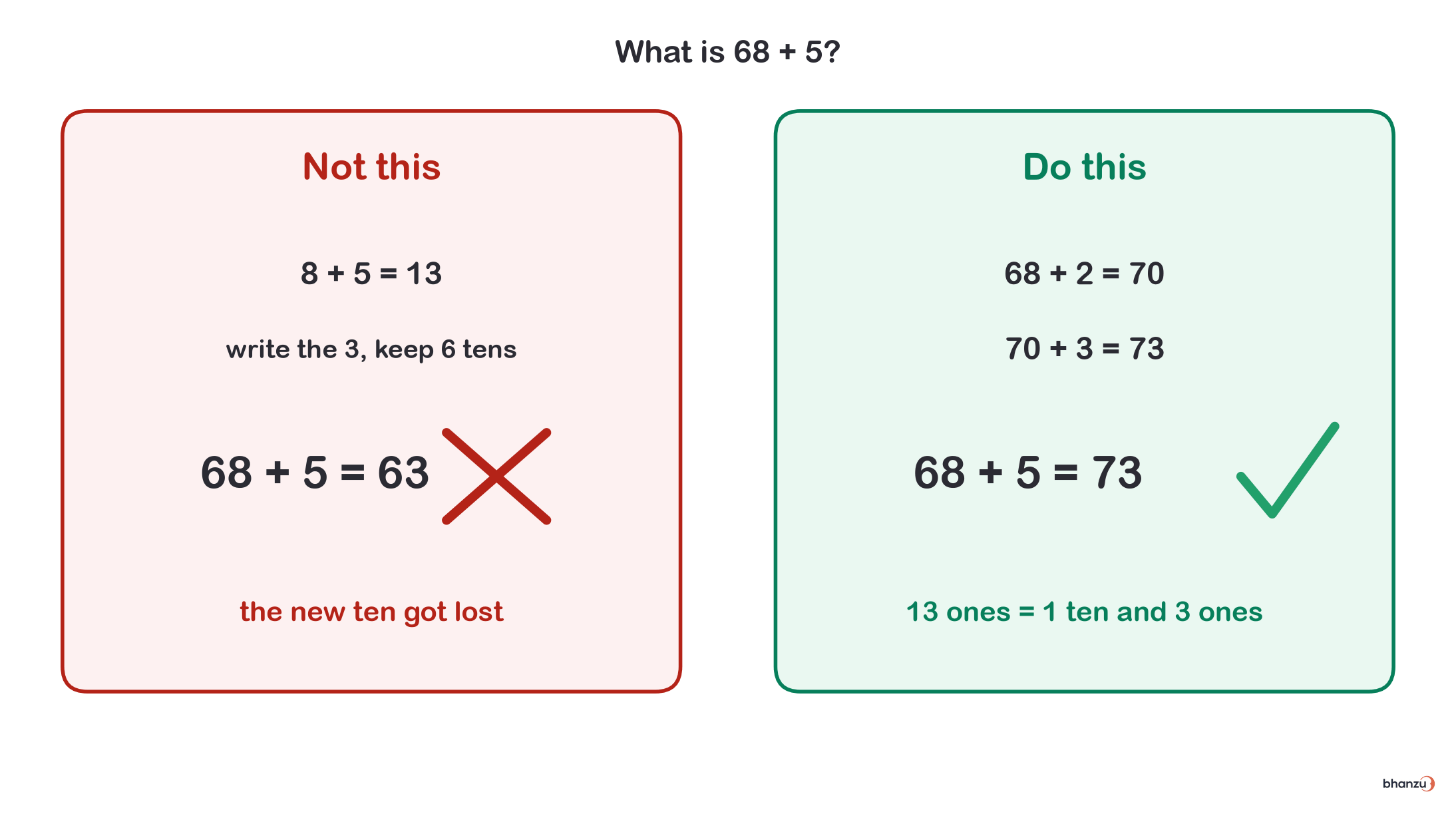
Don't do this: Say "8 plus 5 is 13," write the 3 and keep 6 tens, getting 63.
The correct way: Fill the ten first. , then .
After saying "13," children often write the 3 and stop, because the new ten has no spot on the page. It slips past a child who rushes on without checking the ones.
Mistake 2: Writing all 13 ones in the ones place
Where it slips in: Sums like 75 + 8, when the whole ones total is written after the tens.
Don't do this: Write 7 tens and 13 ones as 713.
The correct way: Trade 10 ones for 1 ten. That makes 8 tens and 3 ones, so .
Children write the two parts they found side by side, but a place holds only one digit.
Key Takeaways
- Before you add, ask how many more reach the next ten, and split the smaller number to match.
- A fact you know, like , gives the answer's last digit and warns that a new ten is coming.
- Making a ten to add with a one-digit number never makes more than one new ten.
- For more practice catching the new ten before it slips away, explore Bhanzu's 1st grade math tutor or its common core math curriculum.
Read More
- Subtracting Multiples of Ten
- Adding Several Numbers With Tens and Ones
- Regrouping Hundreds, Tens and Ones
- Mental Math Examples
Research Behind This Article
- Common Core State Standards Initiative, Grade 1 Number and Operations in Base Ten (1.NBT) (2010). thecorestandards.org
- Common Core State Standards Initiative, Grade 1 Operations and Algebraic Thinking (1.OA) (2010). thecorestandards.org/Math/Content/1/OA
- Russo, James and Hopkins, Sarah, Gender Differences in How Students Solve the Most Difficult to Retrieve Single-Digit Addition Problems (2023). eric.ed.gov
- National Research Council, Adding It Up: Helping Children Learn Mathematics (2001). nationalacademies.org
- Krenger, Marie, Bagnoud, Jeanne and Thevenot, Catherine, The Evolution of Finger Counting Strategies in Addition: A Three-Year Longitudinal Study in Young Children (2026). eric.ed.gov
Quick Quiz: Check Yourself
Three levels, new numbers every time: add by filling the next ten, then missing numbers and exact tens, then cents and sticker stories.
Was this article helpful?
Your feedback helps us write better content
Frequently Asked Questions
What grade learns making a ten to add?
How do I teach the make a ten strategy at home?
Can you use the make a ten strategy to subtract?
Is carrying the same as regrouping?
How does make a ten to add within 20 work?