Key Points
- Adding and subtracting 10 and 100 changes a number's tens or hundreds, so 10 more than 562 is 572 and 100 more is 662.
- A jump of 10 moves one ten, so the ones digit never changes, and a jump of 100 never changes the tens or ones.
- Adding 10 also moves the hundreds digit when there are 9 tens (), and subtracting 10 does when there are 0 tens.
One digit moves, the rest stay put
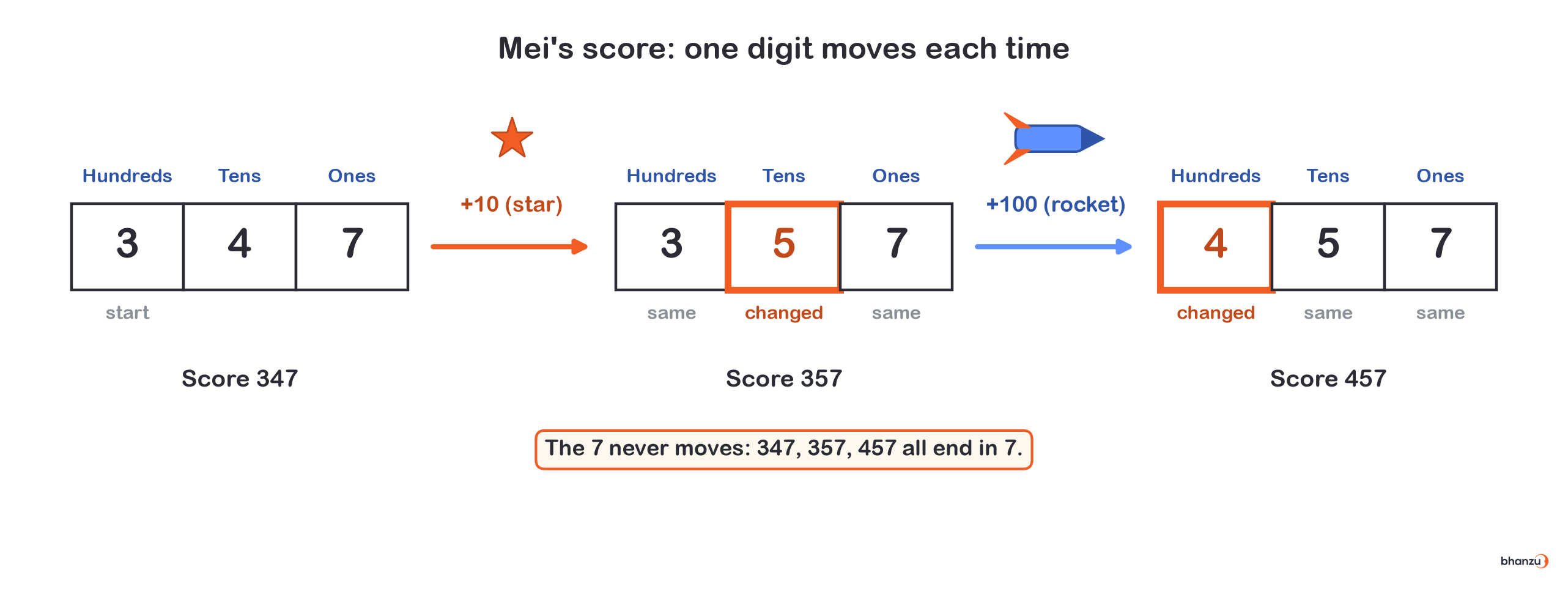
Catch a star worth 10 points, and only one digit of your score moves.
Mei's space game score is 347. One star makes it 357, and a rocket worth 100 makes it 457. The 7 at the end never budges.
At 296, though, a single star changes two digits at once. Later, the same jumps help you add numbers like 347 plus 120, one hundred and two tens at a time.
How do you add and subtract 10 and 100 in your head?
Adding and subtracting 10 and 100 in your head means changing one place by one, the tens or the hundreds, with no counting. A jump of 10 changes the tens digit, and a jump of 100 changes the hundreds digit.
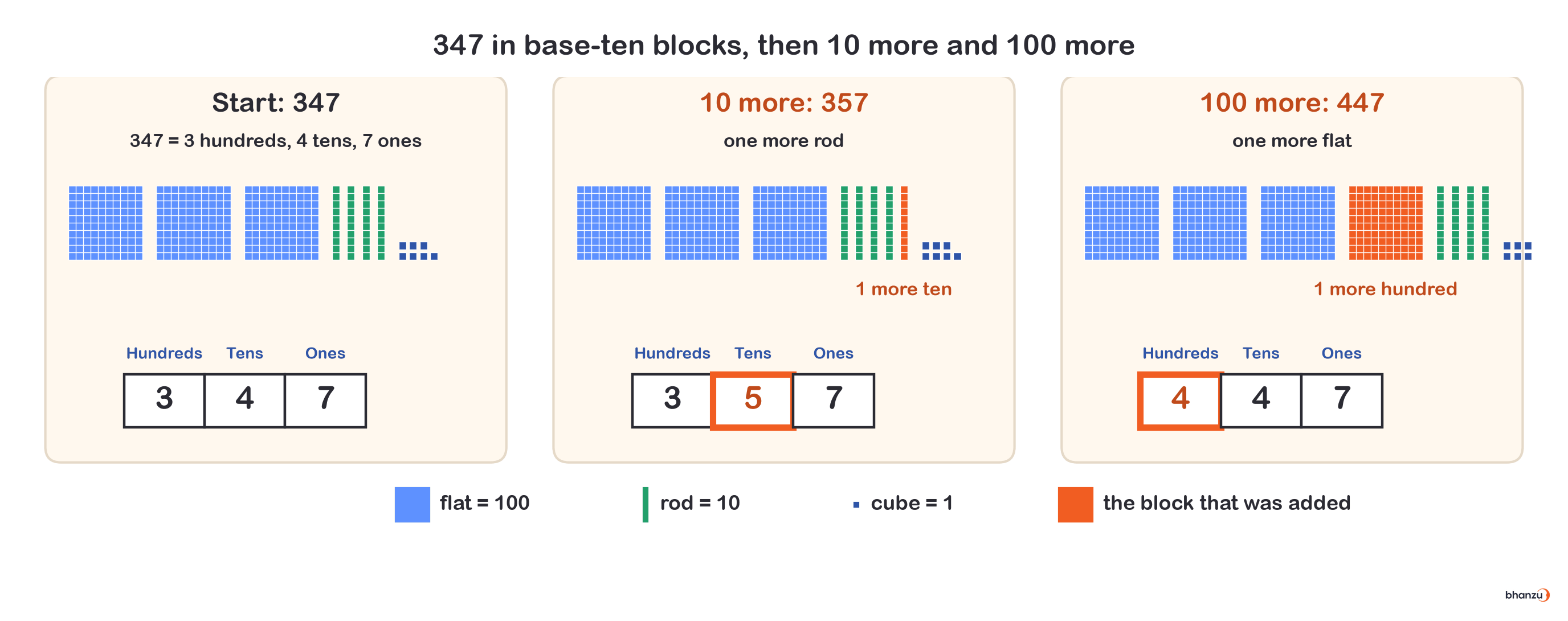
In base-ten blocks, a flat is 100, a rod is 10 and a cube is 1. So 347 is 3 flats, 4 rods and 7 cubes.
| Jump | Start | Answer | Digit that changes |
|---|---|---|---|
| 10 more | 347 | 357 | tens, 4 to 5 |
| 10 less | 347 | 337 | tens, 4 to 3 |
| 100 more | 347 | 447 | hundreds, 3 to 4 |
| 100 less | 347 | 247 | hundreds, 3 to 2 |
This is Common Core standard 2.NBT.B.8, which says to "Mentally add 10 or 100 to a given number 100-900" and to subtract them too. Your child may already find 10 more and 10 less of two-digit numbers like 52, and in 2nd grade the numbers run from 100 to 900. Counting money works the same way, since a dime is 10 cents and a dollar is 100 cents.
Which digit changes, and why?
Adding 10 puts down one rod and nothing else, so 347 becomes 3 flats, 5 rods and 7 cubes, which is 357. A hundred more would add one flat instead.
Expanded form writes a number as the sum of its places, so 347 is , and 10 more turns the 40 into 50.
- Say the number as hundreds, tens and ones.
- Find the place that matches the jump.
- Move that digit up one for more, or down one for less.
- Copy the other digits (a tens digit of 9 or 0 changes the hundreds too).
- Check that the ones digit stayed put after a jump of 10, or the last two digits after a jump of 100.
Of the single kindergarten tasks in a 2023 study that followed 279 US children, base-ten counting best predicted their 2nd grade math with bigger numbers.
Four methods reach the same answer.
- Counting on by ones works, but 100 more takes 100 counts.
- An open number line, a blank line you mark yourself, shows the jump as one hop.
- A hundred chart, with 10 numbers in each row, shows 10 more as one row down.
- The place-value move takes one step, with care at 9 tens or 0 tens.
Researchers Clements and Sarama describe children counting forward and back by 10s and 1s on these tools. Repeat one jump and you are skip counting within 1,000, as in 418, 428, 438.
| Words in the problem | Math it means |
|---|---|
| 10 more than 347 | |
| 100 less than 347 | |
| gave away 10 | subtract 10 |
| 462 is 100 more than what number |
What happens when you add 10 across a hundred?
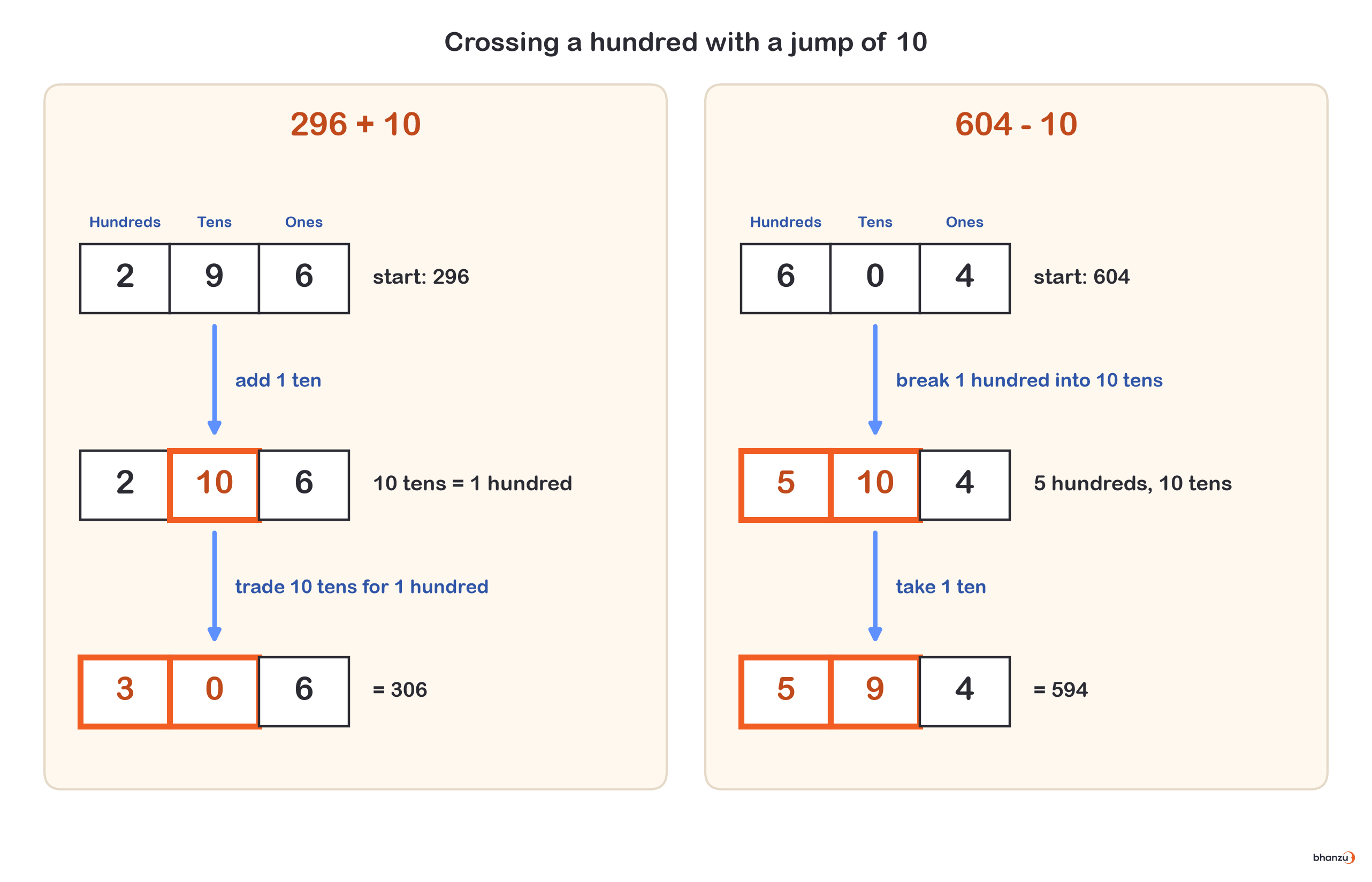
The rule for crossing is short: when the tens digit is 9, adding 10 makes ten tens, which trade for one more hundred. You make the same trade when regrouping hundreds, tens and ones.
With 0 tens, subtracting 10 runs the trade backward. Break one hundred of 604 into ten tens, making 5 hundreds, 10 tens and 4 ones, then take one ten.
This direction is harder, because a hundred has to break before a ten can leave. A child who answers 10 more than 347 in a flash often goes quiet at 10 less than 604.
What is 10 less than 308? Break a hundred to get 2 hundreds, 10 tens and 8 ones, then take a ten.
Jumps of 100 cross only at the top, where . Going down, 100 less than 145 is 45, because by convention a 0 at the front is not written.
Try It Yourself
Pick a start number, then press +10, -10, +100 or -100 and watch the blocks and digits change. Try 296 or 604 to see a hundred and ten tens trade places. Turn on Guess first to pick the answer before each jump.
Examples of adding and subtracting 10 and 100
Example 1
What is 100 more than 237?
237 is 2 hundreds, 3 tens and 7 ones, and one more hundred makes 3 hundreds.
Example 2
What is 10 more than 693?
The tempting move is to skip the 9 and raise the hundreds digit to get 793.
That can't be right. Only the hundreds digit went up, which is what a jump of 100 does.
Nine tens and one more ten make ten tens, or one hundred. So the 6 hundreds become 7, and the tens digit becomes 0.
Example 3
Mei's score changed from 562 to 552. Did she gain or lose 10 points, or 100 points?
The tens digit went from 6 to 5, so Mei lost 10 points.
Example 4
462 is 100 more than what number?
The missing number is the start, and it has one fewer hundred than 462.
Example 5
Leo has 492 cents in his piggy bank. He drops in one dime, then one dollar. How many cents does he have now?
A dime is 10 cents, and the 9 tens in 492 plus 1 ten make a new hundred.
A dollar is 100 cents.
Leo has 602 cents.
Example 6
Mei's score is 586. She catches a rocket worth 100, then two stars worth 10 each, then hits a black hole that takes 100. What is her score now?
The second star crosses a hundred.
Her score is 606. As a check, the rocket and black hole cancel, and two stars add 20.
Adding and subtracting 10 and 100 beyond the textbook
Because numbers are written in hundreds, tens and ones, a jump of a ten or a hundred touches one place. That turns a long count into a quick read.
- It starts the jump strategy. When adding mentally, you can find by jumping 10 to 46, then adding 8 to get 54.
- It needs practice on purpose. In a 2025 Australian study of 853 children, jumps were harder to spot as a quick path than near doubles like .
- It catches mistakes in written sums. If a sum says 528 plus 100 is 538, the jump says 628, since 538 is only 10 more.
Later, rounding 347 to 350 leans on the same one-place idea.
Common errors when working with 10 and 100 jumps
Mistake 1: Changing the wrong digit
Where it slips in: Finding 10 more right after practicing 1 more.
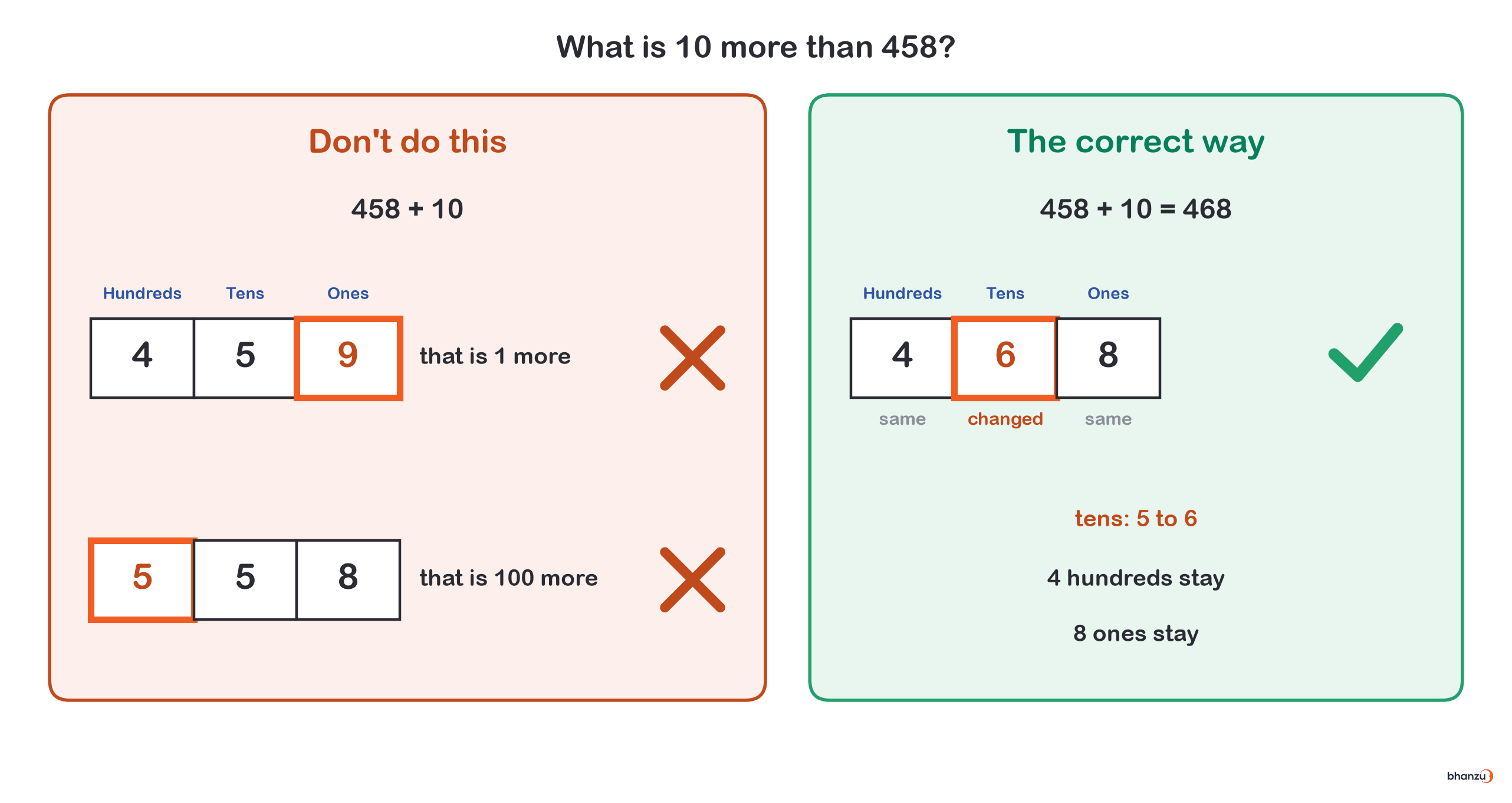
Don't do this: Writing 10 more than 458 as 459 (1 more) or 558 (100 more).
The correct way: Move the tens digit from 5 to 6 to get 468.
Children who have just practiced 1 more often write 459, because the last digit moved in every count they know.
Mistake 2: Taking a ten from an empty tens place
Where it slips in: Finding 10 less than a number with 0 tens, such as 507.
Don't do this: Writing 597, where the 0 became 9 but the 5 hundreds stayed.
The correct way: Break one hundred into ten tens, then take one ten to leave 497.
Counting back has taught that 0 turns into 9, yet 597 is bigger than 507, so it can't be 10 less.
Mistake 3: Going the wrong way in a story
Where it slips in: Stories that say "gave away", "lost" or "spent".
Don't do this: Answering "Sam had 530 stickers and gave away 100" with 630.
The correct way: "Gave away" means fewer, so .
A child who rushes spots the 100 and adds before reading the action word, so read the verb first.
What most guides get wrong about 10 and 100 jumps
The rule "only one digit changes" breaks for 80 of the 801 starting numbers from 100 to 900 when you add 10. It breaks for 81 when you subtract 10. Two checks hold every time instead.
- After a jump of 10, the ones digit is unchanged.
- After a jump of 100, the last two digits are unchanged.
A child who gets 357 right but says "the middle number goes up" has a description, not a reason. Ask how many tens are in 347 and in 357, and the answers, 34 and 35, give the reason.
Donovan and Fyfe reported on 112 children around age 7 in 2022. Those who linked base-ten blocks to written numbers scored higher, even on new questions. So with your child, go step by step from blocks or coins to a drawing, then to mental math.
Key Takeaways
- With 9 tens, adding 10 makes a new hundred, as in .
- With 0 tens, break a hundred before taking 10, as in .
- Adding and subtracting 10 and 100 means reading places, one step instead of 10 or 100 counts.
- For more practice spotting when a jump of 10 changes two digits, explore Bhanzu's 2nd grade math tutor or the Common Core math curriculum.
Read More
- Adding Three-Digit Numbers
- Subtracting Three-Digit Numbers
- Rounding to the Nearest 10 or 100
- Mental Subtraction
Research Behind This Article
- NGA Center and CCSSO, Common Core State Standards for Mathematics, Grade 2 Number and Operations in Base Ten (2010). thecorestandards.org
- Mix, K. S., and others, Predictive Relations between Early Place Value Understanding and Multidigit Calculation: Approximate versus Syntactic Measures, Educational Psychology (2023). eric.ed.gov
- Clements, D. H., and Sarama, J., Learning and Teaching with Learning Trajectories: Counter Forward and Back (10s and 1s) (2019). learningtrajectories.org
- Hopkins, S., Russo, J., and Downton, A., Assessing Children's Capacity for Procedural Flexibility with Mental Addition, Mathematics Education Research Journal (2025). doi.org
- Donovan, A. M., and Fyfe, E. R., Connecting Concrete Objects and Abstract Symbols Promotes Children's Place Value Knowledge, Educational Psychology (2022). eric.ed.gov
Quick Quiz: Check Yourself
Three levels, new numbers every time: jump 10 or 100 either way, cross a hundred or find the start, then solve score and money stories.
Was this article helpful?
Your feedback helps us write better content
Frequently Asked Questions
Is there a trick for adding 10 mentally?
What is 10 less than a number?
What is 100 less than 421?
What mental math should a 2nd grader know?
How do you teach 10 more, 10 less, 100 more and 100 less at home?