Key Points
- Adding two-digit numbers with regrouping starts with the ones, so in the ones make , or 1 ten and 4 ones.
- Ten ones and 1 ten are the same amount, so the new ten joins the tens, and 3 tens, 4 tens and 1 new ten make 8 tens.
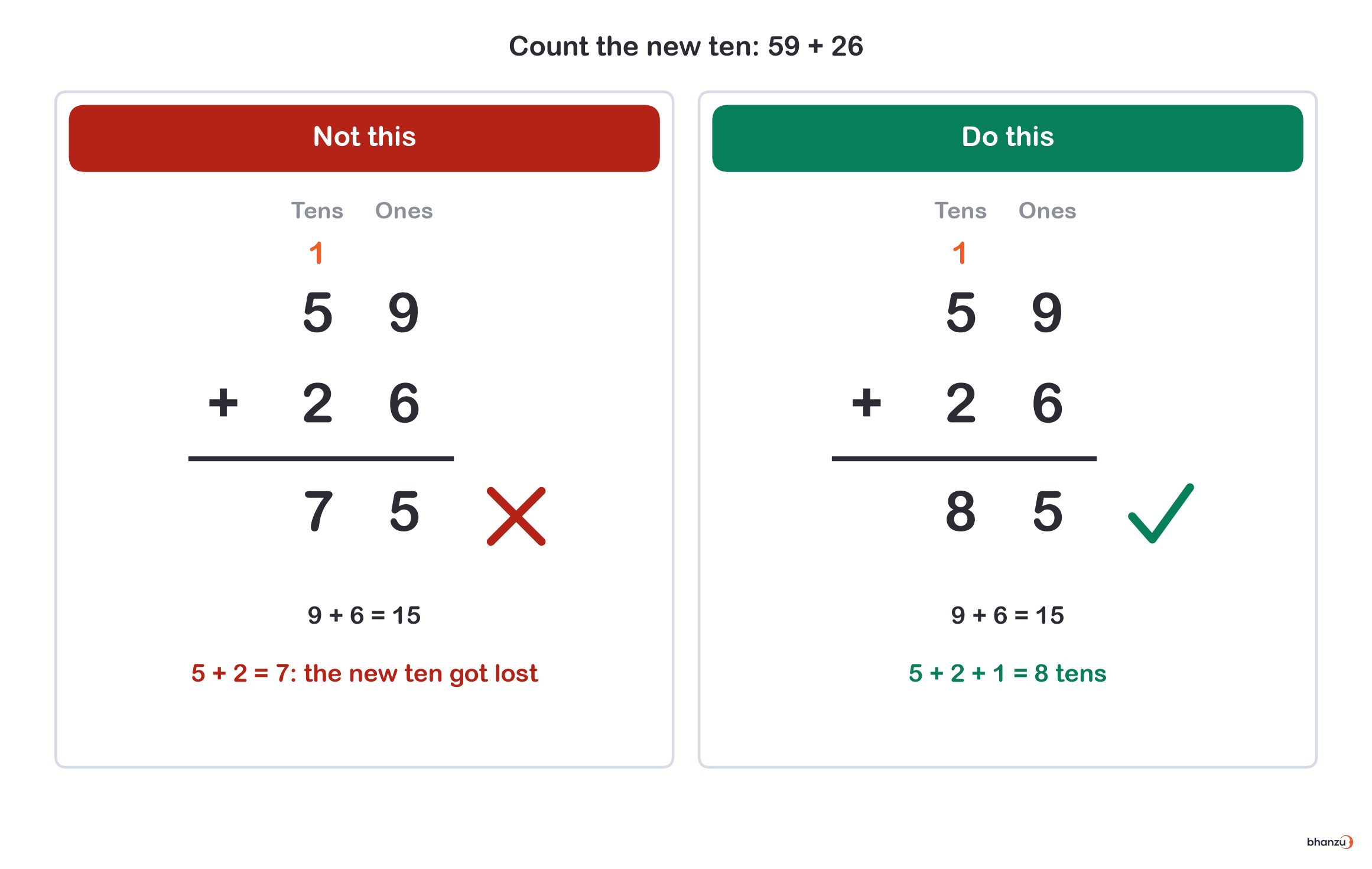
- A common error is losing the new ten in the tens column, so comes out as 75 instead of 85.
The bag of ten hiding in the pile
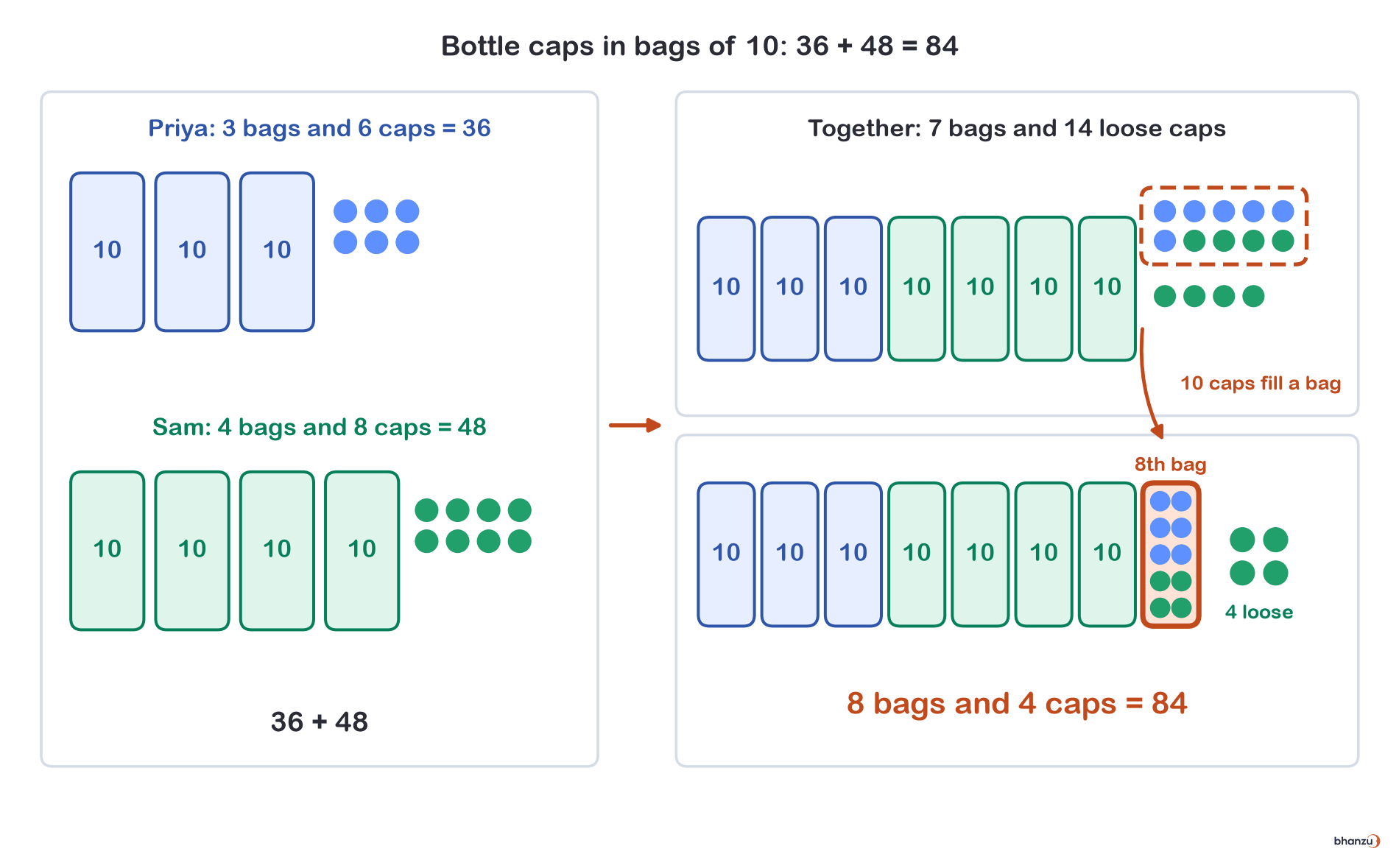
Pour 14 loose bottle caps on a table, and a full bag of 10 is hiding there. Priya and Sam keep art-project caps in bags of 10. Priya has 3 bags and 6 loose caps (36), and Sam has 4 bags and 8 loose (48).
Together they have 7 bags and 14 loose caps, and 10 of those fill an 8th bag, so 84 caps are quick to count. That move has a name: regrouping. Later in 2nd grade, the same move runs backward in subtracting two-digit numbers with regrouping, where a ten opens into 10 ones.
How do you add two-digit numbers with regrouping?
Adding two-digit numbers with regrouping starts in the ones place, where any 10 ones are traded for 1 new ten. Then you add the tens, new ten included, to get the sum, or answer.
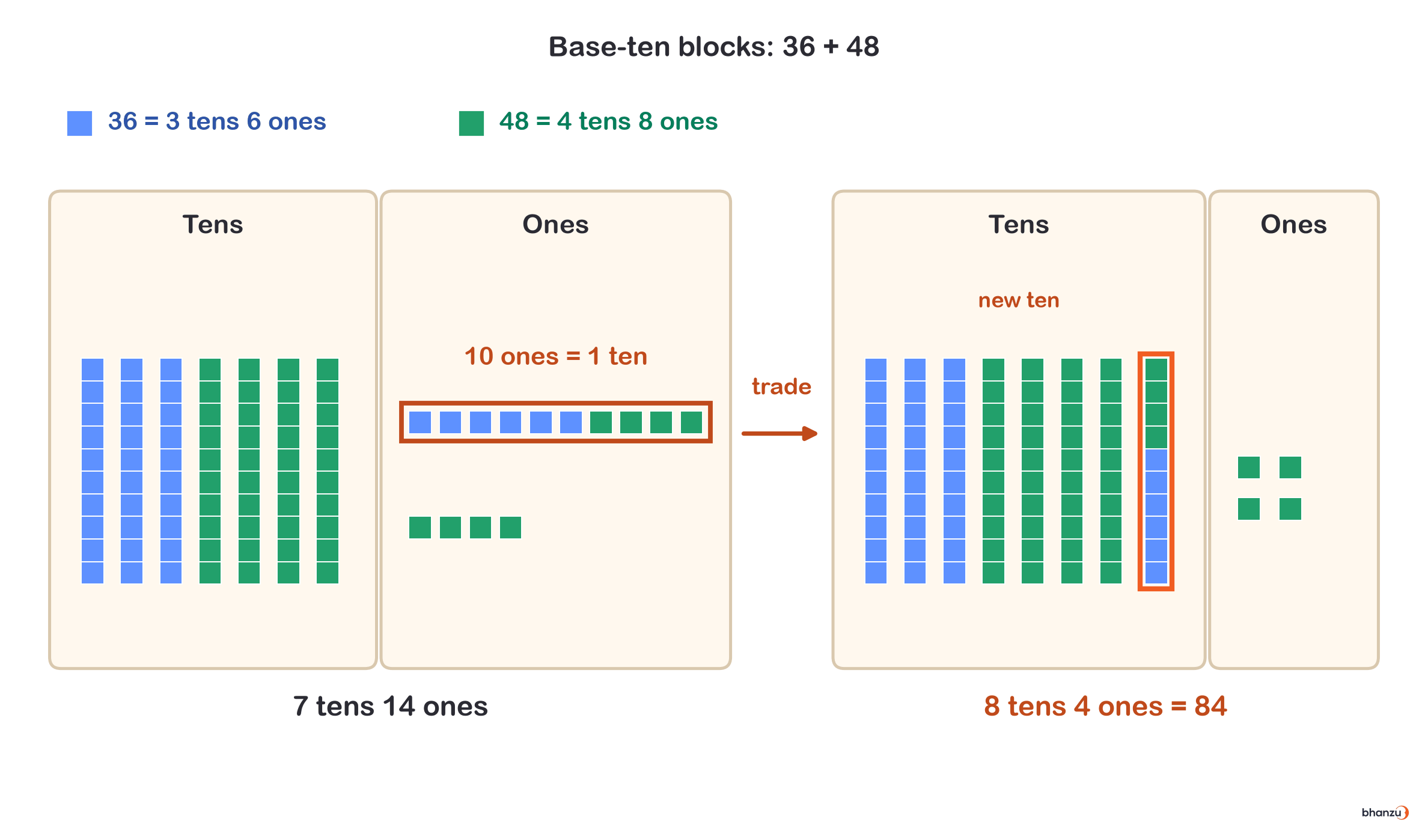
Base-ten blocks show why the trade is fair. A cube is 1 one, and a rod of 10 cubes is 1 ten. Build 36 and 48, push them together, and you get 7 rods and 14 cubes.
What is regrouping in addition?
Regrouping is trading 10 ones for 1 ten (or 10 tens for 1 hundred), so each place holds one digit.
| Blocks for 36 + 48 | Tens | Ones |
|---|---|---|
| Pushed together | 7 | 14 |
| After the trade | 8 | 4 |
In 1st grade, your child added numbers like by adding within 100 by making a new ten. Adding within 100 using place value is part of Common Core standard 2.NBT.B.5, and 2.NBT.B.9 asks children to explain why it works.
A 2023 study of 279 kindergartners found that a task called Base-Ten Counting was the strongest single kindergarten predictor of their multidigit calculation in 2nd grade. That is a link, not proof.
How does the column method work?
The column method stacks ones under ones and tens under tens, then starts with the ones. That makes it an algorithm, a fixed set of steps.
- Write 48 under 36, ones under ones. A one-digit number also goes under the ones.
- Add the ones, .
- Write the 4, and write the new ten as a small 1 in the tens column.
- Add the tens with the small 1, .
- Read the sum, 84.
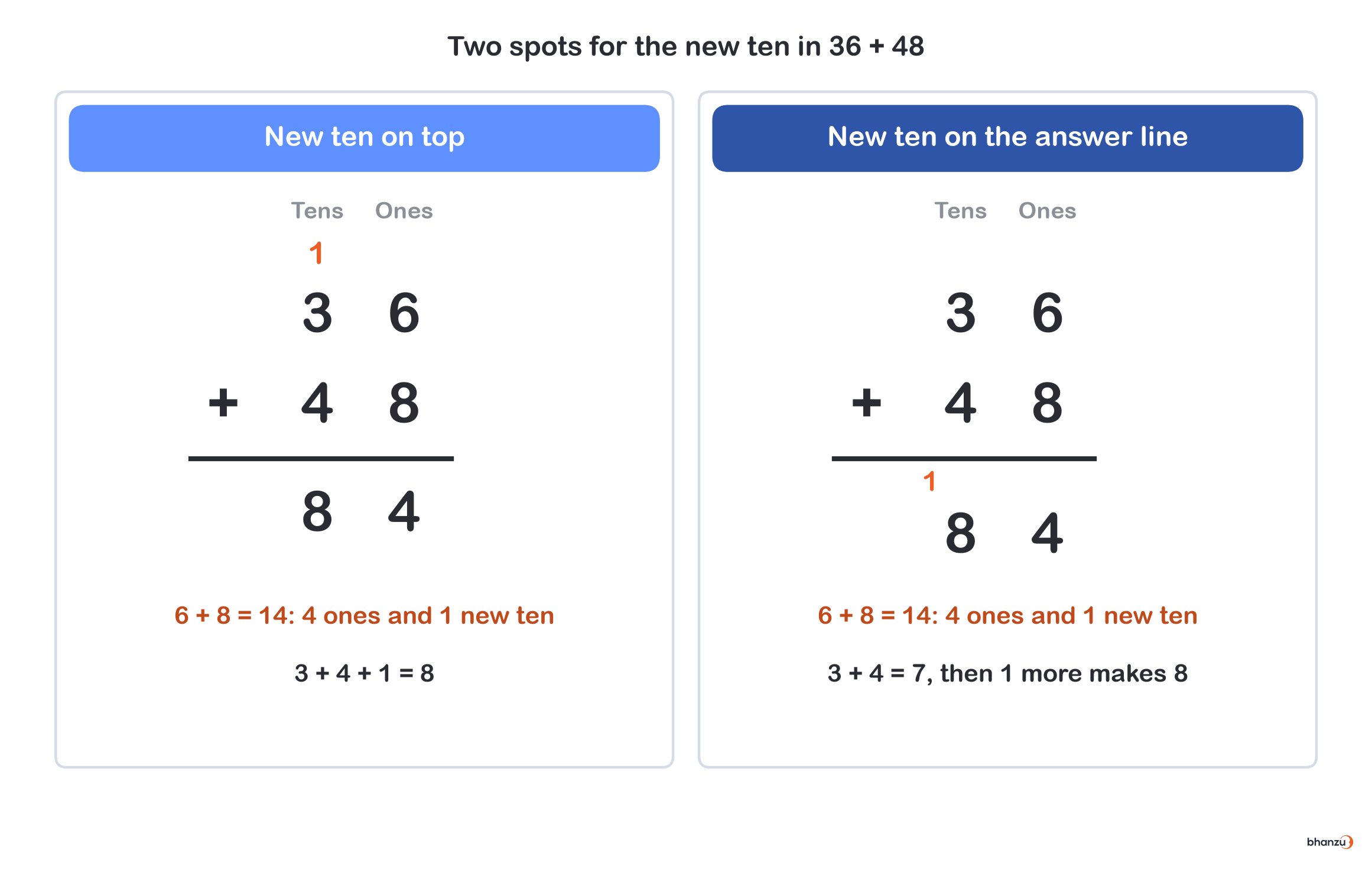
The small 1 can sit above the tens or on the answer line. Both spots mean one ten.
Many 2nd graders want to start with the tens, because they read left to right like a sentence. Then the 7 tens they write first must change to 8 once the ones make a new ten.
Break apart, also called partial sums, adds the tens first on purpose.
Splitting 36 into 30 and 6 works because adding gives the same total in any order and grouping (the properties of operations). Break apart is also handy for adding mentally.
Columns are slower than counting on for sums like or .
When do you need to regroup?
You need to regroup when the ones digits add to 10 or more. With 9 or fewer ones, you're adding tens and ones without regrouping.
| Problem | Ones | New ten? | Sum |
|---|---|---|---|
| No | 88 | ||
| Yes | 90 | ||
| Yes | 84 | ||
| Yes, and a new hundred | 100 |
A 2025 study of children, teenagers and adults found that children treat carrying as a yes-or-no decision. So check the ones for 10 or more before anything else.
Two ones digits add to 18 at most, so the ones make one new ten at most.
With one new ten at most, the tens grow by 0 or 1, and the sum ends in the ones digit of the ones total.
| Words in the problem | Math it means |
|---|---|
| "for both" | add the two prices |
| "brings 16 more" | add 16 |
| "How many full bags of 10?" | count the tens |
| "What digit goes in the box?" | find the hidden digit |
A sum past 100, such as , belongs to adding three-digit numbers, later in 2nd grade. In 3rd grade you'll add within 1000 with the same trade.
Try It Yourself
Drag the ones cubes into the ones box, then press Bundle 10 ones to snap 10 ones into a new ten rod. Move the tens across and watch the sum and its column steps appear. Use the plus and minus buttons to build your own pair, or press New problem.
What makes regrouping worth learning?
Regrouping exists because each place in a number holds one digit, 0 to 9, so a full group of 10 moves one place left.
- It keeps one digit in each place. Writing 7 tens and 14 ones straight in gives 714, which is far too big.
- It works like dimes and pennies. When counting money, 26 cents and 18 cents make 3 dimes and 14 pennies, which trade to 4 dimes and 4 pennies.
- It is the same trade at every place. Ten tens make 1 hundred, as in .
That one rule of ten still works for numbers in the thousands in 4th grade.
Examples of adding two-digit numbers with regrouping
Example 1
What is 18 + 24?
Add the ones.
Write 2 and make 1 new ten, then add the tens.
So .
Example 2
Which sum needs regrouping, 63 + 25 or 63 + 28? Find both sums.
In , the ones make , so there is no new ten and the sum is 88.
In , the ones make , so 1 new ten joins the tens.
The sum is 91, so only needs regrouping.
Example 3
What is 27 + 46?
Starting on the left, the way you read, gives and , written as 613.
That can't be right, because the sum must be less than . Start with the ones instead.
Write 3 and make 1 new ten.
The answer is .
Example 4
What digit goes in the box in ?
The box is the missing ones digit of the first number. The sum ends in 1, so the ones add to 11, since 7 alone is more than 1.
The box is 4. Now check the tens.
So .
Example 5
A pencil costs 39 cents and an eraser costs 25 cents. How many cents does Aisha need for both?
Add the pennies first.
Trade 10 pennies for 1 new dime, then add the dimes.
Aisha needs 64 cents.
Example 6
Priya and Sam have 84 caps, and Mei brings 16 more. Do they reach the 100 caps the class needs, and how many full bags of 10 is that?
Add the ones.
Write 0 and make 1 new ten.
Ten tens make 1 hundred, so , exactly enough to fill 10 bags.
The part of regrouping nobody explains
The small 1 is written like a one but stands for one ten, a genuinely confusing idea for a seven-year-old. Adding It Up, a 2001 National Research Council report, notes that a 1 written on top changes the top number, so children must add a number they can't see. Children who add only the digits they see often forget the extra ten.
The same report says the answer-line spot is taught in China and was also invented by US students. With the 1 under the tens of , your child adds the two digits that are there, , and then 1 more makes 8.
Common errors in double digit addition with regrouping
Mistake 1: Forgetting the new ten
Where it slips in: The tens column of a sum like .
Don't do this: Add , write 5 and the small 1, then add only for 75.
The correct way: Add the small 1 too, so tens and the sum is 85.
The small 1 looks like a note rather than a number. A child who rushes on to the next problem often skips it.
Mistake 2: Treating exactly 10 ones as nothing to carry
Where it slips in: Ones that add to exactly 10, as in , because no ones are left over.
Don't do this: Write 0 for , then add tens for 80.
The correct way: Ten ones make 1 new ten, so the tens are and the sum is 90.
Some children reach 90, then rub it out because no ones were left.
Mistake 3: Lining up the numbers on the left
Where it slips in: A one-digit number in columns, as in , because children start at the left edge, like writing words.
Don't do this: Put the 8 under the 4, add tens, and write 127.
The correct way: Put the 8 under the 7, so gives 5 ones and a new ten, and the sum is 55.
Key Takeaways
- Before writing any digit, ask whether the ones make 10 or more.
- In adding two-digit numbers with regrouping, the ones hand over one new ten at most.
- The small 1 counts as one ten, whether it sits above the tens or on the answer line.
- For help catching a new ten before it slips away, explore Bhanzu's 2nd grade math tutor or math classes for kids.
Read More
- Regrouping Hundreds, Tens and Ones
- Adding Up to Four Two-Digit Numbers
- Adding Within 1000
- New Math vs Old Math
Research Behind This Article
- Common Core State Standards Initiative, Grade 2 Number and Operations in Base Ten (2.NBT) (2010). thecorestandards.org
- Mix, Kelly S. and colleagues, Predictive Relations between Early Place Value Understanding and Multidigit Calculation: Approximate versus Syntactic Measures (2023). eric.ed.gov
- Common Core State Standards Initiative, Mathematics Glossary, Table 3: The Properties of Operations (2010). thecorestandards.org
- Avcil, Mine and Artemenko, Christina, Development of Arithmetic across the Lifespan: A Registered Report (2025). eric.ed.gov
- National Research Council, Adding It Up: Helping Children Learn Mathematics (2001). nationalacademies.org
Quick Quiz: Check Yourself
Three levels, new numbers each time: add with a new ten, add with or without a new ten or find a missing digit, then solve cents and bottle-cap stories.
Was this article helpful?
Your feedback helps us write better content
Frequently Asked Questions
Do second graders learn regrouping?
Are carrying and borrowing the same as regrouping?
How do I teach regrouping in 2nd grade at home?
What is a double digit addition with regrouping mat?
Is regrouping helpful for students?