Key Points
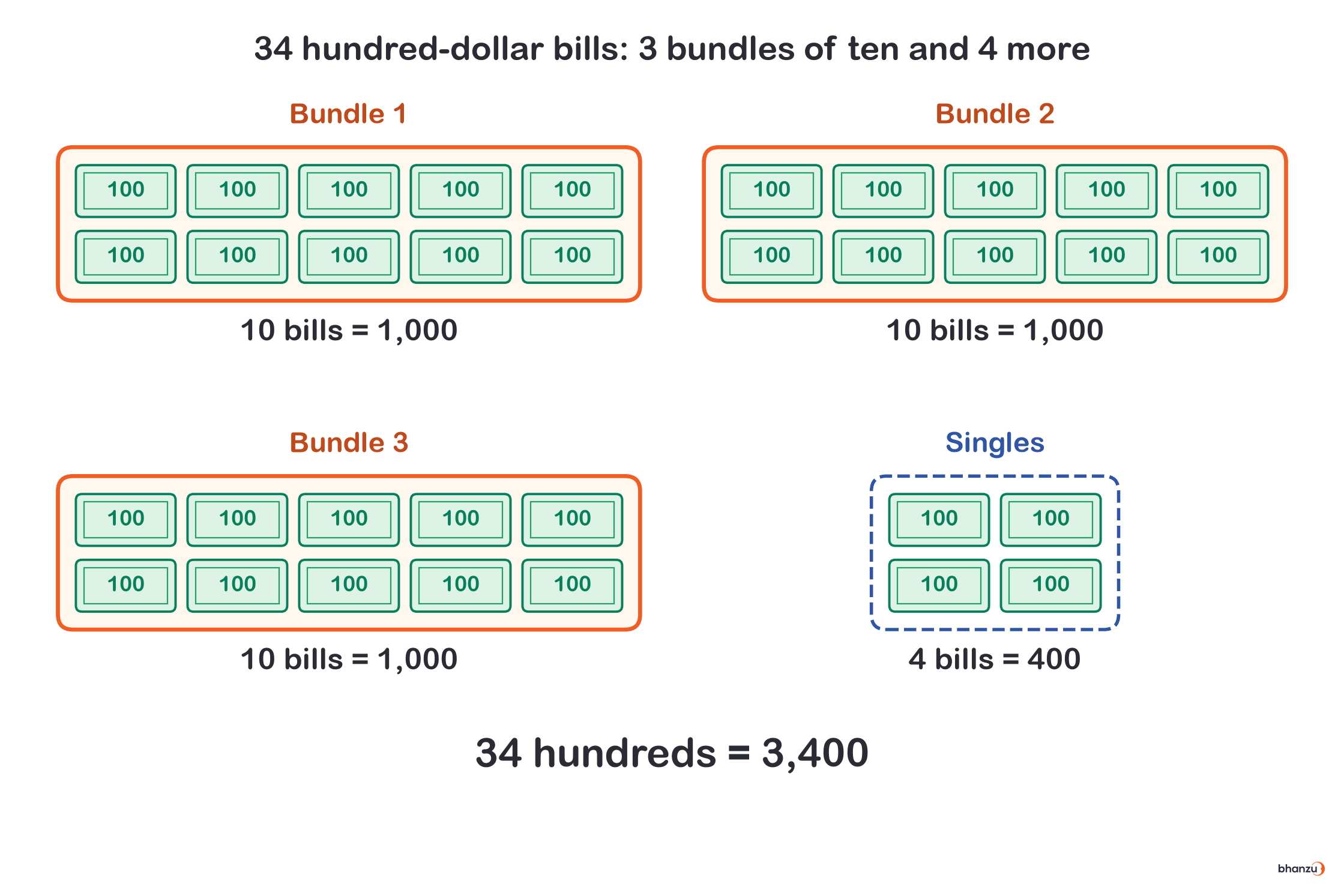
- Regrouping whole numbers gives one amount several correct names, so 3,400 is also 2 thousands 14 hundreds, or 34 hundreds.
- Each place is worth 10 of the place to its right, so a one-place jump multiplies the count by 10 and a two-place jump by 100.
- The hundreds digit of 6,280 is 2, yet the number holds 62 hundreds, because its 6 thousands are another 60 hundreds.
- In 4th grade, Common Core asks children to recognize that each place is worth ten times the place to its right, for whole numbers up to 1,000,000.
A number that answers to many names
Thirty-four hundred-dollar bills make exactly 3,400 dollars. Trade them for ten-dollar bills and you end up with 340 bills. Stack the hundreds in piles of ten instead, and you get 3 thick piles and 4 loose bills. The money never changed, only its name.
Later in 4th grade, you'll use these same trades to subtract across zeros and to split 2,400 into 6 equal groups.
What does regrouping whole numbers mean?
Regrouping whole numbers is renaming a number by breaking one place-value unit into 10 of the next smaller unit, or bundling 10 into one, so the name changes but the value does not. Whole numbers are the counting numbers and zero. Books differ on zero, and this lesson follows the OpenStax Prealgebra textbook in counting it.
In base-ten blocks, a big cube is 1,000, a flat is 100, a rod is 10 and a small cube is 1, each made of 10 of the next smaller piece.
| Name for 3,400 | Thousands | Hundreds | Tens |
|---|---|---|---|
| 3 thousands 4 hundreds | 3 | 4 | 0 |
| 2 thousands 14 hundreds | 2 | 14 | 0 |
| 34 hundreds | 0 | 34 | 0 |
| 340 tens | 0 | 0 | 340 |
This is Common Core standard 4.NBT.A.1: a digit in one place is worth ten times what it would be worth one place to the right. This year your child works with whole numbers up to 1,000,000 and should be able to explain why each place is ten times the next, which goes beyond writing a new name. In 2nd grade, your child traded a hundred for 10 tens while regrouping hundreds, tens and ones.
Regrouping is the trade, and renaming is the new name it gives you. The word also covers carrying and borrowing in addition and subtraction (the same trade, done in the middle of a problem) and, in 3rd grade, grouping factors differently. One word doing three jobs is genuinely confusing.
How many hundreds are in a thousand?
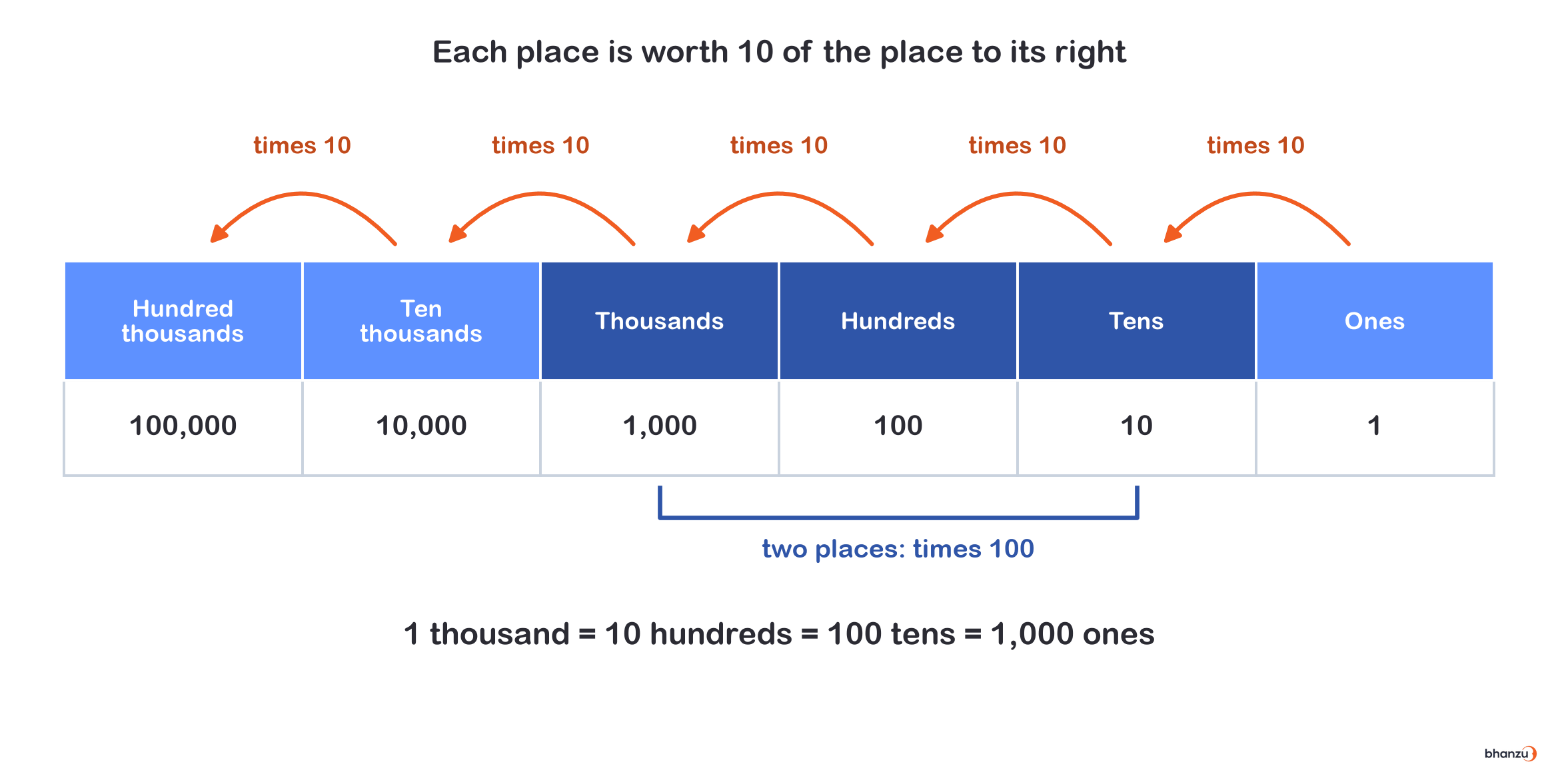
There are 10 hundreds in a thousand, because every place in a whole number is worth 10 of the place to its right.
| 1 of this place | One place right | Two places right | Three places right |
|---|---|---|---|
| 1 thousand | 10 hundreds | 100 tens | 1,000 ones |
| 1 ten thousand | 10 thousands | 100 hundreds | 1,000 tens |
| 1 hundred thousand | 10 ten thousands | 100 thousands | 1,000 hundreds |
Each jump to the right multiplies the count by 10. Two jumps multiply by 10 twice, which is 100, so 1,000 is 100 tens. The standard's own check works the same way, since the 7 in 700 sits one place left of the 7 in 70.
Moving left, divide by 10 per place, so 340 tens is 34 hundreds. The chart's arrows point the other way because they track what one block is worth, not how many blocks you have. The same pattern moves digits when multiplying by 10, 100, and 1,000.
On the 2024 Nation's Report Card, 87% of US fourth graders answered a question about a digit's value correctly, such as a 5 in the hundreds place being worth 500. Regrouping asks the next question, how many hundreds the whole number holds. A child who rushes reads the hundreds digit and stops.
In 5th grade, the same rule runs past the decimal point.
How do you regroup and rename numbers?
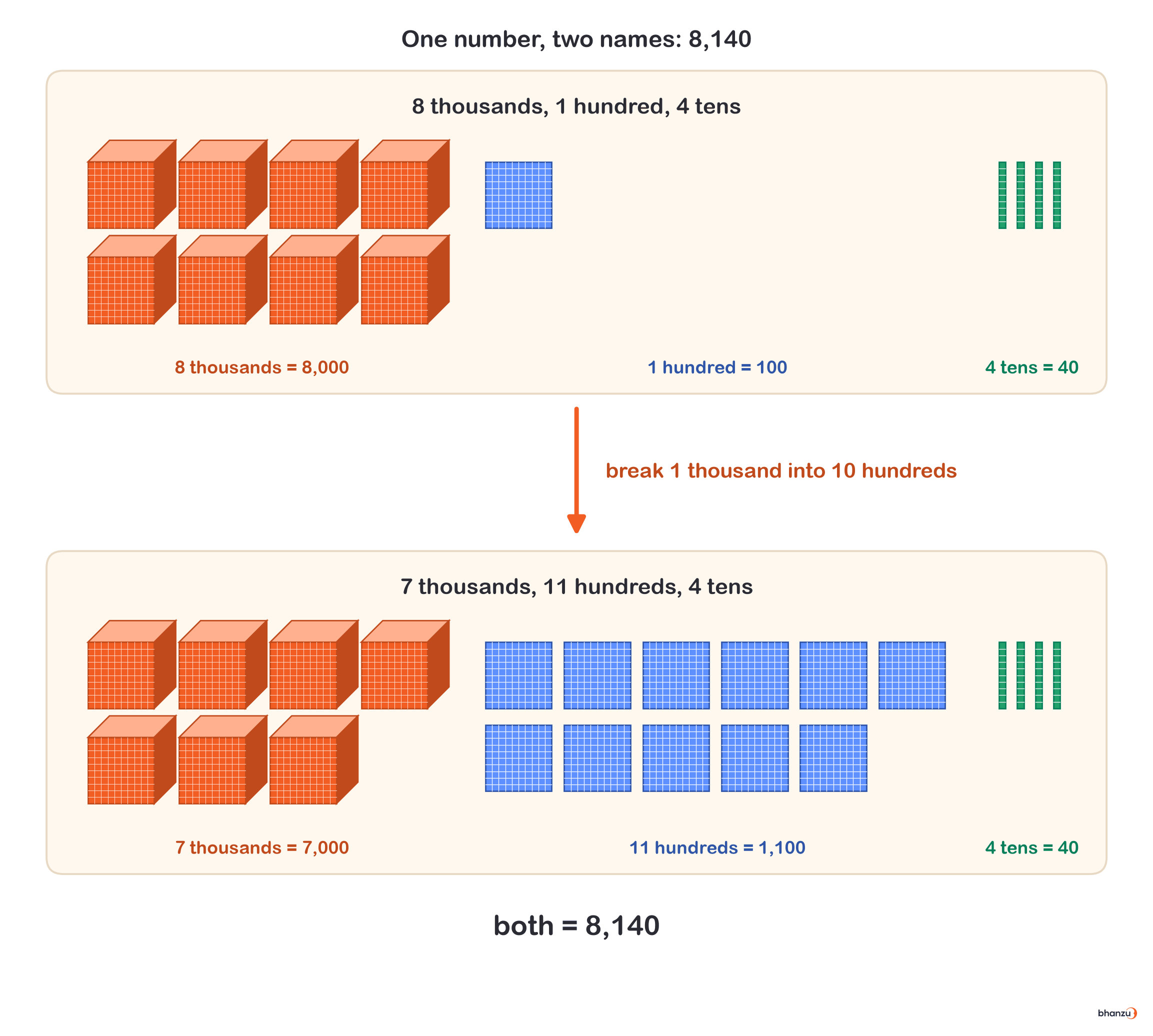
To rename with fewer of a big unit, break 1 of it into 10 of the next place and add them to what is there. To rename with more, bundle 10 into 1. Here is the breaking direction on 8,140, renamed as 7 thousands, some hundreds and 4 tens.
- Write the usual name, 8 thousands, 1 hundred and 4 tens.
- Spot what changed. The thousands dropped from 8 to 7, so 1 thousand was broken.
- Break that thousand into 10 hundreds.
- Add the hundred already there, so hundreds.
- Check in expanded form, .
Bundling runs backward, so 14 hundreds is 1 thousand and 4 hundreds. A child who reaches 11 hundreds often second-guesses it, because a place-value chart seems to want one digit per column (11 hundreds is a fine name). Children who have only traded ones for tens often break a thousand straight into 10 tens, which loses 900.
Three methods rename a number, and they always agree.
- Trade one piece at a time. Blocks or drawings show every step, so learn this one first.
- Count in the new unit. Six thousands is 60 hundreds with no trades, and one shared unit makes comparing quick.
- Multiply or divide by 10 for each jump.
Trading gets slow on big numbers, since renaming 576,851 in hundreds one trade at a time takes 638 trades, so count in the new unit instead.
Zeros need a chain. The number 5,000 has nothing to break below the thousands, so break from the left until it reads 4 thousands, 9 hundreds, 9 tens and 10 ones. That chain lets you subtract across zeros.
Try It Yourself
Tap Break to swap one block for 10 of the next smaller place, or Bundle to trade 10 back for one, and watch the value line stay the same. The count lines show that number in hundreds and in tens. Press New target and rename each number the way the card asks.
Examples of regrouping whole numbers
Example 1
How many $100 bills make $7,000?
One thousand is 10 hundreds, so 7 thousands is 7 groups of 10 hundreds.
It takes 70 bills.
Example 2
6,325 is 5 thousands, some hundreds, 2 tens and 5 ones. How many hundreds?
Usually 6,325 is 6 thousands and 3 hundreds. One thousand was broken into 10 hundreds and added to the 3 already there.
The missing number is 13 hundreds.
Example 3
What number is 5 thousands, 14 hundreds and 3 tens?
The tempting move is to write the counts side by side, 5 then 14 then 3, which gives 5,143.
That answer cannot be right. Fourteen hundreds alone is 1,400, so the number has to be bigger than , and 5,143 is smaller.
Bundle 10 of the 14 hundreds into 1 thousand.
That leaves 6 thousands, 4 hundreds and 3 tens, so the number is 6,430. To check, add the parts.
Example 4
Which is greater, 47 hundreds or 4 thousands 8 hundreds, and by how much?
Rename both in hundreds. Four thousands is 40 hundreds, so 4 thousands 8 hundreds is 48 hundreds.
The 4 thousands 8 hundreds is greater, by 1 hundred.
Example 5
Rename 6,040 as 5 thousands, 9 hundreds and some tens. How many tens?
The number 6,040 has 0 hundreds, so start at the thousands.
Break 1 thousand into 10 hundreds, making 5 thousands, 10 hundreds and 4 tens.
Break 1 of those hundreds into 10 tens, making 5 thousands, 9 hundreds and 14 tens.
The answer is 14 tens.
Example 6
Noah reads that Wyoming had 576,851 residents in the 2020 Census. How many full hundreds is that, and how many people are left over?
Count each place of the 2020 Census figure in hundreds.
The 5 hundred thousands are three places up, so they make 5,000 hundreds.
The 7 ten thousands are two places up, so they make 700 hundreds.
The 6 thousands make 60 hundreds, and the 8 hundreds stay 8.
That leaves 5 tens and 1 one, so Wyoming's count is 5,768 full hundreds of people with 51 left over. To check, multiply back.
The real reason regrouping exists
Regrouping exists because one amount can be counted in any size of unit, and the right unit turns a hard problem into an easy one.
- It lets the standard algorithm subtract across zeros. The standard algorithm (the column-by-column method) needs ones and tens to take from, and renaming supplies them.
- It shrinks big division. The problem 2,400 divided by 6 becomes 24 hundreds divided by 6, which is 4 hundreds, the idea behind dividing multiples of 10, 100 and 1,000.
- It makes big counts easier to say. A stadium crowd of 45,000 is 45 thousand people.
Without regrouping, each of those jobs would mean counting one thing at a time.
What are the most common mistakes with regrouping?
Mistake 1: Reading the digit instead of counting the hundreds
Where it slips in: Any "how many hundreds" question, like Example 6. A place-value chart trains your eye to read one digit per column.
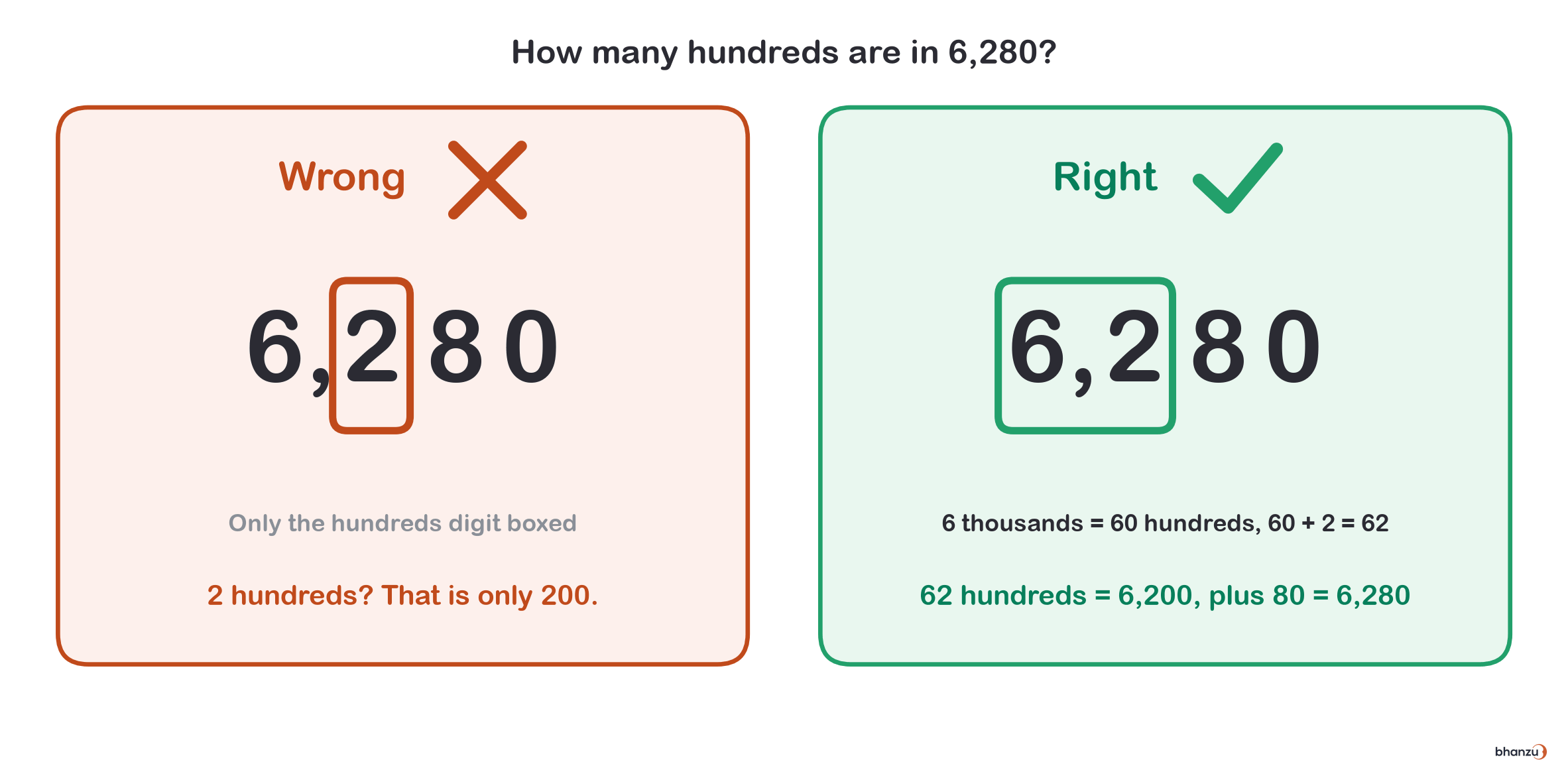
Don't do this: Saying 6,280 has 2 hundreds.
The correct way: Six thousands is 60 hundreds, so 6,280 holds hundreds and 80 more. The 2 alone is only 200.
Mistake 2: Multiplying by 10 when the jump is two places
Where it slips in: Renaming thousands as tens. The 1-for-10 trade is learned between neighbors, so children apply it once even across two places.
Don't do this: Writing 4,000 as 40 tens.
The correct way: Thousands to hundreds is one jump (40 hundreds), and hundreds to tens is a second, so 4,000 is 400 tens. Forty tens is only 400.
Mistake 3: Taking a ten from a zero
Where it slips in: Renaming a number with zeros to get more ones, as when you subtract 8 from 5,003.
Don't do this: Writing 5 thousands, 0 hundreds, 0 tens and 13 ones, which adds up to 5,013.
The correct way: Break 1 thousand into hundreds, 1 hundred into tens and 1 ten into ones, to get 4 thousands, 9 hundreds, 9 tens and 13 ones.
Early trades always had a neighbor with something to give, and a zero has nothing. A child who repeats "borrow 1" but can't say what the 1 is worth is usually stuck right here.
The part of regrouping nobody explains
The digit in a place and the count of that unit are different numbers. The hundreds digit counts only the hundreds left after full thousands are bundled, while the count includes every thousand broken down.
To find any count in 6,280, cover the digits to the right of the unit and read what is left.
| Count | Cover | Read |
|---|---|---|
| hundreds | 80 | 62 hundreds |
| thousands | 280 | 6 thousands |
| tens | 0 | 628 tens |
The covered digits are the leftover, and the pattern holds because each place to the left is worth 10, 100 or more of the unit you count (it still works for millions in later grades). In a 2021 study in Turkey, Seyhan Paydar and Adem Dogan asked fourth graders how many 100-lira notes make 1,200 lira. Among 90 students from four regular public schools, 28 got it right, fewer than a third. Carrying and borrowing never ask for this count, because each of their trades moves just one place.
Key Takeaways
- To rename a number, break one unit into 10 of the next place and add them to what is there, so nothing is gained or lost.
- Count jumps between places, not digits, which is why 4,000 is 400 tens.
- When a place shows 0, keep breaking from the left until the place you need has something to give.
- Regrouping whole numbers is the hidden step inside subtracting across zeros and dividing 2,400 by 6.
- For more practice with a teacher who notices when your child reads the hundreds digit instead of counting the hundreds, explore Bhanzu's 4th grade math curriculum or an elementary math tutor.
Read More
- Comparing and Ordering Multi-Digit Numbers
- Rounding Multi-Digit Numbers
- Multi-Digit Addition
- Regrouping Decimals
- Mental Math for Kids
- Common Core Math vs Traditional Math
Research Behind This Article
- OpenStax, Prealgebra 2e, 1.1 Introduction to Whole Numbers (2020). openstax.org
- Common Core State Standards Initiative, Grade 4: Number and Operations in Base Ten (2010). thecorestandards.org
- National Center for Education Statistics, NAEP Mathematics 2024: National Trends and Student Skills (2024). nationsreportcard.gov
- US Census Bureau, 2020 Census Apportionment Results (2021). census.gov
- Seyhan Paydar and Adem Dogan, Examining 4th Grade Gifted and Non-Gifted Students Understanding Levels of Place Value (2021). eric.ed.gov
Quick Quiz: Check Yourself
Three levels, new numbers every time: Easy counts hundreds in thousands, Medium renames numbers and counts tens, and Hard finds full hundreds in big numbers or renames across zeros.
Was this article helpful?
Your feedback helps us write better content
Frequently Asked Questions
Is regrouping a Common Core standard?
How can I teach regrouping at home?
What is regrouping in subtraction?
How many hundreds are in a million?
Is regrouping a form of decomposition?
How do you explain 1,000 minus 1 with regrouping?