Key Points
- Subtracting three-digit numbers starts with the ones, and a place that runs short trades 1 ten for 10 ones or 1 hundred for 10 tens.
- A trade never changes the amount, since 803 is both 8 hundreds, 0 tens, 3 ones and 7 hundreds, 9 tens, 13 ones.
- In a 1982 study of 1,138 subtraction answer sheets, the second and third most common wrong rules both broke down at a zero.
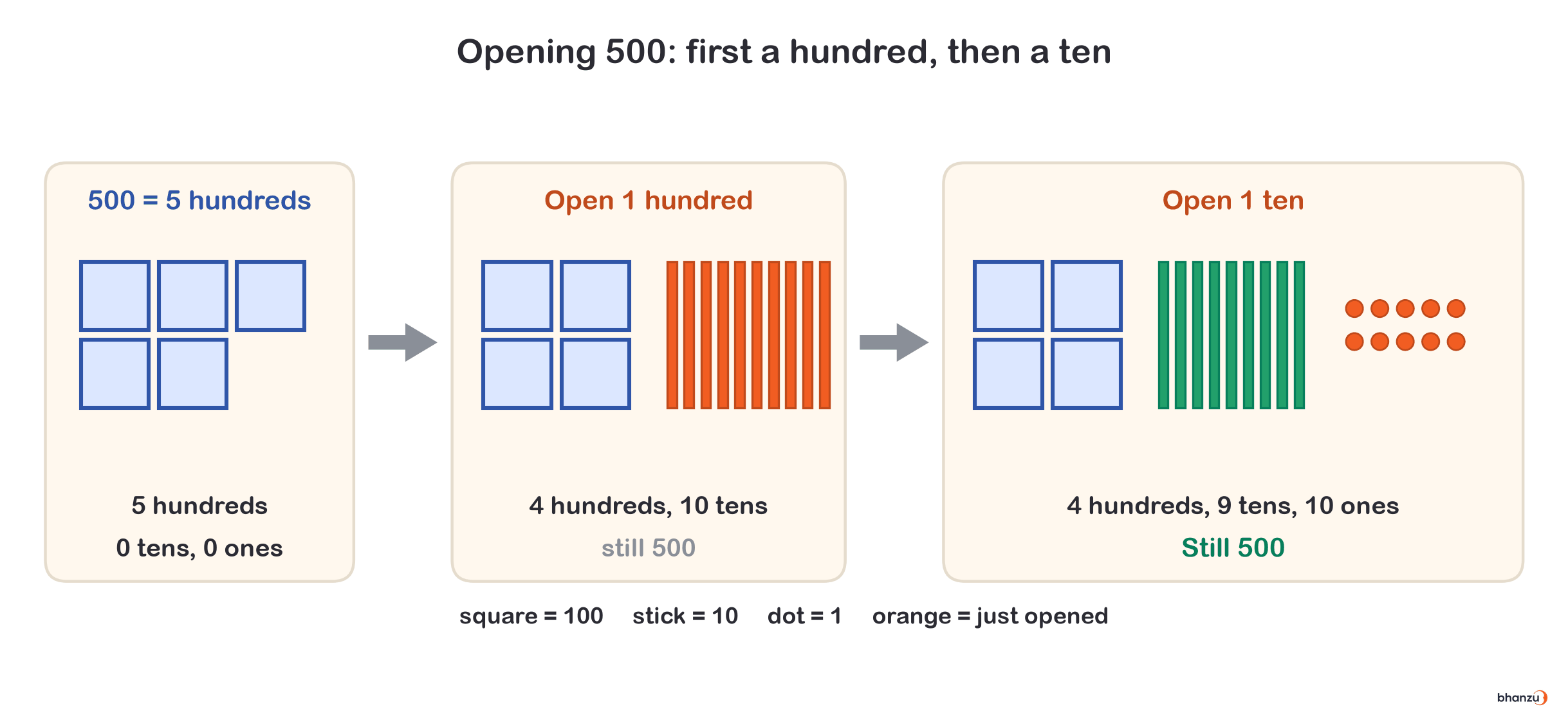
The 500 that has to be opened twice
Maya's new puzzle box says 500 pieces, and 236 are already snapped in. How many are still in the box?
The 500 is 5 hundreds, 0 tens and 0 ones, so there are no loose ones to take 6 from. Open one hundred into 10 tens. Then open one of those tens into 10 ones, and 500 reads as 4 hundreds, 9 tens and 10 ones.
Nothing was lost. In 4th grade, these trades work for numbers in the thousands too.
How do you subtract three-digit numbers?
Subtracting three-digit numbers is done place by place, taking ones from ones, tens from tens and hundreds from hundreds. The answer is called the difference.
On base-ten blocks, a flat is 1 hundred, a rod is 1 ten and a cube is 1 one. Regrouping means trading 1 of a bigger place for 10 of the next smaller place, like opening 1 rod into 10 cubes. It's the ones trade from subtracting two-digit numbers with regrouping, plus a hundreds trade.
Build 435 as 4 flats, 3 rods and 5 cubes, then take away 169.
- You need 9 cubes but have 5, so open 1 rod for 4 flats, 2 rods and 15 cubes.
- You need 6 rods but have 2, so open 1 flat for 3 flats, 12 rods and 15 cubes (still 435).
- Take away 1 flat, 6 rods and 9 cubes to leave 2 flats, 6 rods and 6 cubes, or 266.
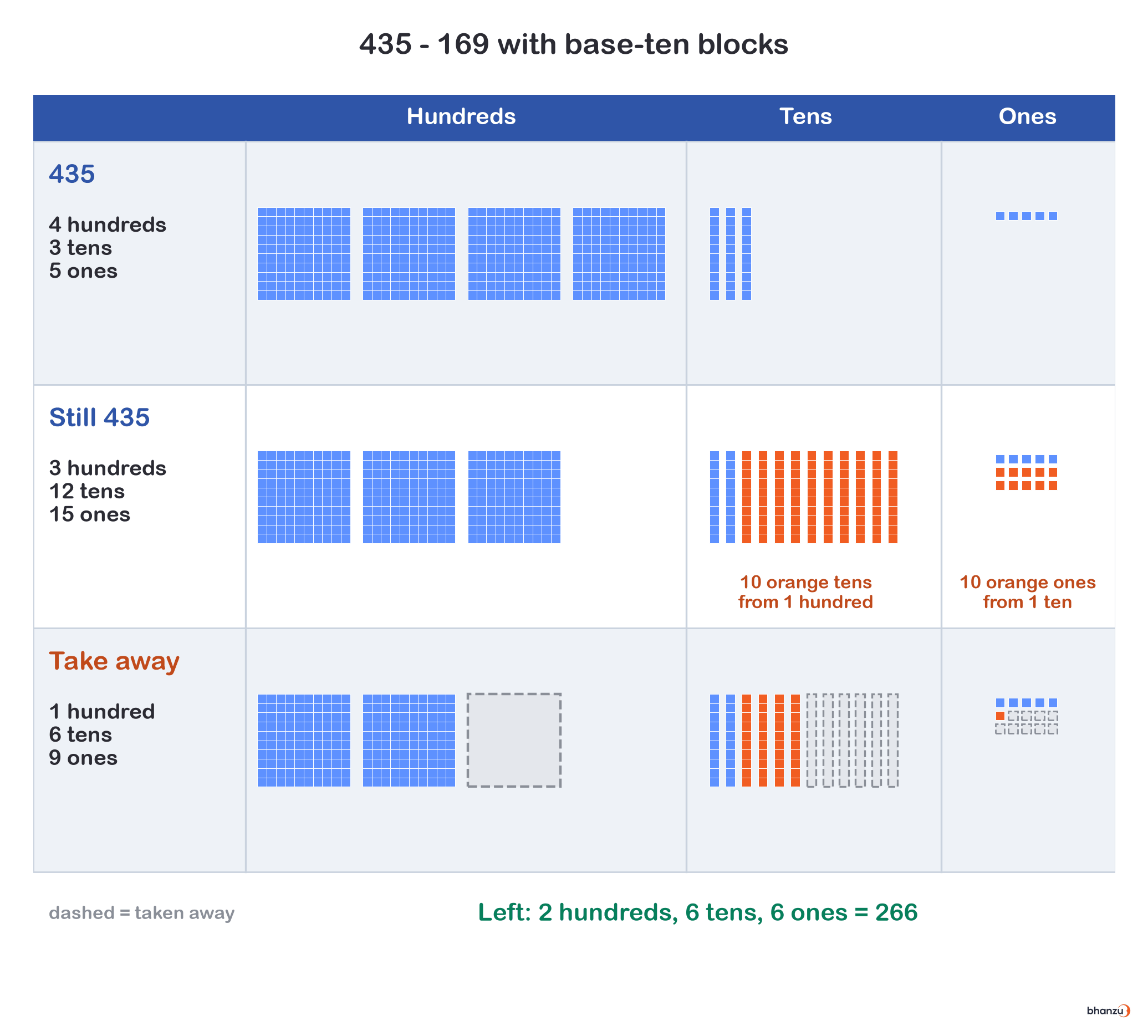
This is Common Core standard 2.NBT.B.7, which expects blocks or drawings beside the written steps, and 2.NBT.B.9 asks your child to explain why trades work.
Story problems keep building this skill after 2nd grade. In the 2025 NAEP long-term trend results, 40% of 9-year-olds reached Level 250, where students use whole-number addition and subtraction in one-step word problems and money situations.
What are the steps for 3-digit subtraction with regrouping?
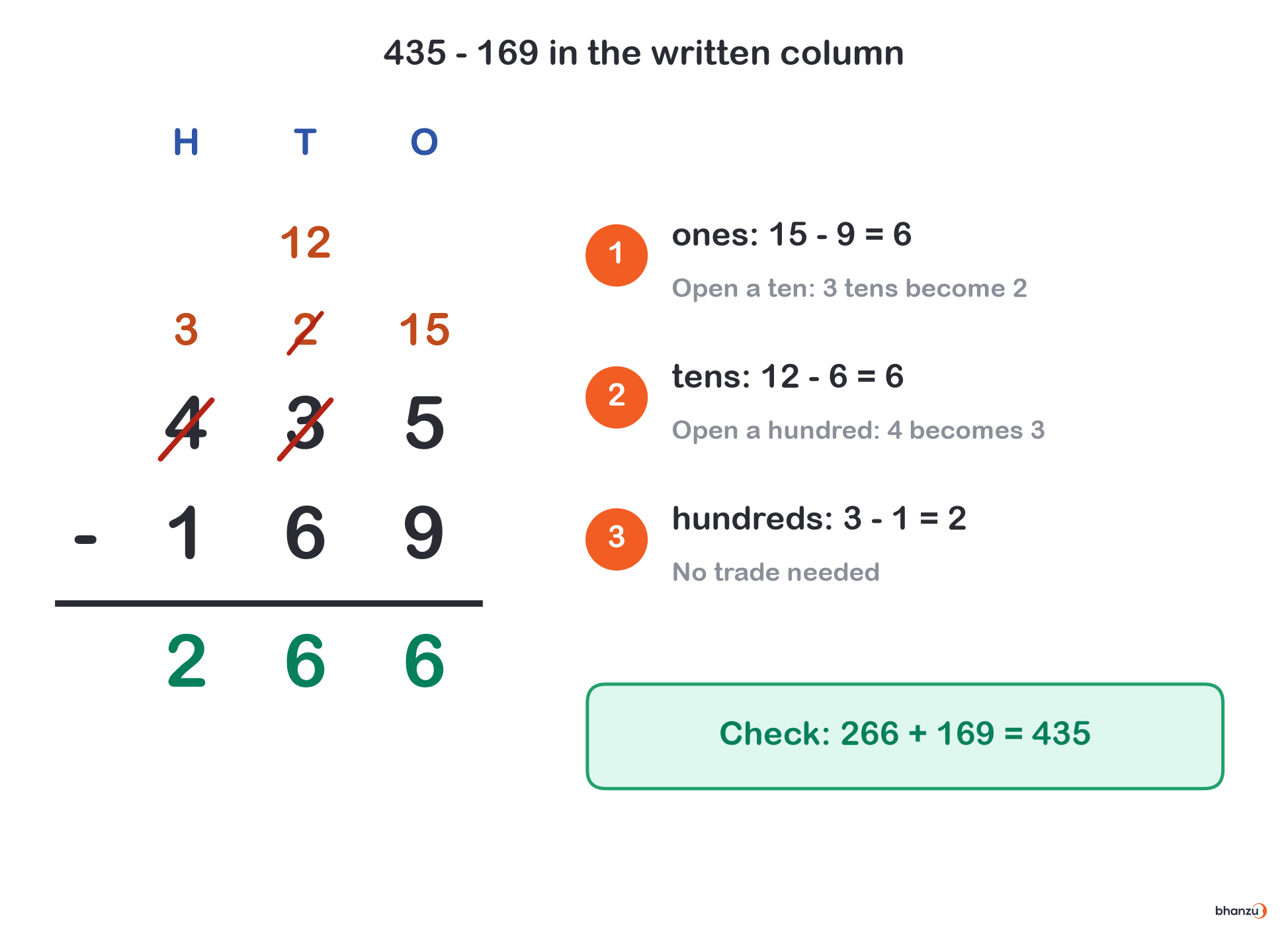
Line up the places and start with the ones. Trade only when a top digit, after any earlier trade, is smaller than the one under it. The column for writes down the trades the blocks made.
- Write 435 over 169, lining up hundreds, tens and ones.
- In the ones, 5 is less than 9. Cross out the 3 tens, write 2, and make 15 ones, so .
- In the tens, 2 is less than 6. Cross out the 4 hundreds, write 3, and make 12 tens, so .
- In the hundreds, , so the answer is 266.
OpenStax's Prealgebra 2e calls this paper trade borrowing.
A child who starts in the hundreds must go back and fix that digit after a tens trade.
How do you check a 3-digit subtraction?
Add the answer to the bottom number, as in adding three-digit numbers, to get back the top number, so . It also finds a missing number, since the box in stands for . A check that lands exactly 10 or 100 too high usually means a ten or a hundred was opened but never crossed out.
How do you subtract across zeros?
When the top tens digit is 0 and the ones need a trade, open a hundred first. One of its 10 tens moves to the ones, so the 0 ends up as 9 and the hundreds drop by 1.
The confusing part: the 0 is briefly 10 and then 9, and only the 9 shows. Children who open a flat on the block mat with ease often stall at that 0 on paper.
Then subtract 156.
So . Renaming 803 this way is the same move as in regrouping hundreds, tens and ones.
Subtracting by adding up, or counting up from the bottom number, is one of three ways.
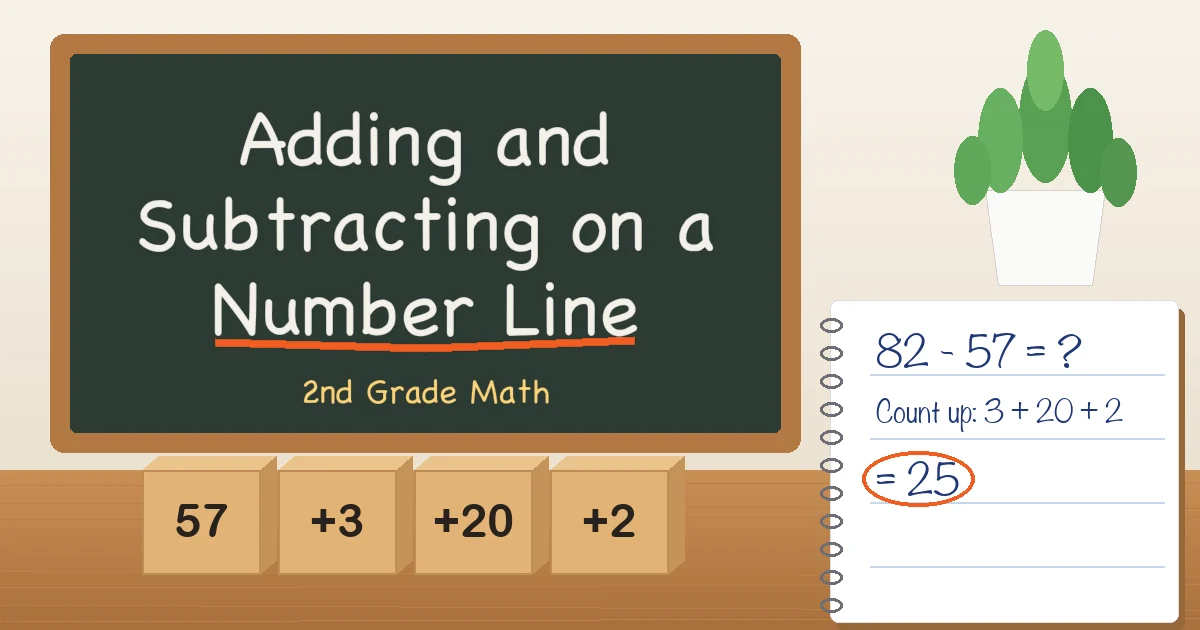
- Counting up on a number line. For , jump 3 to 250, 50 to 300 and 300 to 600, for 353. It's a move from adding and subtracting on a number line, quickest with a round top number.
- Hundreds, then tens, then ones in your head. This kind of mental subtraction gets hard to hold once trades pile up.
- The column with trades. It works for every problem within 1,000 with a larger top number, though counting up solves faster.
A 1982 study by Kurt VanLehn diagnosed 1,138 subtraction answer sheets, mostly from 3rd to 5th graders. The most common wrong rule took the smaller digit from the bigger one (106 sheets). The next two both broke at a zero, stopping the trade there (34) or skipping over it (18).
Try It Yourself
Press Open a ten or Open a hundred when a place runs short, and one piece becomes 10 orange pieces with the same total. When every place has enough, press Take away to see the written subtraction and its addition check. Press New problem for a fresh story.
Examples of subtracting three-digit numbers
Example 1
What is ?
No top digit is smaller, so there are no trades.
Example 2
What is ?
In the tens, 4 is less than 7, so open a hundred.
Example 3
What is ?
The tempting move skips the empty tens and turns the 2 straight into 12.
Then the 0 tens take a hundred.
That gives 367, but , exactly 10 too many. Those 10 extra ones came from nowhere.
Open a hundred into 10 tens first, then one ten into 10 ones.
Example 4
A bike costs $315. Diego has saved $187. How many more dollars does he need?
Find the gap, $$315 - $187$. Open a ten, since 5 is less than 7.
The tens are now 0, which is less than 8, so open a hundred.
Diego needs $128 more.
Example 5
What number goes in the box?
The box is the number you add to 256 to reach 731, so find . Open a ten, then a hundred.
The box is 475.
Example 6
Maya has placed 236 of her 500 puzzle pieces. How many are still in the box?
Find what is left, , by opening a hundred, then a ten.
There are 264 pieces still in the box.
Why does subtracting place by place work?
Place value turns any subtraction up to 999 into three small facts.
- It keeps every step small. After any trades, a top place holds 18 at most, so the biggest fact you need is .
- It never changes the amount. A trade only renames a number, the way a $100 bill swaps for ten $10 bills when you make change.
- It grows from counting by tens and hundreds. A 2023 study followed 279 kindergartners into 2nd grade, and counting base-ten units was the kindergarten task that best predicted later work with bigger numbers.
Small facts and honest renaming do all the work.
Subtracting three-digit numbers: where intuition breaks
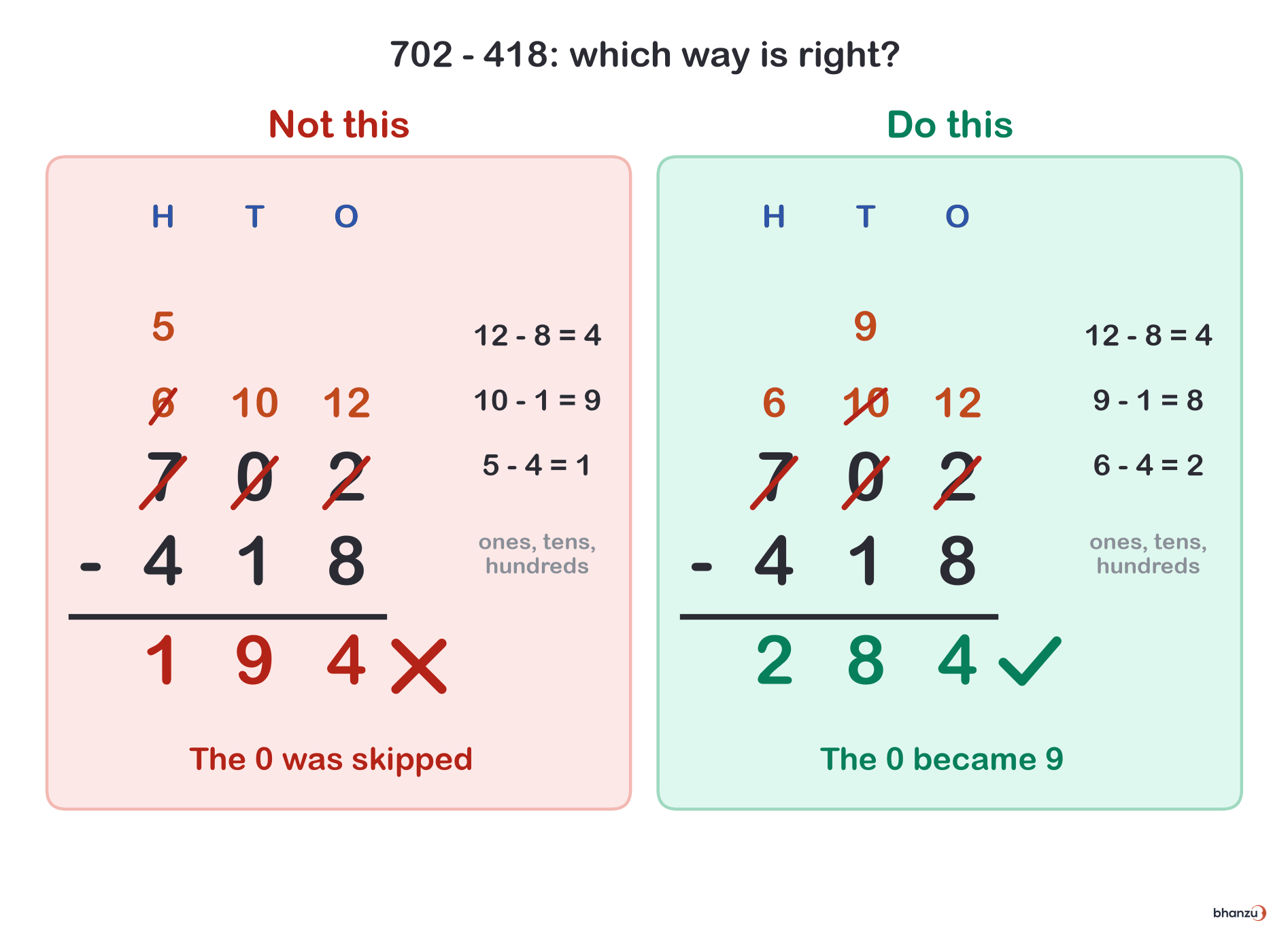
Mistake 1: Jumping over the zero
Where it slips in: A 0 in the top tens when the ones need a trade, as in . A child who has just learned to take from the next place reaches past the 0, which looks empty.
Don't do this: Take a hundred straight for the ones, , then another for the tens, , ending with 194.
The correct way: Open the hundred into 10 tens, then move one ten, for 6 hundreds, 9 tens and 12 ones, then 284.
Mistake 2: Not lowering the hundreds
Where it slips in: Right after a tens trade, as in . The crossed-out 5 is still the bigger mark, so the eye reads it instead of the small 4.
Don't do this: Use the old 5 in the hundreds and write 365.
The correct way: The trade left 4 hundreds, so the answer is 265, and is exactly 100 too high.
Mistake 3: Trading only once
Where it slips in: A problem with two trades, as in . A child who relaxes after the first trade stops comparing the next place.
Don't do this: Open a ten for the ones, then in the tens take 3 from 4, for 215.
The correct way: The tens digit is now 3, less than 4, so open a hundred too, for 2 hundreds and 13 tens, then 195.
What most guides miss about subtracting across zeros
A zero in the tens disappears once you read the top number as tens and ones.
| Problem | As tens and ones | After one trade | Answer |
|---|---|---|---|
| 80 tens, 3 ones | 79 tens, 13 ones | 647 | |
| 100 tens, 0 ones | 99 tens, 10 ones | 643 |
Taking 1 ten from 80 tens leaves 79 tens, written as 7 hundreds and 9 tens. So the 0 turning into 9 and the hundreds dropping are one move. A 9 is never smaller than a bottom digit, so the tens never need a second trade.
Key Takeaways
- Compare each place again after any earlier trade.
- A 0 in the tens becomes 9 when the ones need a trade, and the hundreds drop by exactly 1.
- Subtracting three-digit numbers isn't finished until the answer plus the bottom number gives back the top number.
- A check exactly 10 or 100 too high points to a trade never crossed out.
- For more practice crossing zeros with a teacher who spots a skipped 0, explore Bhanzu's 2nd grade math curriculum or math programs for elementary.
Read More
- Estimating to the Nearest Ten and Hundred
- Adding and Subtracting 10 and 100 Mentally
- Counting Money and Money Word Problems
- Subtracting Within 1,000
- Multi-Digit Subtraction
Research Behind This Article
- Common Core State Standards Initiative, Grade 2 Number and Operations in Base Ten (2.NBT) (2010). thecorestandards.org
- National Center for Education Statistics, NAEP Long-Term Trend Mathematics: Performance-Level Results, Age 9 (2026). nationsreportcard.gov
- OpenStax, Prealgebra 2e, Section 1.3 Subtract Whole Numbers (2020). openstax.org
- VanLehn, Kurt, Empirical Studies of Procedural Flaws, Impasses, and Repairs in Procedural Skills (1982). eric.ed.gov
- Mix, Kelly S. and colleagues, Predictive Relations between Early Place Value Understanding and Multidigit Calculation: Approximate versus Syntactic Measures (2023). eric.ed.gov
- Common Core State Standards Initiative, Grade 3 Number and Operations in Base Ten (3.NBT) (2010). thecorestandards.org
Quick Quiz: Check Yourself
Three levels, new numbers every time: one trade or none, then two trades, a zero or a missing number, then money and puzzle stories.
Was this article helpful?
Your feedback helps us write better content
Frequently Asked Questions
Is regrouping the same thing as borrowing?
What grade learns 3-digit subtraction with regrouping?
How do you teach 3-digit subtraction across zeros at home?
Do kids need to understand "borrow and pay back" subtraction?
How do you solve 3-digit subtraction word problems?