Key Points
- Subtracting two-digit numbers with regrouping swaps 1 ten for 10 ones when the top ones digit is smaller, as in .
- Trading a ten keeps the amount the same, since 4 tens and 3 ones make 43, and so do 3 tens and 13 ones.
- In a 1982 study of 1,138 sets of subtraction answers, taking the smaller digit from the bigger one was the most common wrong rule.
Only 3 loose stickers left
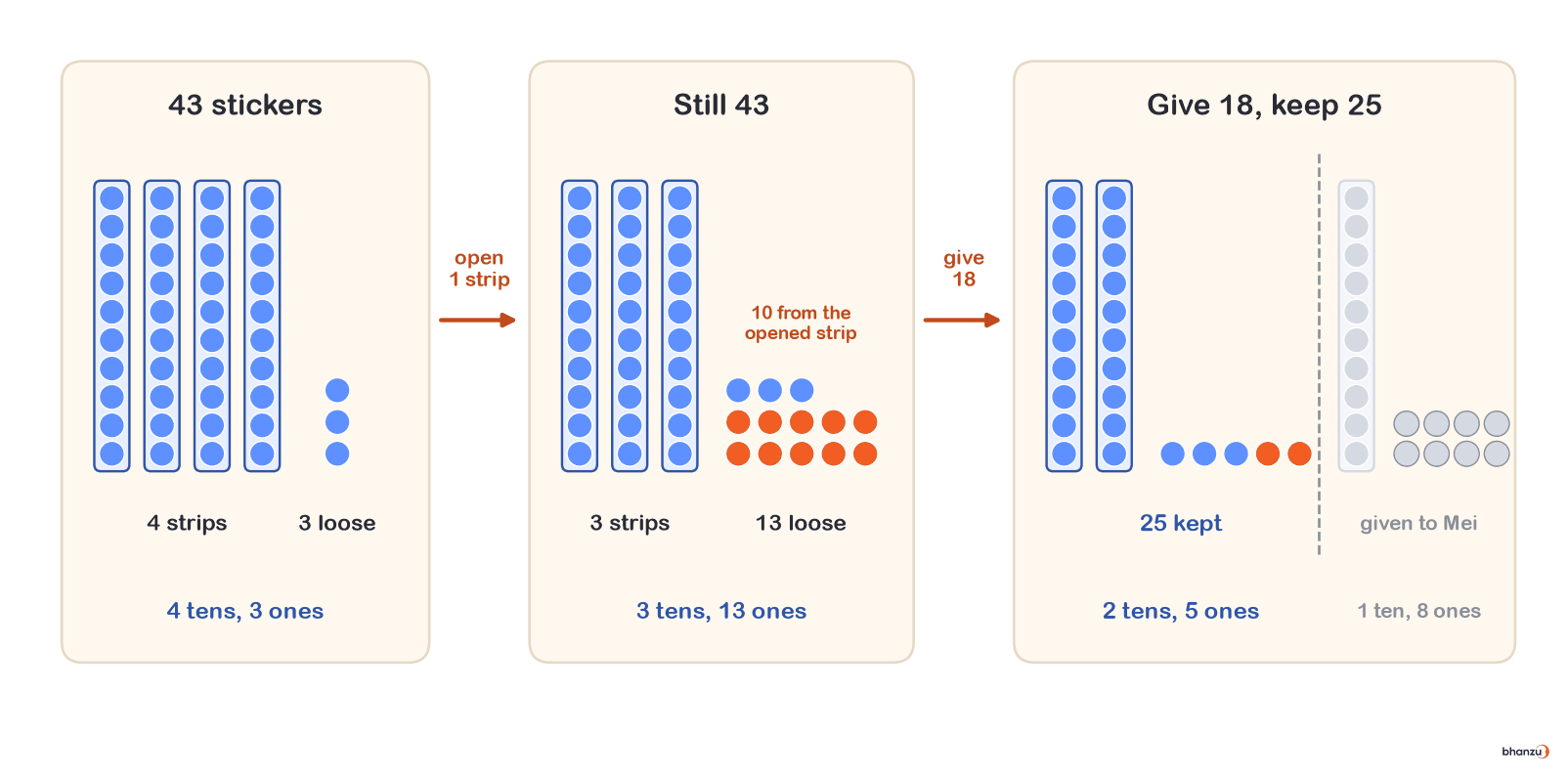
Leo's stickers come on strips of 10, and only 3 loose ones are left. With 4 full strips, he has 43, and Mei asks for 18. He can't hand over 8 loose stickers from 3.
So Leo tears a strip open, and 3 strips and 13 loose still make 43. He gives Mei 1 strip and 8 loose ones and keeps 25. Later in 2nd grade, the same move breaks a hundred into tens when you start subtracting three-digit numbers.
What does regrouping mean in subtraction?
Subtracting two-digit numbers with regrouping opens a ten rod into 10 ones cubes before you take away. You open one when the top ones digit is smaller than the bottom one. That trade is called regrouping, which means changing how a number is grouped while the amount stays the same.
On base-ten blocks, a ten rod is 10 cubes in a row and a ones cube is 1. Build 43 with 4 rods and 3 cubes, then break 1 rod into 10 cubes, the same renaming behind regrouping hundreds, tens and ones.
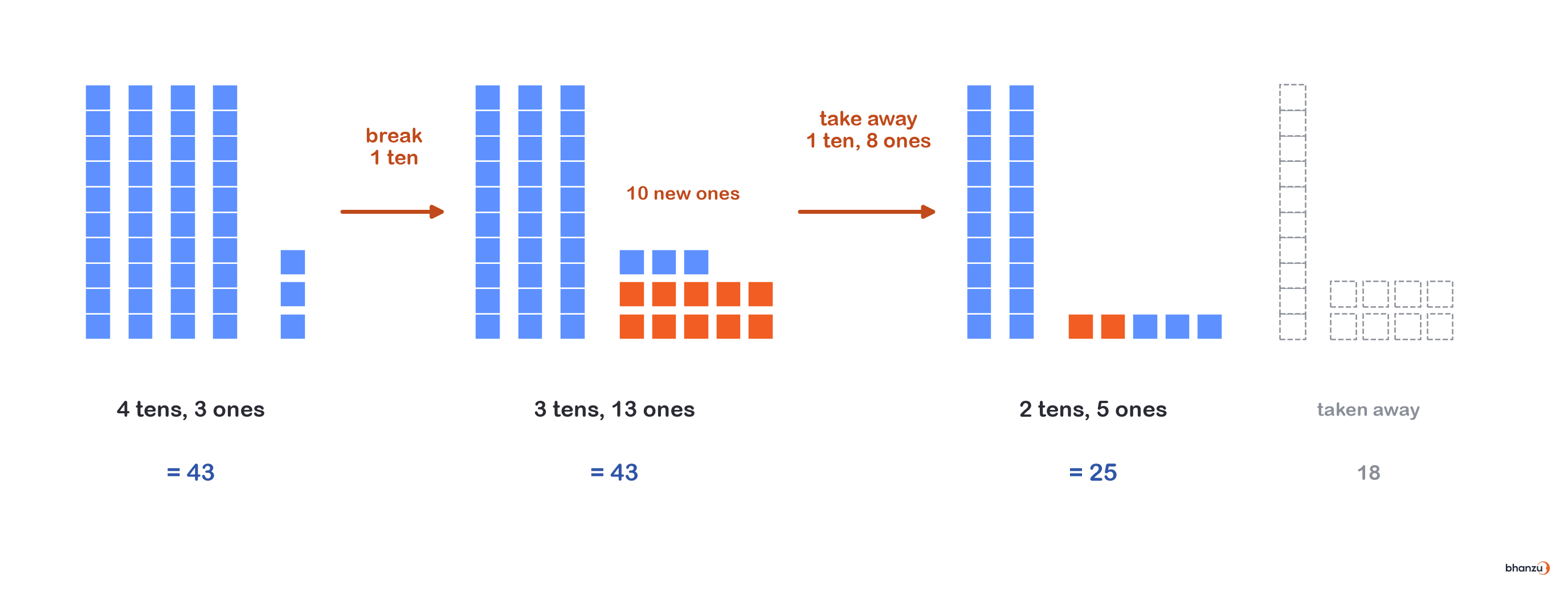
Take away 8 cubes and 1 rod, and 2 rods and 5 cubes stay, so , the difference (the answer to a subtraction).
This is Common Core standard 2.NBT.B.5, and 2.NBT.B.9 asks your child to explain why the trade works with drawings or objects. Expect it to settle more slowly than adding did. On the 2025 Nation's Report Card long-term trend scale, 84% of 9-year-olds reached Level 200, where children add two-digit numbers but are "still developing an ability to regroup in subtraction."
How do you subtract two-digit numbers with regrouping?
Start with the ones. If the top ones digit is smaller, trade 1 ten for 10 ones, then subtract the ones and the tens.
- Write 43 over 18 in column form, tens under tens and ones under ones.
- Compare the ones. 3 is less than 8, so trade.
- Cross out the 4, write a small 3 above it, and make the ones 13.
- Subtract the ones, .
- Subtract the tens, , just like in subtracting multiples of ten. The answer is 25.
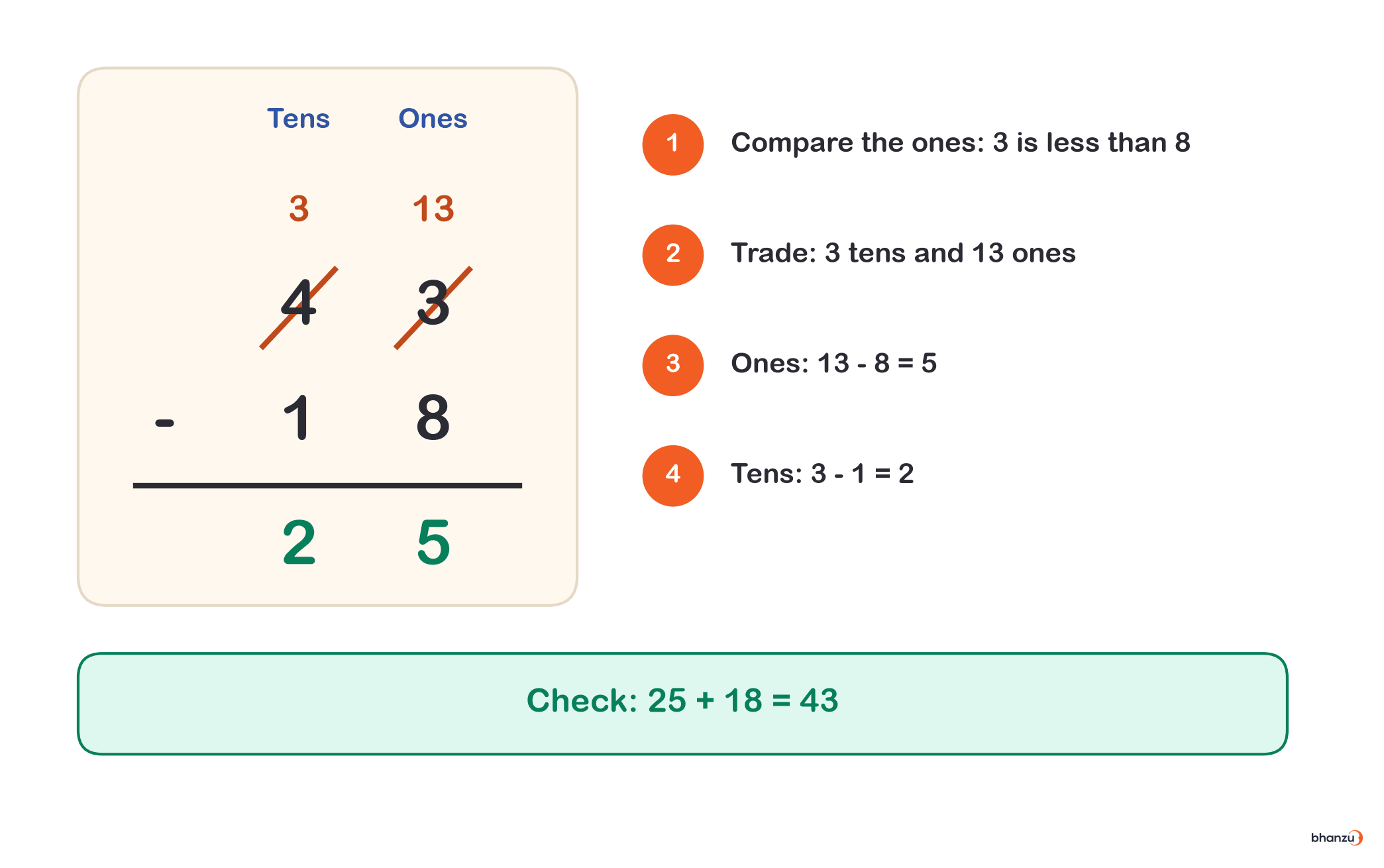
Older books call step 3 borrowing, while the Common Core Grade 2 standards call it decomposing a ten (breaking it apart).
How do you check subtraction with borrowing? Add the answer to the number you took away.
Getting 43 back means 25 is right, the same undoing you met in fact families. This check's ones make a new ten, so it doubles as adding two-digit numbers with regrouping.
Story problems say it in words.
| Words in the problem | Math it means |
|---|---|
| spends 37 cents | subtract 37 |
| gives 27, then gives 19 | subtract twice |
| How many are left? | the difference |
| What number plus 28 makes 64? |
Try It Yourself
Press Break a ten when the ones run short, and watch 1 rod become 10 orange cubes while the total stays the same. Then take away the tens and ones the problem asks for, and the written subtraction and its addition check appear. Press New problem for fresh numbers.
When do you regroup in subtraction?
Compare the ones digits first, and trade only when the top ones digit is smaller.
| Problem | Top ones and bottom ones | Trade? | Answer |
|---|---|---|---|
| 8 is more than 3 | No | 35 | |
| 7 equals 7 | No | 20 | |
| 3 is less than 8 | Yes | 25 | |
| 0 is less than 6 | Yes | 44 |
How do you borrow from 0? A 0 in the top ones place still needs a trade, unless the bottom ones digit is 0 too. In , 7 tens and 0 ones become 6 tens and 10 ones.
Each method finds the same difference.
- Counting up on a number line. For , hop 2 to 70 and 1 more to 71, a gap of 3, but it's slow for numbers far apart.
- Tens, then ones, in your head. Take 10 from 43, then 8 from 33, a mental subtraction route that gets hard as numbers grow.
- The column trade. It works for every two-digit pair with the bigger number on top.
A child who knows may still write 5 for , because in 1st grade the bigger number sat on top. Saying both ones digits aloud first slows down a child who rushes.
Kurt VanLehn's 1982 study of 1,138 sets of subtraction answers counted the smaller-from-bigger rule 106 times on its own. The next most common rule found on its own turned up only 34 times.
Examples of subtracting two-digit numbers with regrouping
Example 1
What is ?
1 is less than 4, so trade for 2 tens and 11 ones.
So , and .
Example 2
What is ?
The tempting move flips the ones to , then does , for 46.
That can't be right, because , not 61.
Instead, 1 is less than 7, so trade for 5 tens and 11 ones.
So , and .
Example 3
Maya has 90 cents. She spends 37 cents on a pencil. How many cents are left?
0 is less than 7, so trade 1 ten (like opening a dime into 10 pennies) for 8 tens and 10 ones.
Maya has 53 cents left, and .
Example 4
What number goes in the box?
The box is what you add to 28 to reach 64, so find . 4 is less than 8, so trade for 5 tens and 14 ones.
The box holds 36, since .
Example 5
Leo has 85 stickers. He gives 27 to Mei and 19 to Diego. How many stickers does he have left?
For , 5 is less than 7, so trade for 7 tens and 15 ones.
That leaves 58. For , 8 is less than 9, so trade for 4 tens and 18 ones.
Leo has 39 stickers left, and .
Why does regrouping work?
Regrouping works because a ten is only 10 ones packed together. Opening one changes the grouping, never the amount.
- It keeps the amount the same. and both make 43.
- It turns one hard problem into two small 1st grade facts, and .
- It matches money. Paying 8 cents with 3 pennies means trading a dime for 10 pennies first.
- It earned its marks. In a study begun in 1937, William Brownell found children who crossed out the tens digit more accurate. A history of subtraction in the United States found almost every later textbook using the marks.
The marks are bookkeeping, and the number stays 43 the whole time.
The pattern hiding inside subtraction with regrouping
After a trade, you never need more than a "10 minus" fact. The 10 new ones and the ones you had sit in separate piles, so take from the 10 and add the rest back.
| Problem | From the 10 | Plus the old ones | Ones digit |
|---|---|---|---|
| 5 | |||
| 5 | |||
| 3 |
Taking from the 10 works because 13 is 10 and 3, and the 3 never moves. A child who counts back on fingers can ask how many the 10 has left.
The genuinely confusing part is "13 ones" itself, a pile you hold for one step, never a digit in the answer.
Double-digit subtraction with regrouping: common confusions cleared up
Mistake 1: Forgetting to lower the tens
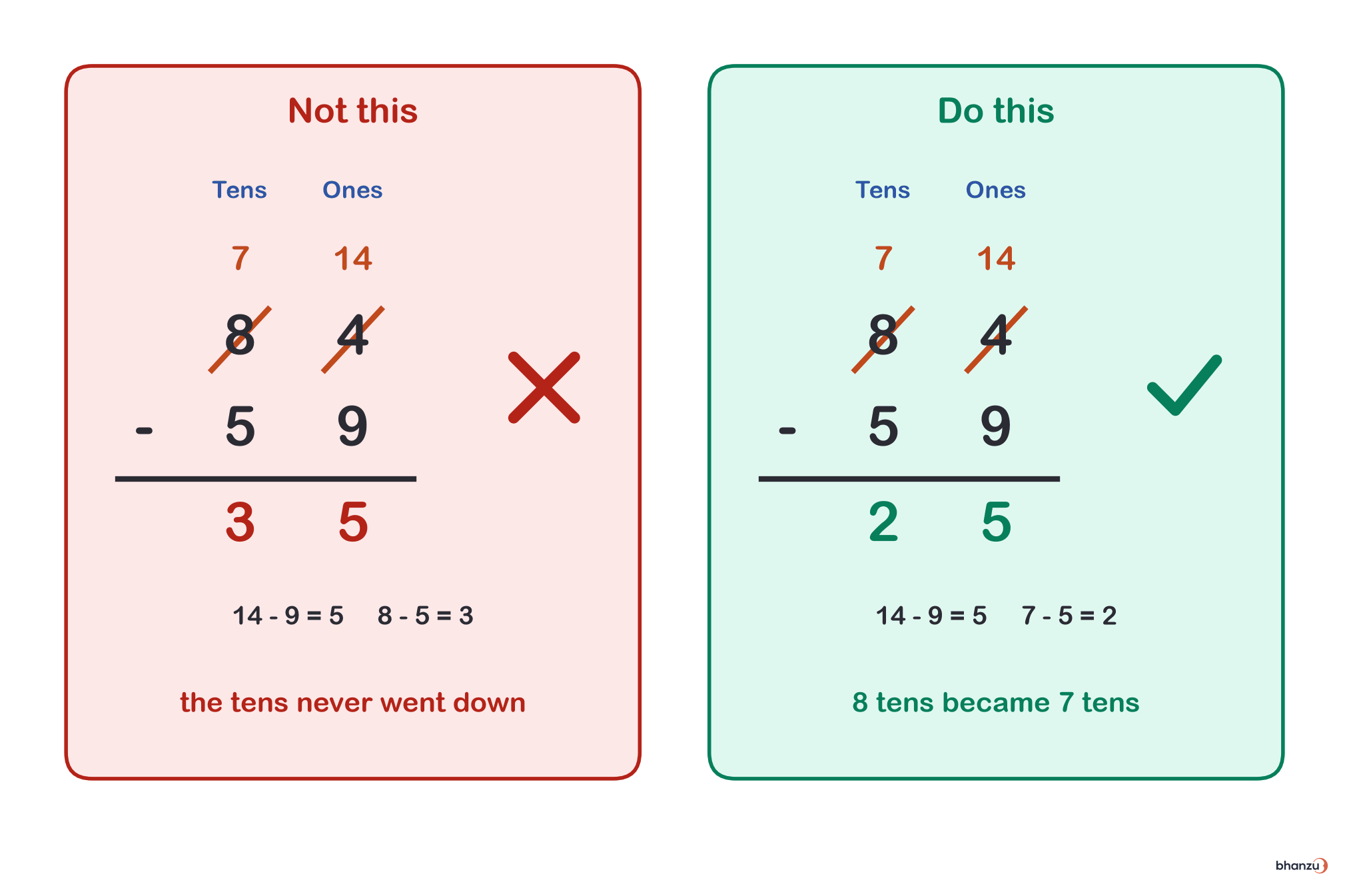
Where it slips in: Right after the trade in . Children often read the big 8 again after writing the small 7 above it, because the old digit is the clearer mark.
Don't do this: Work out , then , for 35.
The correct way: 8 tens became 7 tens, so and the answer is 25, since .
Mistake 2: Copying the bottom digit under a 0
Where it slips in: A top number ending in 0, as in . A 0 looks like nothing to do (it isn't), so the 6 gets copied down.
Don't do this: Write 6 for 0 take away 6, then , for 36.
The correct way: Trade for 4 tens and 10 ones, so , , and the answer is 24.
Mistake 3: Trading when the ones are enough
Where it slips in: A no-trade problem like after a page of trades, once crossing out is a habit, not a decision.
Don't do this: Write 7 over the 8, keep 7 ones, and get and , for 32.
The correct way: 7 is more than 5, so skip the trade. and , so the answer is 42.
Key Takeaways
- Read the ones digits first, and trade only when the top one is smaller.
- Every trade lowers the tens digit by 1 and adds 10 to the ones.
- Subtracting two-digit numbers with regrouping is done when adding back gives the top number.
- A 0 in the top ones place needs a trade too, unless the bottom ones digit is also 0.
- To practice trades with a teacher who catches a forgotten cross-out, explore Bhanzu's 2nd grade math tutor or Common Core math curriculum.
Read More
- Adding and Subtracting on a Number Line
- Finding the Missing Number Within 100
- Subtracting Within 1,000
- Multi-Digit Subtraction
Research Behind This Article
- Common Core State Standards Initiative, Grade 2 Number and Operations in Base Ten (2010). thecorestandards.org
- National Center for Education Statistics, NAEP Long-Term Trend Mathematics: Performance-Level Results, Age 9 (2026). nationsreportcard.gov
- VanLehn, Kurt, Empirical Studies of Procedural Flaws, Impasses, and Repairs in Procedural Skills (1982). eric.ed.gov
- Ross, Susan and Pratt-Cotter, Mary, Subtraction in the United States: An Historical Perspective (1997). openjournals.libs.uga.edu
- Common Core State Standards Initiative, Grade 4 Number and Operations in Base Ten (2010). thecorestandards.org
Quick Quiz: Check Yourself
Three levels, new numbers every time: one subtraction with a trade, then trade-or-not, zero and missing-number problems, then cents and sticker stories.
Was this article helpful?
Your feedback helps us write better content
Frequently Asked Questions
Is borrowing the same as regrouping?
What grade is subtraction with regrouping taught in?
What is the best way to teach subtraction with regrouping at home?
Is 2-digit subtraction with regrouping really hard for a 2nd grader?
Are there fun ways to teach subtraction with regrouping?