Key Points
- Adding tens and ones in 1st grade means adding a one-digit number, as in 75 + 3 = 78, or whole tens, as in 75 + 20 = 95.
- Ones join ones and tens join tens because one ten is a bundle of ten ones, like a base-ten rod of ten cubes.
- For sums below 100, no regrouping is needed when the ones digits add to 9 or less, as in 26 + 3 = 29, while 26 + 4 makes a new ten.
Strips stay strips, loose stickers stay loose
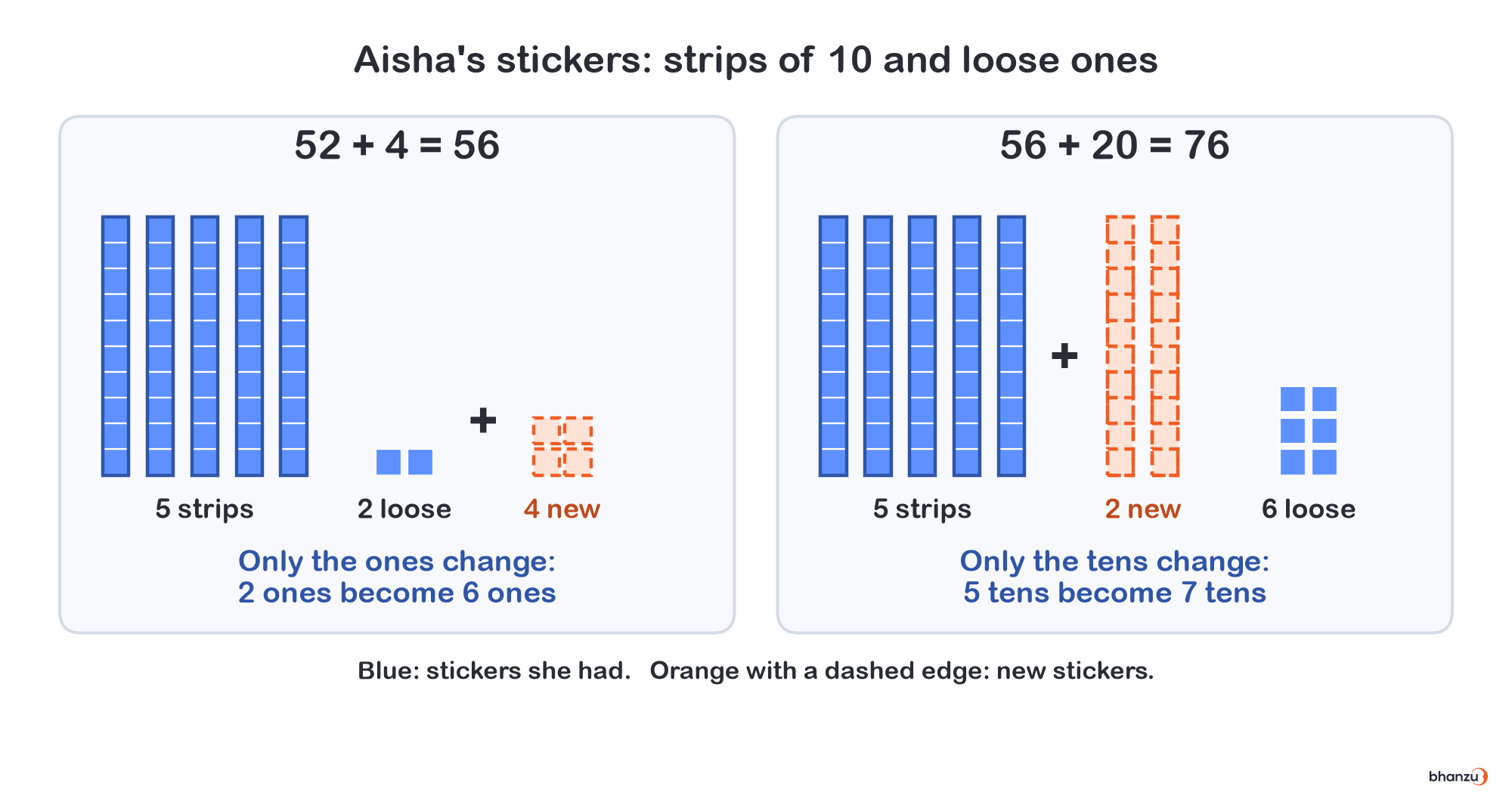
Aisha keeps her stickers in strips of 10, plus a few loose ones. She has 5 strips and 2 loose stickers, which makes 52. A friend hands her 4 loose stickers, and only the loose pile grows, so now she has 56.
Next week she gets 2 more strips. The 6 loose stickers sit still, the strips go from 5 to 7, and she has 76. In 2nd grade, you'll add much bigger numbers with this same idea.
How do you add tens and ones?
Adding tens and ones means adding the right-hand digits (the ones) together and the left-hand digits (the tens) together to make one answer, the sum. Each digit (0 to 9) gets its meaning from its spot, and that idea is called place value.
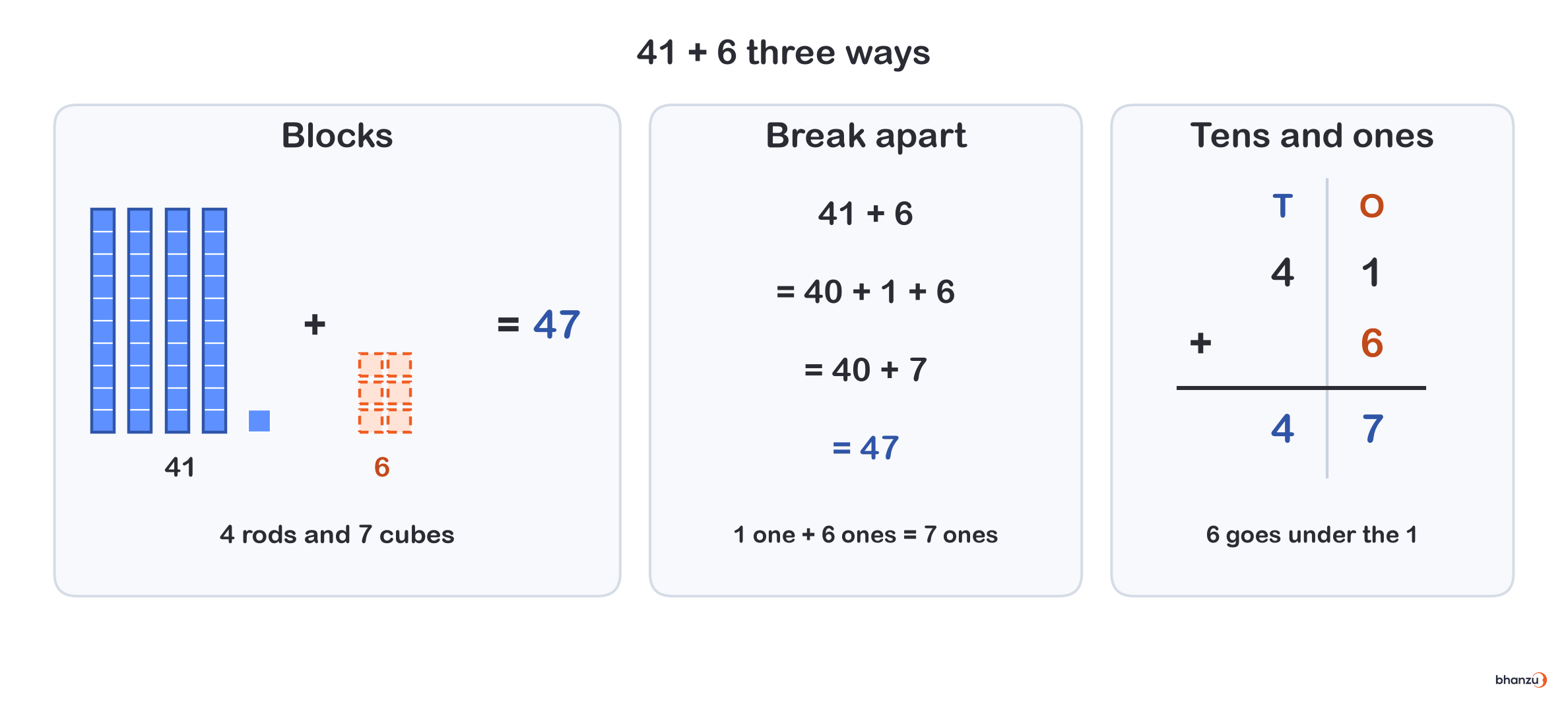
On base-ten blocks, a rod is 10 cubes stuck together, so 41 is 4 rods and 1 cube.
- Say each number as tens and ones. 41 is 4 tens and 1 one, and 6 is 6 ones.
- Add the ones. .
- Add the tens. , because 6 has no tens.
- Put the parts together. 4 tens and 7 ones make 47.
The order doesn't matter, so 6 + 41 is also 47. On paper, write the 6 under the 1, ones under ones.
Expanded form (a 2nd grade name) writes a number as its tens plus its ones.
| Tens and ones | Expanded form | Number |
|---|---|---|
| 4 tens 1 one | 41 | |
| 4 tens 7 ones | 47 |
For 1st graders, Common Core standard 1.NBT.C.4 says "one adds tens and tens, ones and ones" when adding two-digit numbers. When your child says "4 tens and 7 ones" while pointing at the rods and cubes, that explanation counts as much in 1st grade as writing 47.
How do you add tens to a number?
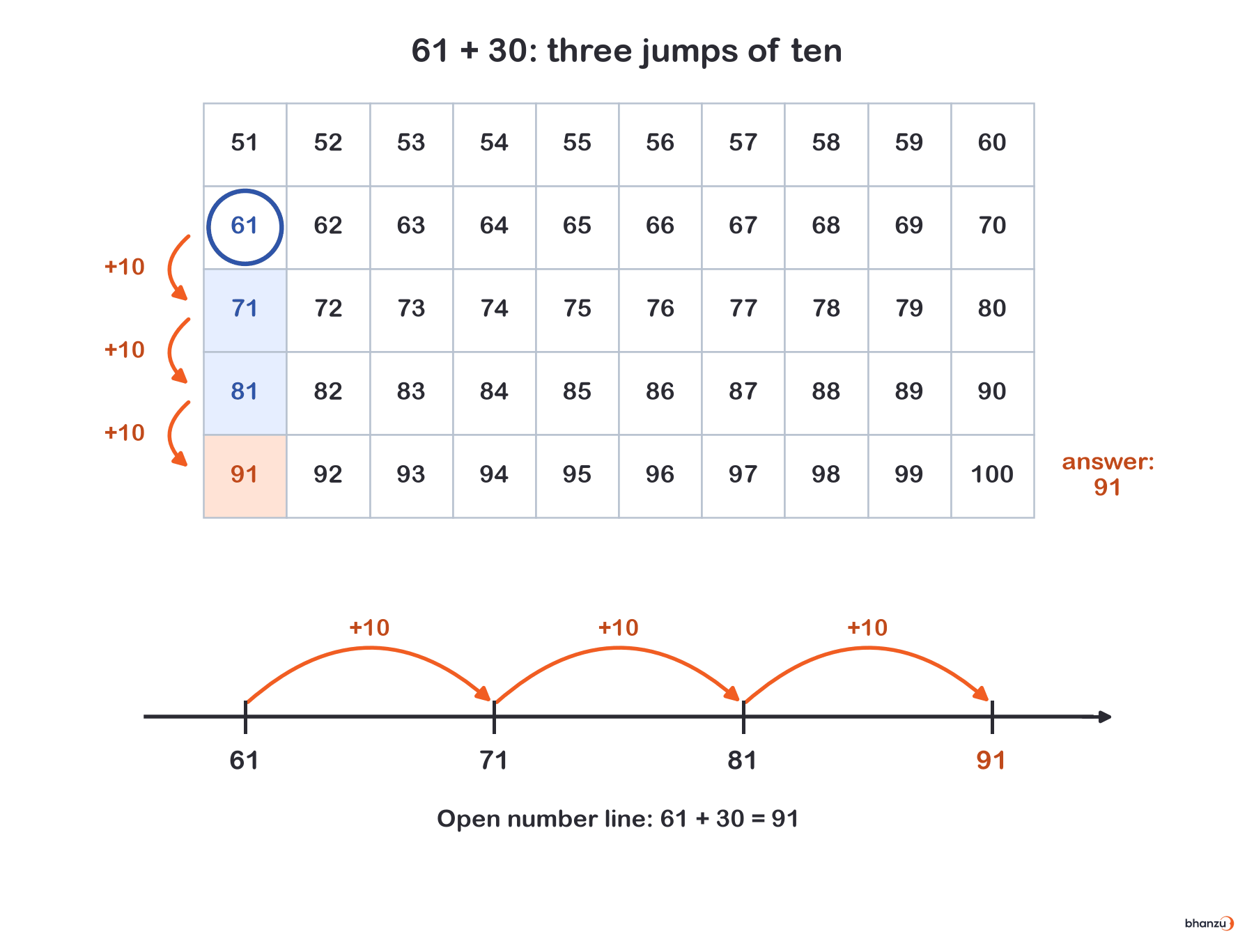
To add whole tens, add only the tens digits and leave the ones digit alone. A multiple of ten, like 10, 20 or 30, is made of whole tens and 0 ones. For 61 + 30, 6 tens and 3 tens make 9 tens, and the 1 one stays.
A hundred chart is a grid of 1 to 100 in rows of 10, so one step down is 10 more. From 61, three steps down land on 71, 81 and then 91. An open number line (a blank line you mark as you go) shows the same three jumps.
Counting on by ones works for 41 + 6, but 61 + 30 would take 30 counts. A child who knows 6 + 3 = 9 in a blink may still count all 30 ones, because the 0 hides that 30 means 3 tens.
Two two-digit numbers follow the same rule. In 31 + 46, the tens make 3 + 4 = 7 and the ones make 1 + 6 = 7. Coins work this way too, since in counting coins a dime counts as a ten and a penny as a one.
Working backward, 61 becoming 68 means 7 was added, since only the ones digit moved, and 43 becoming 73 means 30 was added.
In a 2022 study of 112 children averaging about 7 years old, those who linked base-ten blocks to written numbers scored higher on later checks. At home, ask your child which blocks the 3 in 31 stands for.
When is it addition without regrouping?
Addition without regrouping means no trade of 10 ones for 1 ten is needed, because the ones digits add to 9 or less. Each place holds just one digit, so 10 ones must become a rod.
| Problem | Ones total | New ten needed? |
|---|---|---|
| 26 + 3 | 6 + 3 = 9 | No, 29 |
| 26 + 4 | 6 + 4 = 10 | Yes, 30 |
| 45 + 8 | 5 + 8 = 13 | Yes, 53 |
| 70 + 9 | 0 + 9 = 9 | No, 79 |
Adding whole tens adds 0 ones, so the ones never spill over. With sums below 100, the tens never fill up either.
What is adding with regrouping? It is that trade of 10 ones for 1 ten, taught in making a new ten.
Try It Yourself
Drag a rod or a cube onto the mat, or tap the add buttons, and watch which digit changes. Keep adding cubes until the ones reach 10, then see what the mat asks you to trade.
Examples of adding tens and ones
Example 1
What is 21 + 7?
The ones make , and the tens stay at 2.
Example 2
What is 54 + 30?
The 30 looks like a 3, so adding 3 to the ones gives 57.
That can't be right. 30 is 3 whole tens, and 3 rows down from 54 on a hundred chart is 84. Add tens to tens instead.
That makes 8 tens. The 4 ones stay, so .
Example 3
Which one needs no regrouping, 36 + 3 or 36 + 4? Find that sum.
In 36 + 3, the ones make . In 36 + 4, they make , a new ten.
Example 4
What number goes in the box in ?
The box stands for the number added to 61.
The tens digit stayed 6, and the ones digit went from 1 to 8.
So .
Example 5
Diego has 3 dimes and 2 pennies. Grandpa gives him 2 dimes and 6 pennies. How many cents does Diego have now?
Dimes are tens and pennies are ones, so Diego adds 32 + 26.
The dimes make 3 + 2 = 5 tens, and the pennies make 2 + 6 = 8 ones.
Diego has 58 cents.
Example 6
Aisha has 76 stickers. She gets 2 loose stickers, then 1 more strip of 10. How many stickers does she have now?
The loose stickers join the ones.
The strip joins the tens.
Aisha has 88 stickers.
Why does adding tens to tens work?
Each place in a number counts a different size of bundle, and only same-size bundles join into one count.
- It keeps counts honest. Adding 3 loose stickers to 5 strips can't make 8 strips.
- It turns big jumps into small facts. For 56 + 20, the fact 5 + 2 = 7 gives 76.
- It sets up bigger adding. In a 2023 study of 279 kindergartners, a tens-and-ones counting task was the best single predictor of their 2nd grade calculations with bigger numbers.
In 2nd grade, you'll add hundreds to hundreds the same way.
Adding tens and ones: spot the trap before you fall in
Mistake 1: Putting a one-digit number under the tens
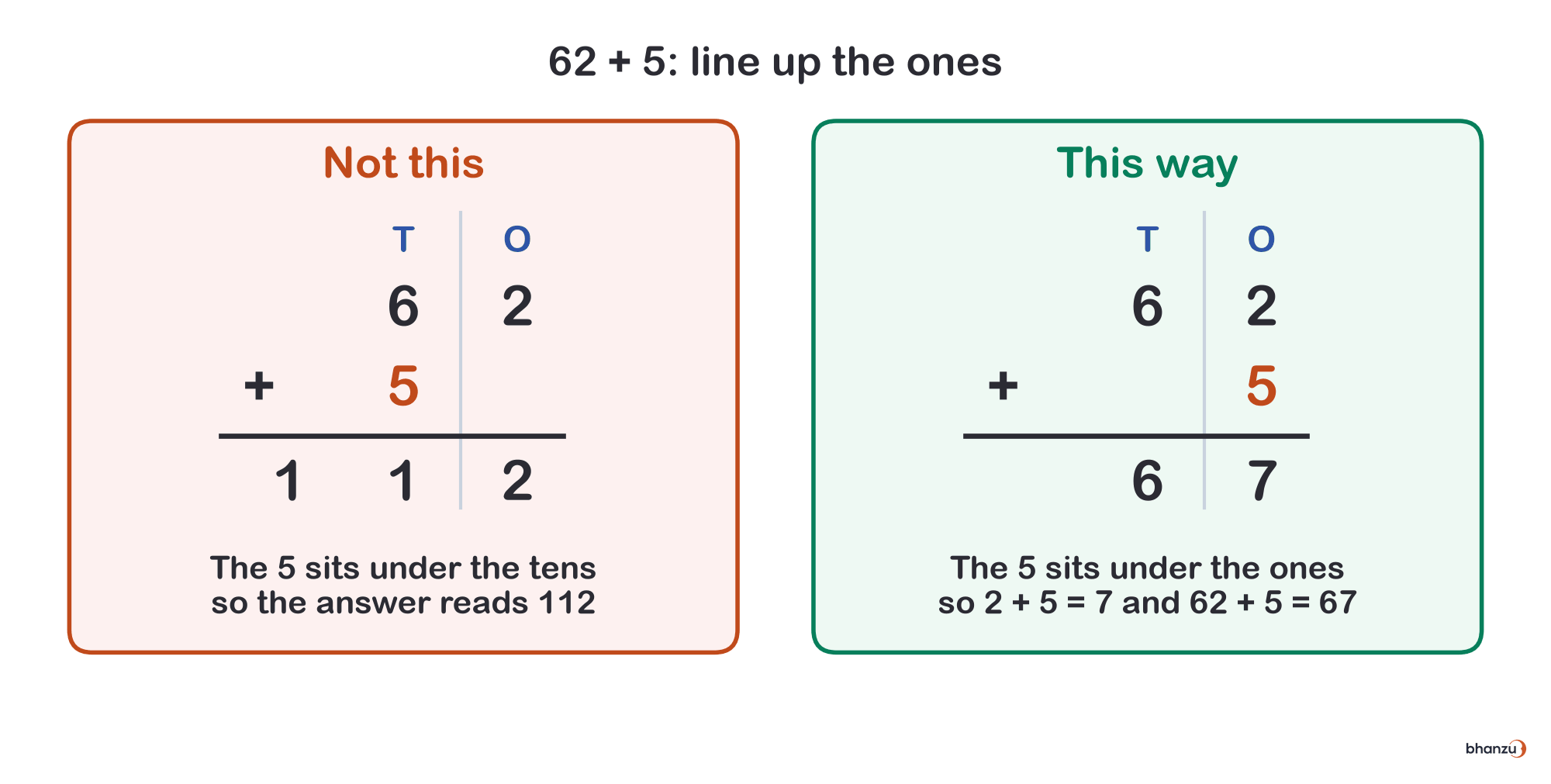
Where it slips in: Writing 62 + 5 in columns. A child who starts each number at the left edge, the way words start a line, puts the 5 under the 6.
Don't do this: Adding 5 to the 6 tens, so and the answer reads 112.
The correct way: Put the 5 under the 2. The ones make , so the sum is 67.
Since 62 + 5 can't pass 100, an answer like 112 is a signal to look again.
Mistake 2: Writing the parts side by side
Where it slips in: Building 40 + 6, or writing "forty-six" after hearing it, because children write down each part they hear.
Don't do this: Writing 406.
The correct way: 4 tens and 6 ones is 46, with the 6 sitting in the spot of the 0.
Mistake 3: Using the no-regrouping steps when the ones make 10 or more
Where it slips in: Problems like 27 + 5, after the steps have worked so often that a child rushes past the ones check.
Don't do this: Writing into the ones place, so the answer reads 212.
The correct way: Check the ones first. 12 ones is 10 or more, so trade 10 ones for 1 ten, which makes 3 tens and 2 ones, or 32.
The part of adding tens and ones nobody explains
With no regrouping, adding the ones first or the tens first gives the same sum, so the order is a choice. Do you add the tens or the ones first? In your head, tens first feels natural, and adding mentally often starts that way with 56 + 23.
On paper, columns start at the ones, because a new ten from the ones must go into the tens first. Grown-ups taught "always start with the ones" often find this confusing, and fairly so.
Building a number is a different job from adding to one.
- Building a number. 40 + 6 makes 46.
- Adding to a number. 41 + 6 makes 47, because 41 already has 1 one.
Writing 406 for forty-six is a common early habit. In a 2014 study of 172 children aged 4 to 6, 76% of the 5-year-olds and 61% of the 6-year-olds wrote a spoken three-digit number this way at least once, like 600402 for 642.
So when your child writes 406, lay a 6 card on top of the 0 in 40 and read the number together.
Key Takeaways
- Glance at the ones digits before adding tens and ones, since 9 or less means no regrouping.
- A one-digit number always sits under the ones digit.
- Adding whole tens leaves the ones digit alone, so 71 + 20 still ends in 1.
- For more practice keeping ones under ones, with a teacher who spots a 5 drifting into the tens, explore Bhanzu's 1st grade math tutor or math programs for kids.
Read More
- Adding Several Numbers With Tens and Ones
- Subtracting Multiples of Ten
- Adding Two-Digit Numbers With Regrouping
- Adding and Subtracting on a Number Line
- Mental Math for Kids
Research Behind This Article
- Common Core State Standards Initiative, Grade 1: Number and Operations in Base Ten (2010). thecorestandards.org
- Lynn Marecek, MaryAnne Anthony-Smith and Andrea Honeycutt Mathis, Prealgebra 2e, 1.2 Add Whole Numbers (2020). openstax.org
- Andrea Marquardt Donovan and Emily R. Fyfe, Connecting Concrete Objects and Abstract Symbols Promotes Children's Place Value Knowledge (2022). eric.ed.gov
- Kelly S. Mix, Corinne A. Bower, Lei Yuan, Gregory R. Hancock and Linda B. Smith, Predictive Relations between Early Place Value Understanding and Multidigit Calculation (2023). eric.ed.gov
- Lisa Byrge, Linda B. Smith and Kelly Mix, Beginnings of Place Value: How Preschoolers Write Three-Digit Numbers (2014). eric.ed.gov
Quick Quiz: Check Yourself
Three levels, new numbers every time: add ones to a two-digit number, add tens or find a missing number, then solve cents and sticker problems.
Was this article helpful?
Your feedback helps us write better content
Frequently Asked Questions
Can you add tens and ones vertically?
What are tens and ones?
How do I teach tens and ones at home?
Can my kindergartner learn tens and ones?
How do you subtract tens and ones?