Key Points
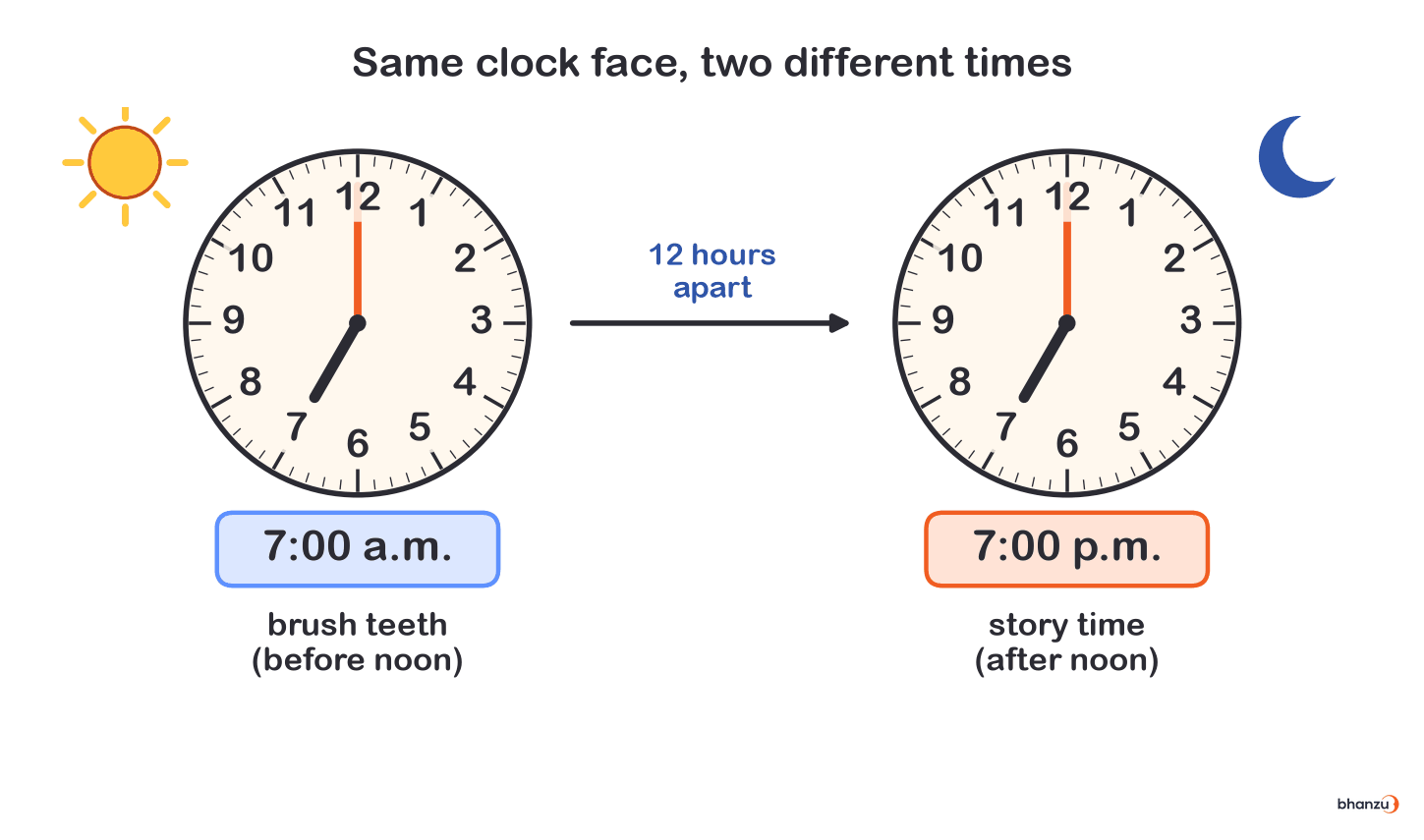
- The labels a.m. and p.m. split each day into two 12-hour halves at 12 noon, so 7:15 a.m. and 7:15 p.m. are 12 hours apart.
- To choose the label, ask whether noon has passed yet today, since a clock face shows every reading twice.
- Noon is 12:00 p.m. and midnight is 12:00 a.m., so the 12 o'clock hour starts each half and 12:05 p.m. comes before 1:00 p.m.
The clock that shows 7:00 twice
Every clock in Maya's house shows 7:00 twice a day, 12 hours apart. One 7:00 comes before school, when she brushes her teeth. The other comes after dinner, at story time.
The hands sit in the same spot both times, so two tiny letters have to say which 7:00 it is. Soon they'll help you find elapsed time, the time that passes between a morning time and an afternoon time.
What do a.m. and p.m. mean?
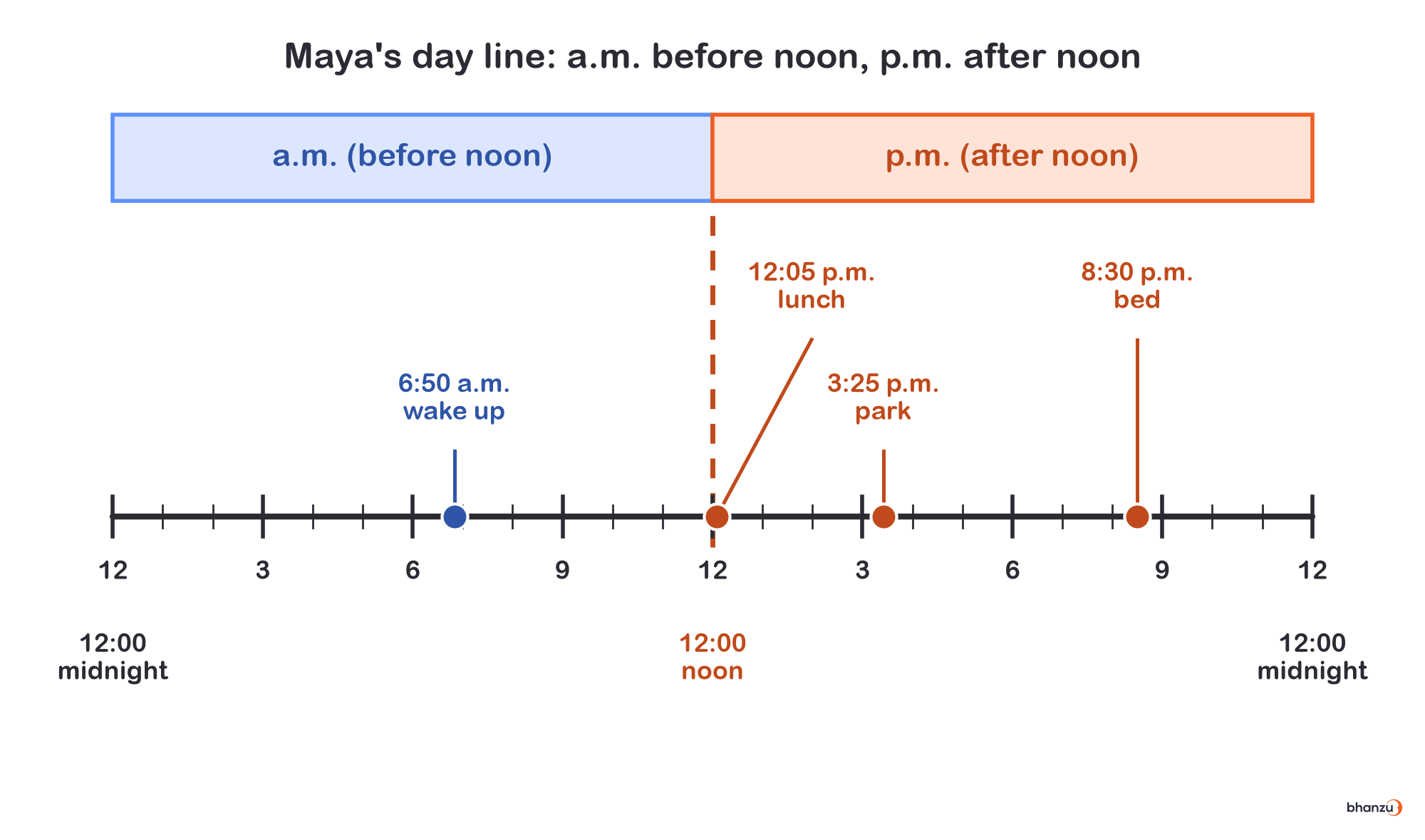
On a day line, a number line for one day, a.m. and p.m. are the two halves on either side of 12 noon. The a.m. half runs from 12:00 midnight up to noon, the middle of the day, and the p.m. half runs from noon to the next midnight.
What do a.m. and p.m. stand for? A.m. is short for the Latin ante meridiem, before noon, and p.m. for post meridiem, after noon.
The hour hand circles a 12-hour clock twice a day, starting each trip at the 12, written XII in Roman numerals on some clocks.
This is Common Core standard 2.MD.C.7, which says to "tell and write time from analog and digital clocks to the nearest five minutes, using a.m. and p.m." in 2nd grade. For your child, that means reading a clock face with hands or a number-only digital clock, writing the time and adding the right label in one go.
How do you know if it is a.m. or p.m.?
Ask one question: has 12 noon happened yet today?
- Read the time on the clock.
- Say what is happening at that time.
- Write a.m. if noon is still coming, or p.m. if it has gone by.
Story words often settle the label first.
| Words in the story | Label |
|---|---|
| morning, breakfast, before school | a.m. |
| afternoon, after lunch, after school | p.m. |
| evening, dinner, bedtime | p.m. |
| after midnight, middle of the night | a.m. |
The sky is no help. On December 21, 2026, in Chicago, the US Naval Observatory lists sunrise at 7:15 a.m. and sunset at 4:23 p.m. So the sun is still down at a 7:00 breakfast and already down at a 5:30 dinner. A child who reads the clock perfectly can still write p.m. after one look at a dark window.
Is 12 noon a.m. or p.m.?
Noon is 12:00 p.m. The moment the clock reaches 12:00 in the daytime, it switches to p.m., so a digital clock shows PM right away.
Midnight, 12:00 a.m., starts a new day, and the date moves to the next box when you are reading a calendar.
| Clock shows | Where it sits |
|---|---|
| 11:55 a.m. | 5 minutes before noon |
| 12:00 p.m. | noon, the p.m. half starts |
| 12:05 p.m. | 5 minutes after noon |
| 11:55 p.m. | 5 minutes before midnight |
| 12:00 a.m. | midnight, a new day starts |
The minute after 11:59 a.m. is 12:00 p.m. So each half starts with its 12 o'clock hour, and a day's a.m. times all come before its p.m. times.
The noon question gets stuck at exactly 12:00, since noon is neither before nor after itself. The National Institute of Standards and Technology calls 12 a.m. and 12 p.m. ambiguous (grown-ups mix them up too). Digital clocks show PM at noon, as this page does.
Try It Yourself
Drag the sun along Maya's day line, from midnight to the next midnight, and watch the clock hands turn as the label flips at noon. Tap one of Maya's events, choose its label, and the sun jumps there if you are right.
How do you write a time with a.m. or p.m.?
Write the hour, a colon, the minutes, a space and one label, like 3:25 p.m.
- Find the hour, the last number the short hour hand has reached.
- Count from the 12 to the long minute hand by skip counting by 5s, since each number marks 5 minutes and .
- Write two digits for the minutes, so five past 3 is 3:05, never 3:5.
- Add the label in lowercase letters with periods.
Children who rush often read 3:50 as 4:50 (by then the hour hand sits close to the 4). An analog clock usually shows no label, so the event decides.
Later you'll meet the 24-hour clock, which writes 3:25 p.m. as 15:25.
Examples of a.m. and p.m.
Example 1
Maya eats breakfast at 7:15. Is it a.m. or p.m.?
Breakfast comes before noon, so the time is 7:15 a.m.
Example 2
On December 21, 2026, Maya wakes up in Chicago at 6:50, before sunrise. Is it a.m. or p.m.?
The sun is not up yet, and a sky with no sun feels like night, so p.m. looks right.
But 6:50 p.m. comes after lunch and school, and Maya has had neither yet today, so p.m. cannot be right.
Noon has not passed yet today, so it is 6:50 a.m. Sunrise that day is 7:15 a.m.
Example 3
The hour hand is between the 3 and the 4, and the minute hand points to the 5. Maya is at the park after school. Write the time and its label.
The hour hand has passed the 3, so the hour is 3.
Counting by fives to the 5 gives 5, 10, 15, 20, 25 minutes.
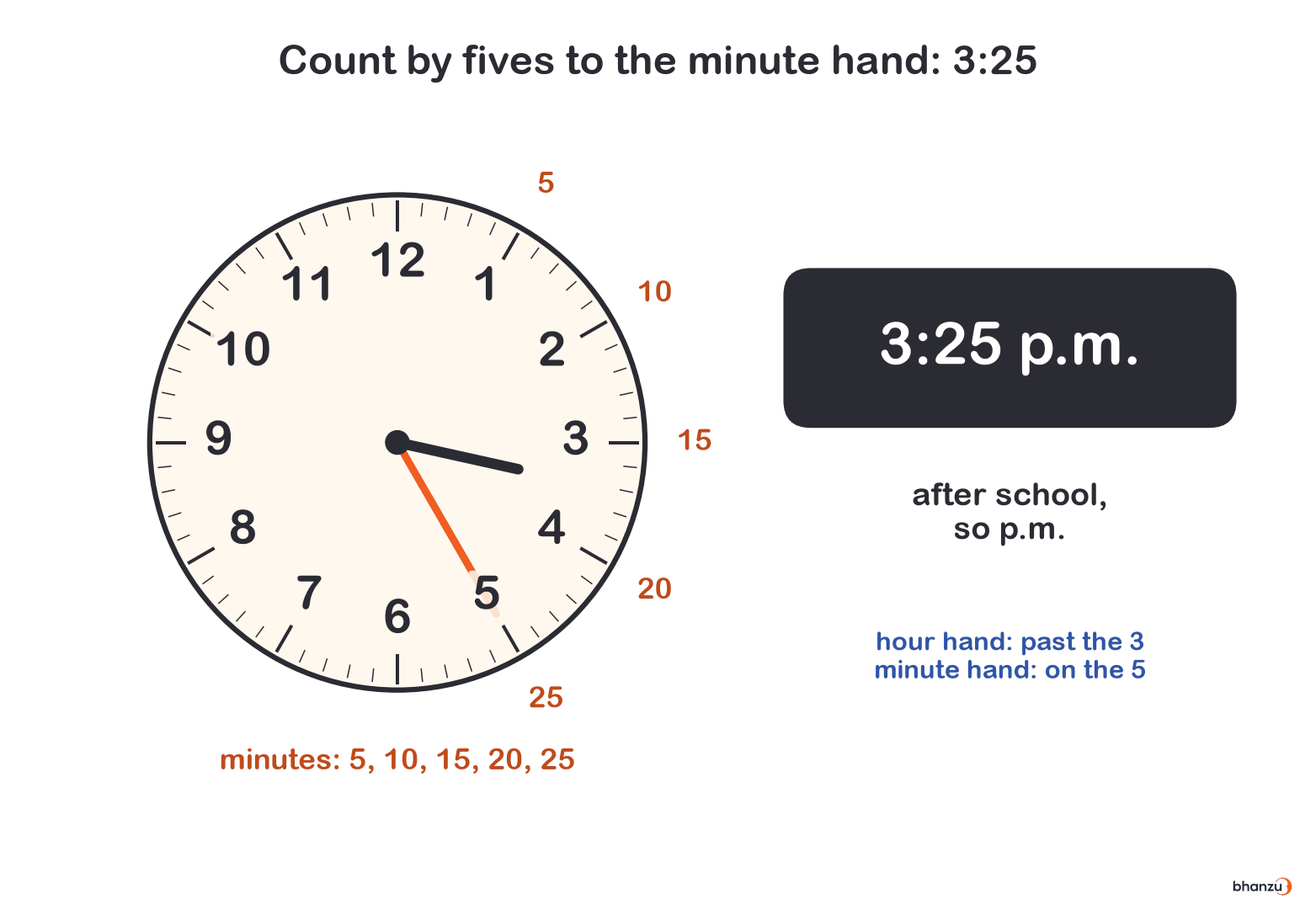
After school is after noon, so the time is 3:25 p.m.
Example 4
The library is open Saturday from 10:00 to 12:00 and from 1:00 to 5:00. Add a.m. or p.m. to all four times.
The 10:00 opening comes before noon, so it is 10:00 a.m.
The 12:00 closing is noon itself, so it is 12:00 p.m.
Both 1:00 and 5:00 come after noon, so they are 1:00 p.m. and 5:00 p.m.
Example 5
Order these times from Maya's day, earliest to latest. 3:25 p.m., 11:40 a.m., 8:30 p.m., 12:05 p.m., 6:50 a.m.
The a.m. times come first, so 6:50 a.m. leads and 11:40 a.m. follows.
The p.m. times come next, with the 12 o'clock hour leading.
The order is 6:50 a.m., 11:40 a.m., 12:05 p.m., 3:25 p.m., 8:30 p.m.
Why do a.m. and p.m. exist?
A clock face has only 12 numbers, but a day has 24 hours. Every reading happens twice, so a label must say which trip the hour hand is on.
- It follows the sun's midday. As early as 3500 BCE, more than 5,000 years ago, Egyptians built tall stone obelisks. Their moving shadows worked as a kind of sundial and split the day into morning and afternoon.
- It keeps alarms straight. An alarm set for 7:00 p.m. instead of 7:00 a.m. rings 12 hours too late for the school bus.
- It pins down clock changes. In 2026, clocks in most of the US sprang forward at 2 a.m. on March 8 and fell back at 2 a.m. on November 1.
With one small label, a 12-number clock face can name all 24 hours.
The pattern hiding inside a.m. and p.m.
Each half of the day counts its hours 12, 1, 2 and on up to 11. The hour hand starts every trip at the top, so 12 is the first hour of a half, never the last. That is why 12:05 p.m. comes 55 minutes before 1:00 p.m.
If your child reads 3:25 correctly but labels it wrong, more clock practice won't help. Ask "Has lunch happened yet?" before the label goes down.
A.m. and p.m.: common confusions cleared up
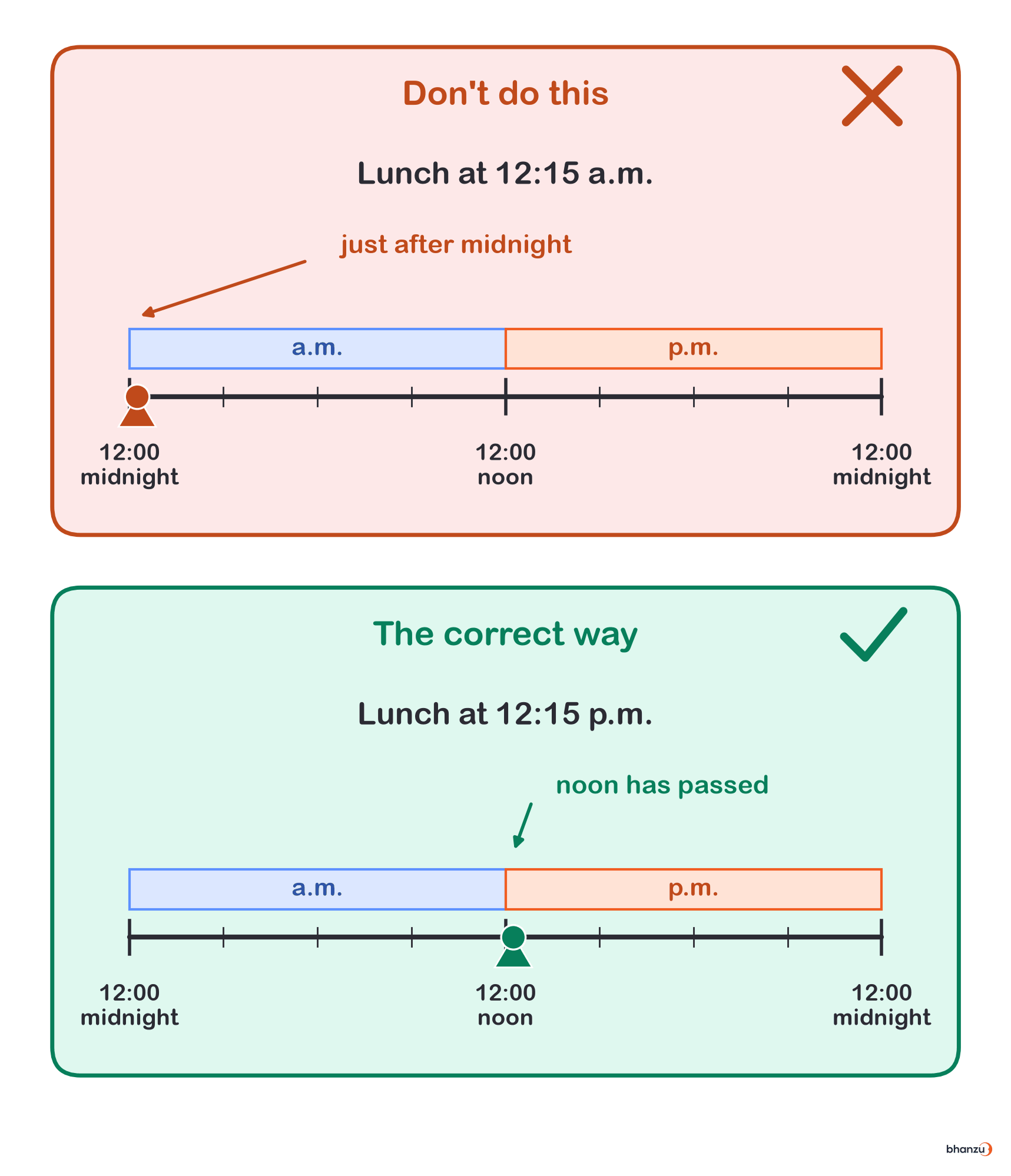
Mistake 1: Calling lunch at 12:15 a.m.
Where it slips in: Lunch, or any time from 12:00 to 12:55 after noon. Children who read 12:15 perfectly often write a.m. anyway, expecting the label to change at 1:00.
Don't do this: Lunch at 12:15 written as 12:15 a.m.
The correct way: Noon passed at 12:00, so lunch is at 12:15 p.m. The time 12:15 a.m. is 15 minutes after midnight.
Mistake 2: Calling midnight p.m.
Where it slips in: Stories that mention midnight. The darkest part of the night feels like the end of the p.m. half, not the start of a new day.
Don't do this: An owl hooting at 12:00 midnight written as 12:00 p.m. (that is lunchtime).
The correct way: Midnight starts a new day and the a.m. half, so the owl hoots at 12:00 a.m., or 12 midnight.
Mistake 3: Writing the label twice
Where it slips in: Times inside sentences. A child who has just learned the label adds "in the morning" too, to be safe.
Don't do this: Writing "8:30 a.m. in the morning" on a schedule.
The correct way: Write "8:30 a.m." or "8:30 in the morning," never both. The US Government Publishing Office style manual lists "2 p.m. in the afternoon" as a form to avoid.
Key Takeaways
- Look at what is happening first, then check whether 12 noon has come yet.
- A.m. and p.m. follow the clock, not the sky, so 6:50 a.m. can come before sunrise.
- The 12 o'clock hour opens each half, so lunch at 12:15 is p.m.
- For help from a teacher who spots the 12:15 a.m. lunch mix-up, explore Bhanzu's 2nd grade math tutor or elementary math programs.
Read More
- Counting Money and Money Word Problems
- Estimating Length
- Days of the Week and Months
- Elapsed Time and Time Word Problems
Research Behind This Article
- NIST, Times of Day FAQs (2024). nist.gov
- NGA Center and CCSSO, Common Core State Standards: Grade 2 Measurement and Data (2010). thecorestandards.org
- US Naval Observatory, Complete Sun and Moon Data for One Day (2026). aa.usno.navy.mil
- NIST, A Walk Through Time: Early Clocks (2026). nist.gov
- NIST, Daylight Saving Time (DST) (2026). nist.gov
- US Government Publishing Office, GPO Style Manual, Chapter 12: Numerals (2016). govinfo.gov
Quick Quiz: Check Yourself
Three levels, new times each round: label an event, sort out 12 o'clock, dark skies and clock hands, then pick the earliest or latest time.
Was this article helpful?
Your feedback helps us write better content
Frequently Asked Questions
Are a.m. and p.m. capitalized?
Is 1:00 a.m. morning or night?
What does AM or PM mean on a digital clock?
What should a 2nd grader know about a.m. and p.m.?
How do I teach a.m. and p.m. to my child at home?