Key Points
- Finding 10 more and 10 less changes a two-digit number by one ten, so 10 more than 83 is 93.
- Ten ones make one ten, so adding 10 means one more ten rod or one row down a hundred chart.
- A common mistake is changing the ones digit, like writing 36 for 10 more than 35.
- Common Core standard 1.NBT.C.5 asks 1st graders to find 10 more and 10 less without counting and to explain why.
The ones digit that never moves
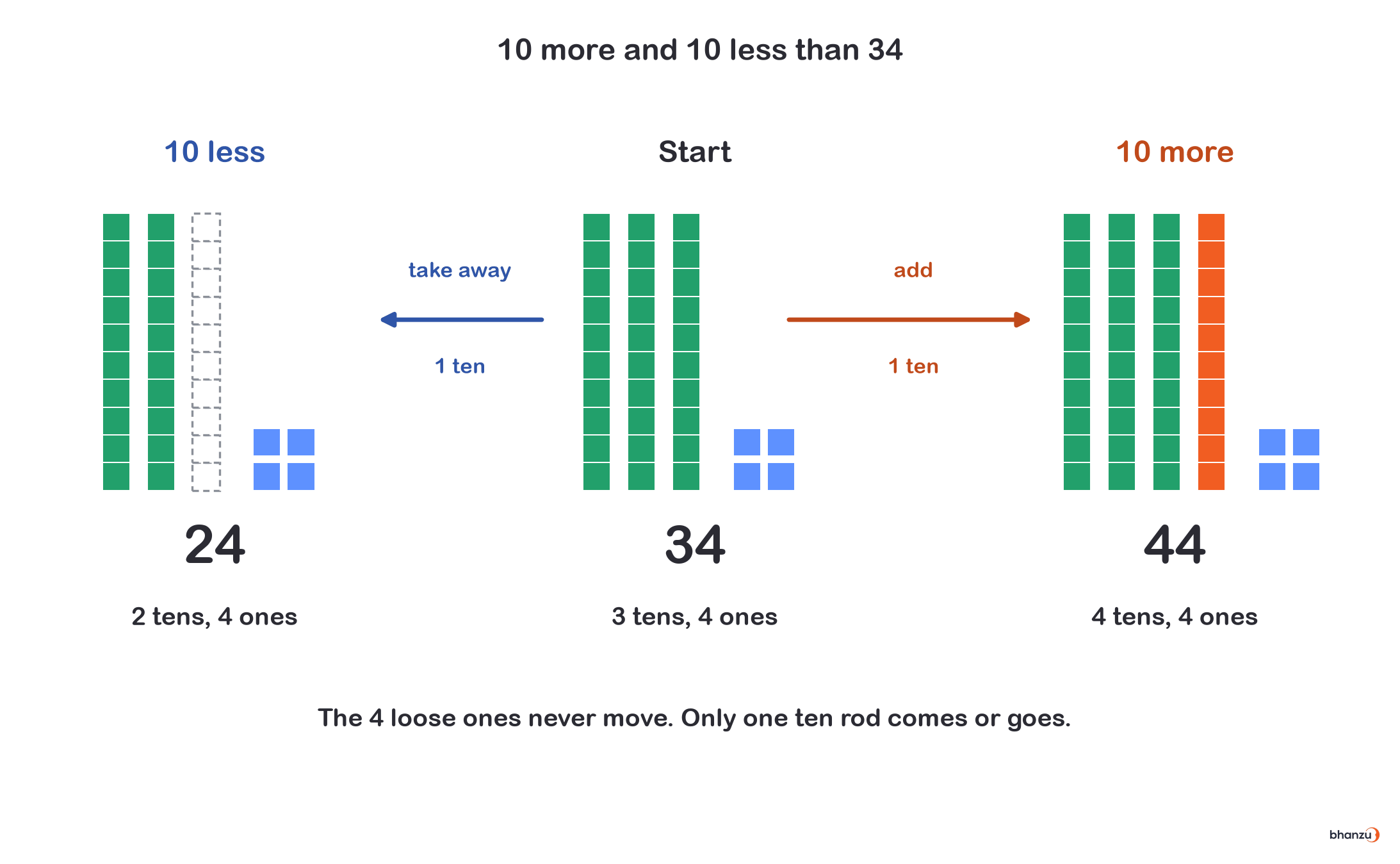
Build 34 with blocks, and you need 3 rods of ten and 4 loose cubes. A rod is ten cubes stuck together. Snap one more rod on and you have 44, or pull one off and you have 24.
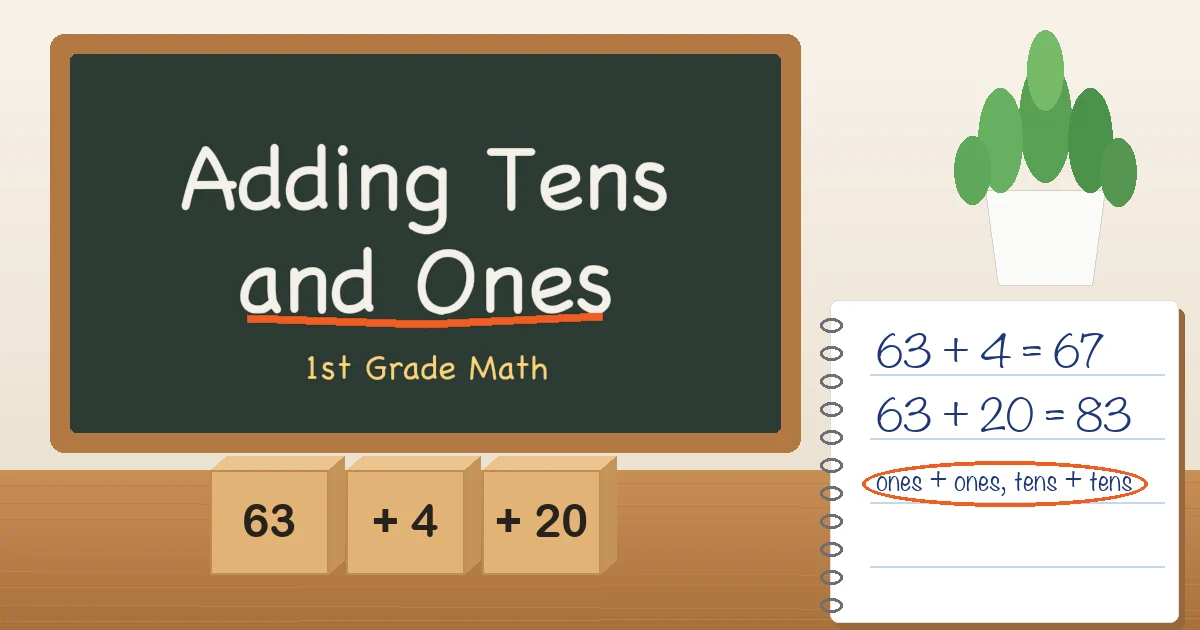
The 4 loose cubes never moved, so the 4 at the end of the number never changed either. Only the rods came and went. Soon you'll use the same move for adding tens and ones, like 34 plus 20.
What is 10 more and 10 less?
10 more and 10 less are the two numbers exactly one ten away from your number, one above it and one below it. On base-ten blocks, with single cubes for ones and rods for tens, that is one rod on or off.
In 52, the tens digit is the 5 on the left: it means 5 tens, or 50. The 2 on the right is the ones digit, and it counts the loose ones.
This is Common Core standard 1.NBT.C.5. It expects 1st graders to find 10 more or 10 less than a two-digit number "without having to count" and to explain the reasoning. If your child can point to the 6 in 62 and say it means six tens, they are ready, because that one idea does most of the work.
How do you find 10 more without counting?
Add one to the number of tens and keep the ones digit the same. For 10 less, take one ten away instead.
- Say 58 as 5 tens and 8 ones.
- Add one ten for 10 more, or take one away for 10 less.
- Keep the 8 ones as they are.
- Put it back together as 68 or 48.
- Check that the ones digit is still 8.
A number line hop of 10 works too. Counting on by ones gets there slowly, with ten chances to lose your place. Jumping a whole ten is one of the first moves in adding mentally.
Missing-number questions run backward. The box stands for the starting number, 34.
| Words in the problem | Math it means |
|---|---|
| 10 more than 34 | |
| 10 less than 34 | |
| 44 is 10 more than what number? | |
| 24 is 10 less than what number? |
A dime is worth 10 cents, so 42 cents plus a dime is 52 cents. Counting coins speeds up once each dime counts as a ten.
Why does the tens digit change?
In a two-digit number, the tens digit counts the tens, and 10 is exactly one ten with zero loose ones. Adding 10 puts one more ten in the tens place and nothing in the ones place.
A hundred chart is a 10 by 10 grid of the numbers 1 to 100 (some charts start at 0). Each row holds 10 numbers, so straight down is 10 more and straight up is 10 less. One square sideways in a row is 1 more or 1 less.
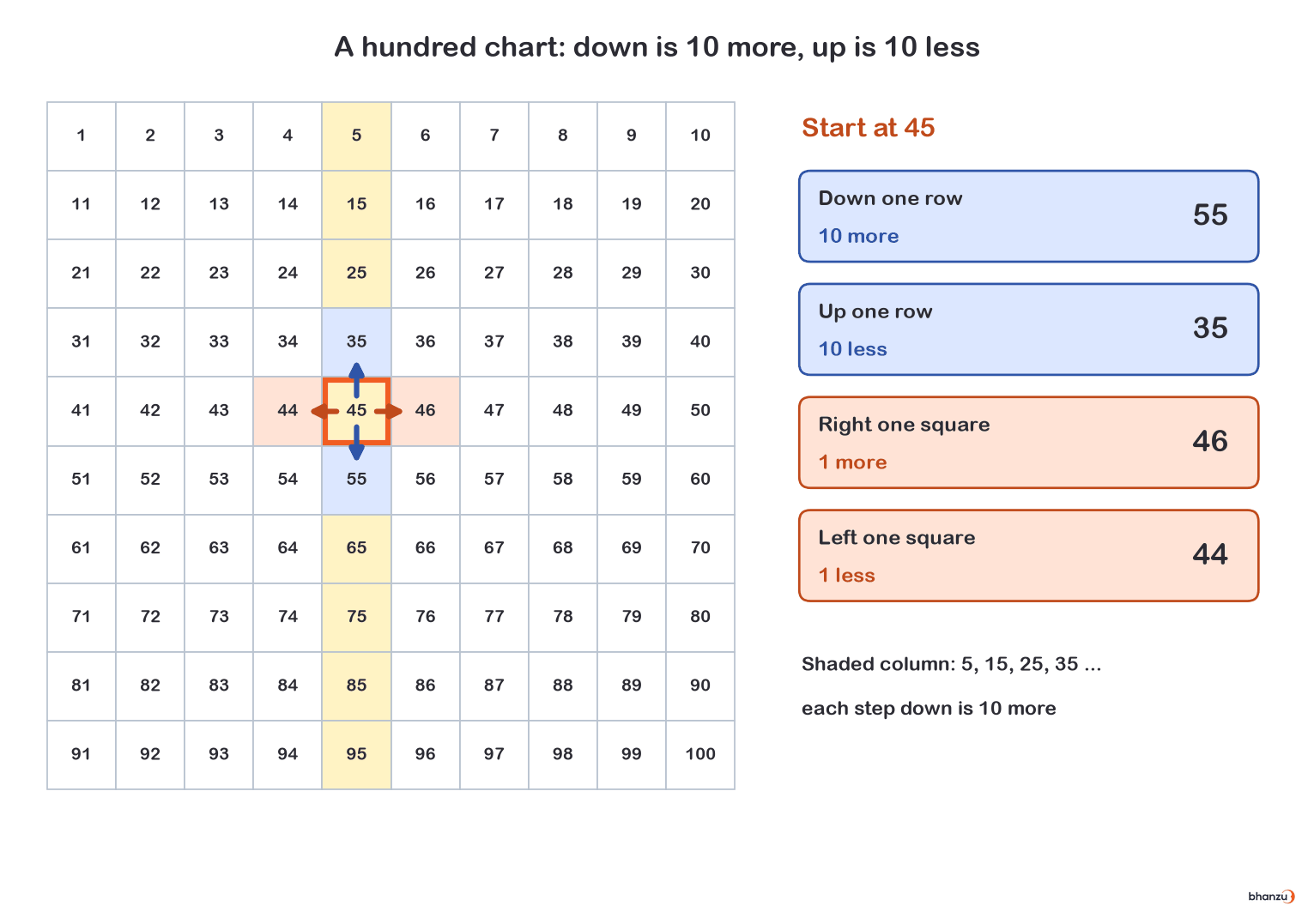
Going straight down from 15 gives 25, 35 and 45, which is skip counting by 10s from 15. Children who chant 10, 20, 30 easily often stall at a start like 15, because every tens count they know ends in 0.
In a 2023 study, kindergarten and first-grade children counted by tens more often when the chart's numbers grew downward than upward. The charts here run top to bottom (the same way you read).
Try It Yourself
Press 10 more or 10 less and watch the blocks, the big number and the chart strip change together. Then press 1 more or 1 less, or drag a rod or cube on or off the mat, and see which digit moves.
What is 10 more than 90?
10 more than 90 is 100, because nine tens and one more ten make ten tens, which is one hundred. Any number in the 90s works the same way, so 10 more than 96 is 106. A child who gets 106 often second-guesses it, because it suddenly has three digits.
Here is the genuinely confusing part, because the tens digit and the number of tens are not the same thing. In 106 the tens digit is 0. Yet 106 holds 10 tens.
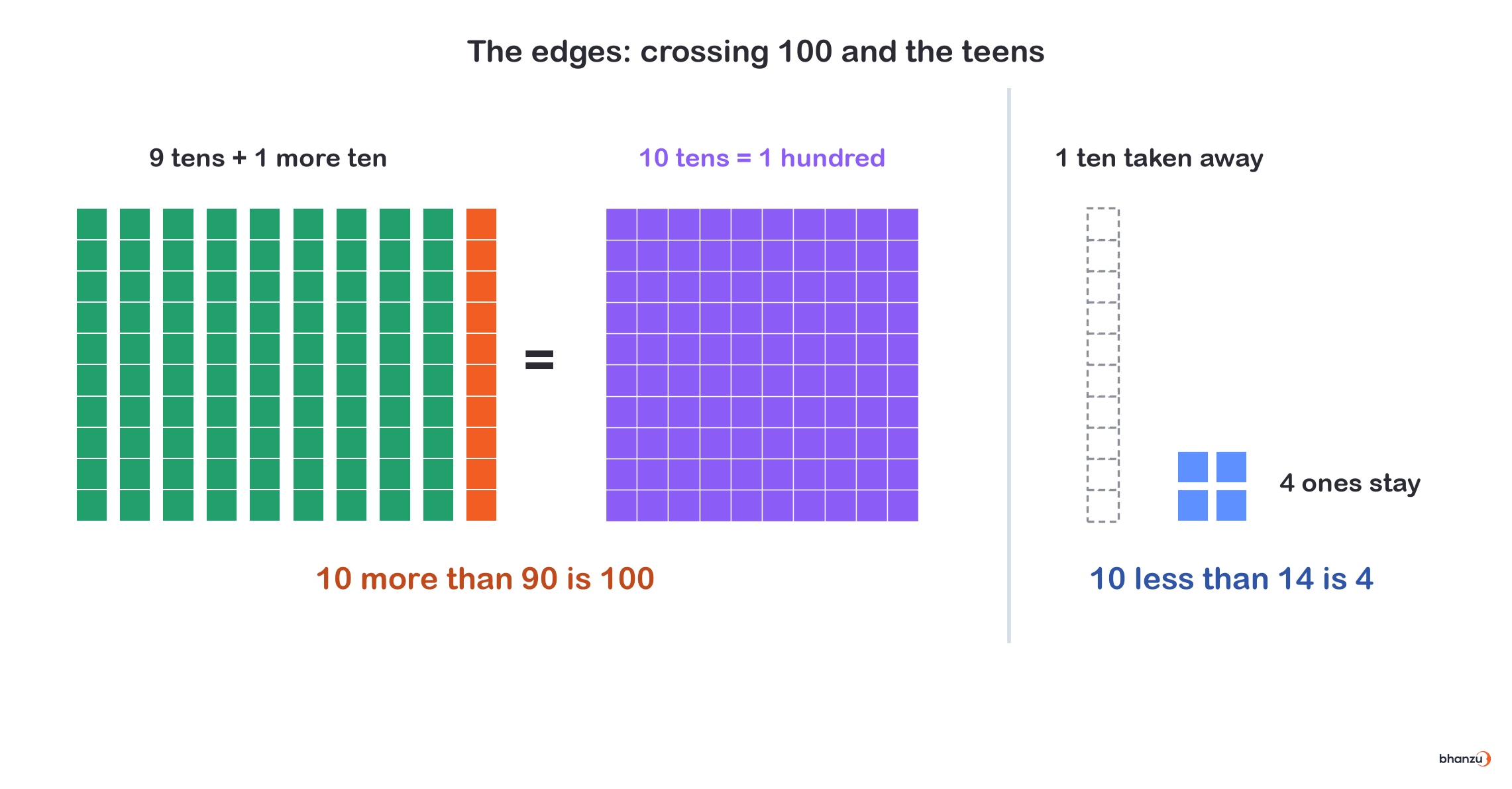
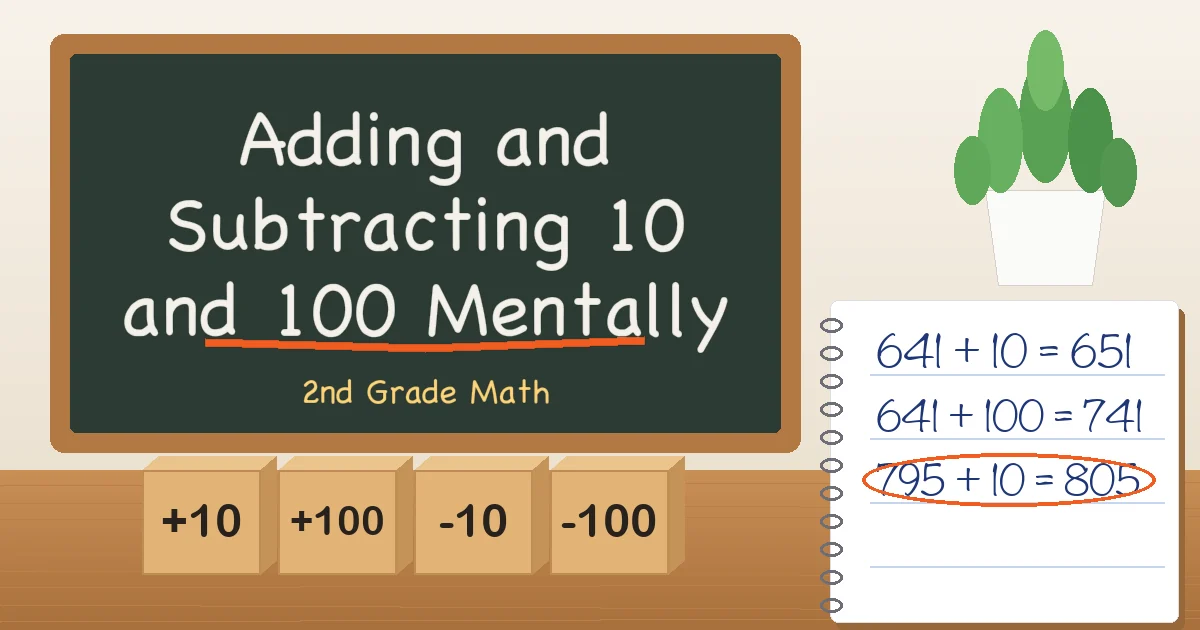
At the small end, 10 less than 14 is 4 (nobody writes 04), and 10 less than 10 is 0. 10 less than 7 goes below zero (a middle school idea). Adding 10 above 100 is 2nd grade work, in adding and subtracting 10 and 100 mentally.
Examples of 10 more and 10 less
Example 1
What is 10 more than 23?
23 is 2 tens and 3 ones, so one more ten makes 3 tens and 3 ones.
Example 2
What is 10 more than 47?
The tempting move is to add 1 to both digits, which turns 47 into 58.
That can't be right. A ten rod adds no loose cubes, so the ones digit must stay 7, not 8.
Change only the tens.
Example 3
72 is 10 more than what number?
72 is the bigger number, so take one ten away.
Example 4
Leo has 36 cents in 3 dimes and 6 pennies. He spends 1 dime. How many cents are left?
A dime is one ten, so 3 dimes become 2 dimes and the 6 pennies stay.
Leo has 26 cents left.
Example 5
What is 10 less than 15, and what is 10 more than 95?
15 is 1 ten and 5 ones, so taking the ten away leaves 5.
95 has 9 tens, and one more ten makes 10 tens, which is 1 hundred.
Example 6
Noah's token is on 26 on a hundred chart. He moves 10 more, 10 more again, then 10 less. Where is it now?
Each 10 more is one row down, and each 10 less is one row up.
The token ends on 36.
The real reason 10 more and 10 less exists
10 more and 10 less is one of the first times that tens and ones save real work.
- It swaps ten counts for one step, so there is no place to lose count.
- It makes coins quicker. One more dime is always 10 more cents, so 57 cents becomes 67 cents.
- It starts subtracting tens. 70 take away 30 is three 10 less steps, the start of subtracting multiples of ten.
- It sets up rounding to the nearest ten, which comes in a couple of years.
Each of these works because 10 moves exactly one ten and leaves the ones alone.
What do teachers watch for in 10 more and 10 less?
Teachers watch for the child with the right answer and no reason, since the standard asks for both. That reason is place value (a digit's spot tells what it is worth), and it takes years to settle.
- A 2004 NCES report followed a national sample of children to spring 2002, the end of third grade for most. By then, 97 percent could solve simple addition and subtraction, yet 42 percent showed they understood place value to the hundreds place.
- A smaller 1986 study of 60 children in grades 2 to 5 found that 28 could not clearly show what the tens digit stands for.
A child who answers 57 and says "I just know" has the fact, not the reason. The reason sounds like "4 tens became 5 tens, and the 7 ones stayed," said out loud. At home, ask your child what the 5 in 57 means.
Common errors when working with 10 more and 10 less
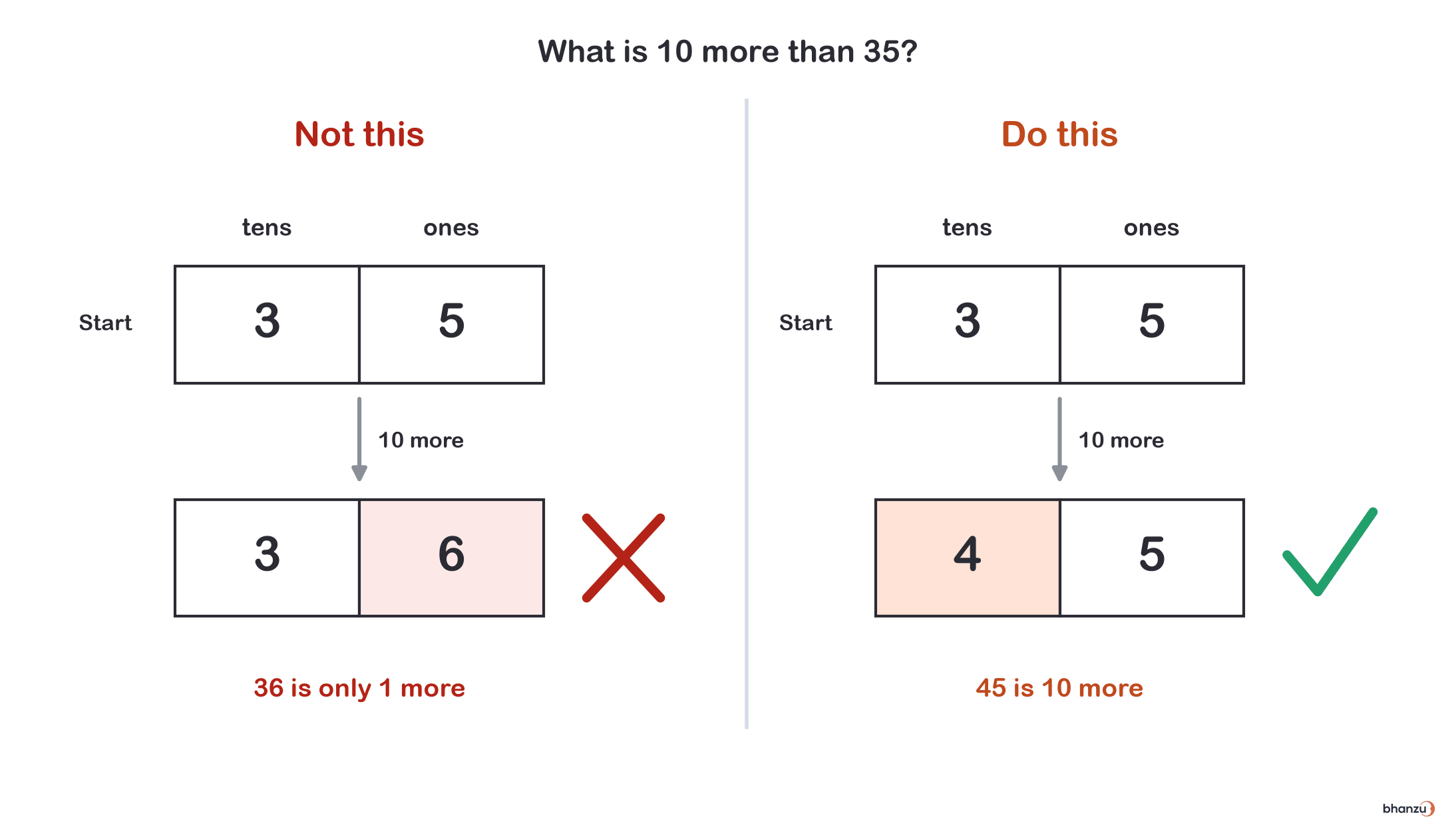
Mistake 1: Changing the ones digit instead of the tens digit
Where it slips in: 10 more right after practicing 1 more. Counting by ones always changes the right-hand digit, so that digit feels like the one to move.
Don't do this: Writing 36 for 10 more than 35.
The correct way: 3 tens become 4 tens and the 5 ones stay, so the answer is 45.
Mistake 2: Counting by ones and landing one short
Where it slips in: Bigger numbers such as 68, when a child doesn't trust the ten jump and counts on fingers.
Don't do this: Counting "68, 69, 70, 71, 72, 73, 74, 75, 76, 77" and stopping at 77.
The correct way: 6 tens become 7 tens, so the answer is 78.
Children often say the starting number as their first count, so ten counted words land one square early.
Mistake 3: Reading "is 10 more than" backward
Where it slips in: Missing-number questions like Example 3, where the word "more" makes children expect a bigger answer.
Don't do this: Reading "64 is 10 more than ___" and writing 74.
The correct way: 64 is the bigger number, so the missing number is 10 less, which is 54.
Key Takeaways
- To check any 10 more and 10 less answer, look at the ones digit, which should match the starting number.
- On a hundred chart, down is 10 more and up is 10 less, since each row holds 10 numbers.
- In the 90s, ten tens turn into a hundred, so 10 more than 96 is 106.
- To practice saying why the tens change with a teacher, explore Bhanzu's 1st grade math tutor or its Common Core math curriculum.
Read More
- Comparing Two-Digit Numbers
- Counting On and Counting Back
- Counting to 120
- Regrouping Hundreds, Tens and Ones
Research Behind This Article
- Common Core State Standards Initiative, Grade 1 Number and Operations in Base Ten (2010). thecorestandards.org
- Osana, Helena P., Wagner, Vera and Navarrete-Ulloa, Jairo A., Spatial Configuration of Hundreds Charts Influences Children's Knowledge of Base-Ten Concepts (2023). eric.ed.gov
- Common Core State Standards Initiative, Grade 2 Number and Operations in Base Ten (2010). thecorestandards.org
- Rathbun, Amy and West, Jerry, From Kindergarten Through Third Grade: Children's Beginning School Experiences (2004). nces.ed.gov
- Ross, Sharon Hill, The Development of Children's Place-Value Numeration Concepts in Grades Two through Five (1986). eric.ed.gov
Quick Quiz: Check Yourself
Easy asks for 10 more or 10 less, Medium for a missing number or dimes, and Hard for the 90s, teens or three chart moves.
Was this article helpful?
Your feedback helps us write better content
Frequently Asked Questions
Is there a trick to add 10 mentally?
How do you find 100 more and 100 less?
Can kindergartners learn 10 more and 10 less?
How do you teach 10 more 10 less at home?
What goes on a ten more ten less anchor chart?