Key Points
- Standard word and expanded form all name one amount, so 3 flats, 5 rods and 2 cubes make 352, three hundred fifty-two, or .
- Expanded form adds the value of each digit, so the 7 in 726 is written as 700, and unit form calls it 7 hundreds.
- A zero is silent in a number name but still written in standard form, so six hundred eight is 608, never 68.
Three fives that are not the same
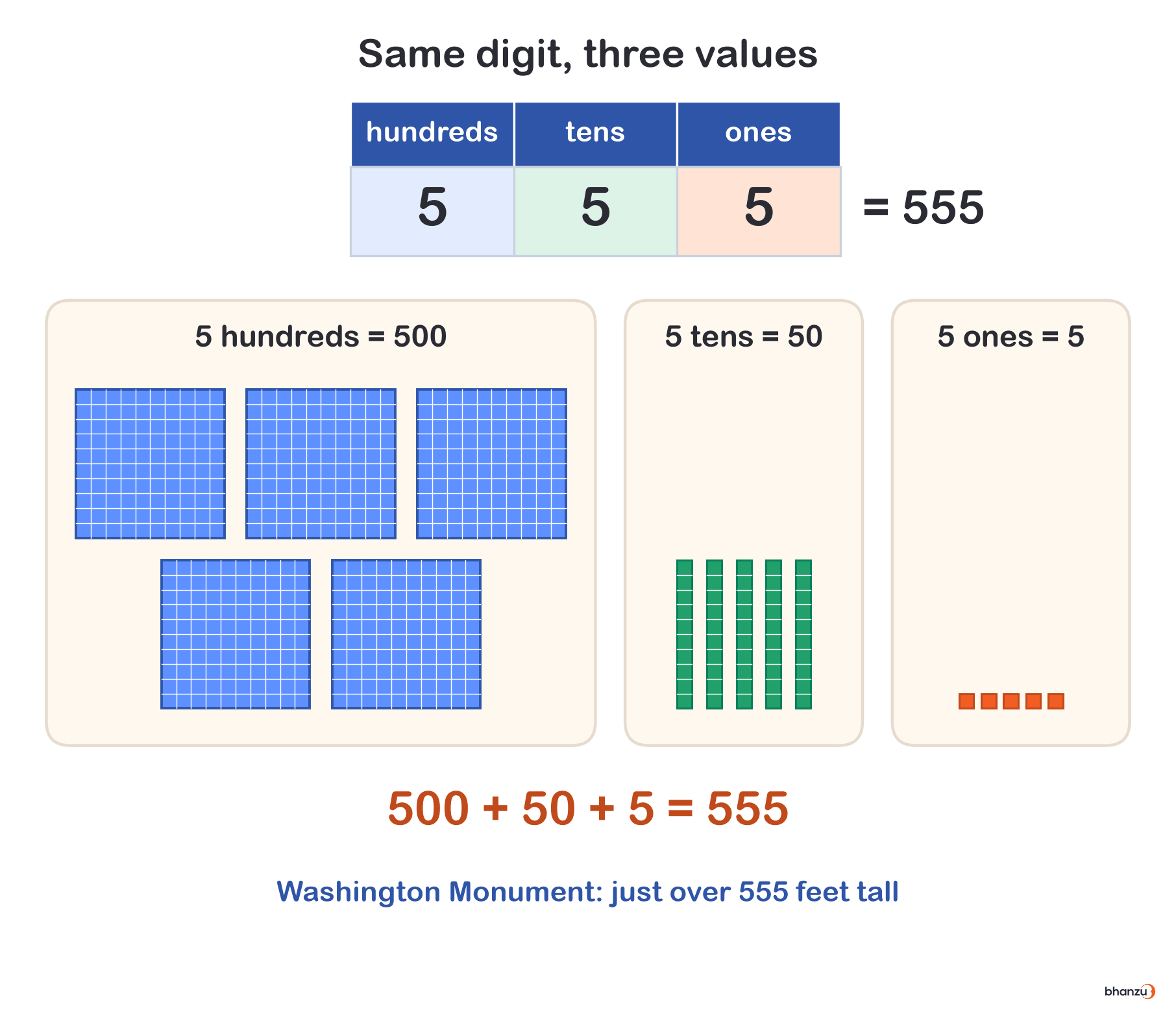
Three 5s in a row can mean three different amounts. The Washington Monument is just over 555 feet tall, and in 555 the first 5 stands for five hundreds. The next 5 means five tens, and the last is five ones.
Where a digit sits decides what it is worth. In 4th grade, you'll use this idea to read numbers all the way up to one million.
What is standard, word and expanded form?
Standard word and expanded form name one amount with digits, with words, or as a sum of what each digit is worth. A digit is one of the symbols 0 to 9. Place value is what a digit is worth because of where it sits.
In base-ten blocks, a flat is 100 (ten rods side by side), a rod is 10, and a small cube is 1. Naming the blocks, such as 3 hundreds 5 tens 2 ones, is called unit form.
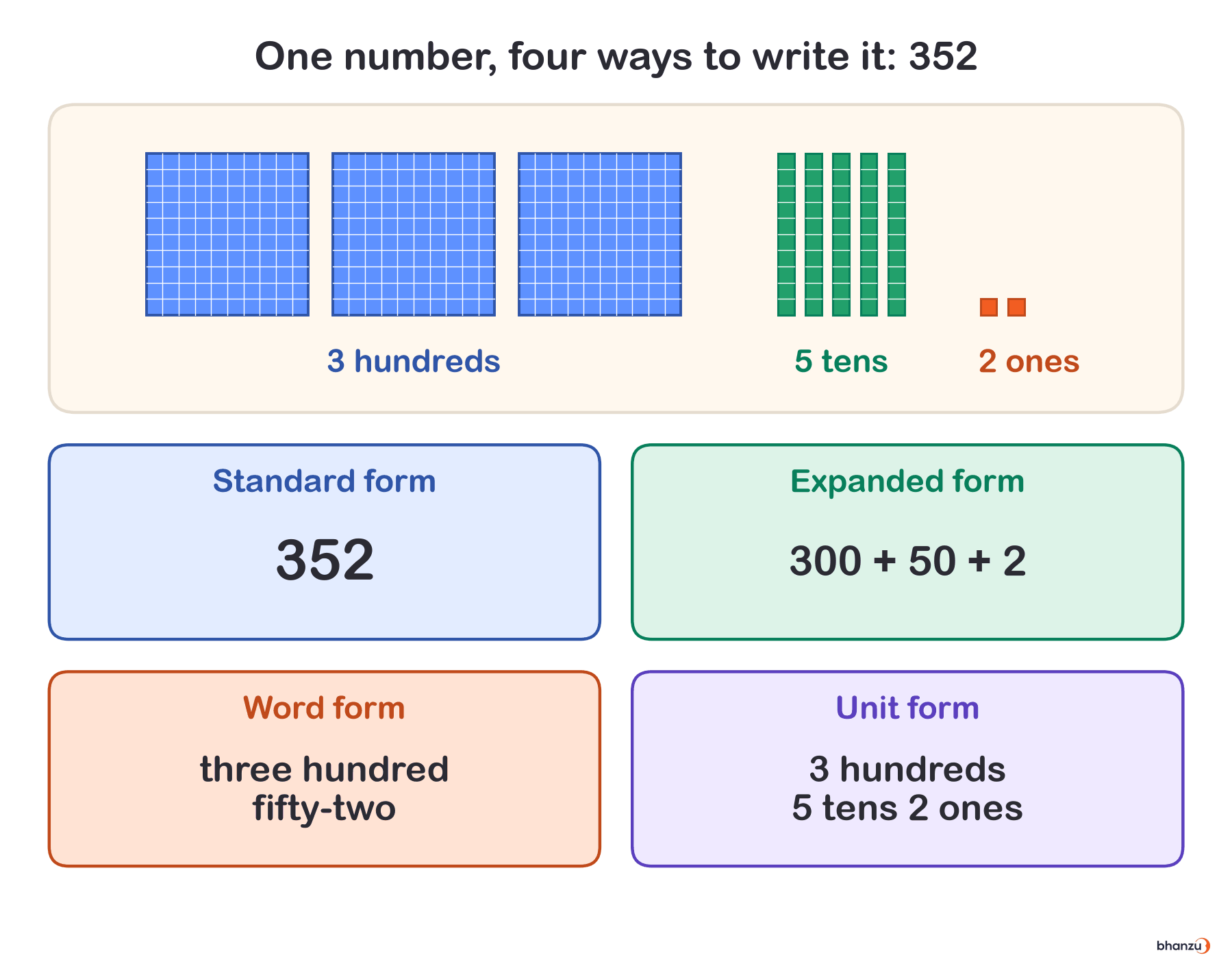
Three flats, five rods and two cubes make 352, or three hundred fifty-two. Standard form packs the place values into position. Expanded form writes them out as , and that is the difference between standard form and expanded form.
This is Common Core standard 2.NBT.A.3, which asks 2nd graders to "read and write numbers to 1000" as numerals, number names and expanded form. In 1st grade, your child learned counting to 120 and saw two-digit numbers as tens and ones, and 4th and 5th grade stretch these forms to bigger numbers and decimals. Place value belongs to number properties and operations, the content area that made up 40% of the questions on the 2024 NAEP mathematics assessment for 4th grade.
How do you write a number in expanded form?
Expanded form writes what each digit is worth and joins the values with plus signs.
- Find each digit's place (hundreds, tens or ones).
- Write each digit's value. In 406, skip counting four flats by hundreds (100, 200, 300, 400) shows the 4 is worth 400.
- Leave out any place whose digit is 0 (some classes write , which also works).
- Join the values with plus signs, biggest first. Any order gives the same total.
- Add the parts back together to check that you get the starting number.
A child who reads 352 aloud as "three, five, two" is reading digits, not a number. Unit form fixes that habit. Say 4 hundreds 0 tens 6 ones, and is right there.
| Standard form | Unit form | Expanded form | Word form |
|---|---|---|---|
| 514 | 5 hundreds 1 ten 4 ones | five hundred fourteen | |
| 490 | 4 hundreds 9 tens 0 ones | four hundred ninety |
Money works the same way, so $352 is 3 hundred-dollar bills, 5 ten-dollar bills and 2 one-dollar bills. The same 352 can also be named 35 tens 2 ones, which is the next skill, regrouping hundreds, tens and ones.
In 5th grade, expanded form can also write 300 as 3 times 100.
How do you write a number in word form?
Word form names the hundreds first, then says the last two digits as one number name.
- Write the hundreds digit as a word, then "hundred" (7 becomes seven hundred).
- Write the last two digits as one name, such as fifty-two, fourteen or ninety.
- Put a hyphen between the tens word and the ones word from 21 to 99, as in sixty-three.
- Write nothing for a zero, so 406 is four hundred six.
- Leave out "and" in a whole number, as the OpenStax Prealgebra 2e textbook does.
To go back to digits, draw three boxes for hundreds, tens and ones. Write 0 in any box the words skip. Four hundred seventy becomes 470, while four hundred seven becomes 407.
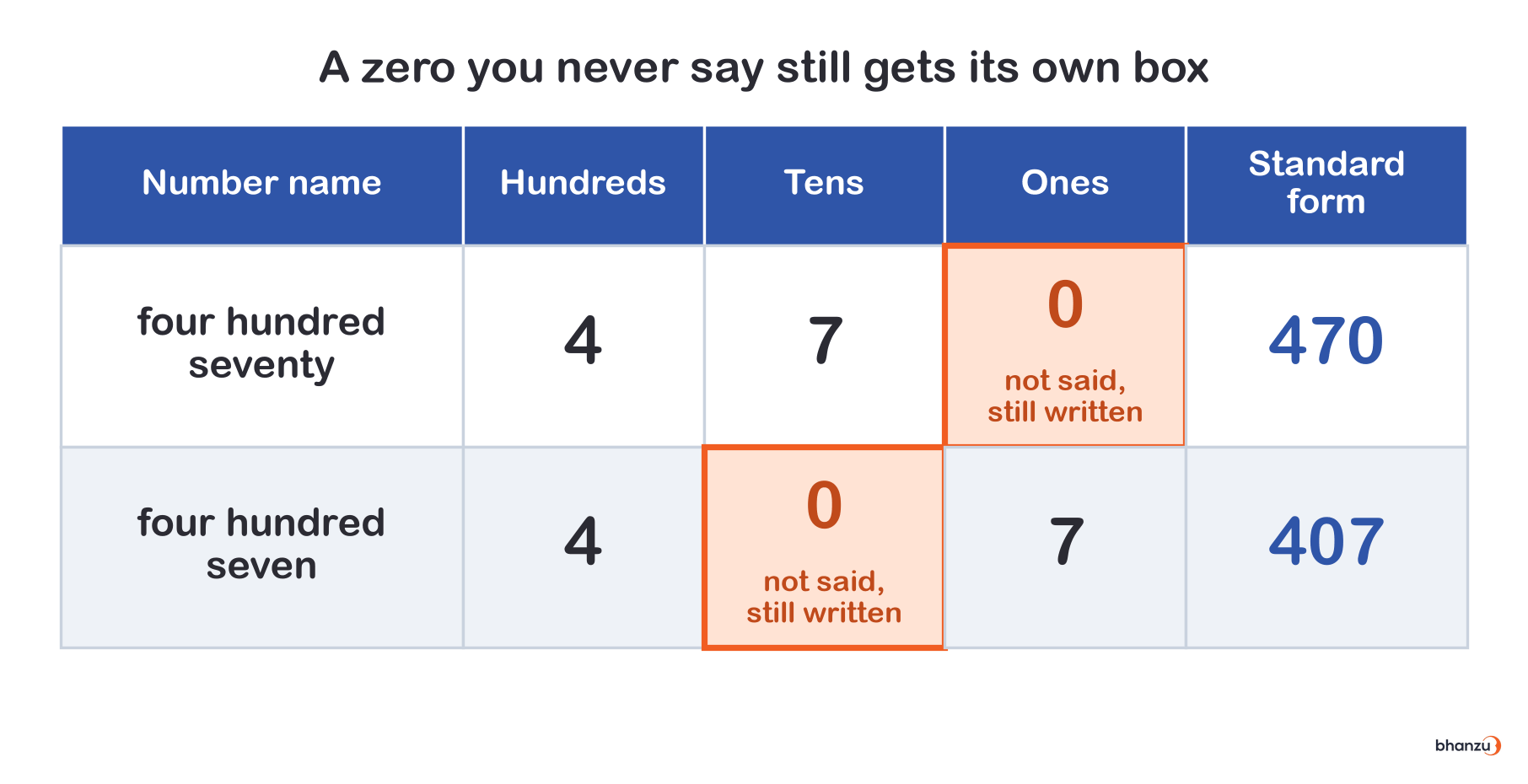
In five hundred fourteen, "fourteen" means 1 ten and 4 ones, so the tens box gets a 1. The number is 514.
A child who writes 406 and then erases the 0, because nobody says "zero", had it right the first time.
Try It Yourself
Tap plus or minus under each column to add or take away blocks. Watch the standard, unit, expanded and word forms change together. Press New challenge for a number name to build, and notice what the expanded form does when a column is empty.
Examples of standard word and expanded form
Example 1
Write 285 in expanded form.
The 2 sits in the hundreds place, so it is worth 200. The 8 is worth 80, and the 5 is worth 5.
Example 2
Write four hundred six in standard form.
The tempting move is to write each part you hear. "Four hundred" is 400 and "six" is 6, so side by side they make 4006.
That can't be right: every number below 1,000 has three digits or fewer, and 4006 reads as "four thousand six".
Use unit form instead. Four hundred six is 4 hundreds, 0 tens and 6 ones, so the three boxes hold 4, 0 and 6.
Example 3
What number is ?
Sort the parts biggest first.
That is 7 hundreds, 2 tens and 6 ones, so the number is 726.
Example 4
The Washington Monument has 896 steps. Write 896 in expanded form and word form.
The 8 is worth 800, the 9 is worth 90, and the 6 is worth 6.
In word form, 896 is eight hundred ninety-six.
Example 5
Two hundred seventeen, 2 hundreds 1 ten 7 ones and all claim to be 217. Which one is wrong?
Two hundred seventeen and 2 hundreds 1 ten 7 ones both mean 217, because seventeen is 1 ten and 7 ones.
So is the odd one out. The expanded form of 217 is .
Example 6
A bike costs $275. Priya pays with as few $100, $10 and $1 bills as she can. How many bills does she use, and how is the price written in words?
That means 2 hundred-dollar bills, 7 ten-dollar bills and 5 one-dollar bills.
Priya uses 14 bills, and the price in words is two hundred seventy-five dollars.
Where do standard, word and expanded form show up in real life?
Each form does a different job. Digits are quick to work with, words are hard to change, and expanded form shows the parts you add.
- Checks spell the amount in words. Under the Uniform Commercial Code, section 3-114, when a check's words and numbers disagree, the words count. A 1 becomes a 7 with one pen stroke, but "one" can't.
- Adding uses expanded form. Adding three-digit numbers means hundreds plus hundreds, tens plus tens and ones plus ones, so is , or 566.
- Comparing starts with the hundreds. In comparing three-digit numbers, 409 is bigger than 390 because it has 4 hundreds and 390 has only 3.
The amount stays the same, so pick the form that makes the job easier.
The easy-to-make errors (and how to catch them)
Mistake 1: Dropping the zero
Where it slips in: Writing a number from its name when a place is empty, such as the tens in six hundred eight.
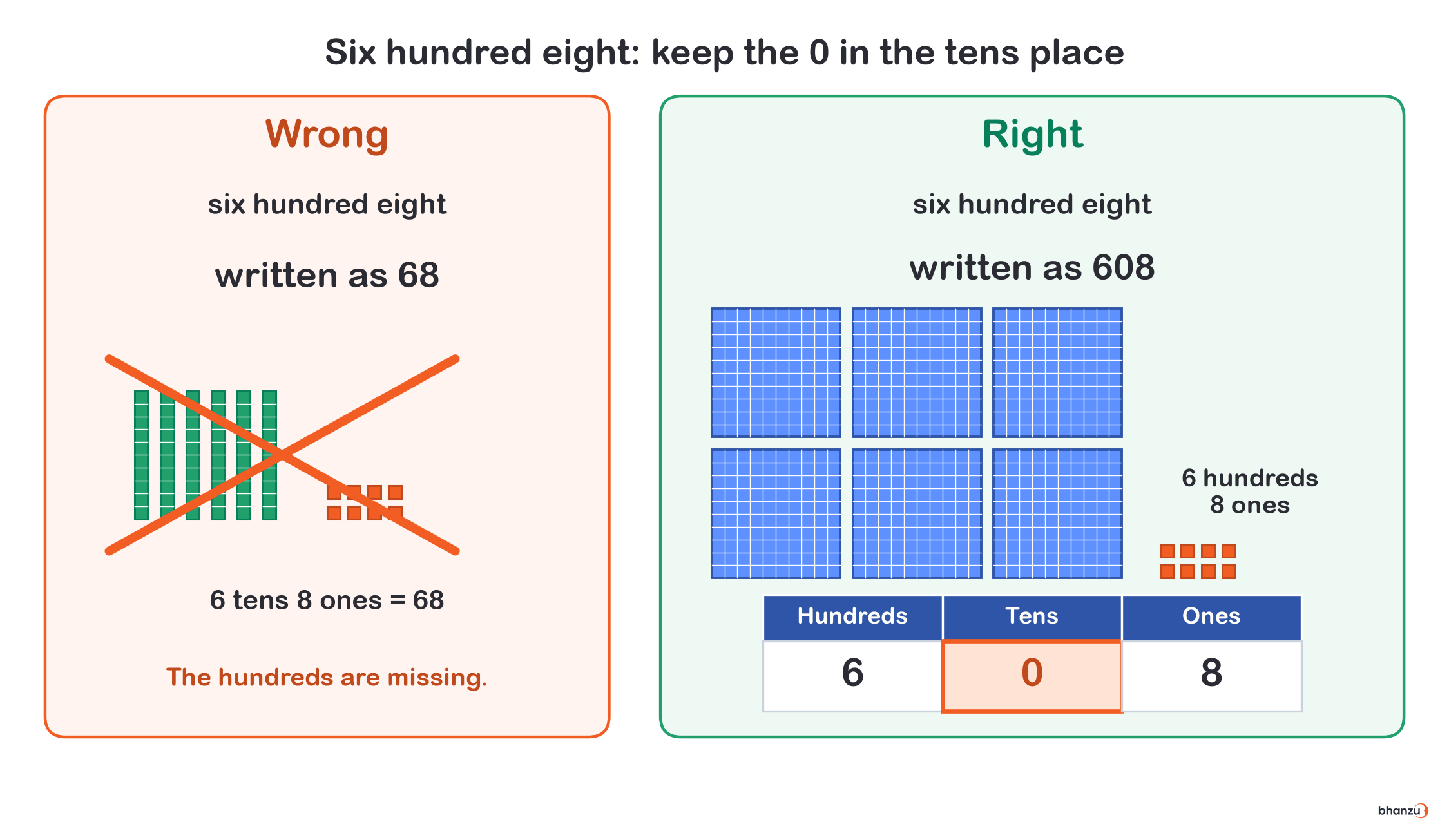
Don't do this: Writing six hundred eight as 68.
The correct way: Fill three boxes with 6, 0 and 8 to get 608. The number 68 is only 6 tens and 8 ones.
Children who say six hundred eight perfectly still write 68, because no word in the name asks for a 0.
Mistake 2: Writing digits instead of values
Where it slips in: Turning standard form into expanded form, when a child rushes and copies the digits with plus signs.
Don't do this: Writing , which adds up to only 14.
The correct way: Write each digit's value, , and add the parts back to get 473 again.
Mistake 3: Adding "and" or dropping the hyphen
Where it slips in: Turning standard form into word form, because children hear "and" in speech so often.
Don't do this: Writing 763 as "seven hundred and sixty three".
The correct way: Write "seven hundred sixty-three", with no "and" and a hyphen joining sixty and three.
British English keeps that "and", but US school math saves it for the decimal point, which comes in later grades.
The part of word form nobody explains
Digits show place by where they sit, but number names show place with extra words.
- "Hundred" marks the hundreds, so three hundred means 3 hundreds.
- "-ty" marks the tens, so forty means 4 tens.
- Names from thirteen to nineteen say the ones first, so "fourteen" in 514 names the 4 before the ten.
That teen flip is why five hundred fourteen and five hundred forty-one sound so alike. A zero inside a number name is never said at all.
Roman numerals show writing with no place value. Each X in XXX is worth 10, so XXX is 30, and there is no symbol for zero.
Key Takeaways
- Name the place before you write the value, so a 9 in the tens place becomes 90.
- A zero you never say still needs its own box.
- Adding the parts back together checks any standard word and expanded form answer.
- For more practice with silent zeros like the one in six hundred eight, explore Bhanzu's 2nd grade math curriculum or an elementary math tutor.
Read More
- Comparing Two-Digit Numbers
- Standard, Word and Expanded Form for Large Numbers
- Decimals in Expanded Form
- Counting Money and Money Word Problems
Research Behind This Article
- National Park Service, Frequently Asked Questions: Washington Monument (2024). nps.gov
- Common Core State Standards Initiative, Number and Operations in Base Ten: Math Standards by Domain (2010). thecorestandards.org
- National Center for Education Statistics, Distribution of Mathematics Questions: 2024 (2026). nces.ed.gov
- OpenStax, Prealgebra 2e, 1.1 Introduction to Whole Numbers (2020). openstax.org
- Legal Information Institute, Cornell Law School, U.C.C. Section 3-114: Contradictory Terms of Instrument (2002). law.cornell.edu
Quick Quiz: Check Yourself
Three levels, new numbers every time. Easy asks for a digit's value or a number from expanded form, and Medium turns number names and jumbled sums into digits. Hard pays a price in bills or spots the form that does not match.
Was this article helpful?
Your feedback helps us write better content
Frequently Asked Questions
Is it forty or fourty in the word form of numbers?
How do you write 305 in words?
How can I teach expanded form at home?
Is standard and expanded form taught in 1st grade?
What is standard form in algebra?