Key Points
- Missing numbers in multiplication and division are unknowns in equations like , and Common Core asks 3rd graders to find them.
- A missing factor or divisor is found by dividing, and a missing product or dividend by multiplying the two known numbers.
- With whole numbers bigger than 1, the dividend is always the biggest, so the box in is 27.
- Reading the equal sign as "is the same as" fixes a common mix-up, so gives 9, not 144.
The number under the juice spill
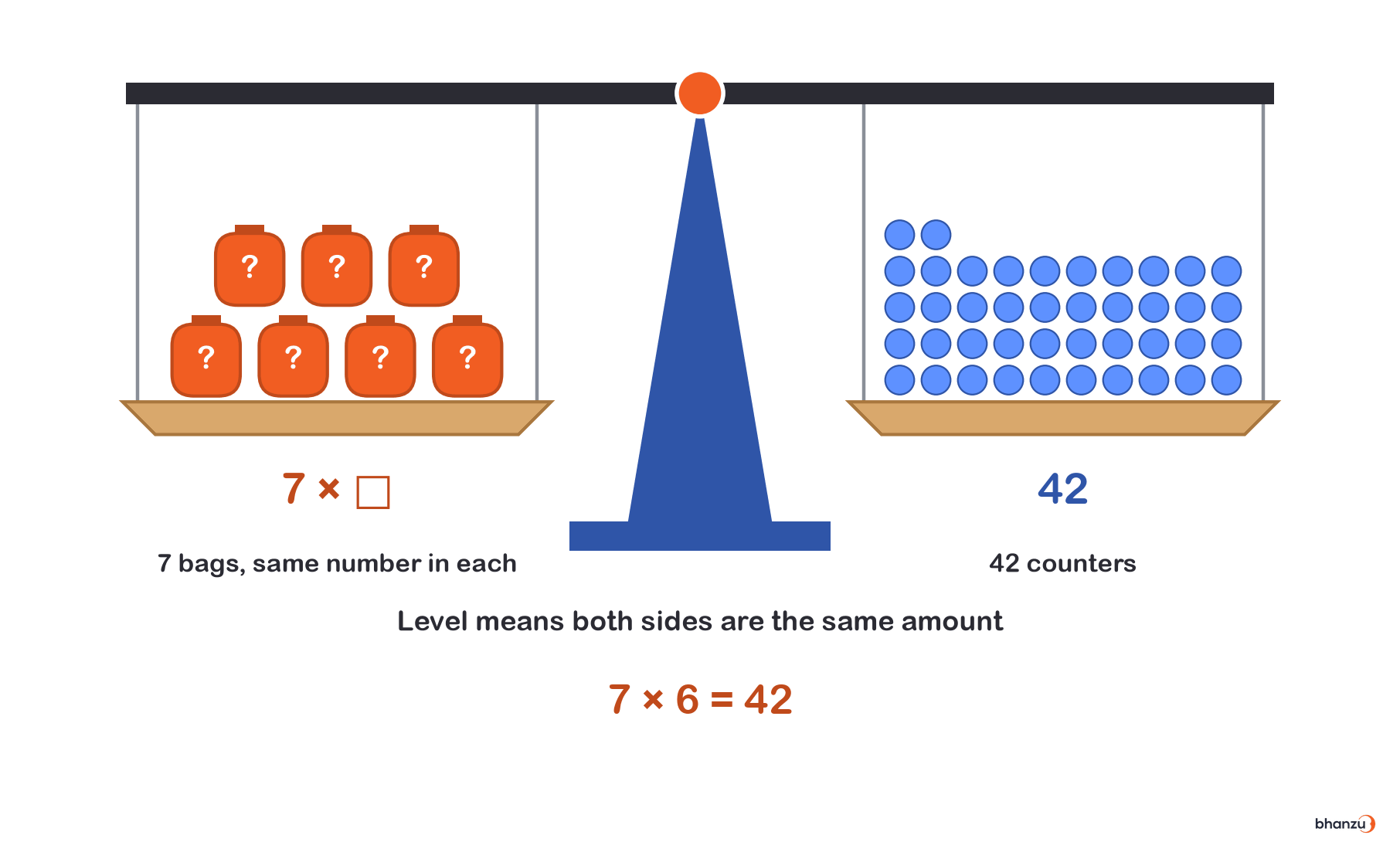
A drop of juice lands on your homework and hides one number. The line now says 7 bags, each with the same number of apples, hold 42 apples in all. You can still get the number back, because the other two numbers pin it down.
Bags of 5 apples make 35, too few, and bags of 7 make 49, too many. So the hidden number is 6 (the only one that fits). In a few grades, that hidden number gets a letter, and the idea turns into algebra.
What are missing numbers in multiplication and division?
Missing numbers in multiplication and division are unknown values in equations, which are math sentences with an equal sign. Each equation links three numbers, so the two you know lead you to the third.
Seven bags hold equal groups of apples, 42 apples in all, so the hidden number is the size of each group.
The 7 and the box are factors, the numbers being multiplied, and 42 is the product, the answer. A box standing for a factor is a missing factor, also called an unknown factor. Common Core's table of situations gives the hidden number one of three jobs: the total, the number of groups, or the size of each group.
Finding these unknowns is Common Core standard 3.OA.A.4. By the end of 3rd grade, your child is expected to find the unknown in any spot, even when the box is the number being divided.
How do you find a missing factor?
To find a missing factor, divide the product by the factor you know. Common Core standard 3.OA.B.6 describes division this way, as an unknown-factor problem.
- Say what the box stands for. In , it is the number of apples in each bag.
- Turn it into division. Divide 42 by 7, because division undoes multiplication.
- Use a times fact. Since , you know .
- Put 6 in the box and check that is true.
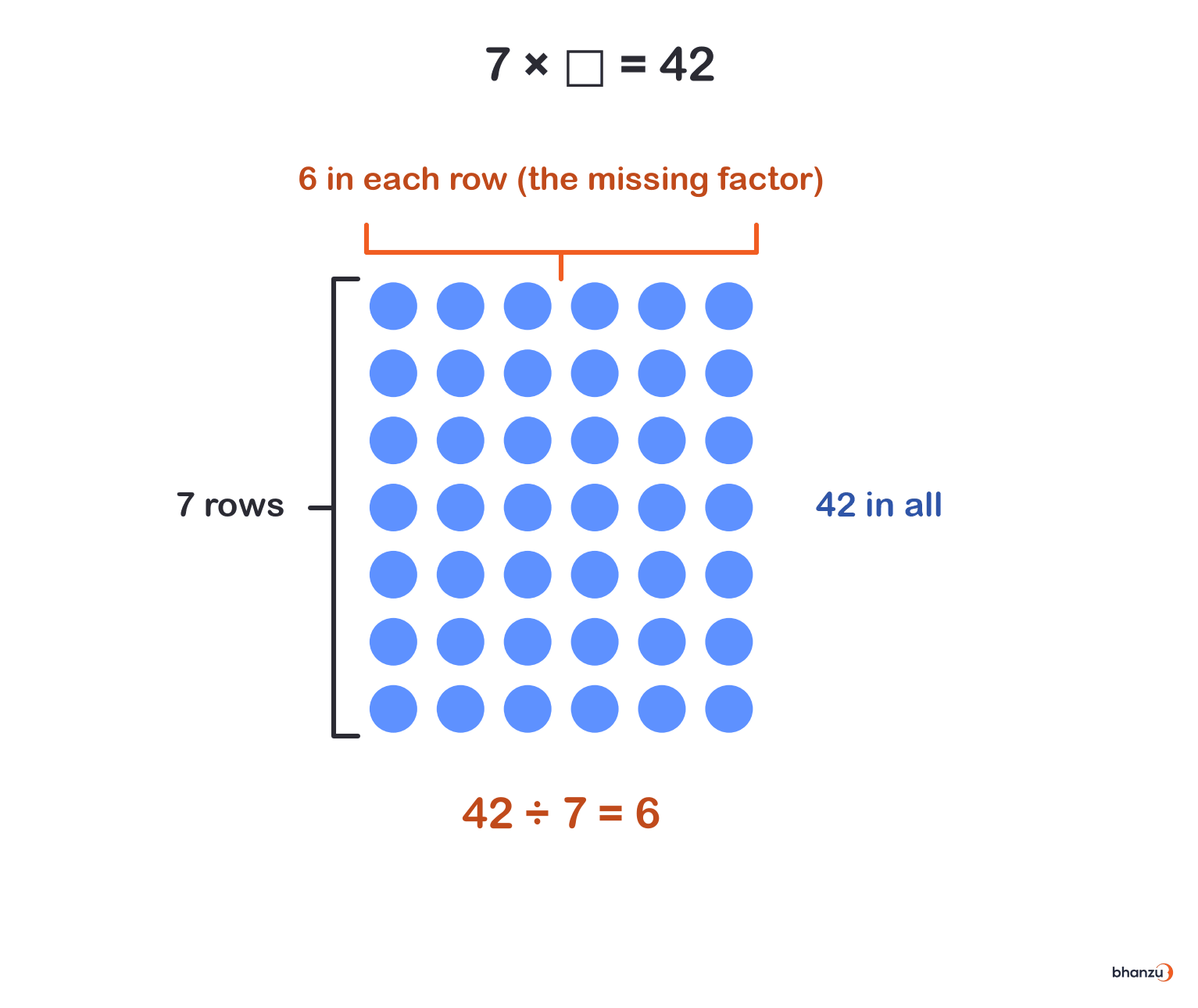
The numbers 6, 7 and 42 form one of the fact families, facts made from the same three numbers. So is true as well.
Other methods work too, each with a limit.
- Skip counting. Count by 7s to 42 (7, 14, 21, 28, 35, 42), and the six counts give the box. For it takes nine counts.
- A nearby fact. Since , one group of 7 fewer is 63, so that box is 9.
- Guess and check. Try a number, multiply, and adjust, which can take many tries.
A child who skip counts on fingers often loses the count partway and starts over. Knowing the division facts within 100 makes it one step.
How do you find missing dividends and divisors?
Ask whether the box is the total or a part. If it is the total, multiply the other two numbers. If it is a part, divide the total by the number you know.
Every division equation has three parts, the dividend, divisor and quotient. In , 40 is the dividend, 5 is the divisor (the number you divide by), and 8 is the quotient. With whole numbers bigger than 1, the dividend is always the biggest, so a missing dividend is bigger than both numbers you see.
| Where the box is | Equation | Move | Box |
|---|---|---|---|
| Product | multiply 5 by 8 | 40 | |
| First factor | divide 27 by 9 | 3 | |
| Second factor | divide 42 by 7 | 6 | |
| Quotient | divide 40 by 5 | 8 | |
| Dividend | multiply 4 by 7 | 28 | |
| Divisor | divide 20 by 4 | 5 |
The names can feel slippery, because the divisor is sometimes the number of groups and sometimes the size of each group. The move stays the same.
Children often expect a bigger box to give a bigger answer. A bigger divisor gives a smaller quotient, though, so 10 in gives only 2.
What can a box or a letter stand for?
A box, a blank, a question mark and a letter all stand for one number you have not found yet. A letter used this way is a variable. Say what it stands for first, such as for the price of one pack in dollars.
The equal sign works both ways, so the total can come first. Read as "5 is the same as what number divided by 3," and multiply 5 by 3, because multiplying undoes dividing.
Letters follow the same moves. In , is the factor that goes with 7, so divide 35 by 7 to get .
In multiplication and division word problems, certain words tell you the box's job.
| Words in the problem | Math it means |
|---|---|
| in all, total | the product or the dividend |
| each, every | the size of each group |
| shared equally | divide |
| how many packs | the number of groups |
| is the same as | equals, |
In 6th grade, hanger diagrams turn this balancing into a picture.
Try It Yourself
Use the plus and minus buttons to change the number in the box, and watch the balance tip toward the heavier side. When both sides sit level, the readout shows the matching multiplication and division facts. Press Hint if you get stuck, and New problem to hide the box in a different spot.
Why does finding the unknown matter?
Real life hands you two numbers and hides the third. A missing-number equation writes that down so you can solve it.
- It answers "how many in each?" Sharing 28 crackers equally among 4 friends is , so each gets 7.
- It answers "how many packs?" Needing 70 stickers in packs of 10 gives , so you buy 7.
- It checks division. You know because .
- It starts algebra. The NAEP mathematics framework for 2022 and 2024 puts 15 percent of 4th grade questions in algebra. One goal is finding "the value of the unknown in a whole number sentence."
Each one comes down to naming the hidden number's job, then multiplying or dividing.
Examples of missing numbers in multiplication and division
Example 1
Find the missing number in .
The box is the number in each of 4 groups. Divide 24 by 4, because division undoes multiplication.
The box is 6, and checks it.
Example 2
Find the missing number in .
The box is a part, so divide the total, 63, by 9.
The box is 7, and checks it.
Example 3
Find the missing number in .
The sign says divide, so it is tempting to divide the numbers you can see.
But , not 9, so 3 cannot be right. The dividend should be the biggest number, and 3 is smaller than 9.
The box is the total, so multiply, because multiplying undoes dividing.
The box is 27, and checks it.
Example 4
Find in .
Here is the factor that goes with 8 to make 56. Divide 56 by 8, because division undoes multiplication.
So , and checks it.
Example 5
Which box holds the bigger number, or ?
In the first equation the box is a factor, so divide.
In the second it is the dividend, so multiply.
The numbers match, but the jobs differ, so the second box, 40, is bigger than the first box, 5.
Example 6
Ms. Rivera buys 6 packs of markers that each cost the same. She pays $54 in all. Write an equation with a letter for the price of one pack and solve it.
Let stand for the price of one pack in dollars.
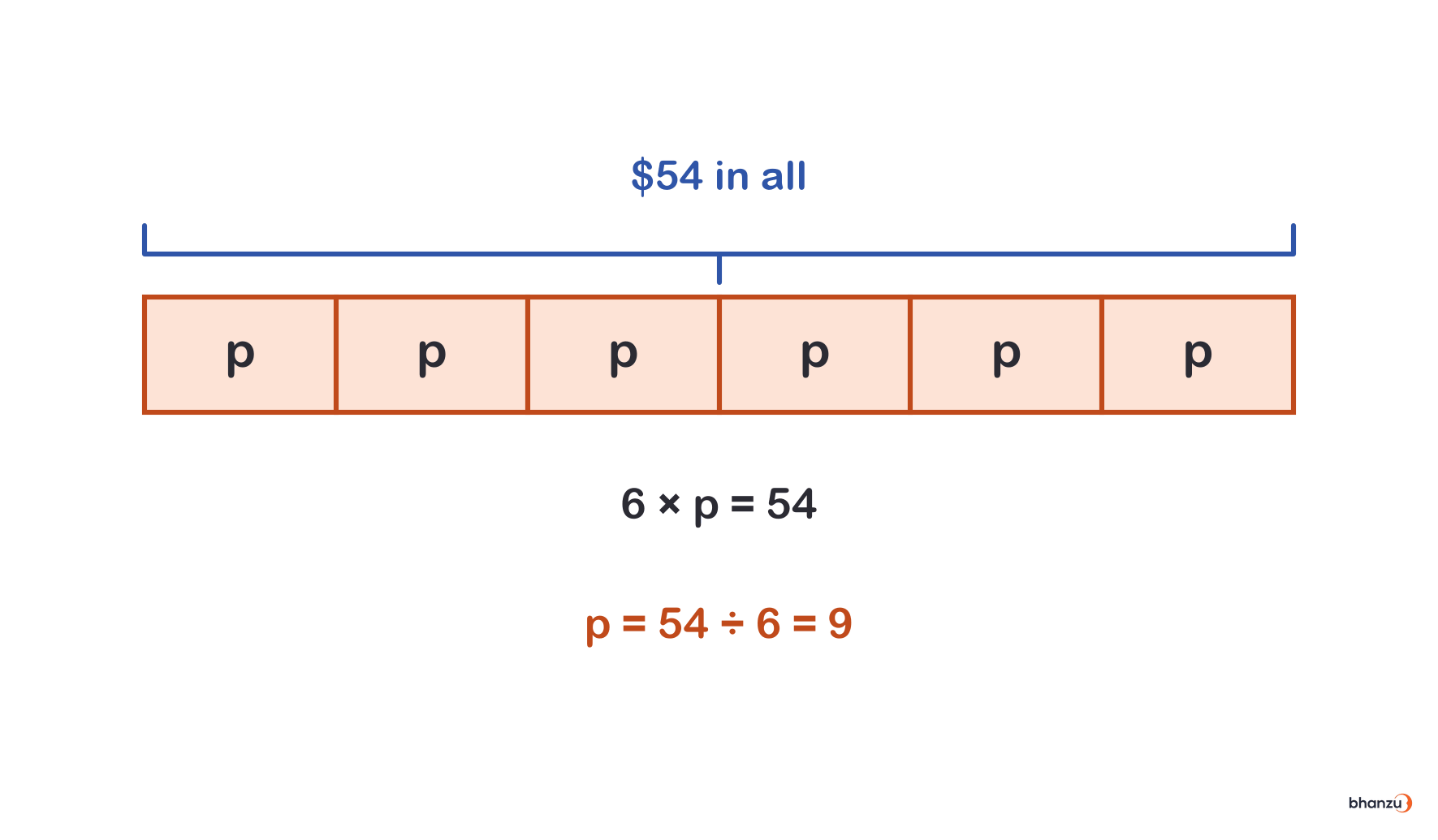
Divide 54 by 6, because division undoes multiplication.
One pack costs $9, and checks it.
What most guides miss about missing numbers
Most practice puts the box after the equal sign, so the sign starts to mean "write the answer here" to a child. In a 2022 study of 1,745 students in grades 1 to 5, few read the sign as "the same as," its real meaning. A 2012 review of 8 elementary textbook series found that 7 rarely showed other equation shapes, such as with the answer on the left.
That is why a flipped equation can look wrong to a child who solves easily.
The fix is to say the equal sign aloud as "is the same as," then check that both sides match. That check is the skill behind true or false equations from 1st grade. Asking whether is true makes a good warm-up.
Where to watch your step on missing numbers
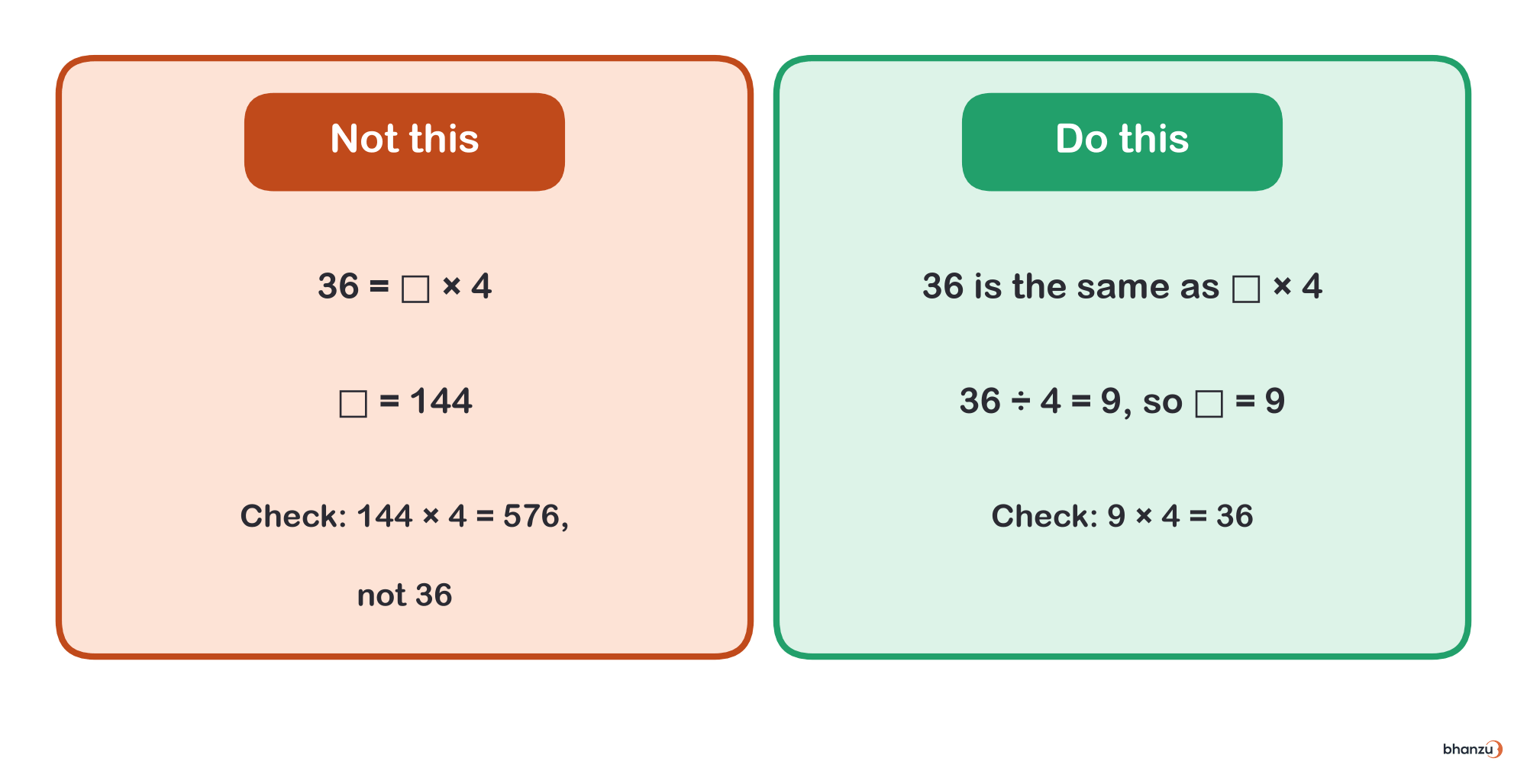
Mistake 1: Treating the equal sign as an answer slot
Where it slips in: Equations that start with the total, such as , after months of seeing the answer come last.
Don't do this: Multiply the numbers you see, .
The correct way: Read it as "36 is the same as what number times 4," so divide 36 by 4 to get 9. Then checks it.
Children who read the equal sign as "now write the answer" grab both numbers and multiply. Putting 144 back gives , nowhere near 36.
Mistake 2: Multiplying when the divisor is missing
Where it slips in: Division equations with the box after the division sign, such as . A child who has just learned that a missing dividend means multiply uses that rule on every division box.
Don't do this: Multiply .
The correct way: The box is a part, so divide 30 by 6 to get 5, and checks it.
Mistake 3: Subtracting the number you know
Where it slips in: Early missing-factor problems such as , which look like the adding problems from 1st and 2nd grade.
Don't do this: Take away the number you know, .
The correct way: Ask what number times 5 makes 45, then divide 45 by 5 to get 9. Check that .
In 1st grade, finding the missing number in an equation such as meant subtracting, and that habit lingers.
Key Takeaways
- Before you solve, decide whether the box is the total or a part.
- Multiply for a missing product or dividend, and divide for any other missing number.
- Missing numbers in multiplication and division can sit on either side of the equal sign.
- Put your answer back in the first equation, and if the sides do not match, rethink the box's job.
- For more multiply-or-divide practice with a teacher who spots the slip, explore Bhanzu's 3rd grade math tutor or math programs for kids.
Read More
- Finding the Missing Number Within 100
- Two-Step Word Problems
- Multiplicative Comparison
- Equations With Tape and Hanger Diagrams
- Division Property of Equality
- How to Teach Multiplication
Research Behind This Article
- Common Core State Standards Initiative, Grade 3: Operations and Algebraic Thinking (2010). thecorestandards.org
- Common Core State Standards Initiative, Mathematics Glossary, Table 2: Common Multiplication and Division Situations (2010). thecorestandards.org
- National Assessment Governing Board, Mathematics Assessment Framework for the 2022 and 2024 National Assessment of Educational Progress (2022). nagb.gov
- Ralston, N. and Li, M., Student Conceptions of the Equal Sign: Knowledge Trajectories across the Elementary Grades, Elementary School Journal (2022). eric.ed.gov
- Powell, S. R., Equations and the Equal Sign in Elementary Mathematics Textbooks, Elementary School Journal (2012). eric.ed.gov
Quick Quiz: Check Yourself
Three levels, new numbers every time: find a missing factor, find a missing dividend, divisor or letter, then solve a story problem with a letter.
Was this article helpful?
Your feedback helps us write better content
Frequently Asked Questions
How do you teach missing numbers in multiplication and division?
What grade do kids learn division?
What grade do kids learn algebra?
Why does algebra use letters?
Are missing number problems algebra?