Key Points
- Two-step word problems in 3rd grade use any of the four operations, and a hidden first answer, like 40 muffins on 5 trays of 8, feeds step two.
- Each step gets its own equation with a letter for the unknown, so and give 40 baked and 33 left.
- Doing the steps in the wrong order turns 6 boxes of 8 crayons, 5 broken, into 18 instead of 43, and an estimate near 45 catches the mistake.
One question hiding behind another
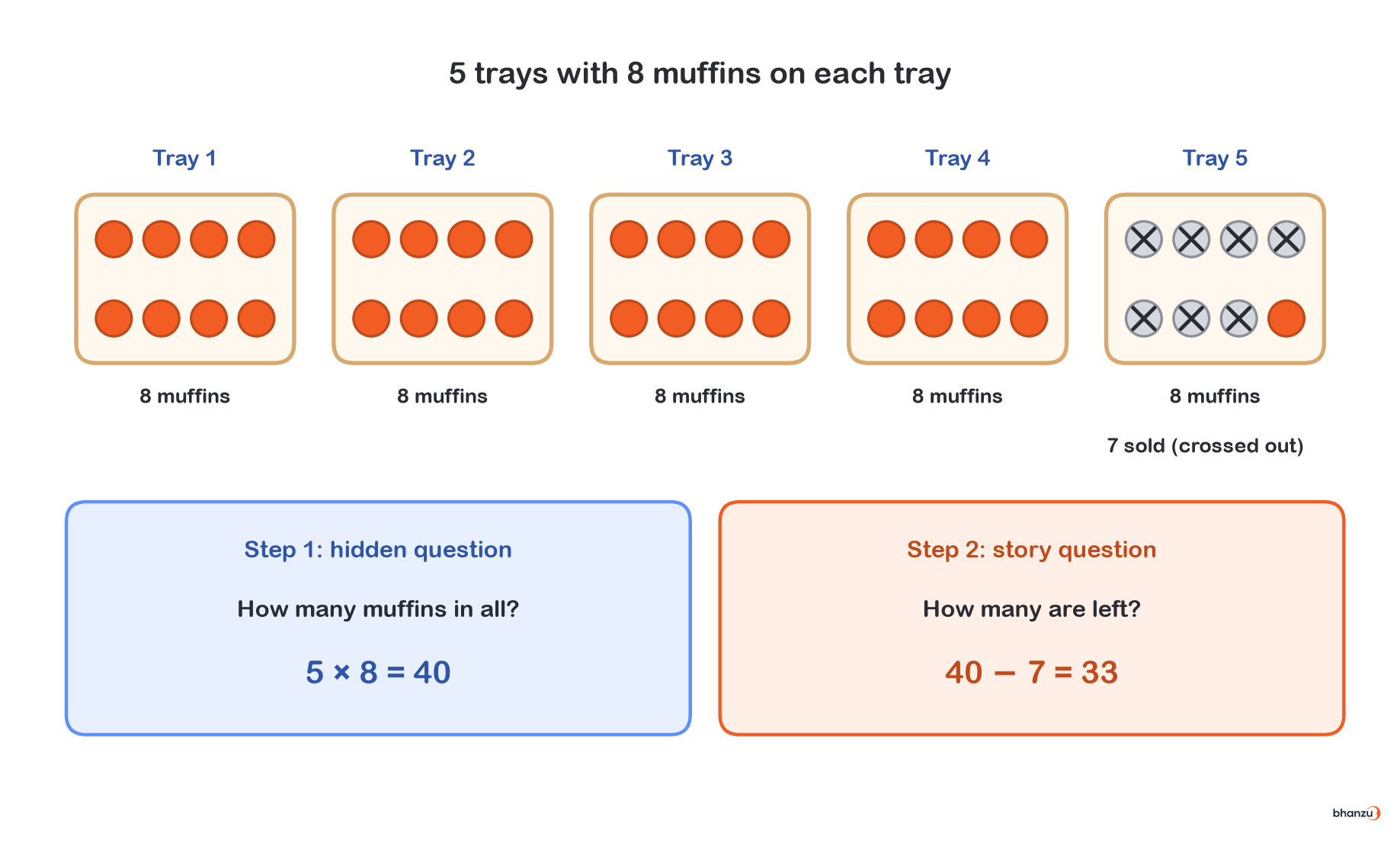
The bake sale sign says 5 trays of 8 muffins, and 7 are already sold. A customer asks how many muffins are left. The sign never says how many there were to begin with.
So that number comes first. Five trays of 8 make 40 muffins, and only then does 40 take away 7 give 33.
Next year, the same habit carries you through stories with three steps, and it already helps whenever you plan snacks for a party.
What are two-step word problems?
Two-step word problems are story problems that need two operations in a row, and the first answer becomes a number in the second step. The operations are adding, subtracting, multiplying and dividing. The first step answers the hidden question, the question the story never asks out loud.
In the muffin story, lay out 5 equal groups of 8 counters, and the hidden total of 40 is there to count. Each step then becomes an equation, a number sentence with an equals sign, such as .
This skill is Common Core standard 3.OA.D.8. By the end of 3rd grade, your child is expected to plan these stories, write each step as an equation with a letter and check the answer with rounded numbers.
In 2nd grade, two-step word problems within 100 used only adding and subtracting, and 3rd grade brings in multiplying and dividing. Two-step stories are one family of math word problems, set apart by the hidden question.
How do you solve a two-step word problem?
Find the hidden question, answer it, then use that answer to finish the story's question.
- Read the story and say its question in your own words.
- Find the hidden question, the number you need that the story never gives.
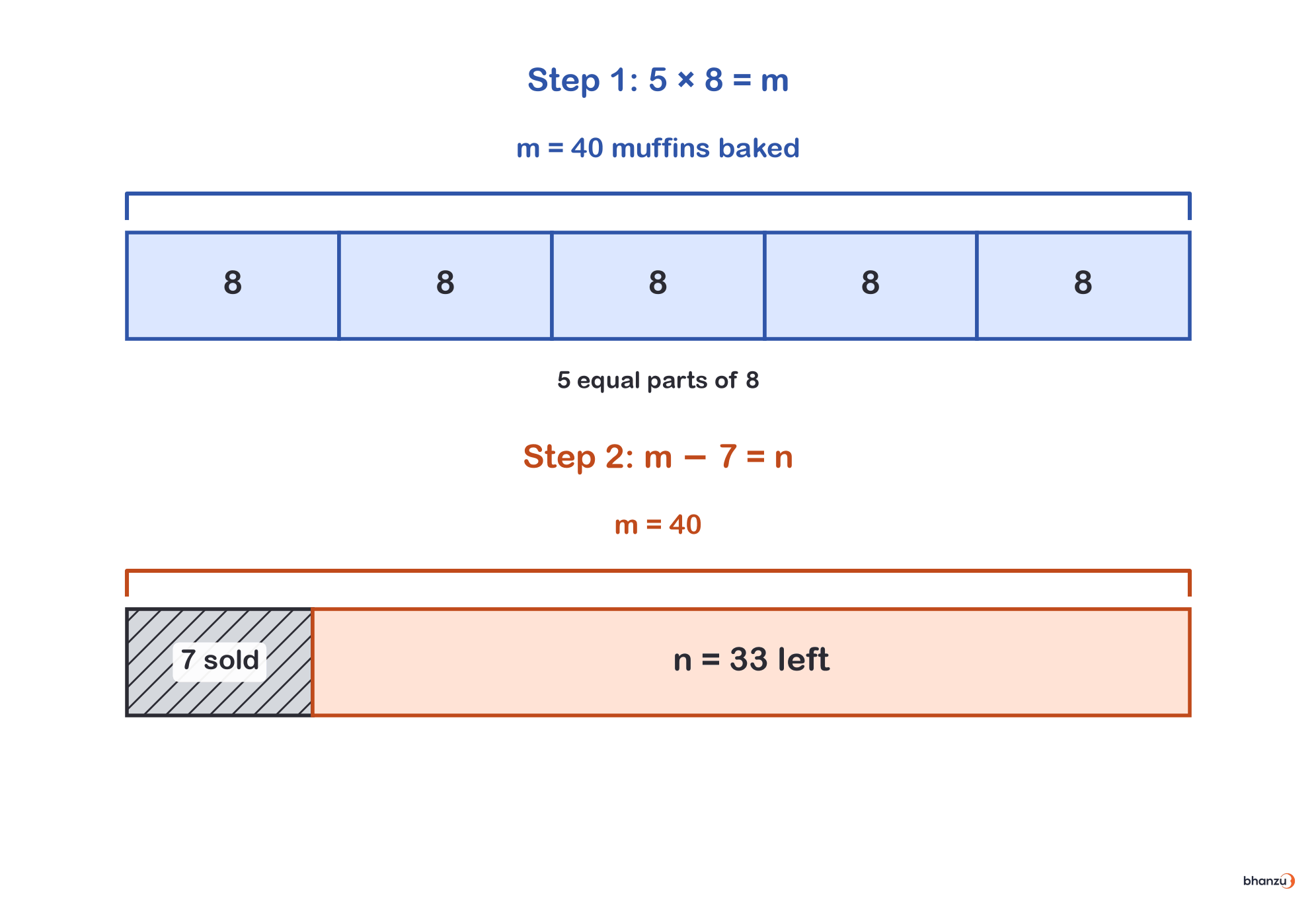
- Draw a bar model, a long bar split into parts (also called a tape diagram), with one equal part for each equal group.
- Write an equation for each step, with a letter for each unknown. Here is the muffins baked and is the muffins left, so and .
- Solve in order. Multiply first, so , then subtract, .
- Write the answer with its label, 33 muffins, and check it against an estimate, a close-enough answer from rounded numbers.
A letter can sit anywhere in an equation. To find it, undo the step with the opposite operation, so becomes , and . Bar models get slow with three-digit numbers, so for those, go straight to the equations.
Some children write both equations neatly but can't say what counts. Asking what the 40 stands for pulls the story back in.
Holding two steps in mind takes practice, even in 4th grade. A 2024 Nation's Report Card question asked for a bulletin board's area, then the paper rolls to cover it, with no calculator. Full credit went to 27% of fourth graders, and 39% reached NAEP Proficient or above in math that year.
Try It Yourself
Read the bake sale story and tap the hidden question first. Pick an operation for each step, and watch the counters fill equal groups and the number bond join or split the parts. At the end, compare your answer with the estimate, then press New story.
Which operations show up in two-step problems?
All four operations can show up, in any pair. In 3rd grade, the multiplying and dividing steps come from equal groups, arrays (rows and columns of objects) and measurements. Each of those steps is a one-step story like the ones in multiplication and division word problems.
| Words in the problem | Math it means |
|---|---|
| 3 trays with 5 cookies on each tray | multiply, |
| bakes 4 more cookies | add 4 |
| packs them in boxes of 4 | divide by 4 (how many groups) |
| shares the rest equally among 3 shelters | divide by 3 (how many in each group) |
Division hides two different questions. Packing 36 muffins in boxes of 4 asks how many groups, but sharing $60 among 3 shelters asks how much each group gets. Only the story says which one you have (the Common Core glossary lists them as two separate kinds of division).
Children who learned that "in all" means add often add 3 and 6 for 3 boxes of 6 pens in all. The right total is 18, not 9.
How do you check if an answer makes sense?
Round each number, redo the plan in your head, and see whether the exact answer lands close to the estimate.
Say the class bakes 9 trays of 7 cookies, and a parent brings 38 more. The exact answer is , then . Rounding 63 to 60 and 38 to 40 gives , so 101 fits.
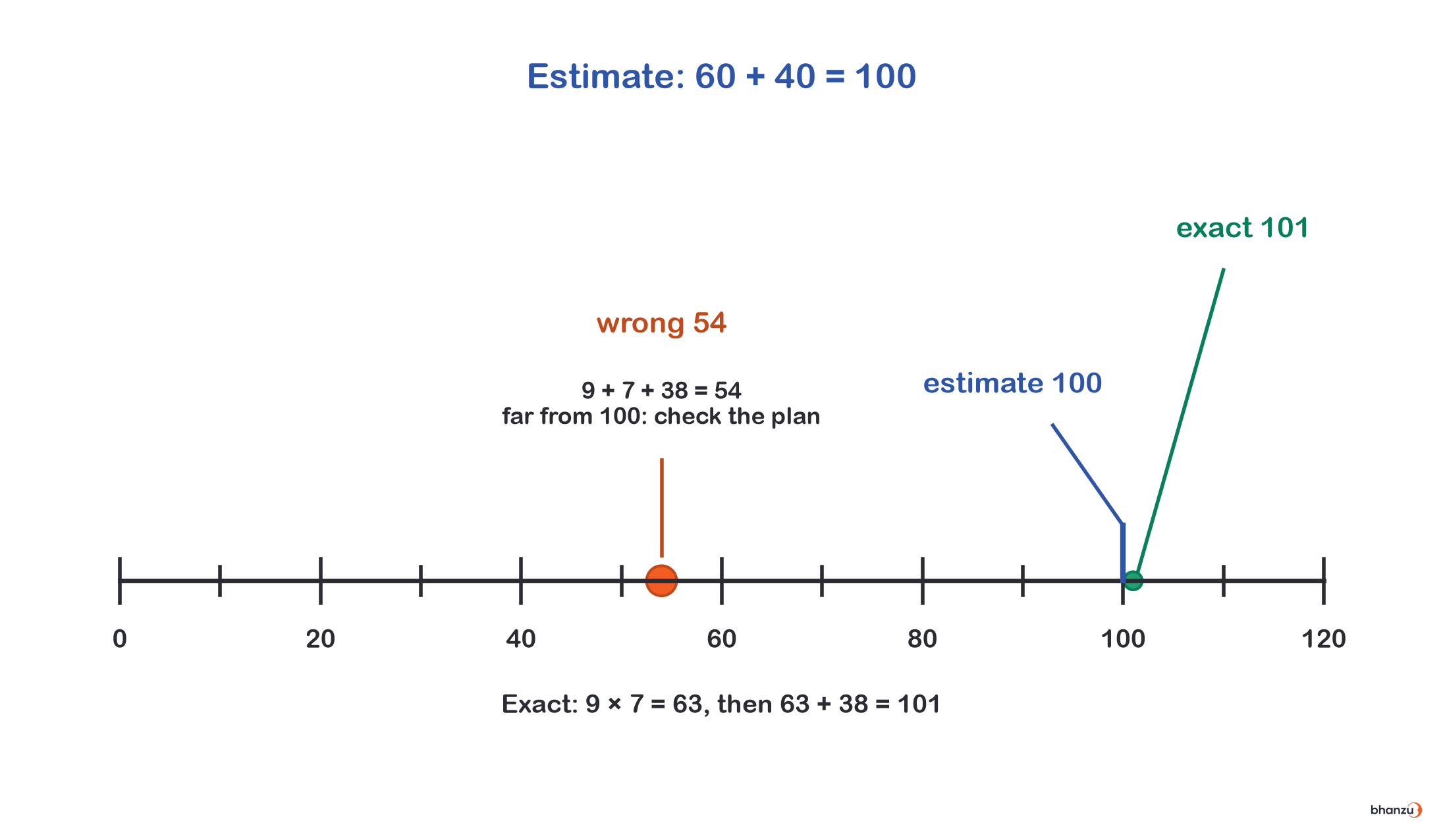
An answer of 54, from adding , lands far from 100. Swapping each number for its nearest ten is the skill in rounding to the nearest 10 or 100. An estimate misses small mistakes, though, since 99 and 101 both sit near 100.
For small mistakes, work backward with the opposite operation, and . A 2012 What Works Clearinghouse guide on problem solving in grades 4 to 8 rated checking your own work as backed by strong evidence. The guide calls it monitoring and reflecting, with prompts like "Does the solution make sense?"
Examples of two-step word problems
Example 1
Aisha bakes 3 trays of 5 cookies, then 4 more cookies. How many cookies does she bake in all?
Step 1. Multiply the trays by the cookies on each tray to find , the cookies on the trays.
Step 2. Add the 4 extra cookies to find , the total.
Aisha bakes 19 cookies.
Example 2
The class has 6 boxes of 8 crayons, and 5 crayons break. How many crayons are not broken?
The tempting move takes the 5 broken crayons out of one box first, , then multiplies, .
That can't be right. Only 5 crayons broke, and 6 boxes of 8 is close to 50, so the answer should be near 45. An answer of 18 would mean 30 crayons broke.
Step 1. Multiply the boxes by the crayons in each box to find , all the crayons.
Step 2. Subtract the 5 broken crayons.
The class has 43 crayons that still work.
Example 3
Leo bakes 17 blueberry muffins and 19 banana muffins, then packs them in boxes of 4. How many boxes does he fill?
Step 1. Add the two kinds to find , all the muffins.
Step 2. Divide into groups of 4 to find , the number of boxes.
Leo fills 9 boxes.
Example 4
Mei cuts a 56-inch ribbon into 7 equal pieces and uses 40 inches of it on gift bags. How many pieces does she use?
Step 1. Divide the ribbon by 7 to find the length of each piece.
Each piece is long. Step 2. Let stand for the pieces Mei uses, so , and undo the multiplying by dividing.
Mei uses 5 pieces.
Example 5
The class raises $75, spends $15 on supplies and shares the rest equally among 3 animal shelters. How much does each shelter get?
Step 1. Subtract the supplies to find , the money left.
$$r = $75 - $15 = $60$$
Step 2. Share equally among 3 to find , the amount in each group.
$$s = $60 \div 3 = $20$$
Each shelter gets $20.
Example 6
The bake sale starts with 500 cookies and sells 238 on Friday and 179 on Saturday. How many cookies are left? Solve it two ways.
Plan A. Add the two days to find , the cookies sold, then subtract from 500.
Plan B. Subtract one day at a time.
Both plans leave 83 cookies, and rounding to tens gives , close to 83.
The real reason two-step word problems exist
Real answers often depend on a number nobody tells you. Two-step word problems train you to go and find that number.
- It plans how much to make. 5 tables of 6 cupcakes need 30, and 4 spares bring the order to 34.
- It keeps game scores fair. 3 rounds of 8 points make 24, and a 5-point penalty leaves 19.
- It grows into algebra. The letter that names a hidden answer is the same idea middle school calls a variable.
A calculator can do every operation in these stories, but only the person reading the story can find the hidden question.
The pattern hiding inside two-step word problems
The hidden question is a small number sentence tucked inside a bigger one. The order of operations, the agreed rule to multiply and divide before adding and subtracting, decides whether that part needs parentheses (curved brackets).
- A hidden step that multiplies or divides, followed by adding or subtracting, needs no parentheses. The crayon story becomes , so .
- A hidden step that adds or subtracts, followed by multiplying or dividing, needs them. Leo's muffins become , so .
Without them, divides 19 by 4 first, which doesn't even come out even. Plan A of Example 6 needs them too, , since steps at the same level run left to right. You'll meet more one-line equations in order of operations in 2-step expressions.
The mistakes kids make most often with two-step word problems
Mistake 1: Stopping at the hidden answer
Where it slips in: Stories whose first step gives a big, finished-looking number, like a product. A child who rushes often treats that number as the answer.
Don't do this: Diego buys 4 packs of 6 juice boxes, and the class drinks 15. Writing and stopping there.
The correct way: 24 is only the hidden answer. Subtract the 15, , so 9 juice boxes are left.
Mistake 2: Adding when the story has equal groups
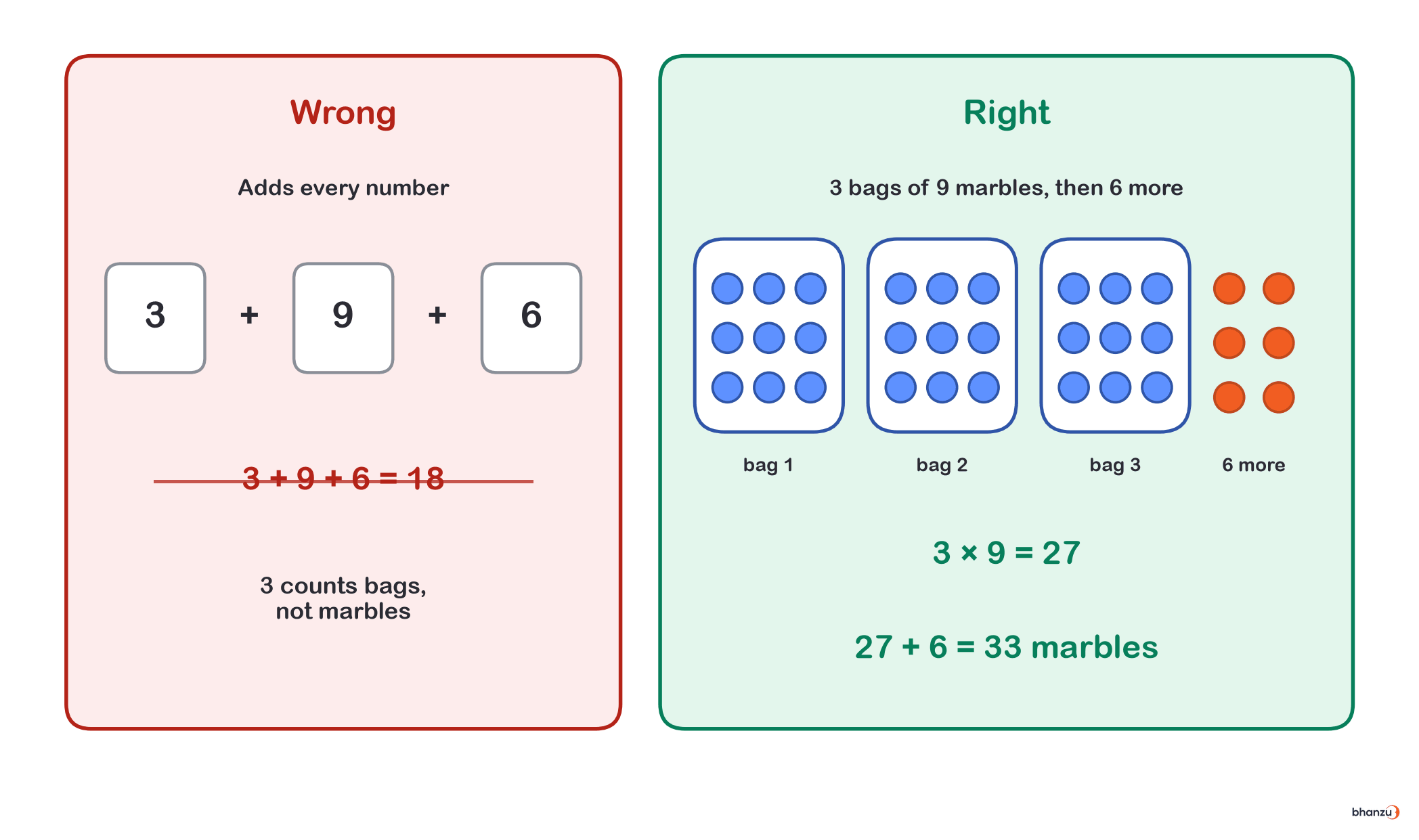
Where it slips in: Stories with equal groups, like 3 bags of 9 marbles. A child who adds every number in sight misses that 3 counts bags (not marbles).
Don't do this: Adding when Noah has 3 bags of 9 marbles and wins 6 more.
The correct way: Multiply the bags by the marbles in each bag, , then add 6 to get 33 marbles.
Mistake 3: Subtracting when the story shares equally
Where it slips in: Stories where "equally" or "on each page" signals sharing. Sharing feels like taking away, so the 5 pages get subtracted as if they were stickers.
Don't do this: Priya puts 30 stickers equally on 5 pages, then adds 2 more to each page. Writing , then .
The correct way: Share 30 into 5 equal groups, , then add 2 to get 8 stickers on each page. Having 27 on every page would take 135 stickers, and Priya only had 40.
Key Takeaways
- Say the hidden question out loud before writing a single number.
- When a story says "in each" or "equally," decide which number counts groups before you multiply or divide.
- Trust an answer to two-step word problems only after it lands near your rounded estimate.
- For more practice spotting the hidden question and the equal-groups trap, explore Bhanzu's 3rd grade math tutor or Common Core math curriculum.
Read More
- Multiplying by Multiples of 10
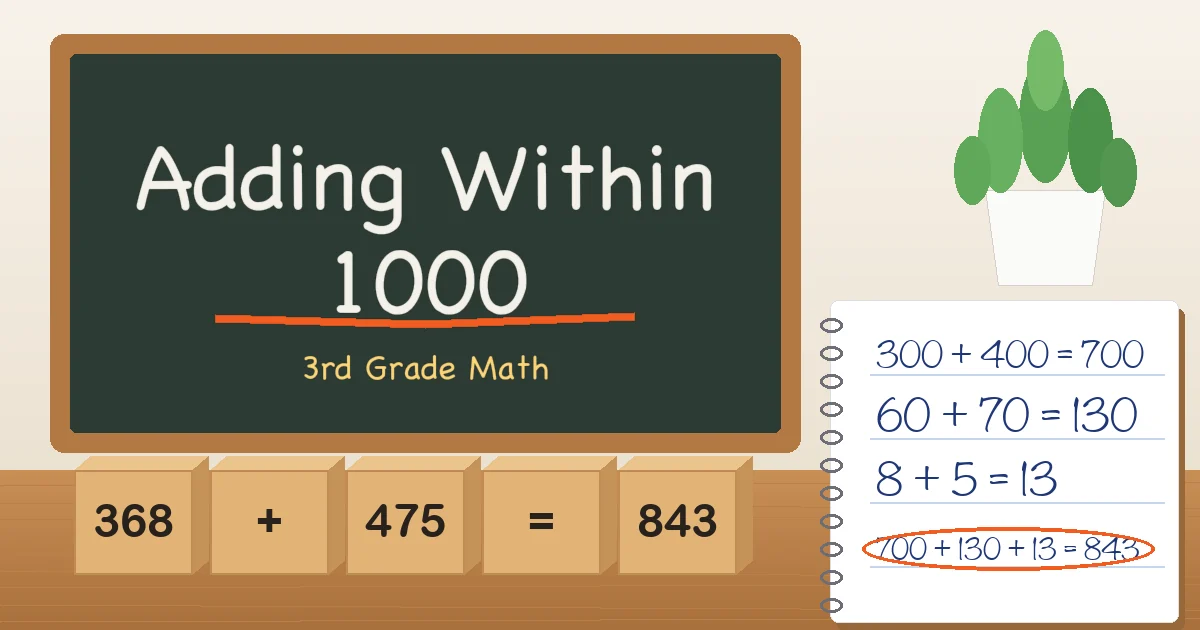
- Estimating Sums and Differences
- Finding the Unknown in Multiplication and Division Equations
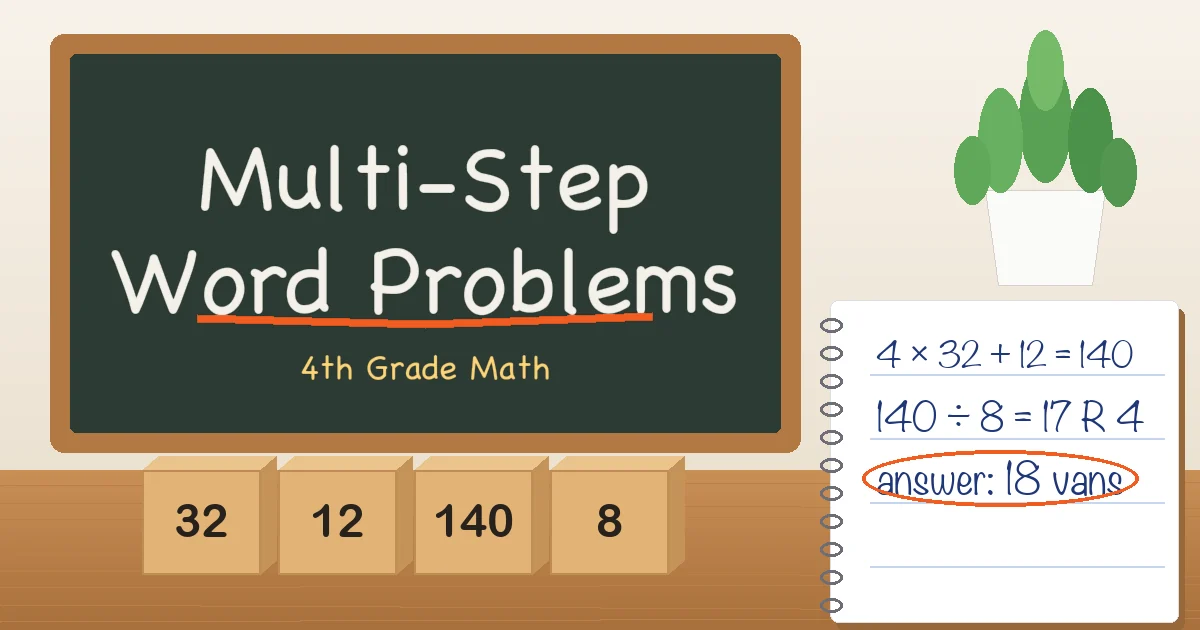
- Multi-Step Word Problems
Research Behind This Article
- Common Core State Standards Initiative, Grade 3 Operations and Algebraic Thinking (2010). thecorestandards.org
- Common Core State Standards Initiative, Operations and Algebraic Thinking, Kindergarten to Grade 5 (2010). thecorestandards.org
- National Center for Education Statistics, NAEP Mathematics: National Trends and Student Skills, Grade 4, 2024 (2025). nationsreportcard.gov
- Common Core State Standards Initiative, Mathematics Glossary: Table 2, Common Multiplication and Division Situations (2010). thecorestandards.org
- What Works Clearinghouse, Institute of Education Sciences, Improving Mathematical Problem Solving in Grades 4 Through 8 (2012). ies.ed.gov
Quick Quiz: Check Yourself
Three levels, new numbers every time: multiply then add or subtract, then pack or share equally, then three-digit sales, ribbon pieces and bigger groups.
Was this article helpful?
Your feedback helps us write better content
Frequently Asked Questions
When do kids learn two-step word problems?
Do two-step word problems always use two different operations?
How can I help my child with two-step word problems at home?
How do you know whether to multiply or divide in a word problem?
What is the difference between one-step and two-step word problems?
What does a two-step multiplication word problem look like?