Key Points
- Finding the missing number within 100 means deciding which value keeps both sides of the equal sign the same, such as 26 in .
- A missing whole comes from adding the two parts, and a missing part comes from counting up from the known part.
- Signs and clue words can mislead, so needs 48 rather than 12, and "25 fewer" can mean adding.
The beads still waiting for the string
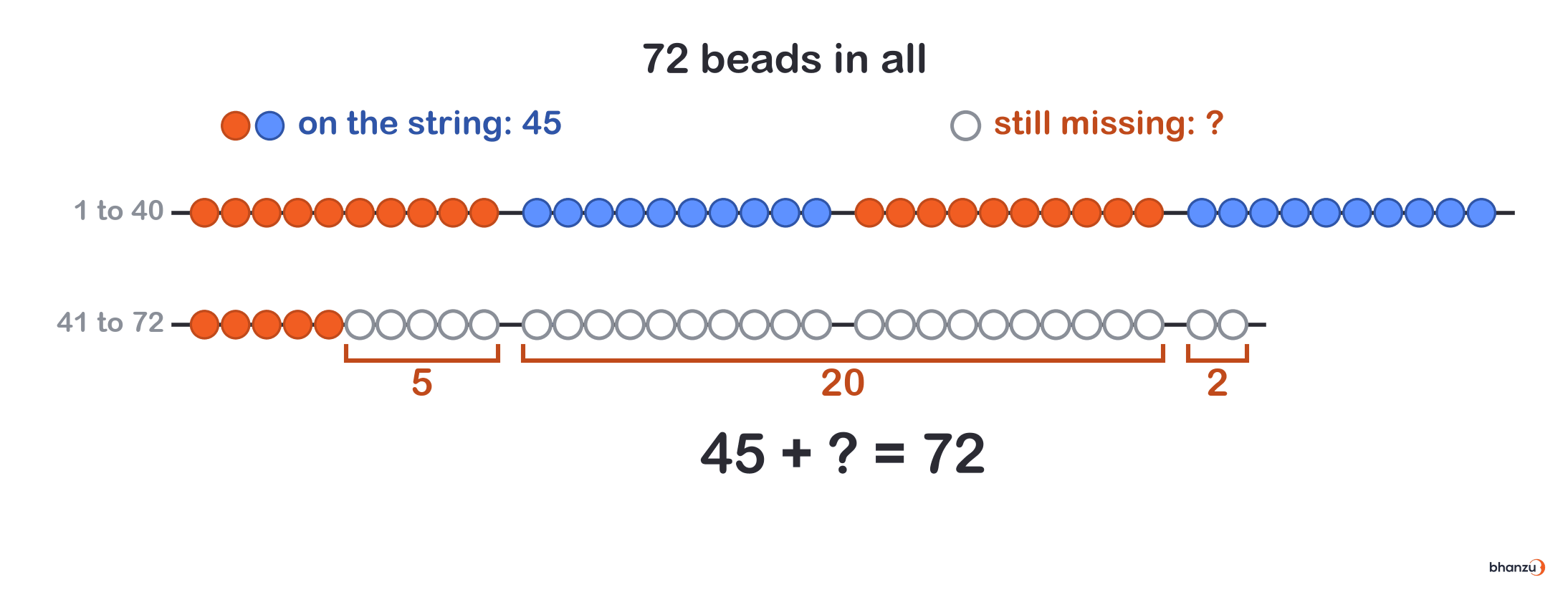
Maya's bracelet needs 72 beads, and 45 are already on the string. How many more does she need?
Counting the empty places one by one works, but there's a shorter road, because 45 and one hidden number already make 72. Next year, the same thinking finds the missing number in a multiplication, such as 4 times what makes 20.
How do you find the missing number within 100?
Finding the missing number within 100 means naming the whole and its two parts, then adding or counting up until both sides match. An equation is a math sentence with an equal sign, such as , and the ? stands for one number you haven't found yet. The equal sign means "is the same as."
The whole is the total, and the parts are the two numbers that make it. In Maya's bead string, 72 is the whole, and 45 and the ? are the parts.
- Say the equation out loud, and read the equal sign as "is the same as."
- Point to the whole and the two parts.
- If the whole is missing, add the parts. If a part is missing, count up from the other part or take it from the whole.
- Put your number back in and check.
The whole can sit on either side, so works like . In 2nd grade, your child does this with numbers up to 100, building on finding the missing number in an equation within 20.
This is Common Core standard 2.OA.A.1, which asks children to solve one- and two-step word problems within 100 with unknowns in all positions. It leans on 2.NBT.B.5, adding and subtracting within 100 fluently with place value and the link between addition and subtraction.
How do jumps of ten find the missing number?
Jumps of ten find a missing part by counting up from the part you know. Stop at the next ten, jump by tens, then add the ones left over to reach the whole.
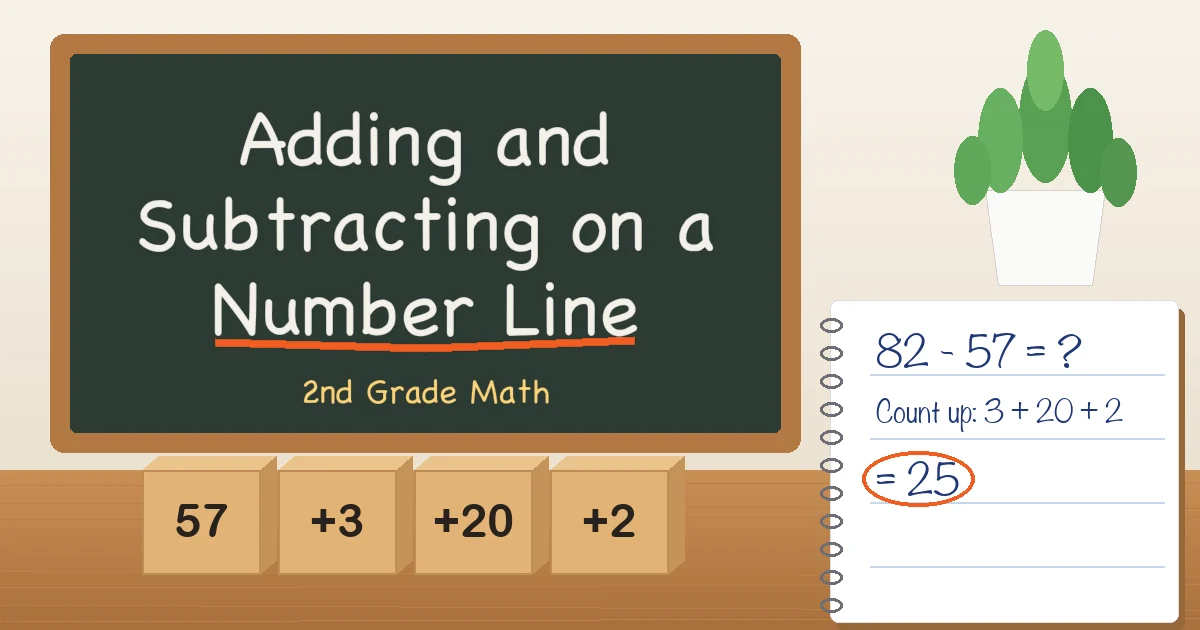
Draw the jumps on an open number line, a line with marks only where you land. It works like adding and subtracting on a number line, except the answer is the total of the jumps. For Maya's :
- From 45 to 50 is a jump of 5.
- From 50 to 70 is two jumps of 10.
- From 70 to 72 is a jump of 2.
Maya needs 27 more beads.
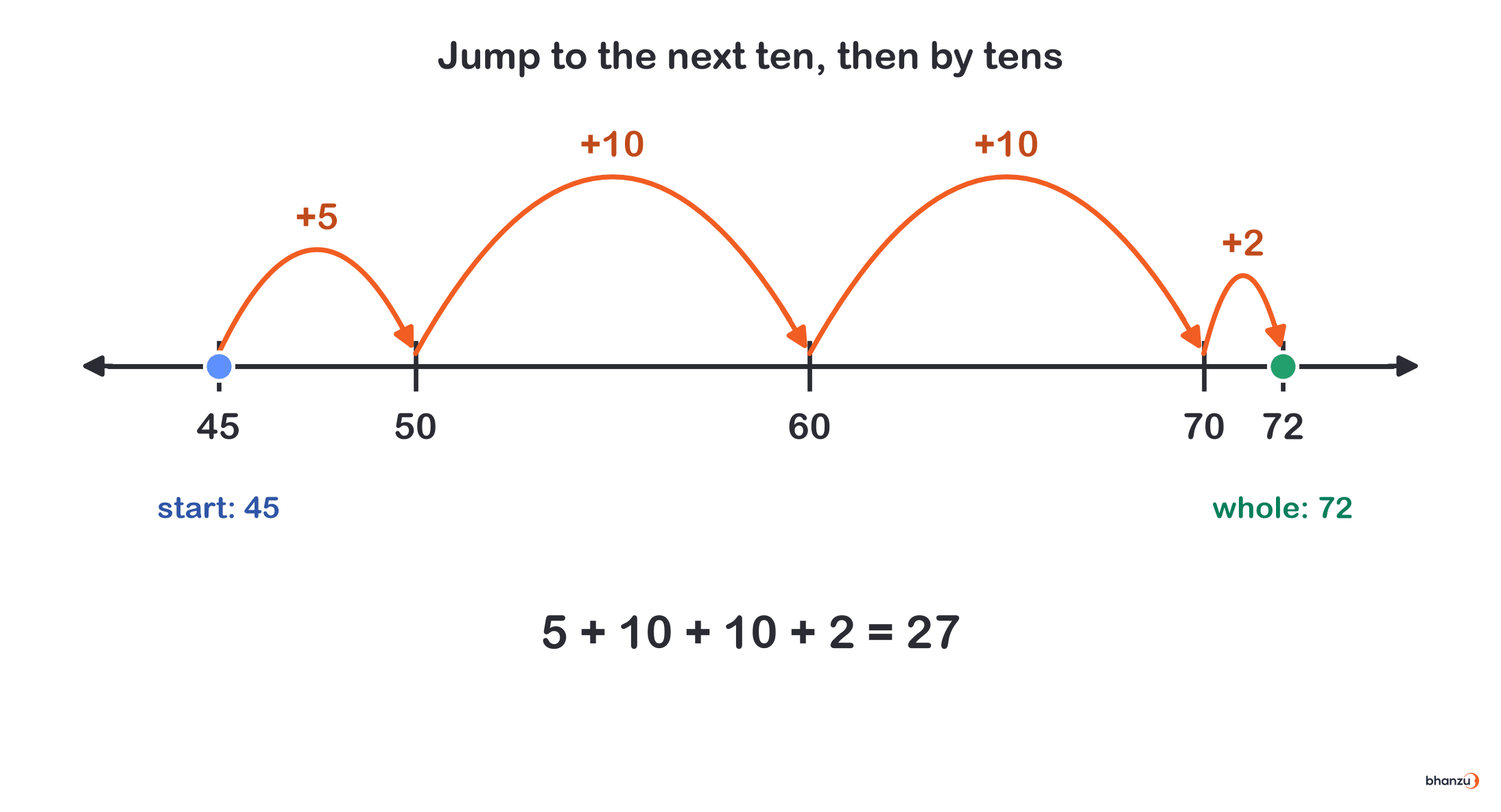
Stopping at 50 matters, because tens are simple to count (50, 60, 70). A child who counts every hop one at a time often loses track in the 60s. Jumps are quickest when the numbers sit close, and for , taking 12 from 95 is faster.
On a 2024 Nation's Report Card question, 87% of 4th graders answered correctly when asked for the missing number in an addition with 18 and 23. The report's notes describe this same route (2 to reach 20, then 3 more).
How do you think addition to subtract?
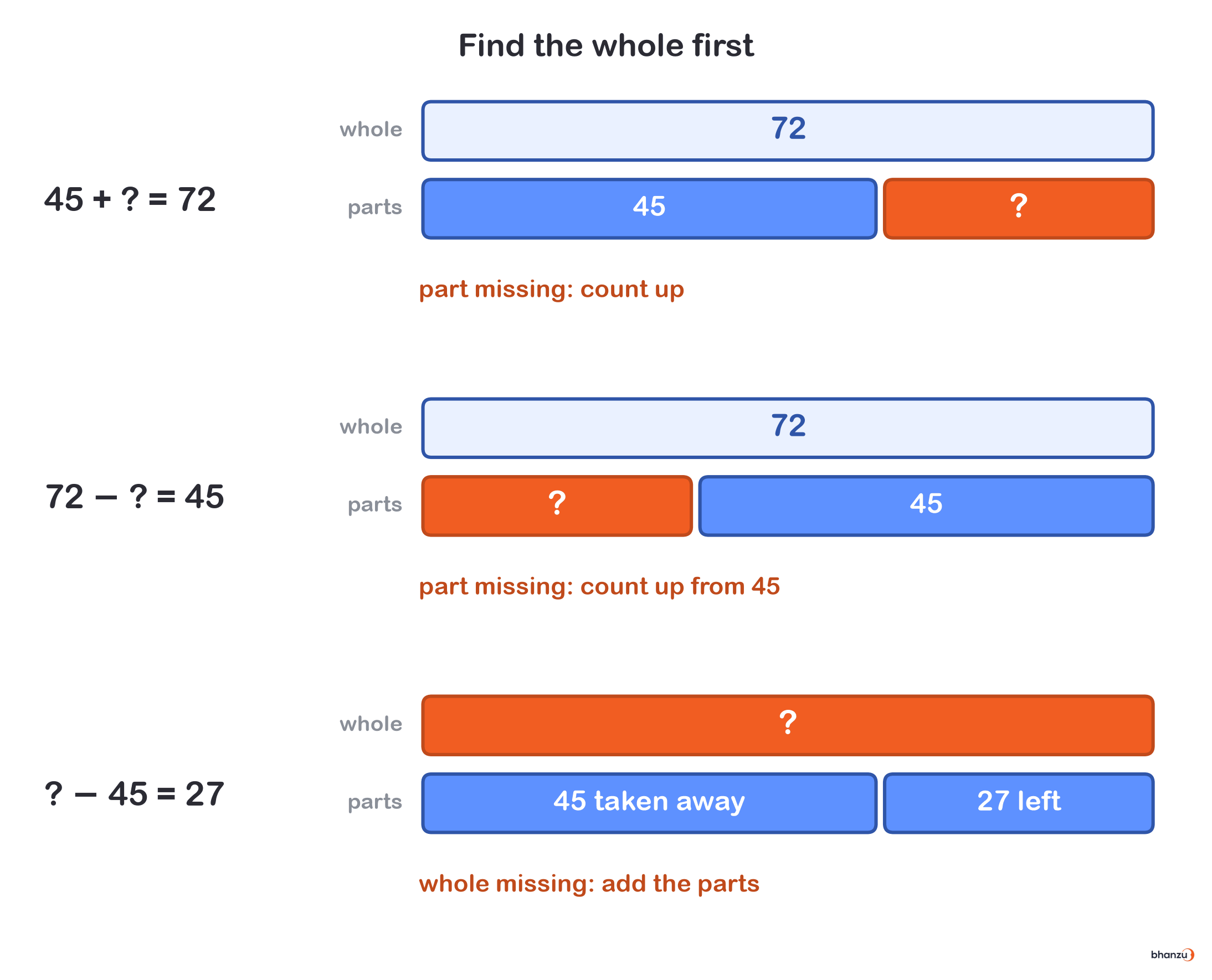
The problem looks like a take-away, yet it asks the same thing as . Thinking addition to subtract means turning a subtraction into an addition with a missing part. The numbers 27, 45 and 72 make one of the fact families, facts built from the same three numbers.
A subtraction that asks for a part can feel backward at first. One rule clears it up, because the start of a take-away is always the whole.
- Start missing. In , add the parts to get 72.
- Number taken away missing. In , count up from 45 to get 27.
- Answer missing. In 72 take away 45, count up from 45 or use subtracting two-digit numbers with regrouping.
How do you find the missing number in subtraction word problems? Look for the words that name the whole. Common Core's glossary Table 1 sorts story problems by which number is unknown.
| Words in the problem | Math it means |
|---|---|
| "at first" in a take-away story | The start, which is the whole |
| "left" | The part that stays after taking away |
| "how much more" | A missing part, so count up |
| "fewer than" or "more than" | Compare, so find who has more first |
Try It Yourself
Tap +10 and +1 to fill the mystery box with tens rods and ones cubes until the tipping balance sits level. Hint names the whole and the parts, and New problem moves the box to a new spot, even the start of a subtraction.
Examples of finding the missing number within 100
Example 1
Find the missing number in .
Count up by tens from 40 to the whole, 70. That is 50, 60 and 70, three jumps of ten.
The missing number is 30, because .
Example 2
Find the missing number in .
The tempting move is to take away the numbers you see.
That can't be right. Taking away never makes a number bigger, so a start of 12 can't leave 30.
The ? is the start, so it is the whole. Add the 18 taken away back to the 30 left.
The missing number is 48, because .
Example 3
Find the missing number in .
91 is the whole and 87 is a part. They're close, so count up 3 from 87 to 90, then 1 more to 91.
The missing number is 4, because .
Example 4
Pick the number that makes true from 34, 46 and 88.
61 sits alone, so it is the whole. Count up from 27 to 30, then to 60, then to 61.
The answer is 34, because . Adding the two numbers you see gives 88, and taking the smaller digit from the larger gives 46.
Example 5
Diego has 59 cents. A toy car costs 85 cents. How much more money does Diego need?
The price is the whole, and Diego's 59 cents is a part.
Count up from 59 to 60, then to 80, then to 85.
Diego needs 26 more cents, because .
What makes finding missing numbers worth learning?
A missing number is how math writes down something you don't know yet, so you can work backward from what you do know.
- It answers "how many more" without counting one by one, like Maya's 27 beads and Diego's 26 cents.
- It works backward from the end of a story. Lose 18 points and end a game with 30, and says you started with 48.
- It makes the equal sign mean "the same as." A 2020 study of 177 second graders found that their equal sign knowledge predicted their algebra (math where letters stand for numbers) in 4th grade.
In middle school, a letter such as x takes the place of the ?, and the same find-the-whole thinking solves it.
Tripping points to avoid with missing numbers
Mistake 1: Adding when the missing number is taken away
Where it slips in: A ? right after a minus sign, as in , when a child who has just learned that adding undoes taking away uses it everywhere.
Don't do this: , more than the 64 you started with.
The correct way: 64 is the whole, so count up from 39 by 1, 20 and 4. The ? is 25, and .
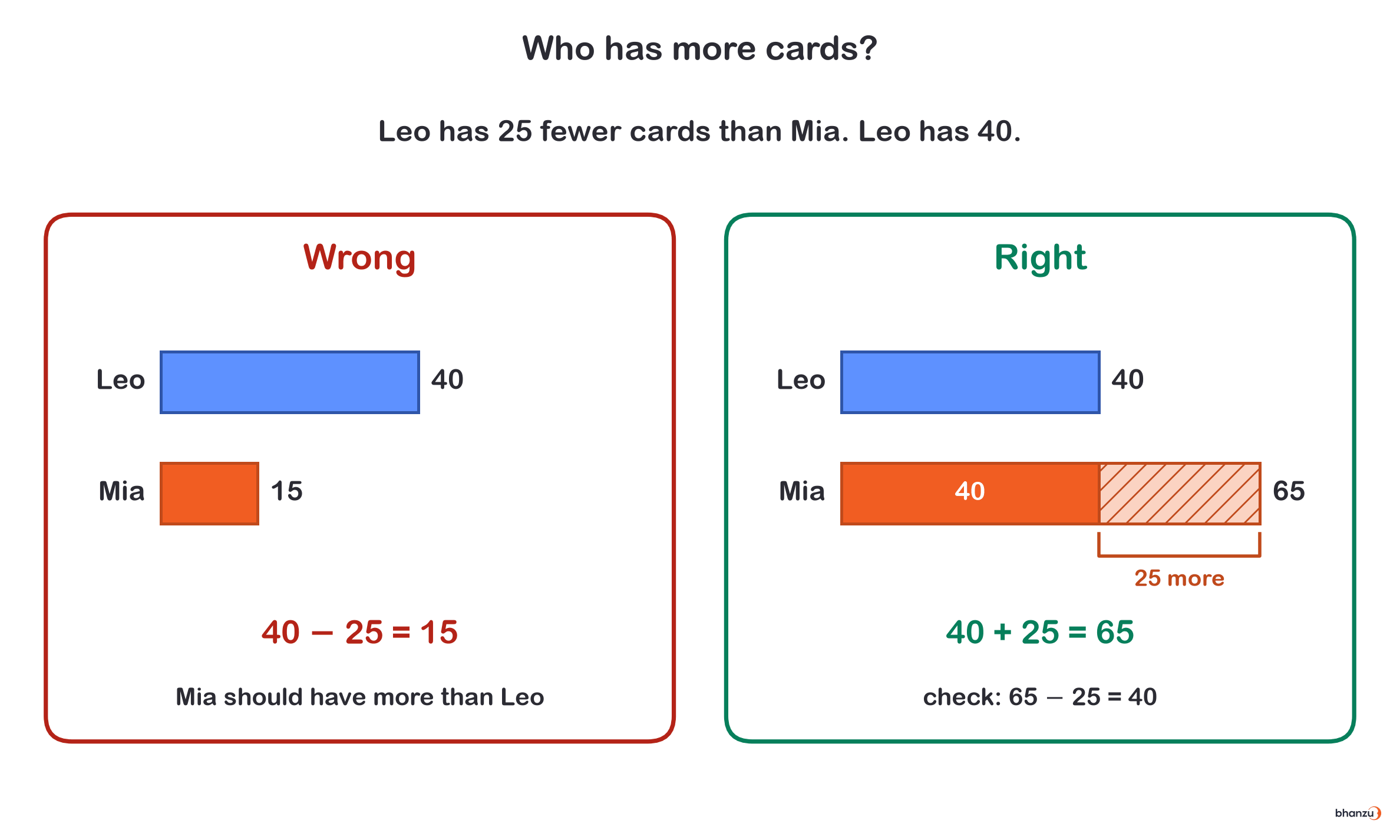
Mistake 2: Letting the word "fewer" pick the operation
Where it slips in: Stories like "Leo has 25 fewer cards than Mia. Leo has 40. How many does Mia have?" A child who circles clue words often subtracts before reading the whole sentence.
Don't do this: , which gives Mia fewer cards than Leo.
The correct way: Mia has more, so her number is the whole, . Add the 25 back to get .
Mistake 3: Taking the smaller digit away in each place
Where it slips in: The take-away route for , which is 72 take away 45.
Don't do this: Taking 4 tens from 7 tens and 2 ones from 5 ones to get 33. But .
The correct way: Trade 1 ten for 10 ones. Then 6 tens and 12 ones take away 4 tens and 5 ones leaves 27, and .
A child who writes 33 here usually isn't being careless. Taking 2 from 5 looks friendlier, and "small from big" feels like a rule.
What most guides miss about missing numbers
The sign in a problem tells you what happened in the story, and you still choose how to work it out. is a take-away, yet counting up from 58 is quicker (2 to 60, then 3 to 63).
In a 2012 study by Peters and colleagues, 106 children in grades 3 to 6 took away on small problems written as subtraction, such as . They added on for problems written as addition, while adults switch to whichever way fits.
One addition checks every missing number, whatever the sign.
| Problem | Missing number | Check by adding the parts |
|---|---|---|
| 48 | ||
| 25 | ||
| 27 |
Key Takeaways
- Point to the whole before choosing plus or minus.
- When finding the missing number within 100, stop at the next ten before jumping by tens.
- "Fewer" tells you who has less, so work out who has more first.
- Whatever the sign, adding the two parts shows if your answer is right.
- For more practice spotting the whole in problems like , explore Bhanzu's 2nd grade math tutor or Common Core math curriculum.
Read More
- Adding Two-Digit Numbers With Regrouping
- Two-Step Word Problems Within 100
- Finding the Unknown in Multiplication and Division Equations
- Equations With Tape and Hanger Diagrams
Research Behind This Article
- Common Core State Standards Initiative, Grade 2: Operations and Algebraic Thinking (2010). thecorestandards.org
- National Center for Education Statistics, NAEP Mathematics: National Trends and Student Skills (2025). nationsreportcard.gov
- Common Core State Standards Initiative, Common Core State Standards for Mathematics, Glossary Table 1 (2010). thecorestandards.org
- Matthews and Fuchs, Keys to the Gate? Equal Sign Knowledge at Second Grade Predicts Fourth-Grade Algebra Competence (2020). eric.ed.gov
- Peters, De Smedt, Torbeyns, Ghesquiere and Verschaffel, Children's Use of Subtraction by Addition on Large Single-Digit Subtractions (2012). eric.ed.gov
Quick Quiz: Check Yourself
Three levels, new numbers every time: a missing tens number or total, the ? anywhere in an addition or subtraction within 100, then a one-step story with beads, cards, stickers or cents.
Was this article helpful?
Your feedback helps us write better content
Frequently Asked Questions
What is a missing addend?
How do you teach missing addends to a 2nd grader?
Is it normal for a child to prefer addition to subtraction?
Is finding the missing number within 100 the same as missing numbers on a hundred chart?
How do you find the missing number in subtraction with borrowing?