Key Points
- Relating multiplication and division starts with a fact family, where 4, 7 and 28 make two times facts and two division facts.
- Division is an unknown-factor problem, so asks which number times 8 makes 32, and the answer is 4.
- Only 45 fact families hold all 162 multiplication and division facts with factors from 1 to 9, and the 9 square families have just two facts each.
Turn the sticker sheet sideways
Priya's sticker sheet has 4 rows of 7 stars, and turning it sideways gives 7 rows of 4. Not one star moved. Both ways still hold 28.
Now share it. Give each of 4 friends one row, and each gets 7 stars. Hand out 7 at a time instead, and the stars run out after 4 friends.
The same three numbers answer every question, whether you multiply or divide. In 4th grade, you'll use this link to divide much bigger numbers and check each answer by multiplying back.
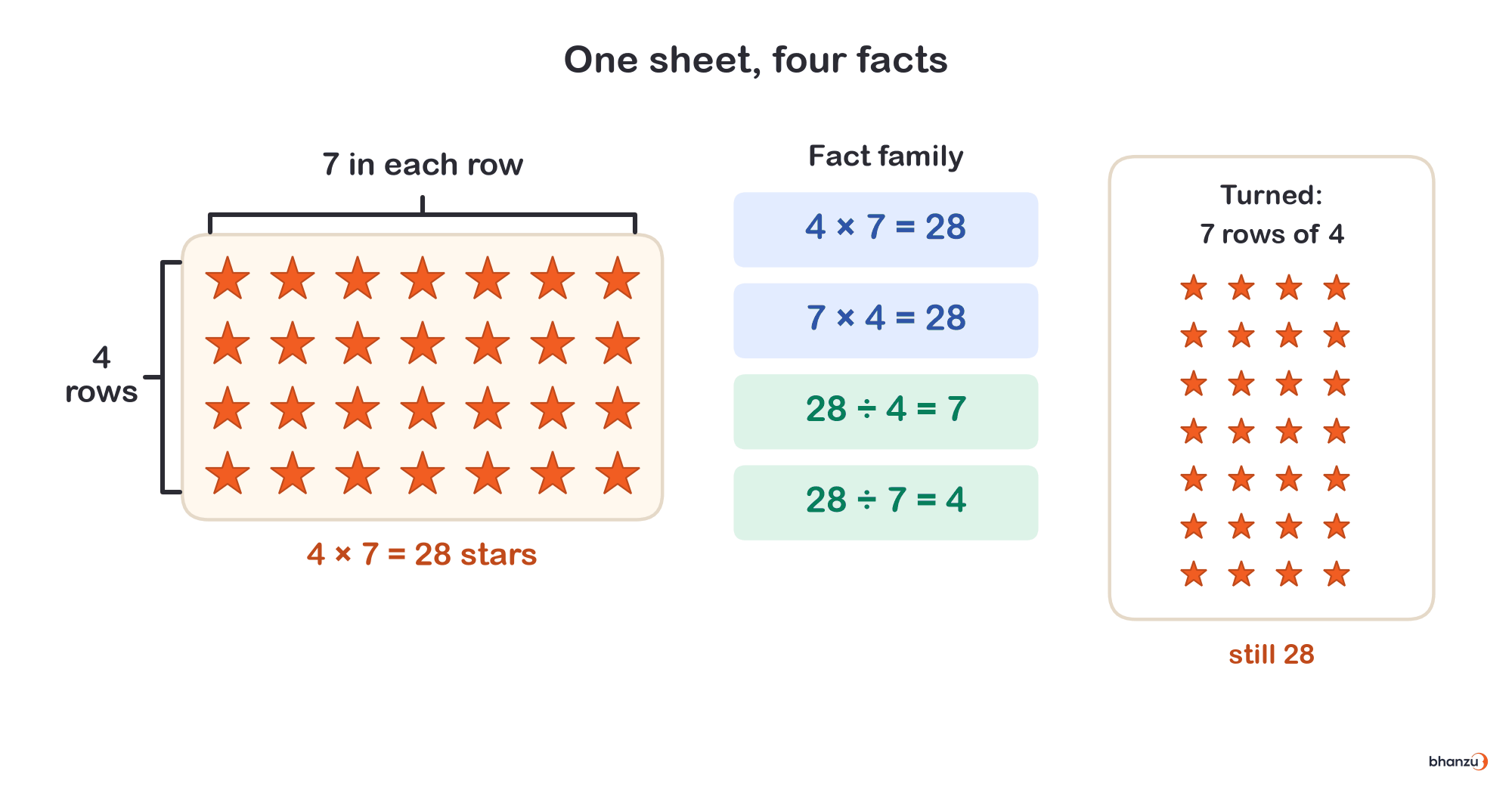
How are multiplication and division related?
Relating multiplication and division means reading a division as a times fact with one factor (a number you multiply) missing. So , because 4 rows of 7 make 28. The product, 28, is the answer to .
In , the dividend, divisor and quotient are 28, 4 and 7. You share the dividend, divide by the divisor and get the quotient.
Multiplication and division are inverse operations, which means one undoes the other. A fact family is the set of related facts you can write with the same three numbers. Priya's sheet is an array (objects in equal rows and columns).
Common Core standard 3.OA.B.6 asks 3rd graders to "understand division as an unknown-factor problem," which is this exact move. The next standard, 3.OA.C.7, expects your child to "know from memory all products of two one-digit numbers" by the end of the year. In the 2024 Nation's Report Card, 39% of US fourth graders scored at or above NAEP Proficient, a level NAEP illustrates with understanding how the four operations relate.
Writing all four facts from one array
Every multiplication and division fact family can be read off one array in four steps.
- Count the rows and the stars in each row, 4 rows of 7 for 28 stars.
- Write the times fact both ways, since a turned sheet holds the same stars.
- Write the two division facts, starting each with the product, 28.
- Check that every fact uses only 4, 7 and 28.
Grown-ups call step 2 the commutative property, but children need not use that name yet. It's the same idea as fact families with addition and subtraction from 1st grade, with times and divide in place of plus and minus.
When both factors match, as in 5, 5 and 25, you get a square family with just two facts.
How can you use multiplication to divide?
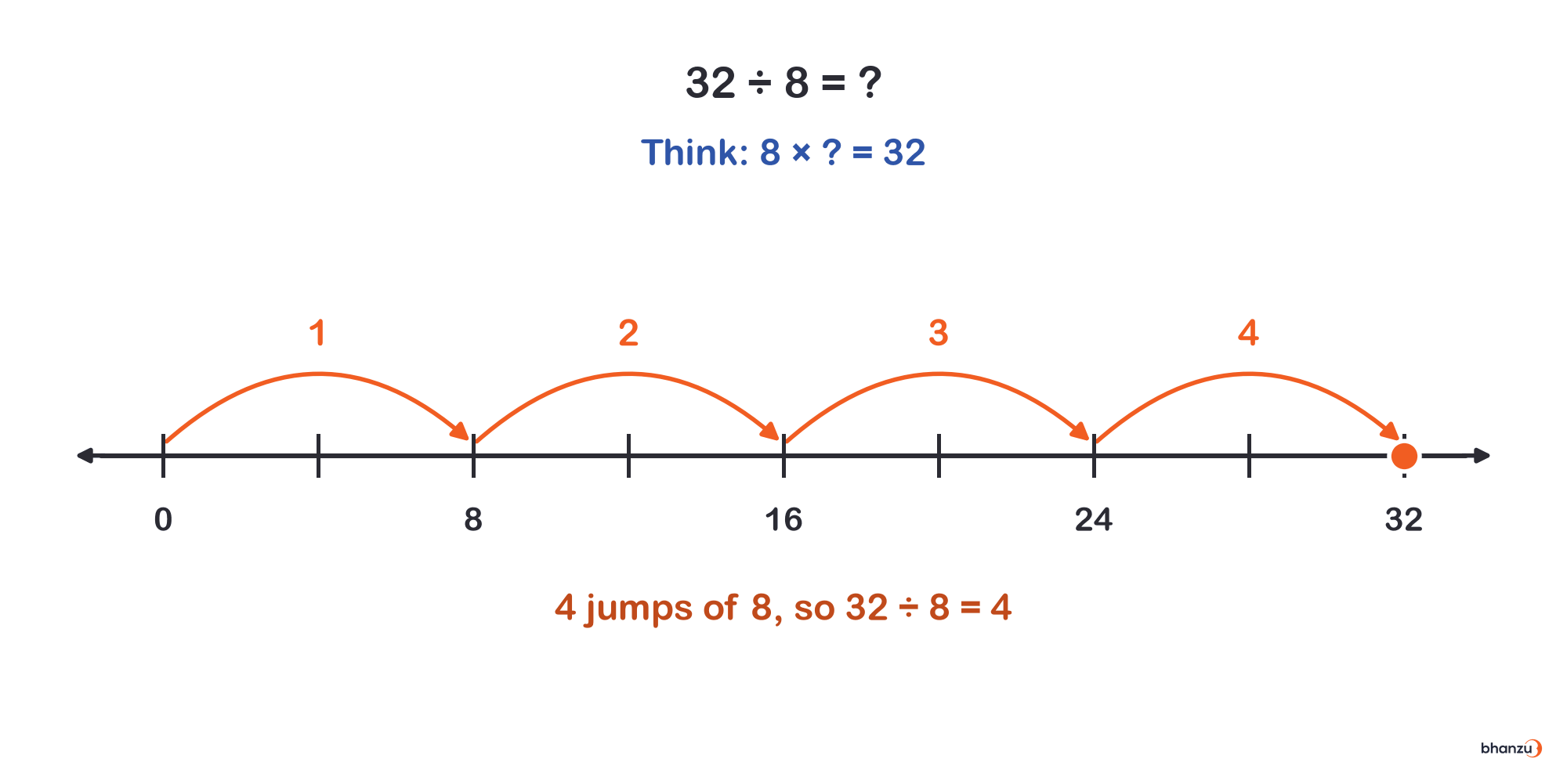
To divide, turn the division into a times fact with a box. The box stands for the missing factor, the number you don't know yet.
- Read as "8 times what makes 32?" and write .
- Skip count along the 8 times table, 8, 16, 24, 32, which is 4 jumps.
- Since , you know .
- Multiply back to check, .
A child can say in a second and still deal out 40 counters to work out (the division sign looks like a brand-new job). In a 2024 study of 253 Australian students in Years 3 to 6, some skip counted to multiply but counted by ones to divide.
Three patterns rebuild a fact you don't know yet, and they build fluent division facts within 100.
- Turn it around. For , the fact works too, since a turned array holds the same stars.
- Step down from ten groups. For , start at and take away one 6, so the answer is 9.
- Step up from a fact you know. For , start at and add one 7, so the answer is 8.
Skip counting gets slow past about 5 jumps, and then a known fact is quicker. Dividing by 0 never works, because would need a number times 0 to make 5, and none does. The box can also sit in other spots, as in finding the unknown in multiplication and division equations.
Which question does each division fact answer?
On Priya's sheet of 4 rows of 7, tells how many are in each group, and tells how many groups there are. Share 28 stars into 4 rows and each row gets 7, which is . Make groups of 7 and you get 4 groups, which is .
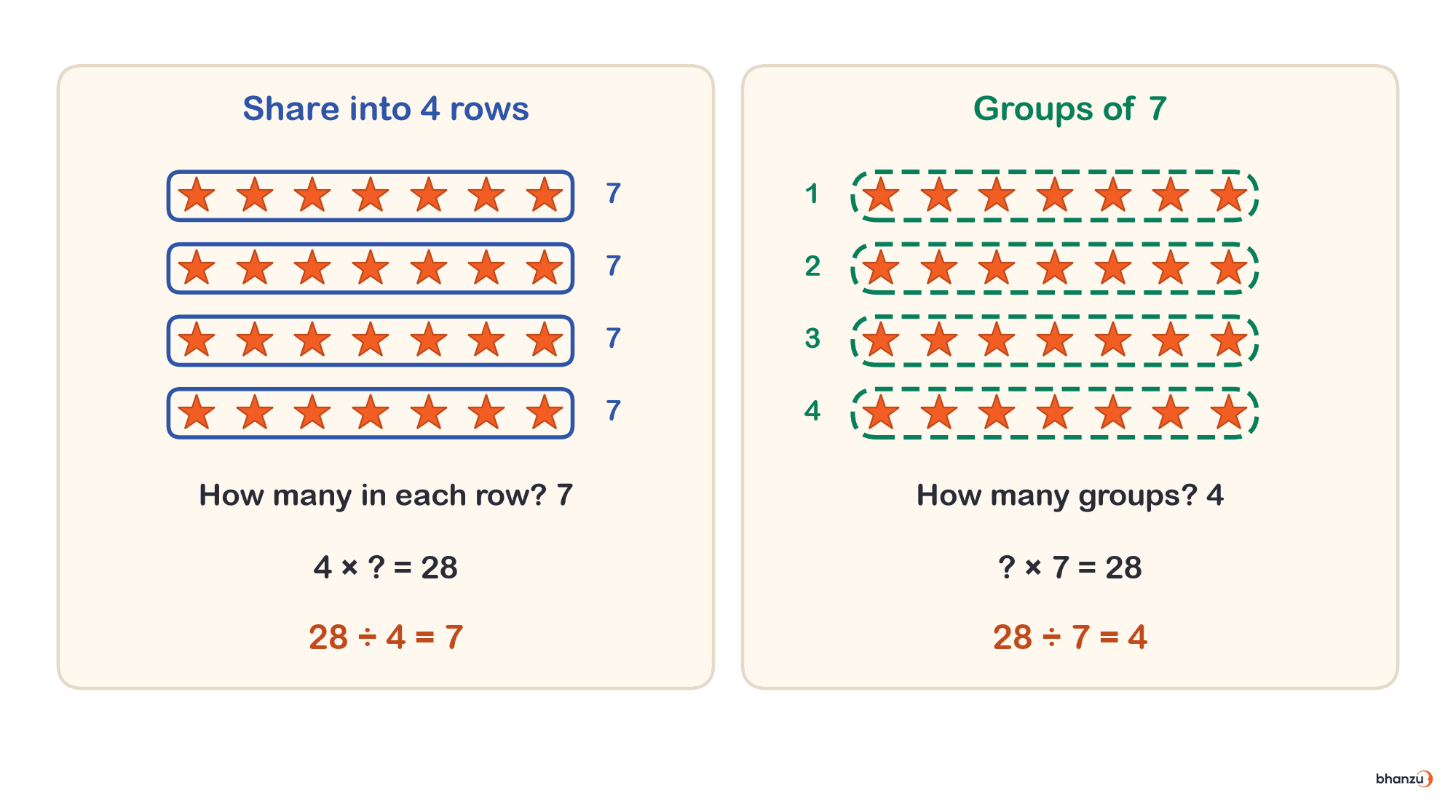
Common Core's math glossary lists both kinds of division, and story words show which one you have.
| Words in the problem | Math it means |
|---|---|
| 3 rows of 5 stars | |
| packs 63 crayons, 9 to a box | how many groups, |
| shares 63 crayons equally into 7 cups | how many in each, |
| sheets cost $9 each, spends $81 |
Longer equal-groups stories come up in multiplication and division word problems.
Try It Yourself
Drag the orange corner of the star sheet, or use the arrow keys, and watch the fact family change. Press Share into rows or Count the groups to see which question each division fact answers. Then tap Hide a number for instant feedback, or build a square sheet to find a two-fact family.
Examples of relating multiplication and division
Example 1
A sticker sheet has 3 rows of 5 stars. Write its fact family.
3 rows of 5 make 15.
The division facts start with 15.
Example 2
Find with a times fact, then finish its family.
Think and skip count by 9 (9, 18, 27, 36, 45). That is 5 jumps.
So , and the family also holds these facts.
Example 3
Find .
The tempting move treats the 4 like a missing part and subtracts it.
That cannot be right. 4 groups of 32 would be far more than 36, since 4 groups of 30 alone make 120.
Think instead. From , one 4 less is 36.
So . Multiply back to check, .
Example 4
A fact family has the numbers 8 and 48, with 48 as the product. Find the missing factor and all four facts.
Think . From , one more 8 makes 48.
The missing factor is 6.
Example 5
Mei packs 63 crayons 9 to a box. Diego shares 63 crayons equally into 7 cups. Which fact answers both, and what are the answers?
Mei needs the number of groups, . Diego needs the number in each group, .
From , one 7 less is 63.
That one fact answers both. Mei fills boxes, and each of Diego's cups holds crayons.
Example 6
Sticker sheets cost $9 each. Sam spends $81 on sheets and shares them equally with 2 friends. How many sheets does each of the 3 get?
The number of sheets is the missing factor in . From , one 9 less is 81.
Sam buys 9 sheets, and sharing them equally among the 3 people means .
Each person gets 3 sheets. Multiply back to check, and .
The real reason fact families exist
Fact families exist because division is the same equal-groups picture with a different number hidden. Once you see that, every division points back to a times fact.
- It turns a new sign into an old question. becomes "8 times what makes 72?", which the 8s facts already answer.
- It comes with a built-in check. After , multiplying lands back on 72.
- It speeds up something children already do. In a 2025 study of 94 children aged 5 and 6, 84 shared 12 candies equally into 3 jars before any division lessons. Only 5 used a number fact to do it.
Sharing fairly is one big reason division exists. A 3rd grader who thinks multiplication can split 72 stickers among 8 friends without dealing out a single one.
Common errors when working with fact families
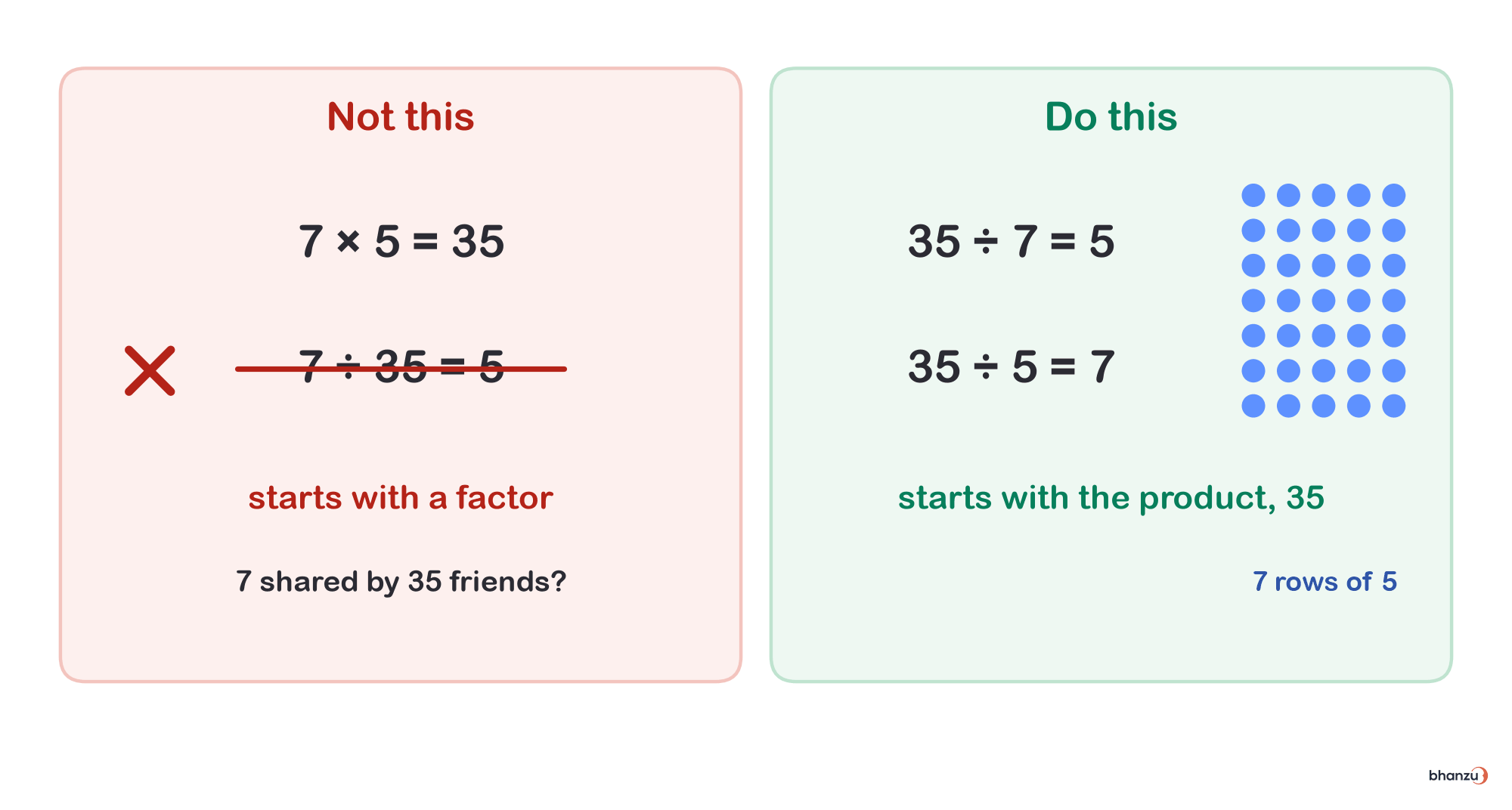
Mistake 1: Starting a division fact with a factor
Where it slips in: Right after writing .
Don't do this: Copy the line and change only the sign, .
The correct way: Start with the product, so and .
A child who rushes copies the times fact and swaps only the sign, since order never mattered in multiplication. But 7 stickers shared by 35 friends gives each less than one.
Mistake 2: Letting an addition fact into the family
Where it slips in: Small numbers that also make an adding set, such as 3, 4 and 7.
Don't do this: Write , or slip into the family for 3, 4 and 12.
The correct way: Multiply first. , so the family uses 3, 4 and 12, while 3, 4 and 7 make an addition family.
In 1st grade, "fact family" meant adding and subtracting. Now the same name covers a new pair of operations.
Mistake 3: Hunting for four facts in a square family
Where it slips in: Families whose two factors match, such as 7, 7 and 49.
Don't do this: Write twice and twice to fill four lines.
The correct way: Write the two different facts, and , and stop.
Worksheets don't agree here, which is genuinely confusing. Some draw four lines and repeat both facts, so a child with the right answer of two keeps second-guessing it.
The pattern hiding inside fact families
All 162 multiplication and division facts with factors from 1 to 9 fit into just 45 fact families. Zero stays out (dividing by 0 has no answer).
Each of the 81 times facts has one division partner. Of the 45 families, 36 hold four facts and 9 square families hold two.
So one family learned covers up to four facts. Only the nine square families, up to , have two. A chart promising four facts in every family sends a careful child hunting for facts that aren't there.
In 5th grade, the same link returns when a fraction turns out to be a division.
Key Takeaways
- Relating multiplication and division gets easier once you read a division aloud as a times question with a box.
- A division fact starts with the product, so is right and is not.
- Before calling three numbers a multiplication family, multiply the two smaller ones and check you land on the biggest.
- For practice turning dealt-out counters into times facts, explore Bhanzu's 3rd grade math tutor or math programs for elementary students.
Read More
- Estimating Sums and Differences
- Associative Property of Multiplication
- Fractions as Division
- How to Do Long Division
- Tables from 1 to 20
Research Behind This Article
- Common Core State Standards Initiative, Grade 3: Operations and Algebraic Thinking (2010). thecorestandards.org
- National Center for Education Statistics, NAEP Mathematics: National Trends and Student Skills (2025). nationsreportcard.gov
- OpenStax, Marecek and others, Prealgebra 2e, 1.5 Divide Whole Numbers (2020). openstax.org
- Bao and Stephens, An Analysis of Multiplicative Thinking Development in Years 3 to 6 (2024). eric.ed.gov
- Common Core State Standards Initiative, Mathematics Glossary, Table 2: Common Multiplication and Division Situations (2010). thecorestandards.org
- Cheeseman, Downton and Driscoll, Partitive Division: The Numbers Matter to Young Children (2025). eric.ed.gov
Quick Quiz: Check Yourself
Three levels, new numbers every time: finish a fact family, divide or find a missing factor, then solve packing, sharing and money stories.
Was this article helpful?
Your feedback helps us write better content
Frequently Asked Questions
What is a related fact in math?
Is division the opposite of multiplication?
What is a fact family house?
Is division hard for 3rd graders?
How can I teach division to my 3rd grader at home?