Key Points
- Multiplicative comparison treats one amount as a number of copies of another, so says 28 is 4 times as many as 7, and also 7 times as many as 4.
- A comparison bar model draws the starting amount once and the other amount as copies. Multiplying finds the bigger amount, and dividing finds the starting amount or the times number.
- A frequent mistake is adding, which turns 4 times as many as 9 into 13 instead of 36, the total of 4 copies of 9.
Eleven Earths across one Jupiter
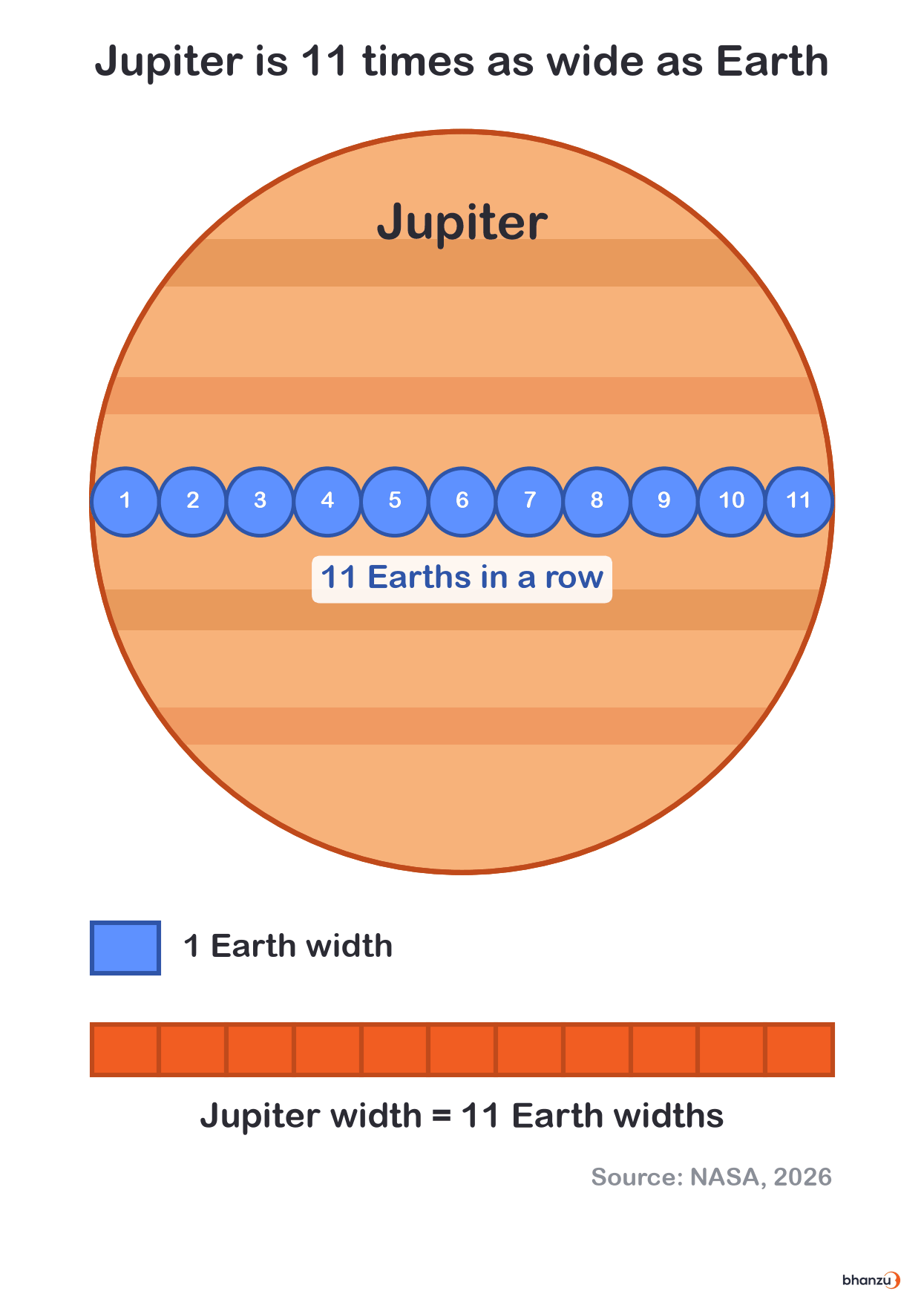
Line up 11 Earths side by side, and they would stretch across Jupiter. NASA's Jupiter facts page, updated in October 2026, says Jupiter is 11 times wider than Earth. If Earth were the size of a grape, Jupiter would be about as big as a basketball.
That fact counts Earth widths instead of extra miles, and a "how many times" sentence like that is a multiplicative comparison.
Next year, in 5th grade, the same idea grows into scaling, where multiplying by a fraction can even make a number smaller.
What is multiplicative comparison?
Multiplicative comparison describes one amount as equal copies of another amount, so "28 is 4 times as many as 7" means 4 copies of 7 make 28. A comparison bar model (also called a tape diagram) shows this with one bar of 7 and a second bar built from 4 boxes, each as long as the first.
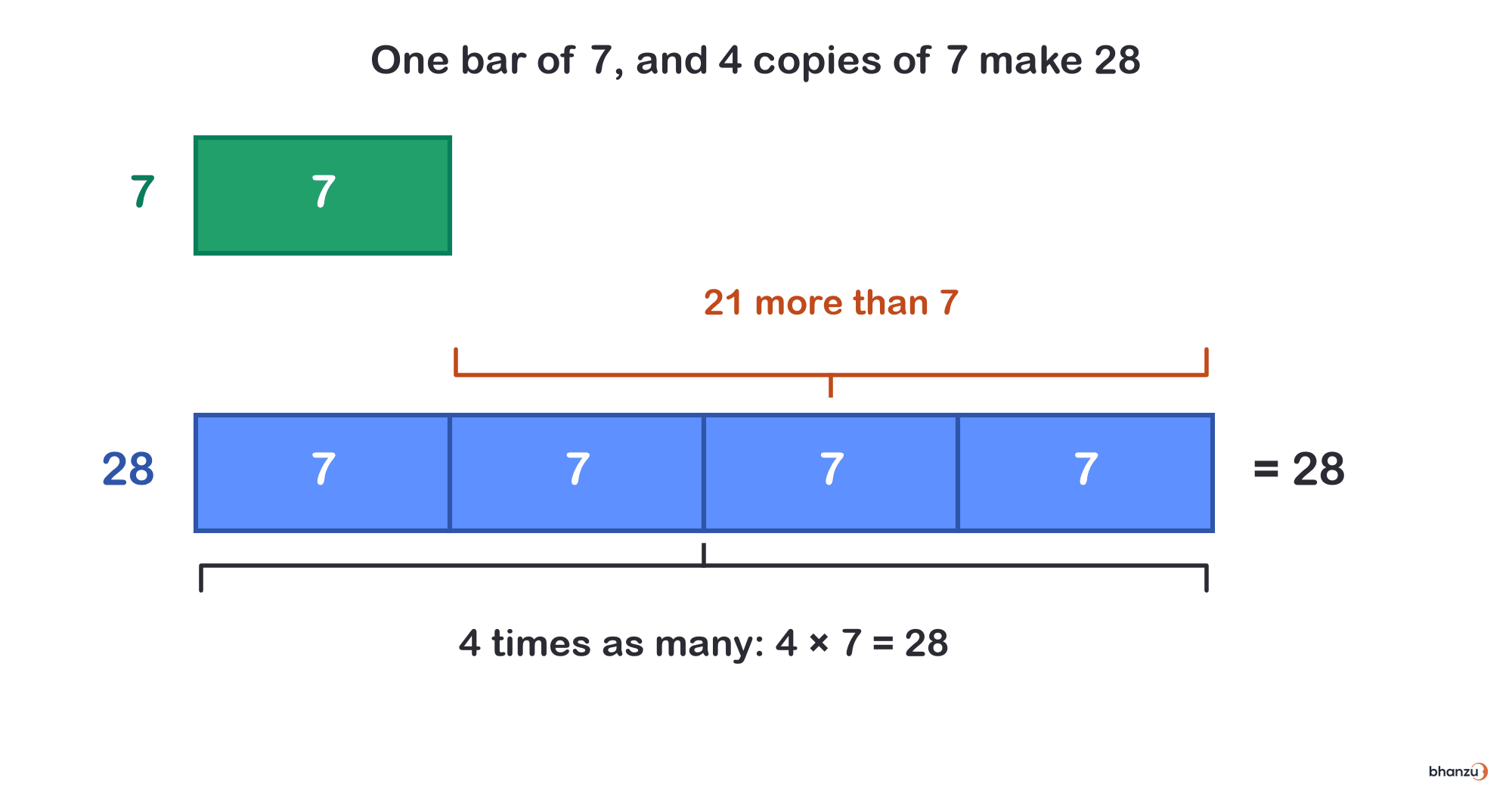
Written as an equation, the same two bars give three true sentences.
| Sentence | What the bars show |
|---|---|
| 28 is 4 times as many as 7 | 4 copies of 7 |
| 28 is 7 times as many as 4 | 7 copies of 4 |
| 28 is 21 more than 7 | 7 with 21 added on |
The first two rows work because the factors (the numbers being multiplied) can swap places and keep the same product, the answer to a multiplication. A child who learned left to right often stalls when the product comes first.
These ideas come from Common Core standards 4.OA.A.1 and 4.OA.A.2, which ask students to read multiplication as a comparison and to solve comparison word problems. By the end of 4th grade, your child should turn a "times as many" sentence into an equation and back, and tell it apart from a "how many more" sentence. If facts still feel shaky, these tips on how to teach multiplication help at home.
How do you solve multiplicative comparison word problems?
Start with the one-bar amount, the amount right after "times as many as," because every equation is built from it. The times number, or multiplier, says how many copies make the other amount.
- Find the one-bar amount.
- Draw it once, then draw the other amount as equal copies.
- Put a letter on the unknown. A variable is a letter that stands for a number you don't know yet.
- Multiply if the bigger amount is unknown. Divide if the one-bar amount or the times number is unknown.
- Check by multiplying the times number by the one-bar amount.
What does 3 times as many mean? It means 3 copies of the one-bar amount, much like the equal-groups word problems of 3rd grade, so with 8 as the one bar, 3 times as many is .
Common Core lists exactly three compare problems. With as the bigger amount, the starting (one-bar) amount and the times number, one number set covers all three.
| You know | You want | Equation | Solve |
|---|---|---|---|
| 8 and "3 times as many" | Bigger amount, | Multiply, | |
| 24 and "3 times as many" | One-bar amount, | Divide 24 by 3, | |
| 24 and 8 | Times number, | Divide 24 by 8, |
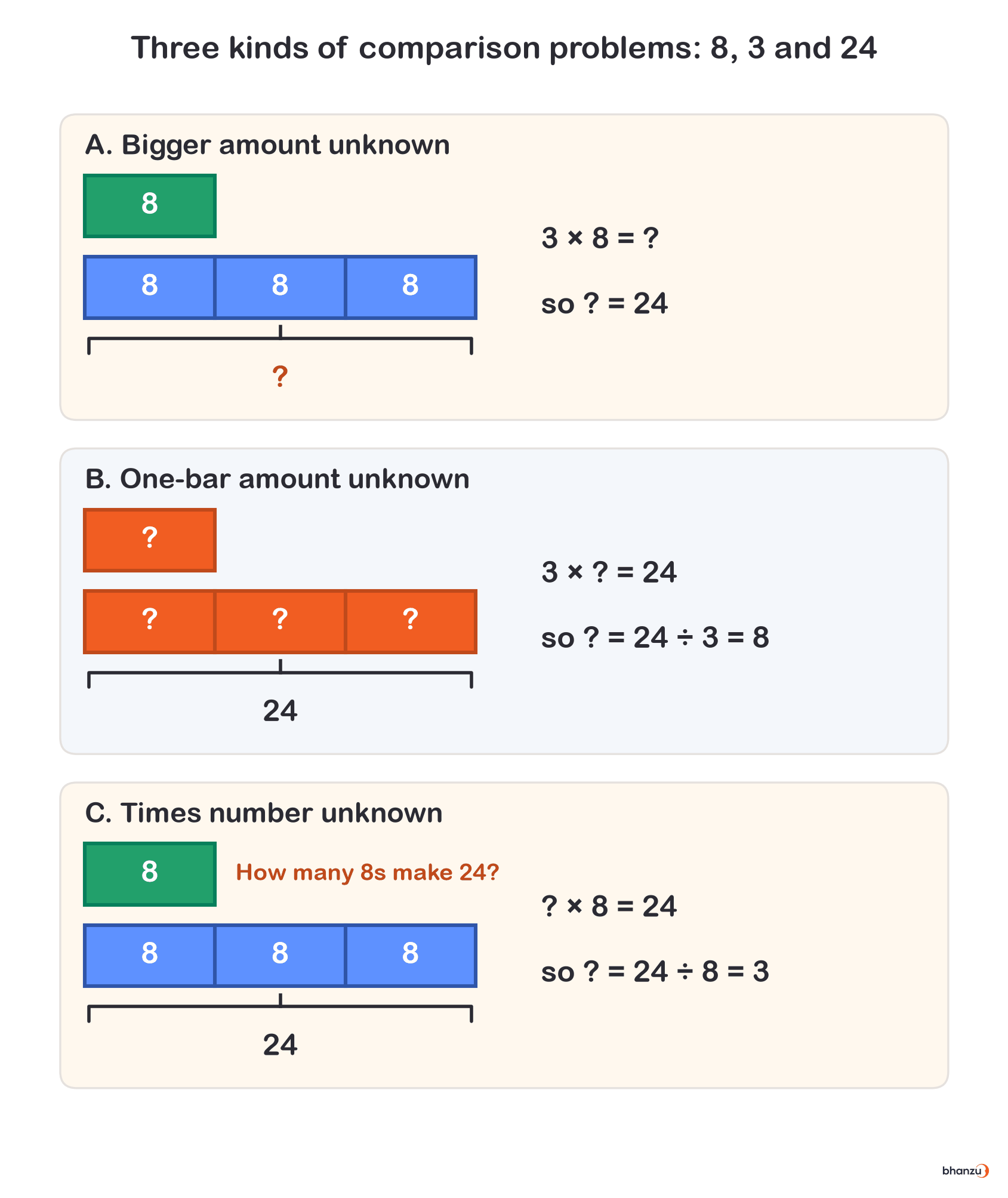
Dividing works because and belong to one fact family, so dividing by 3 undoes multiplying by 3. A child who draws the copies correctly but writes the total under the short bar has only swapped the labels.
Drawing every copy gets slow past about 10 copies or with big amounts, as in 4 times as many as 125. Draw one bar for 125 and a long bar marked "4 copies," or go straight to multiplying by a 1-digit number. A number line with equal jumps of 8 works too. For parents, a 2012 What Works Clearinghouse practice guide for grades 4 to 8 rated teaching visual representations such as strip diagrams as backed by strong evidence.
How is multiplicative comparison different from additive comparison?
Additive comparison asks how many more or fewer and uses addition or subtraction, while multiplicative comparison asks how many times as many and uses multiplication or division. Take 30 and 6. 30 is 24 more than 6, and 30 is also 5 times as many as 6.
In 2nd grade, finding how much longer one ribbon was than another was an additive comparison. The words in a problem show which kind you have.
| Words in the problem | Math it means |
|---|---|
| Priya read 6 times as many pages as Noah's 8 | |
| The dog's 45 pounds is 5 times as much as the cat | |
| How many times as much is $56 as $8? | |
| How much taller is 54 inches than 9 inches? |
A problem can ask for both, one after the other. If a class collects 6 cans on Monday and 3 times as many on Saturday, Saturday has 18 cans, which is more.
Try It Yourself
Drag the orange handle, or press the arrow keys, to stretch the blue bar into 1 to 10 copies of the green bar. The minus and plus buttons set the green bar from 2 to 12. Watch the readout write the times sentence, the equation and the "how many more" difference as the two comparisons pull apart.
Examples of multiplicative comparison
Example 1
Write two "times as many" sentences for .
42 is 6 times as many as 7.
42 is 7 times as many as 6.
Both work because also makes 42.
Example 2
Aisha's dog weighs 45 pounds. That is 5 times as much as her cat weighs. How much does the cat weigh?
The tempting move is to multiply.
That makes the cat 225 pounds, heavier than the 45-pound dog, which cannot be right because the dog is the heavier pet.
The cat comes right after "as much as," so it is the one bar. Let be the cat's weight in pounds.
Divide 45 by 5, which undoes multiplying by 5.
The cat weighs 9 pounds, and confirms it.
Example 3
Noah read 8 pages. Priya read 6 times as many pages as Noah. How many pages did Priya read?
Let be Priya's pages, with Noah's 8 as the one bar.
Priya read 48 pages.
Example 4
Leo saved $56. Mei saved $8. How many times as much money did Leo save as Mei?
Mei's $8 is the one bar. Let be the times number.
Divide 56 by 8, which undoes multiplying by 8.
Leo saved 7 times as much as Mei.
Example 5
A sunflower is 54 inches tall, and a tulip is 9 inches tall. Write one additive and one multiplicative comparison.
Subtract to find how much taller.
The sunflower is 45 inches taller than the tulip.
Divide to find how many times as tall.
The sunflower is 6 times as tall as the tulip.
Example 6
A farm stand sold 125 ears of corn on Monday and 4 times as many on Saturday. How many more ears did it sell on Saturday than on Monday?
Monday's 125 ears is the one bar. Let be Saturday's ears.
Subtract Monday's 125 from Saturday's 500 to find how many more.
The stand sold 375 more ears on Saturday. Four copies is 3 copies more than one, and agrees.
The real reason multiplicative comparison exists
A multiplicative comparison keeps its meaning when the measuring tools change, and a "how many more" comparison does not.
- It doesn't care what you measure with. A pencil 6 paper clips long is 3 times as long as a 2-clip eraser. Measured in cubes, 12 and 4, it is still 3 times as long, while the difference jumps from 4 clips to 8 cubes.
- It shows how big a gap really is. A $6 pen costs $4 more than a $2 pen, and that is 3 times as much. A $204 bike also costs $4 more than a $200 bike, yet those bikes cost almost the same.
- It handles sizes too big to count. NASA's Sun facts page, updated in September 2026, says the Sun is about 100 times wider than Earth and about 10 times wider than Jupiter. Ten Jupiter widths would be about 110 Earth widths, close to that rounded 100.
Copies stay copies whatever the unit. In 6th grade, that same idea comes back as ratios.
What are the most common mistakes with multiplicative comparison?
Mistake 1: Adding the two numbers
Where it slips in: Bigger-amount problems that say "times as many," such as Example 3. Years of "more than" problems taught children to combine the numbers they see, so adding feels natural.
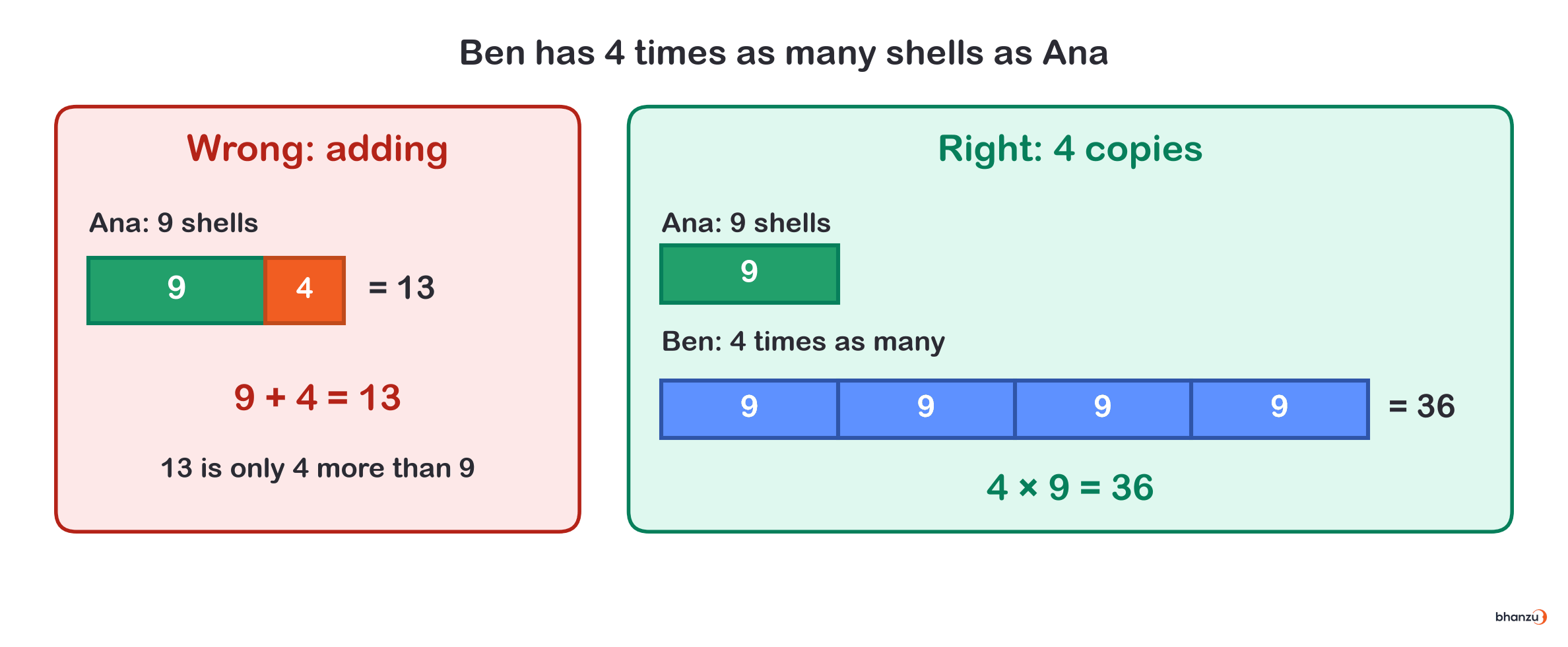
Don't do this: Ana has 9 shells and Ben has 4 times as many, so Ben has shells.
The correct way: Ben has 4 copies of 9, so shells. The 13 only means 4 more than 9.
Mistake 2: Subtracting when the question asks how many times
Where it slips in: Times-number problems like Example 4. For years, "how many" questions were "how many more" questions, so a child who starts solving before reading to the end subtracts.
Don't do this: Diego has 40 stickers and Sam has 8, so Diego has times as many.
The correct way: With as the times number, , so divide 40 by 8 to get . The 32 counts how many more, which answers a different question.
The pattern hiding inside multiplicative comparison
When the times number is a whole number, the amount right after "times as many as" is the one bar, whether it is given, like Noah's 8 pages, or unknown, like the cat's weight.
- It holds whatever the question asks for: the bigger amount, the one bar or the times number.
- "Half as many as" flips it, because then the amount after "as" is the bigger one.
- It runs both ways. NASA's Moon facts page (updated in February 2026) says the Moon is less than a third of the width of Earth, so Earth is more than 3 times as wide as the Moon.
Does "times more than" mean the same as "times as many as"? NASA writes "11 times wider than Earth" to mean 11 times as wide. Even grown-ups argue about whether "3 times more than 5" means 15 or 20, and neither side is being silly. Common Core problems use "times as many as" and "times as much as," which have only one meaning.
Key Takeaways
- Find the amount after "times as many as" first, since every multiplicative comparison equation starts from that one bar.
- Multiply only when the bigger amount is missing, and divide when it is already given.
- Check whether the question asks "how many times" or "how many more," because 54 and 9 answer both (6 and 45).
- A multiplicative comparison stays the same in paper clips or in cubes, while a difference changes with the unit.
- When your child wants more problems that turn "times as many" sentences into bars, explore Bhanzu's 4th grade math tutor or the Common Core math curriculum.
Read More
- Multi-Digit Subtraction
- Multiplying by 10, 100, and 1,000
- Multi-Step Word Problems
- Multiplication as Scaling
- What Is a Ratio
Research Behind This Article
- NASA Science, Jupiter Facts (2026). science.nasa.gov
- NGA Center and CCSSO, Grade 4 Operations and Algebraic Thinking (2010). thecorestandards.org
- NGA Center and CCSSO, Table 2, Common Multiplication and Division Situations (2010). thecorestandards.org
- Woodward, J. and others, What Works Clearinghouse, Improving Mathematical Problem Solving in Grades 4 Through 8 (2012). ies.ed.gov
- NASA Science, Sun: Facts (2026). science.nasa.gov
- NASA Science, Moon Facts (2026). science.nasa.gov
Quick Quiz: Check Yourself
Three levels, new numbers every time: find the bigger amount or read an equation as a comparison, then find the starting amount or the times number, then solve a two-step problem.
Was this article helpful?
Your feedback helps us write better content
Frequently Asked Questions
What is a multiplicative comparison statement?
How many times more is 120 than 30?
What goes on a multiplicative comparison anchor chart?
Is 4th grade math hard?
How can I help my child with math word problems?