Key Points
- The equal sign means "is the same as," so an equation is true only when its two sides have the same value.
- To check true or false equations, work out each side on its own, then compare the two values.
- A common mix-up reads the equal sign as "the answer comes next," which makes look backwards.
The balance that tells the truth
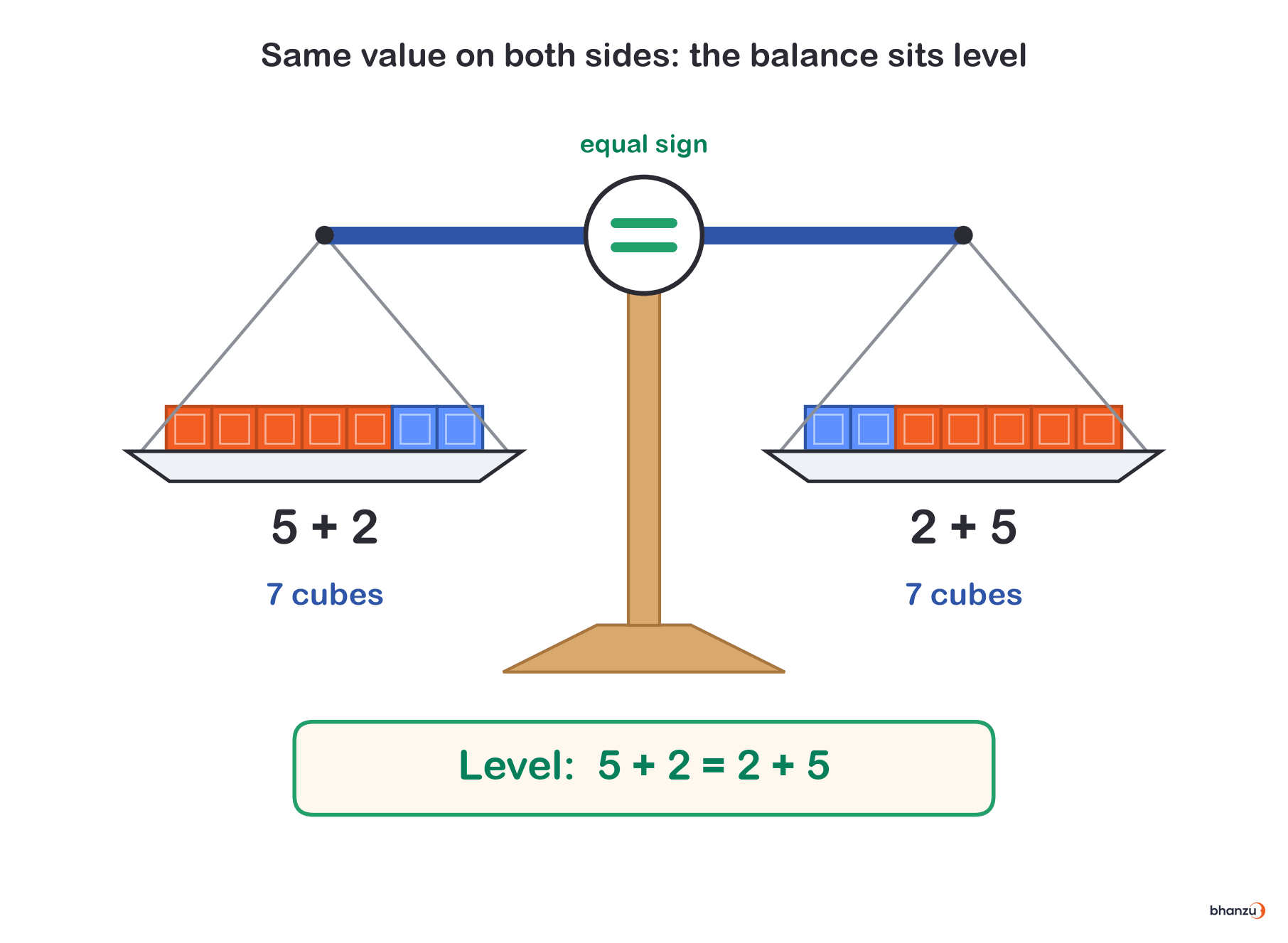
Put 7 cubes on each tray of a pan balance, and the trays sit level. A pan balance is a scale with two trays, and the heavier tray sinks.
Now try something sneaky. Put 5 orange and 2 blue cubes on one tray, then 2 blue and 5 orange on the other. The trays still sit level, because each holds 7.
The equal sign is the middle of that balance. Next, it helps you find missing numbers, and in a few grades, solve equations.
What does the equal sign mean?
In true or false equations, the equal sign claims "is the same as," so you check if both sides really have the same value. An equation is a number sentence with an equal sign in it.
Cubes come before symbols. Put 7 cubes on one tray and 8 on the other, then take 1 off the 8 (now both trays hold 7). This equation records what happened.
This is Common Core standard 1.OA.D.7. In 1st grade, your child works with numbers within 20, and the goal is to read any equation in either direction and judge it, even with work on both sides.
How do you know if an equation is true?
An equation is true when its two sides have the same value. Four steps check it.
- Find the equal sign. Everything before it is the left side, and everything after it is the right side.
- Work out the left side.
- Work out the right side.
- Compare. Same value means true, and different values mean false.
Read the sign as "is the same as" while you check. Some children stop at the first number after the sign, so step 1 marks out the whole right side first.
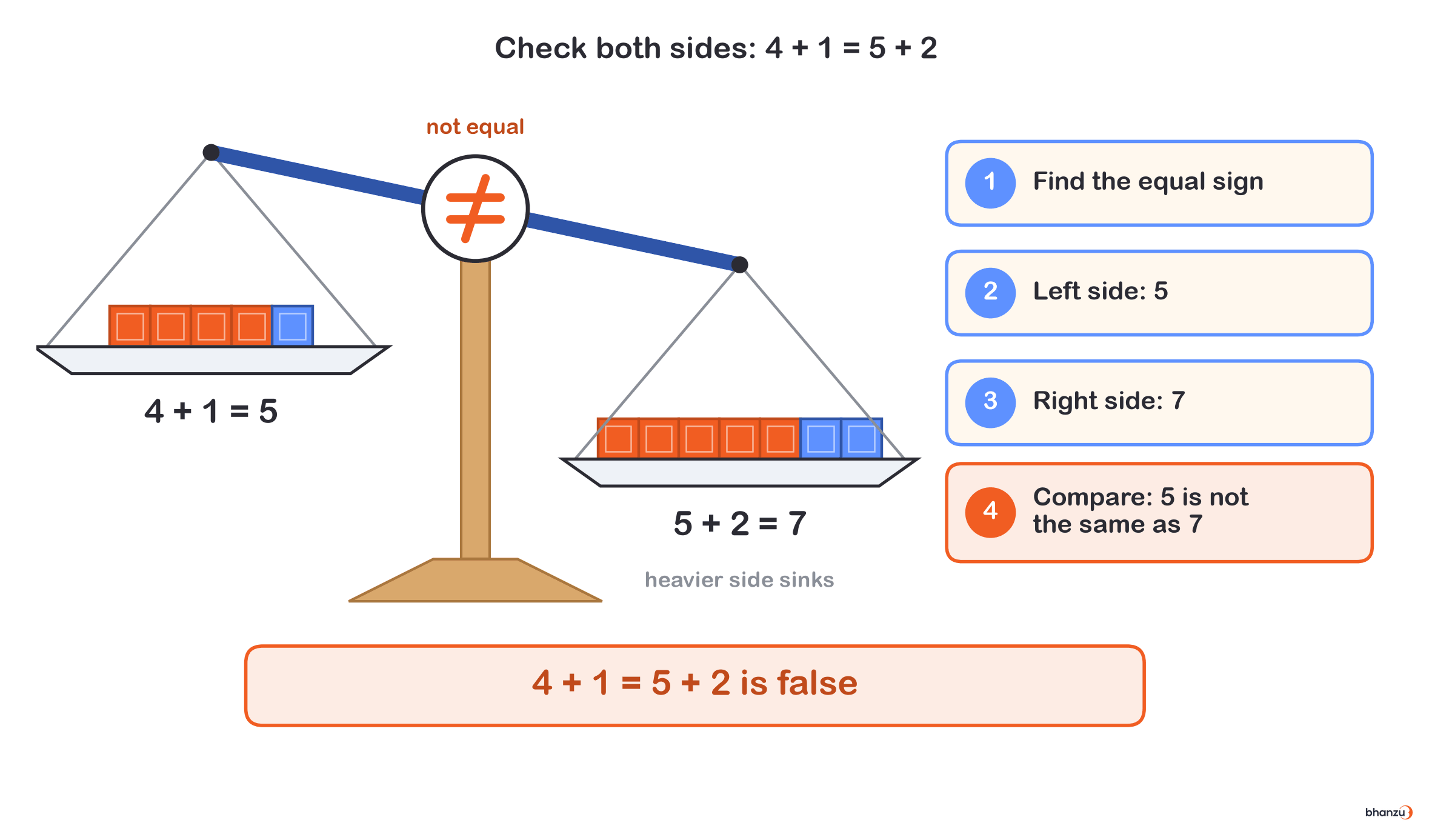
A false equation has two sides with different values, like . Swap in the not equal sign, an equal sign with a slash through it, and the statement becomes true.
When comparing two-digit numbers, the equal sign teams up with the greater than and less than signs. One distinction confuses grown-ups too, because is a false equation while marking it false is the right answer.
Story problems turn everyday words into these symbols.
| Words in the problem | Math it means |
|---|---|
| is the same as | |
| is not the same as | |
| finds 4 more | |
| spends 2 |
Which equations look wrong but are true?
Some equations look strange and are still true, because both sides match. Common Core uses these four as examples:
| Equation | What looks strange | True or false? |
|---|---|---|
| No plus or minus | True, 6 and 6 | |
| Answer first | True, 7 and 7 | |
| Work on both sides | True, 7 and 7 | |
| Looks normal | False, 5 and 7 |
Swapping the two numbers you add always gives a true equation, because adding works in any order (grown-up books call it the commutative property). That's why and share a fact family.
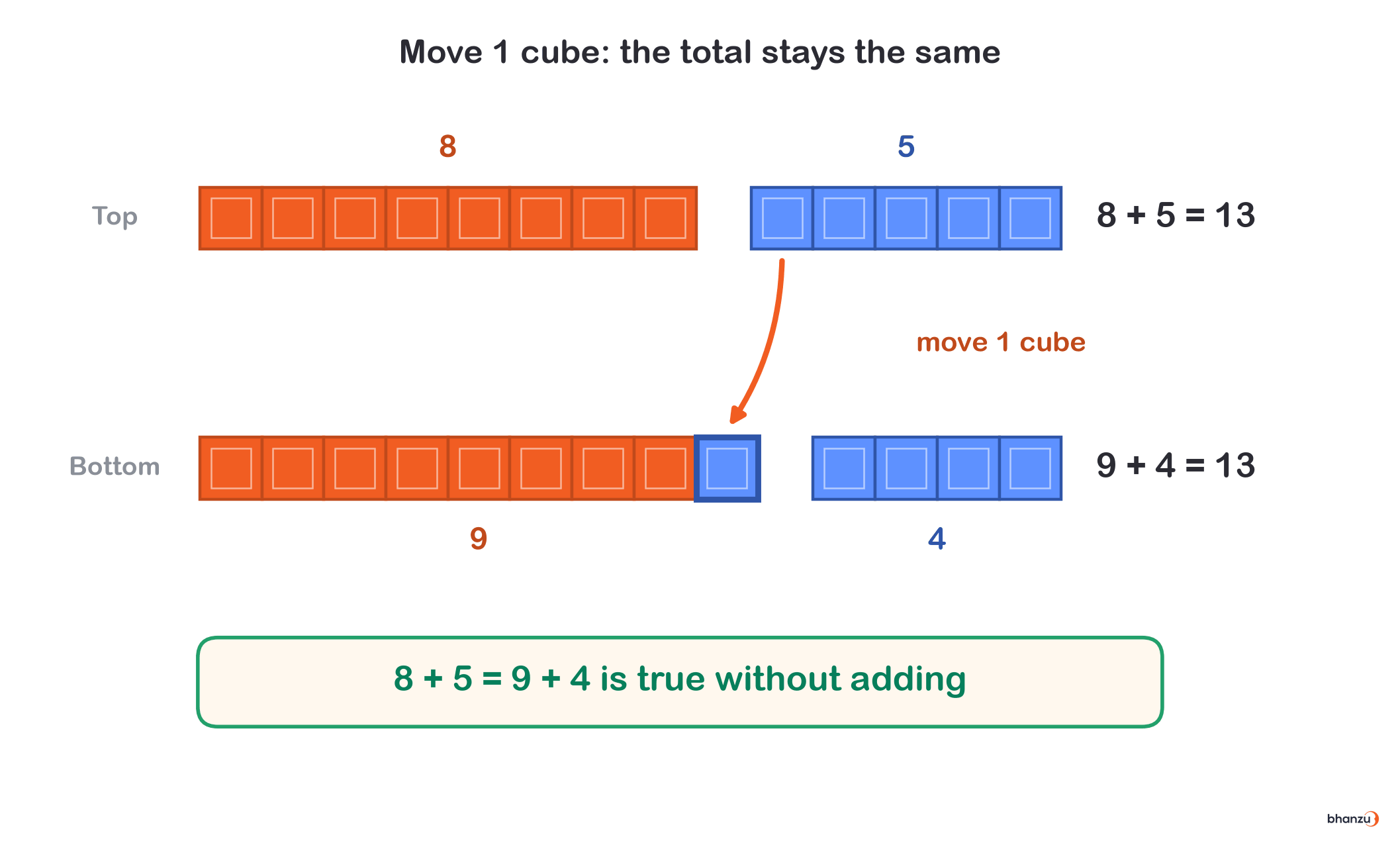
You can check this one without adding. The 9 is 1 more than the 8 and the 4 is 1 less than the 5, so one cube just moved groups. For parts that aren't close, like , work out each side.
A question mark in an equation stands for a number nobody has told you yet. To find which number makes the equation true, try each choice and keep the one that makes both sides match. Then go further with finding the missing number in an equation.
Try It Yourself
Use the plus and minus buttons to change any number, and watch the balance tip toward the heavier side. Press Hint for one move to try. Keep going until the trays sit level and the middle sign turns from not equal to equal.
Examples of true or false equations
Example 1
Is 9 = 10 - 1 true or false?
The left side is 9.
The right side, , is also 9.
Both sides match, so it's true.
Example 2
Is 4 + 3 = 7 + 2 true or false?
It's tempting to say true, because makes 7 and a 7 sits right after the equal sign.
That can't be right, because the 7 is only part of the right side.
The left side is .
The whole right side is , so the equation is false.
Example 3
Leo's tray has 9 orange and 6 blue cubes, and Aisha's has 10 orange and 5 blue. Is 9 + 6 = 10 + 5 true or false?
Leo has cubes.
Aisha also has cubes.
Both sides are 15, so it's true and the trays sit level.
Example 4
Pick the number from 7, 6 and 13 that makes 7 + 6 = ? + 7 true.
The left side is , so the right side must make 13 too.
Trying 13 gives , too big.
Trying 7 gives , which is still not 13.
Only 6 works, because .
Example 5
Mei has 9 cents and finds 4 more, while Noah has 15 cents and spends 2. Do they have the same amount?
Mei has cents.
Noah has cents.
Both sides are 13, so yes, they have the same amount.
The real reason the equal sign exists
The equal sign gives people a short way to claim two amounts match, a claim anyone can check. In 1557, the Welsh doctor and mathematician Robert Recorde printed it in his book The Whetstone of Witte. He chose two parallel lines "bicause noe 2 thynges can be moare equalle" (old spelling for "because no two things can be more equal").
- It turns a sentence into a short line. "7 is the same as 8 take away 1" becomes .
- It keeps trades fair. Trading 3 stickers plus 4 stickers for 7 stickers is fair, but trading them for 6 is not.
- It opens the door to algebra. A 2020 study by Matthews and Fuchs of 177 children found that equal sign knowledge in 2nd grade strongly predicted algebra skill in 4th grade.
Years from now, the rule that keeps a balance level grows into the properties of equality you'll use in algebra.
Why do kids get true or false equations wrong?
Mistake 1: Calling an answer-first equation backwards
Where it slips in: Equations with one number on the left, like Example 1. Almost every sum a child has met put the answer last.
Don't do this: Marking false because the answer should come last.
The correct way: Work out . Both sides are 7, so the equation is true.
Children who have only seen often call this one backwards, even when they know 3 and 4 make 7.
Mistake 2: Thinking an equation holds only one problem
Where it slips in: Equations with work on both sides, like Example 3. A page of one-problem equations makes a second problem look like a leftover.
Don't do this: Writing 10 after the equal sign in and crossing out .
The correct way: Both sides make 10, so is true.
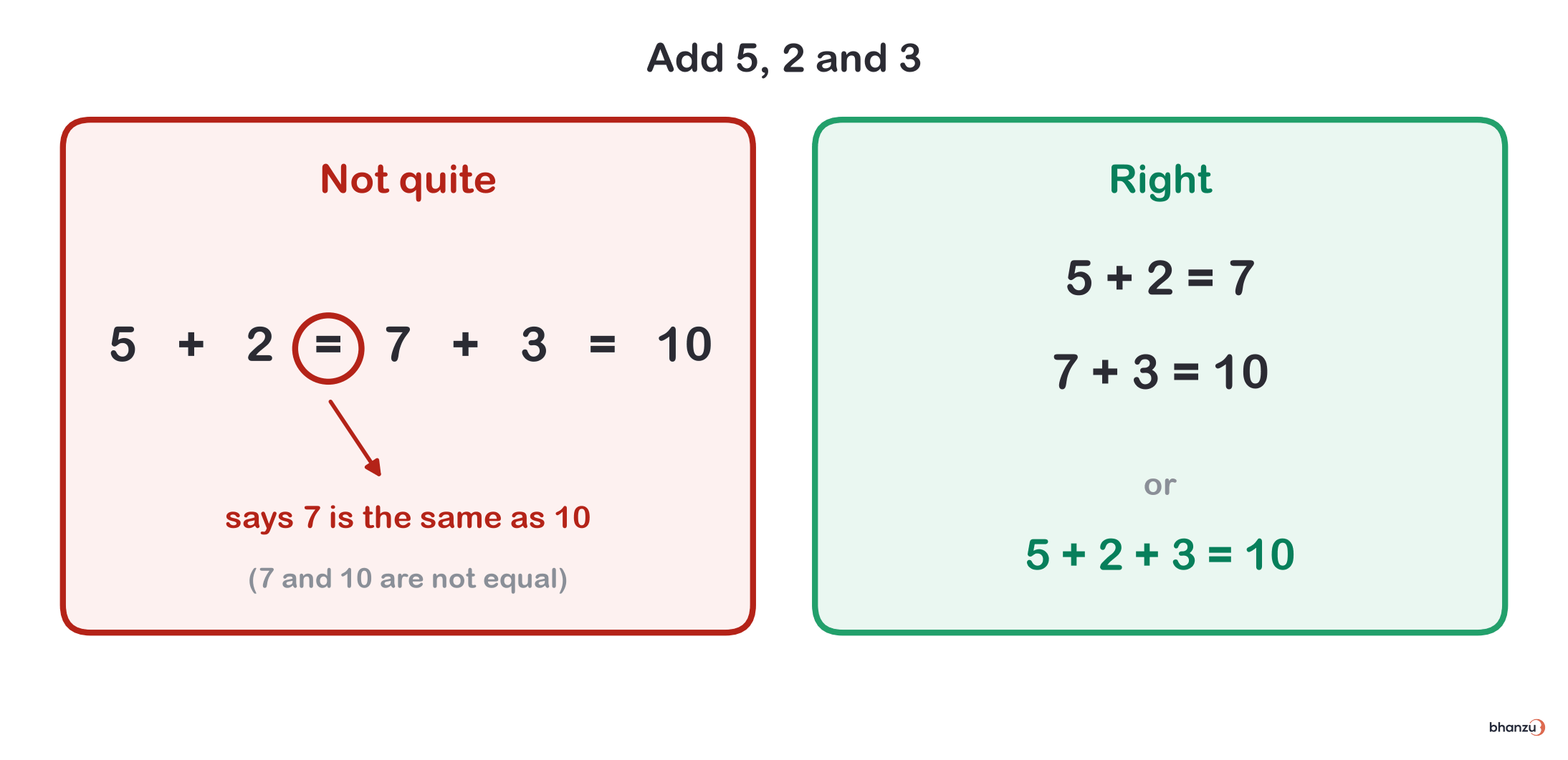
Mistake 3: Writing a running total
Where it slips in: Adding three numbers such as 5, 2 and 3, once the equal sign starts to mean "and then" to the child.
Don't do this: Writing .
The correct way: Write and then , or write .
That first equal sign claims 7 is the same as 10. Children who write the chain usually added correctly (7 and 10 are both right totals), so only the sign needs fixing.
What do most guides get wrong about the equal sign?
Most guides define the equal sign as "the same as" and move on. Yet most practice puts the answer last, as in . A calculator's = key does too.
Many children then read the sign as "the answer comes next," and the habit can last for years. A 2026 study of 277 pupils around age 11 in Northern Ireland found it still common.
| What the 277 pupils did | Share |
|---|---|
| Named the equals sign correctly | 96.4% |
| Said it means work out the answer | 49.1% |
| Called it the same value on both sides | 22.0% |
The fix is three small habits.
- Mix the shapes. Show answer-first and both-sides equations from the first week.
- Say the meaning. Read every equal sign as "is the same as."
- Ask three questions while you solve. What information is given? What steps do I need to take to get the right answer? How can I check that my answer is right?
Fyfe, Byers and Nelson tried those questions in a 2022 classroom study of 135 children, 59 of them first graders. Children taught with those questions were more accurate than children taught without them, right after the lesson and two weeks later.
Key Takeaways
- Before you mark true or false equations, work out the whole right side, not just its first number.
- An equation can start with its answer or have no plus or minus at all and still be true.
- Each equal sign makes its own claim, so split a running total into separate equations.
- For more practice catching running totals and backwards-looking equations, explore Bhanzu's 1st grade math tutor or the Common Core math curriculum.
Read More
- Adding Three Numbers
- Finding the Missing Number Within 100
- Equations With Tape and Hanger Diagrams
- Common Core Math vs Traditional Math
Research Behind This Article
- Common Core State Standards Initiative, Grade 1, Operations and Algebraic Thinking, 1.OA.D.7 (2010). thecorestandards.org
- O'Connor and Robertson, MacTutor History of Mathematics, Robert Recorde (2002). mathshistory.st-andrews.ac.uk
- Matthews and Fuchs, Keys to the Gate? Equal Sign Knowledge at Second Grade Predicts Fourth-Grade Algebra Competence, Child Development (2020). pmc.ncbi.nlm.nih.gov
- Mills, Di Lonardo Burr, Rodgers, Denvir, Wylie and Xu, Exploring how understanding of the equals sign relates to additive and multiplicative equivalence performance beyond arithmetic fluency, Journal of Experimental Child Psychology (2026). eprints.whiterose.ac.uk
- Fyfe, Byers and Nelson, The benefits of a metacognitive lesson on children's understanding of mathematical equivalence, arithmetic, and place value, Journal of Educational Psychology (2022). pmc.ncbi.nlm.nih.gov
Quick Quiz: Check Yourself
Three levels, new numbers every time: judge answer-first and answer-last equations, judge work on both sides, then find missing numbers or judge cents stories.
Was this article helpful?
Your feedback helps us write better content
Frequently Asked Questions
How do you teach the equal sign to kids?
Is it equal sign or equals sign?
Are true or false equations taught in 1st grade?
Where does the "answer comes next" habit come from, and how can I help?
Why was the equal sign so humble?