Key Points
- Multi-step word problems in 4th grade link two or more operations, so a first answer, such as 4 classes of 32 campers making 128, feeds the next step.
- Each step of a multi-step problem gets an equation with a letter for the unknown, such as , and a rounded estimate checks the size of the final answer.
- A remainder needs a decision, since 140 people in vans of 8 gives 17 R 4, and 17 vans would leave 4 people behind, so the trip needs 18.
The leftover that changes the answer
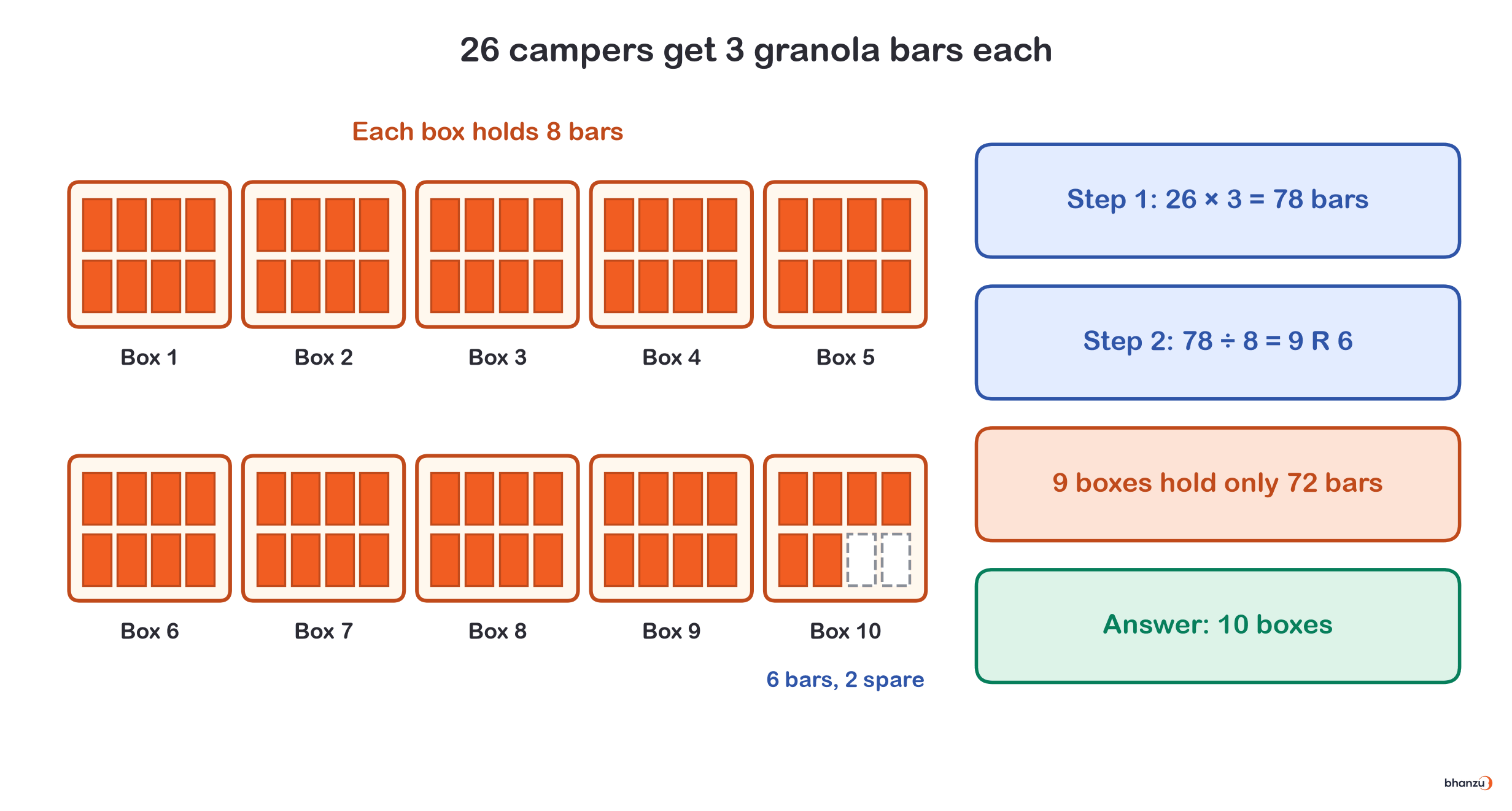
Twenty-six campers each get 3 granola bars, and bars come in boxes of 8. That's 78 bars, but 9 boxes hold only 72, so the camp needs 10 boxes and 2 bars go spare.
One answer fed the next step, and the last step asked what the numbers meant for real campers. The same plan carries into stories with fractions and decimals in later grades, and it already helps the next time you shop for a party.
What are multi-step word problems?
Multi-step word problems are stories that need two or more operations (adding, subtracting, multiplying or dividing) in a row, where one step's answer becomes a number in the next. In the granola boxes, 26 campers times 3 bars is step one, and packing 78 bars into boxes of 8 is step two.
Common Core standard 4.OA.A.3 asks 4th graders to do three things with these stories.
- Solve them with whole numbers, including stories where a remainder, the amount left over after equal sharing, must be interpreted.
- Write equations with a letter standing for the unknown number.
- Judge whether an answer is reasonable with mental math and rounding.
Two-step word problems in 3rd grade stop at two operations, while 4th grade stories can run three or four steps.
Your child may need more help with planning than with arithmetic. In the 2024 Nation's Report Card, 54% of fourth graders earned full credit on a multi-step story about tickets left after two sales, even with an onscreen calculator available.
How do you solve multi-step word problems?
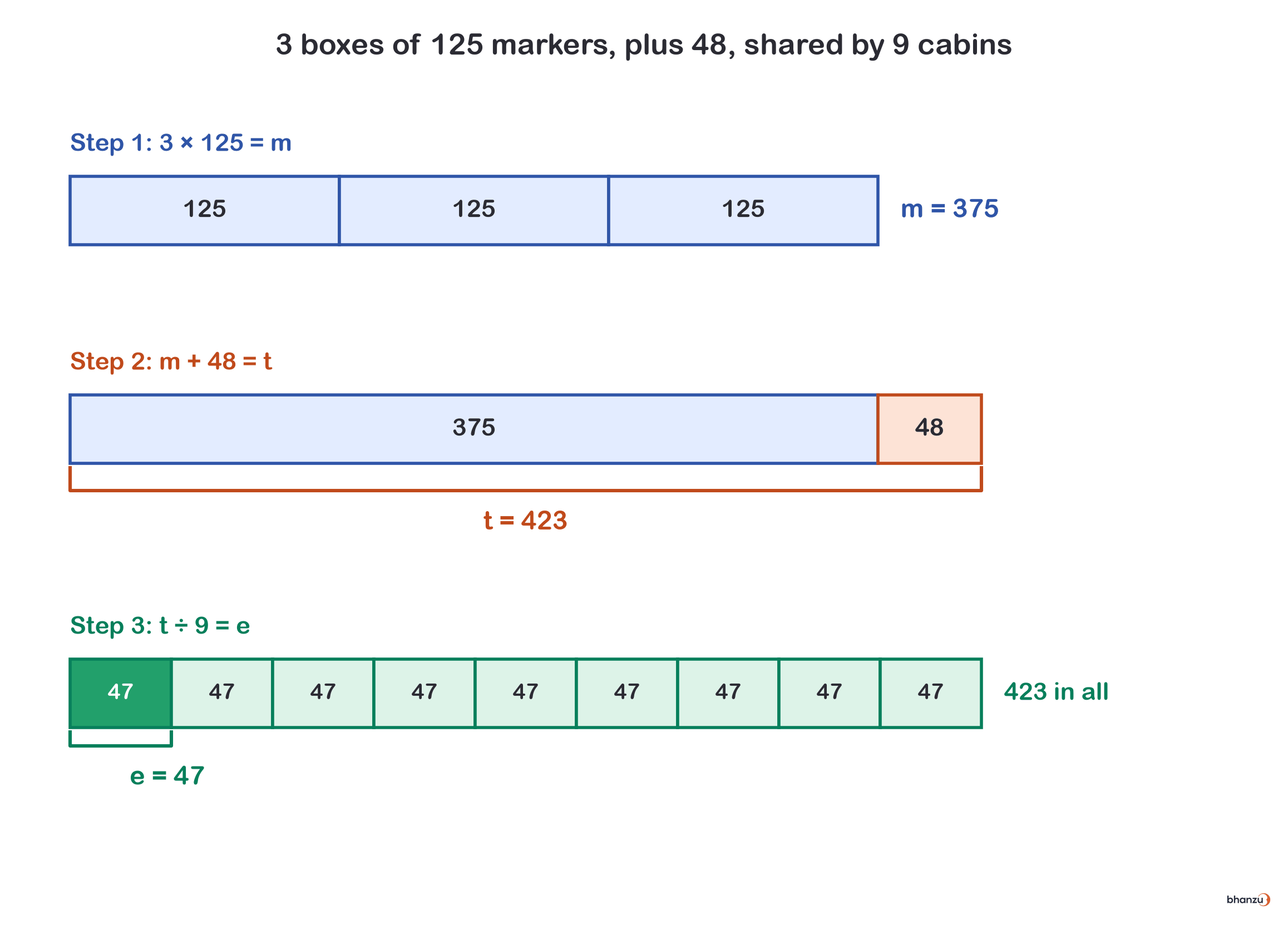
Solve one step at a time, give each unknown number a letter, and finish with the story's question. The camp buys 3 boxes of 125 markers, already has 48, and shares all the markers equally among 9 cabins.
- Say the story's question in your own words, such as markers for one cabin.
- Label each number, such as 125 markers in each box.
- Sketch a bar model, a long rectangle cut into parts that shows what each step joins or shares (some books call it a tape diagram).
- Let be the markers in the boxes and multiply, , so .
- Let be all the markers and add the 48, , so .
- Let be the markers for each cabin and share by dividing, , so .
Each cabin gets 47 markers. A child can write 375, 423 and 47 and still not know which one counts markers for one cabin, and saying each label out loud fixes that.
The whole plan fits in one equation, , because the order of operations finishes the parentheses first. A step that says "5 times as many" is a multiplicative comparison, so multiply to go up and divide to go back.
Other routines include checklists such as CUBES, clue-word lists, guess and check, and working backward. Drawing a bar for every step gets slow by four steps, and then labeled equations alone do the job.
What does interpreting remainders mean?
Interpreting remainders means deciding what the leftover from a division means for the story's question. Long division splits 75 campers into vans of 8 as , and that one division answers three questions.
| The question asks | What the remainder does | Answer |
|---|---|---|
| How many vans are needed? | Adds one more van | 10 vans |
| How many vans are full? | Gets dropped | 9 vans |
| How many campers ride in the last van? | Is the answer | 3 campers |
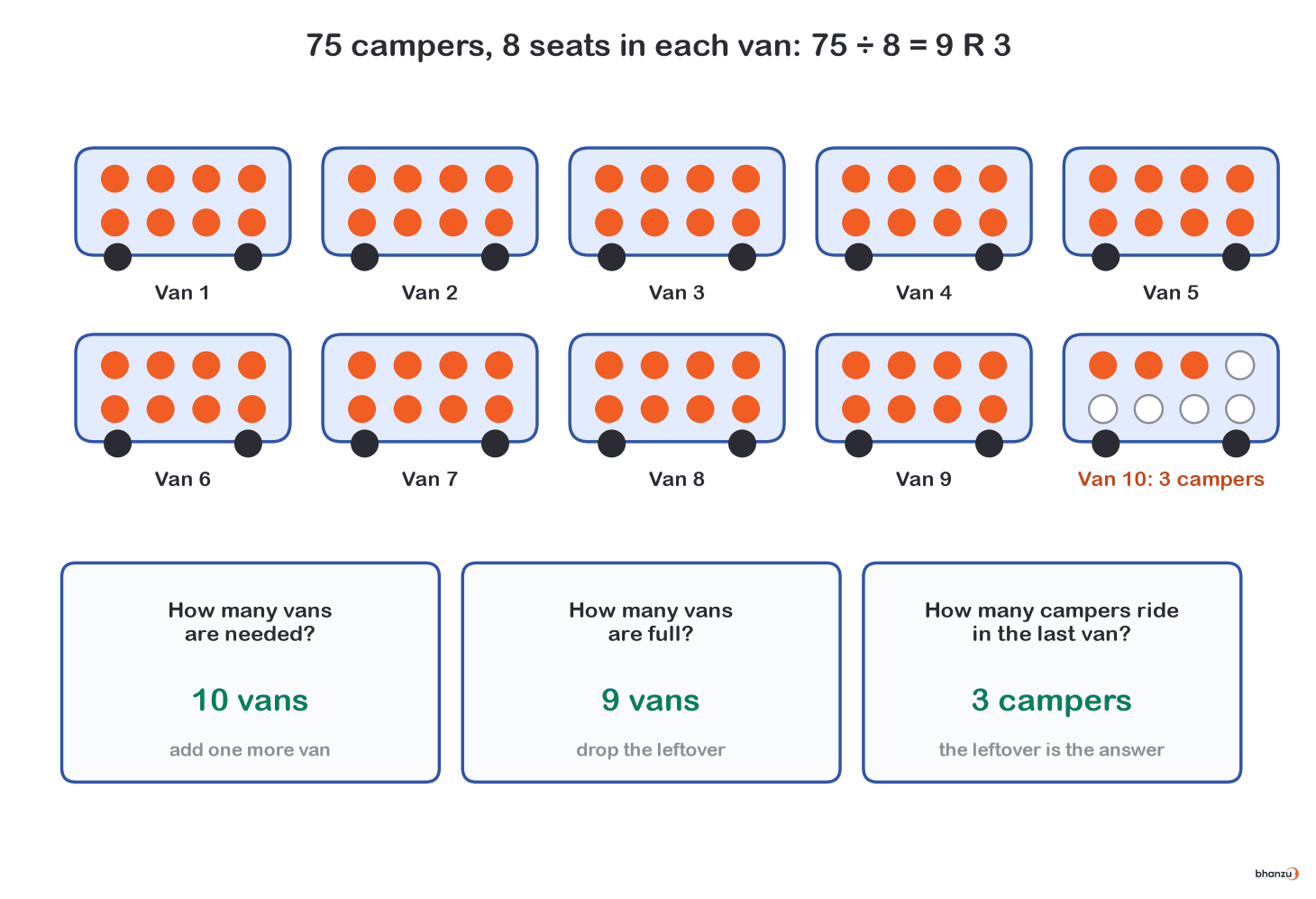
All three questions start with "How many," so the deciding words sit at the end (a detail that is easy to miss). The dividend, divisor, quotient and remainder are the number shared, the group size or number of groups, the answer and the leftover, and they always fit one check.
Deciding is the step people skip. In a 1990 study of 195 middle school students, 61% divided correctly on a bus problem, but only about 45% gave the number of buses the story needed. Later, stories with fractions can split a leftover into equal parts, but 4th grade answers stay whole numbers.
How can you check the answer to a multi-step problem?
Two checks work together: estimate with friendly numbers first, then run the steps backward with the opposite operations. For the markers, round 375 to 400 and 48 to 50.
So 47 is believable, and 470 is not. Picking numbers that divide easily is the same move used in estimating products and quotients.
An estimate misses small mistakes (46 also sits near 50), so run the steps backward too.
Landing back on 125 confirms every step. A 2012 What Works Clearinghouse guide for grades 4 to 8 found moderate evidence for teaching more than one way to solve a problem, and solving a second way gives a third check.
Try It Yourself
Pick the operation for each step of the camp story and watch the bar model grow and the counters fill each group. When a division leaves a remainder, choose what it means, then press New story for new numbers.
Examples of multi-step word problems
Example 1
The camp kitchen has 5 cases of 24 juice boxes. The campers drink 87. How many juice boxes are left?
Let be all the juice boxes. Multiply the cases by the boxes in each case, then subtract the 87 the campers drank.
There are 33 juice boxes left.
Example 2
4 classes of 32 campers and 12 adults ride vans to the lake. Each van holds 8 people. How many vans are needed?
Let be the campers and all the people. Multiply the classes by the campers in each, add the 12 adults, then divide by the 8 seats in each van.
The tempting answer is 17 vans. But 17 vans seat only people, so 4 people would stay behind.
One more van carries those 4 people, so the trip needs 18 vans.
Example 3
Diego has 4 bags of 18 leaves and glues 7 leaves on each page of his nature journal. How many pages can he fill completely?
Multiply to find the leaves, then divide by the 7 leaves on each page.
The question asks for full pages, so drop the remainder. Diego fills 10 pages, and checks it.
Example 4
The camp store shares 4 boxes of 38 glow sticks equally among 6 cabins, as many as possible for each. How many glow sticks are left over?
Multiply, then share among the cabins.
The question asks what is left, so the remainder is the answer, 2 glow sticks.
Example 5
The lake trail had 1,250 visitors in July, 5 times as many as in March. April had 87 more visitors than March. How many visitors came in April?
Let be the March visitors. July had 5 times as many, so undo the multiplying by dividing 1,250 by 5.
Let be the April visitors and add the 87 extra visitors.
April had 337 visitors.
Example 6
The camp has 1,000 name stickers and gives one to each student in 4 classes of 28 and 3 classes of 31. How many stickers are left? Solve it two ways.
Plan A, with for the stickers left, uses one equation.
Multiply inside the parentheses, add, then subtract.
Plan B takes one group of classes at a time.
Rounding 28 and 31 to 30 gives an estimate of , close to the exact 795 stickers left.
Multi-step word problems beyond the textbook
Real plans hide their steps, and the last one is usually a decision. Outside school, nobody hands you one operation at a time.
- It decides how much to buy. Five families of 4, with 2 tacos per person, need 40 shells, and 3 boxes of 12 hold only 36, so the cook buys 4 boxes.
- It catches calculator answers that don't fit. A calculator shows 17.5 for 140 divided by 8, and only the story says whether that means 18 vans or 17 full ones.
- It grows into algebra. The letters you write for each step are the start of the variables you'll use in middle school.
A calculator can do the arithmetic, but only the reader can choose the steps and decide what a leftover means.
Tripping points to avoid with multi-step word problems
Mistake 1: Stopping one step early
Where it slips in: Three-step stories, right after the longest calculation. A child who rushes treats that finished number as the finish line.
Don't do this: A store has 5 boxes of 36 pencils, sells 64, and packs the rest into bags of 4. Working out and , then answering 116 bags.
The correct way: 116 counts pencils, not bags, so one step is left, bags.
Mistake 2: Writing the remainder into the answer
Where it slips in: Stories that ask for full groups. A child who has just finished a long division often copies the whole last line, because division practice ends with "R 2" written beside the quotient.
Don't do this: 4 classes of 23 campers make relay teams of 6. Writing and , then giving 15 R 2 teams as the answer.
The correct way: The question asks for full teams, so the answer is 15 teams, and the 2 extra campers join two of them.
Mistake 3: Using every number in the story
Where it slips in: Stories with a distance, time or date the question never needs. A child who thinks every number must be used finds a job for the extra one.
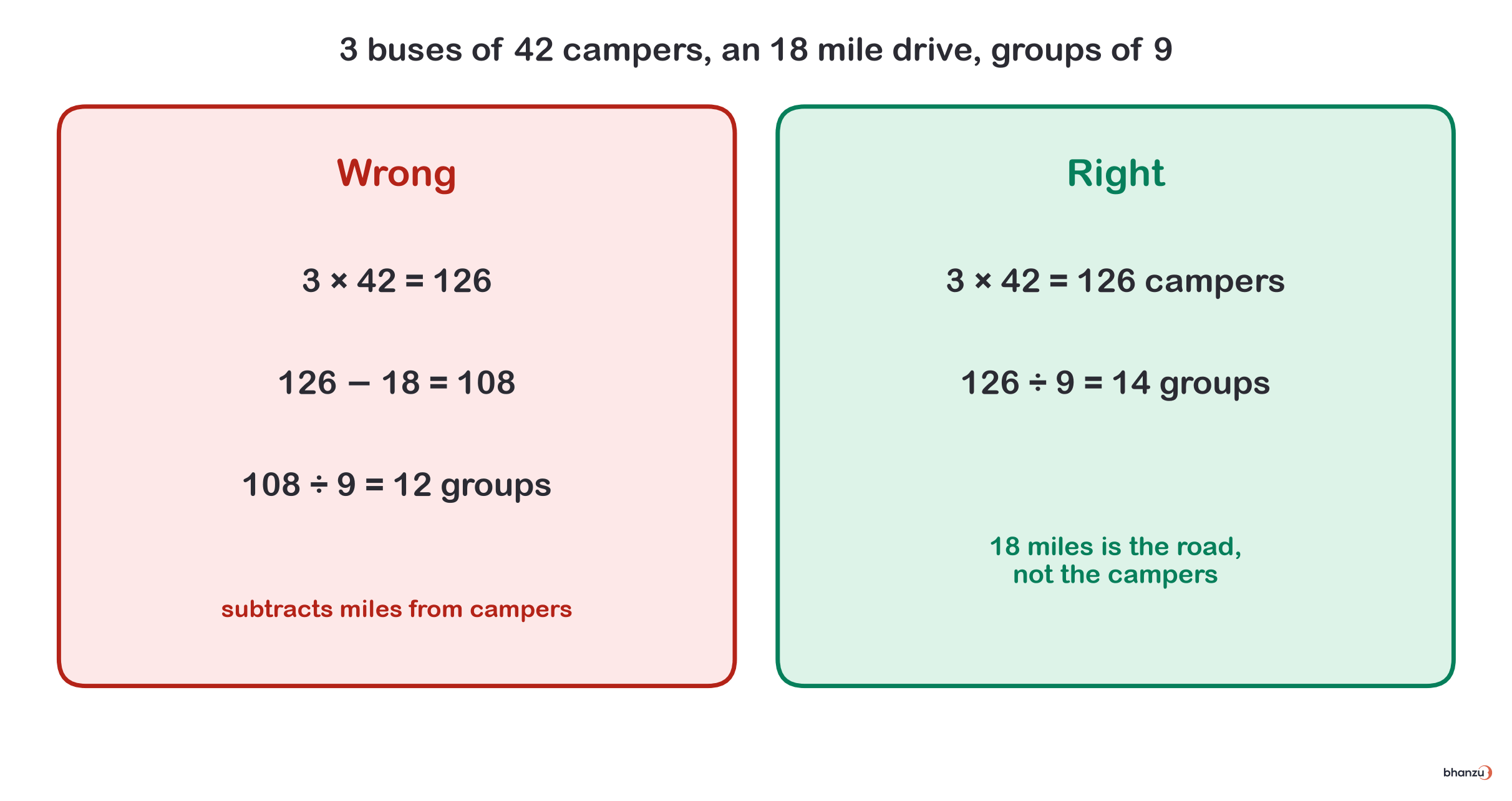
Don't do this: 3 buses carry 42 campers each, the drive is 18 miles, and the campers split into hiking groups of 9. Working out , then and groups.
The correct way: The 18 miles measures the road, not the campers, so groups.
The part of multi-step word problems nobody explains
Labels, not clue words, choose the operation. Campers divided by campers per van gives vans, and vans times seats per van gives seats.
Clue words point at actions, but one word can point two ways, since "each" multiplies in 3 bags of 8 apples each and divides when 24 apples are shared so each friend gets 8.
| Words in the problem | Math it means |
|---|---|
| 4 classes of 32 campers | multiply, |
| each van holds 8, how many vans | divide by 8, then decide on the remainder |
| 5 times as many as in March | multiply by 5, or divide by 5 to go back |
| 4 shelves left to fill, 35 books each | multiply, |
Children taught that "left" means subtract often work out when Sam has 96 books shelved and 4 shelves left to fill with 35 books each. The labels give 4 shelves of 35, or 140 books, so Sam will have books shelved.
Key Takeaways
- Say what each number counts before you choose an operation.
- After any division, reread the question to decide whether to add a group, drop the leftovers or report the remainder.
- Trust an answer to multi-step word problems when your estimate lands near it and the steps run backward.
- For more practice planning long stories and deciding what a remainder means, explore Bhanzu's 4th grade math tutor or math programs for elementary students.
Read More
- Dividing Multiples of 10, 100 and 1,000
- Multiplying by 1-Digit Numbers
- Measurement and Money Word Problems
- Fraction Addition and Subtraction Word Problems
- Math Word Problems
Research Behind This Article
- Common Core State Standards Initiative, Grade 4 Operations and Algebraic Thinking (2010). thecorestandards.org
- Common Core State Standards Initiative, Operations and Algebraic Thinking, Kindergarten to Grade 5 (2010). thecorestandards.org
- National Center for Education Statistics, NAEP Mathematics: National Trends and Student Skills, Grade 4, 2024 (2025). nationsreportcard.gov
- Edward A. Silver and colleagues, Sense-making and the Solution of Division Problems Involving Remainders (1990). eric.ed.gov
- What Works Clearinghouse, Institute of Education Sciences, Improving Mathematical Problem Solving in Grades 4 Through 8 (2012). ies.ed.gov
Quick Quiz: Check Yourself
Three levels, new numbers every time: two-step stories that multiply then add or subtract, stories with a remainder to interpret, then harder stories with times as many, four steps or an extra number to skip.
Was this article helpful?
Your feedback helps us write better content
Frequently Asked Questions
What grade are multi-step word problems taught in?
How can I help my child with multi-step problems at home?
How do you solve 2-step word problems?
What do multi-step division word problems look like in 4th grade?
Do multi-step word problems use all four operations?