Key Points
- Adding three numbers finds the total of three addends, such as , by adding one pair and then the third number.
- The quickest pair makes 10, like 8 and 2, or is a double, like 6 and 6, because adding onto 10 takes one step and doubles are often facts a child already knows.
- A frequent mistake after making a ten is using one number twice, which turns into 17 instead of 18.
Three beanbag scores and a hidden ten
Noah tossed beanbags in three rounds and scored 8, 5 and 2 points. Before adding, he looked at all three scores. He spotted that the 8 and the 2 make 10.
Then 10 and 5 more made 15, so his total took two quick steps. He never had to count all 15 points one by one. Soon you'll total game scores and prices this way in your head.
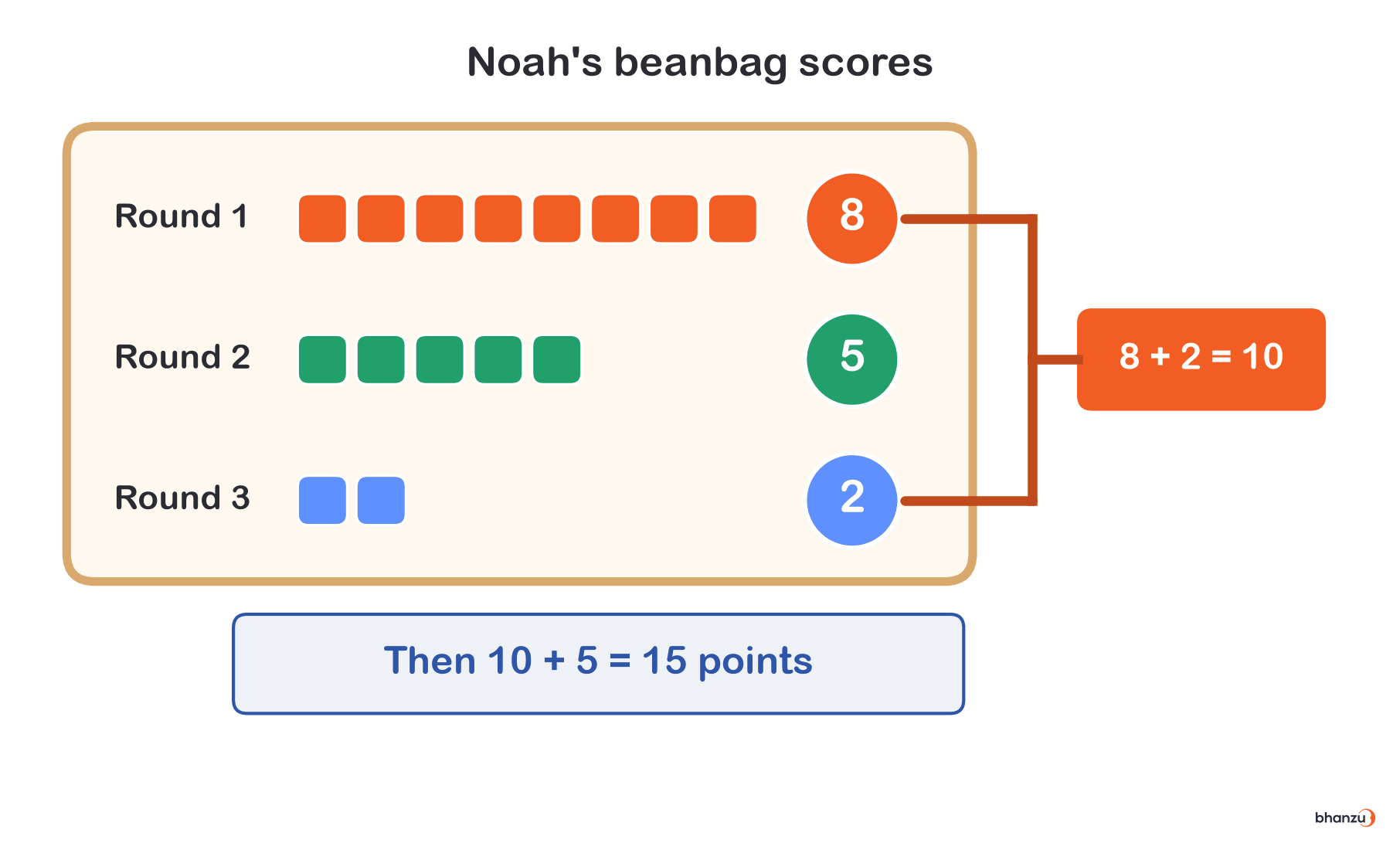
How do you add three numbers?
Adding three numbers is a two-step job of joining a pair, then adding the number that's left. Each number you add is an addend, and the total of all three is the sum.
With counters, put Noah's 8 and 2 in a ten frame, a card with 2 rows of 5 boxes that holds exactly 10. The full frame and 5 more counters make 15 (a number line works too).
- Say all three numbers.
- Pick two that are easy to add.
- Add that pair.
- Add the third number to that answer.
This skill is Common Core standard 1.OA.A.2. By the end of 1st grade, your child is expected to solve story problems with three numbers whose total is 20 or less, using objects, drawings or equations.
Which two numbers should you add first?
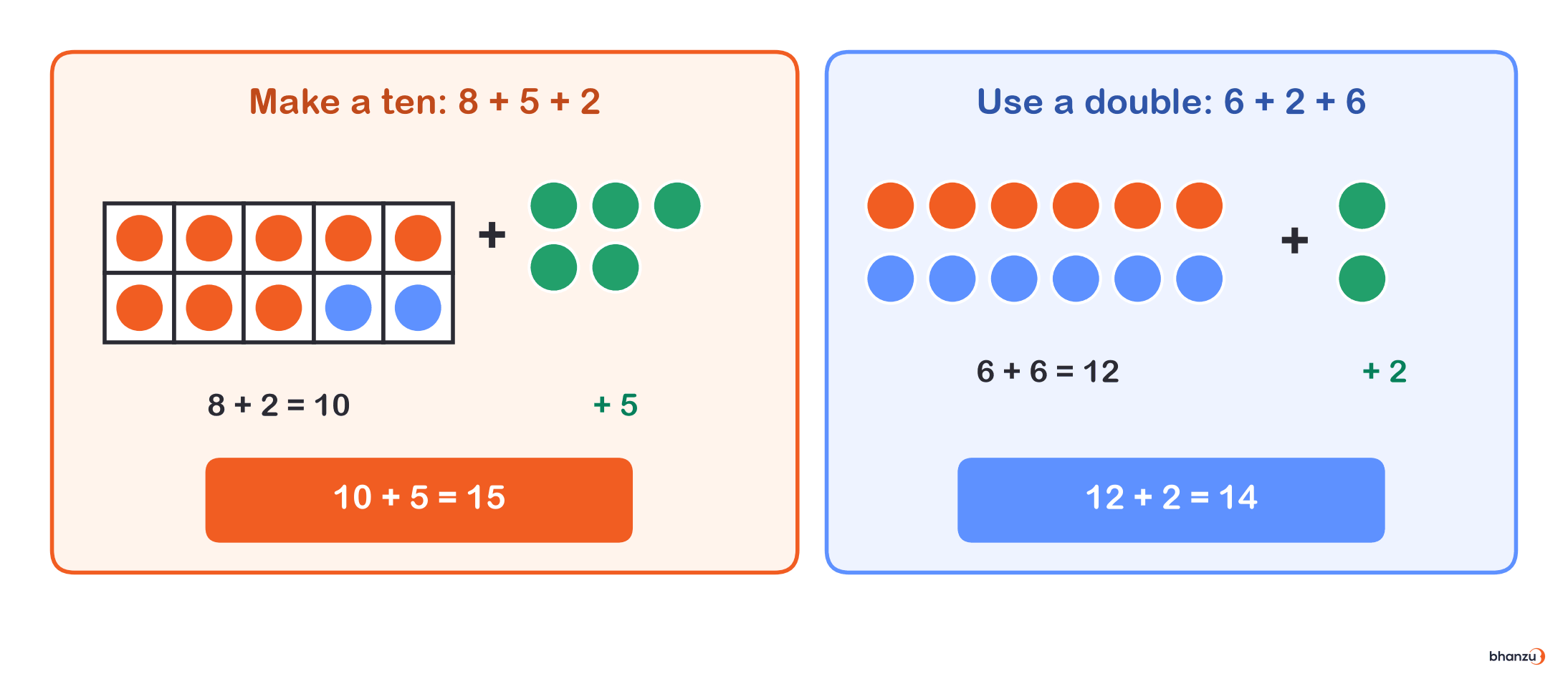
Add a pair that makes 10 first, then look for a double, and if neither shows up, any pair works.
Make a ten strategy
The pairs that make 10 are 1 and 9, 2 and 8, 3 and 7, 4 and 6, and 5 and 5. In , join the 8 and the 2.
Adding onto 10 takes one step, because every teen number is 10 and some ones. For a small third number, you can also count on from 10.
Look for a double
A double is a number added to itself, like 6 and 6 (two equal rows of counters). Doubles are often facts a child already knows. In , join the two 6s first.
When there is no ten and no double
In , no pair makes 10 and no numbers match, so join any pair.
Making a ten needs two numbers that reach 10, or one number you can split, as Common Core shows for .
A child who has just learned to make ten often hunts for a ten in every problem and stalls when there isn't one. Any pair still gives the right total.
Why can you add three numbers in any order?
Moving counters around never adds any or takes any away, so three numbers give the same total in any order. Noah's 15 counters stay 15 whichever two you join first.
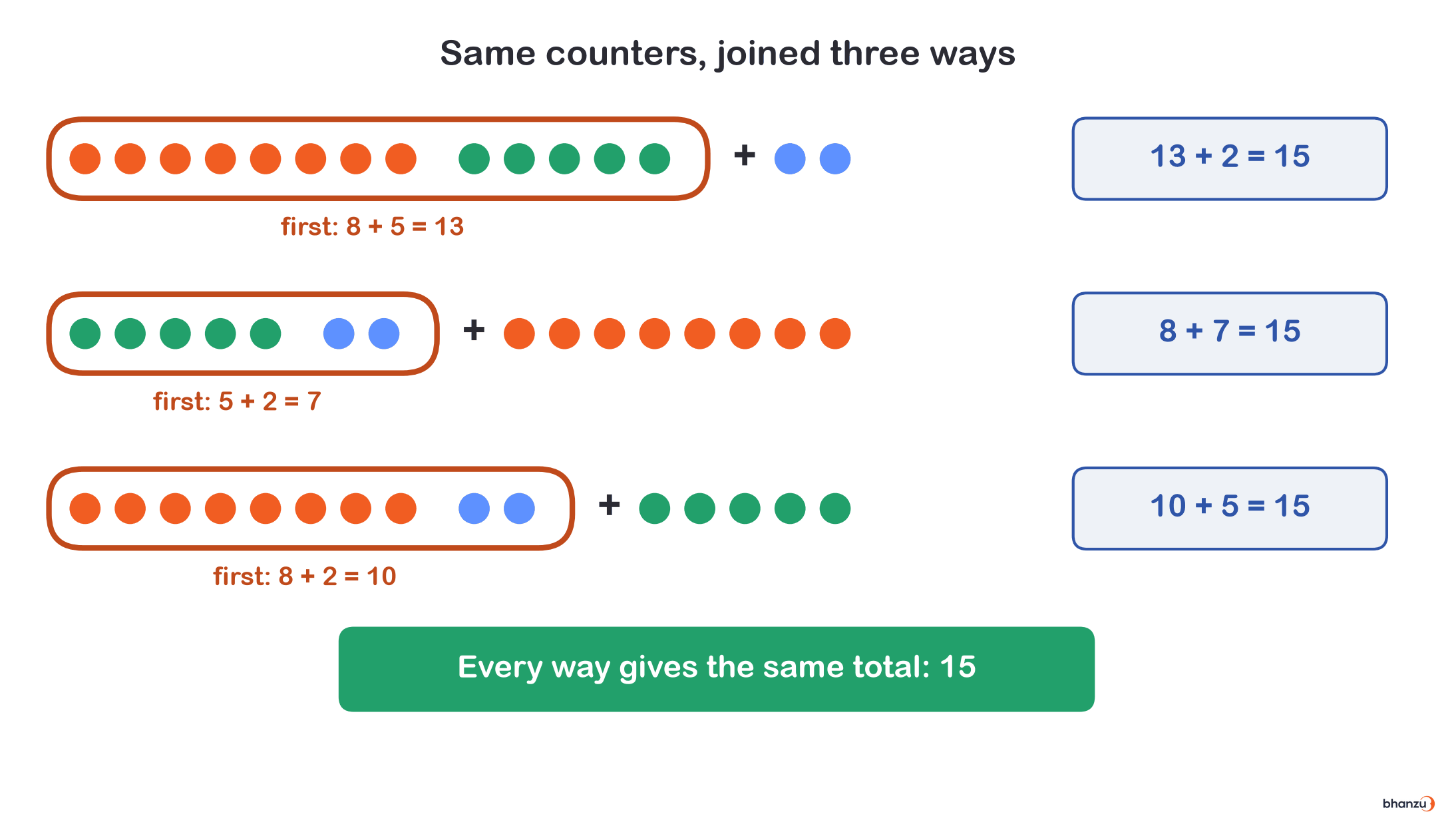
A child who pushes two piles together sometimes counts every counter again from 1 (all 13, after joining 8 and 5). The joined pile already has a number, so count on from it. To check , add again starting with .
What is the associative property of addition?
The associative property of addition says that grouping three addends differently keeps the same sum.
Swapping two addends, as in , is the commutative property. The two names are easy to mix up, even for adults.
In a 1998 study of 48 children aged 6 to 8, the children who understood the order and grouping rules added faster and more accurately. In 3rd grade, the same grouping idea works when you multiply three numbers.
How do you solve word problems with three numbers?
Turn the story into an equation, then add with the pair-first steps. Aisha reads 6 pages on Monday, 7 on Tuesday and 6 on Wednesday, and the story asks how many pages she reads altogether.
The ? stands for the pages you don't know yet. The two 6s make 12, and pages. When a story gives the total, the ? is a missing addend, and you find the missing number in an equation by asking what to add.
| Words in the problem | Math it means |
|---|---|
| scores 8, 5 and 2 points in three rounds | add all three, |
| how many cents does she spend in all | add the three prices |
| how many pages altogether | add, |
| needs more points to reach exactly 20 | one addend is missing, |
Read each story aloud with your child and point to every amount before anyone adds. Talking through math word problems this way shows which numbers belong together.
Try It Yourself
Set the counters on three trays with the plus and minus buttons, then pick which two trays to add first. The pair fills a ten frame, and the readout says if it makes a ten or a double. Add the third tray, try other pairs to see the same total, or tap Story for a word problem.
Examples of adding three numbers
Example 1
What is ?
The 3 and the 7 make a ten.
The sum is 11.
Example 2
Leo says . Is he right?
Join the double first.
Yes, Leo is right.
Example 3
What number makes true?
The ? stands for the one addend you don't know. The tempting move is to add every number you see.
That can't be right, because 19 is the total of all three parts and no part can be bigger than the whole. Join the two parts you know instead.
Ask what you add to 10 to make 19.
The missing number is 9, and checks it.
Example 4
Mei buys a pencil for 8 cents, an eraser for 3 cents and a sticker for 2 cents. How many cents does she spend in all?
The ? stands for the cents Mei spends.
The 8 and the 2 make a ten.
Mei spends 13 cents.
Example 5
Priya needs exactly 20 points to win a beanbag game. She scores 9 in round 1 and 5 in round 2. How many points does she need in round 3?
The ? stands for her round 3 points.
The 9 takes 1 from the 5 to make 10, with 4 left over.
Ask what you add to 14 to make 20. Since 4 and 6 make 10, it's 6.
Priya needs 6 points in round 3.
What makes adding three numbers worth learning?
Adding three numbers gives you a real choice to make, which pair to start with. A good choice means you never count all the way from 1.
- It turns a hard sum into an easy one. Starting with skips the harder fact , the same habit behind adding mentally.
- It shows that a total doesn't depend on order. In a 2023 study that followed 273 fourth graders into 5th grade, children who better understood the rules of arithmetic had stronger arithmetic skills.
- It leads to bigger sums, such as adding up to four two-digit numbers in 2nd grade.
Picking the easy pair is a choice you'll keep making, with bigger numbers every year.
Tripping points to avoid with adding three numbers
Mistake 1: Stopping at the ten
Where it slips in: Right after a pair makes 10, as in . The ten feels like the finish line, so a child proud of spotting it writes 10 and stops.
Don't do this: Writing as the answer.
The correct way: Add the third number to the ten, so .
Mistake 2: Using one number twice
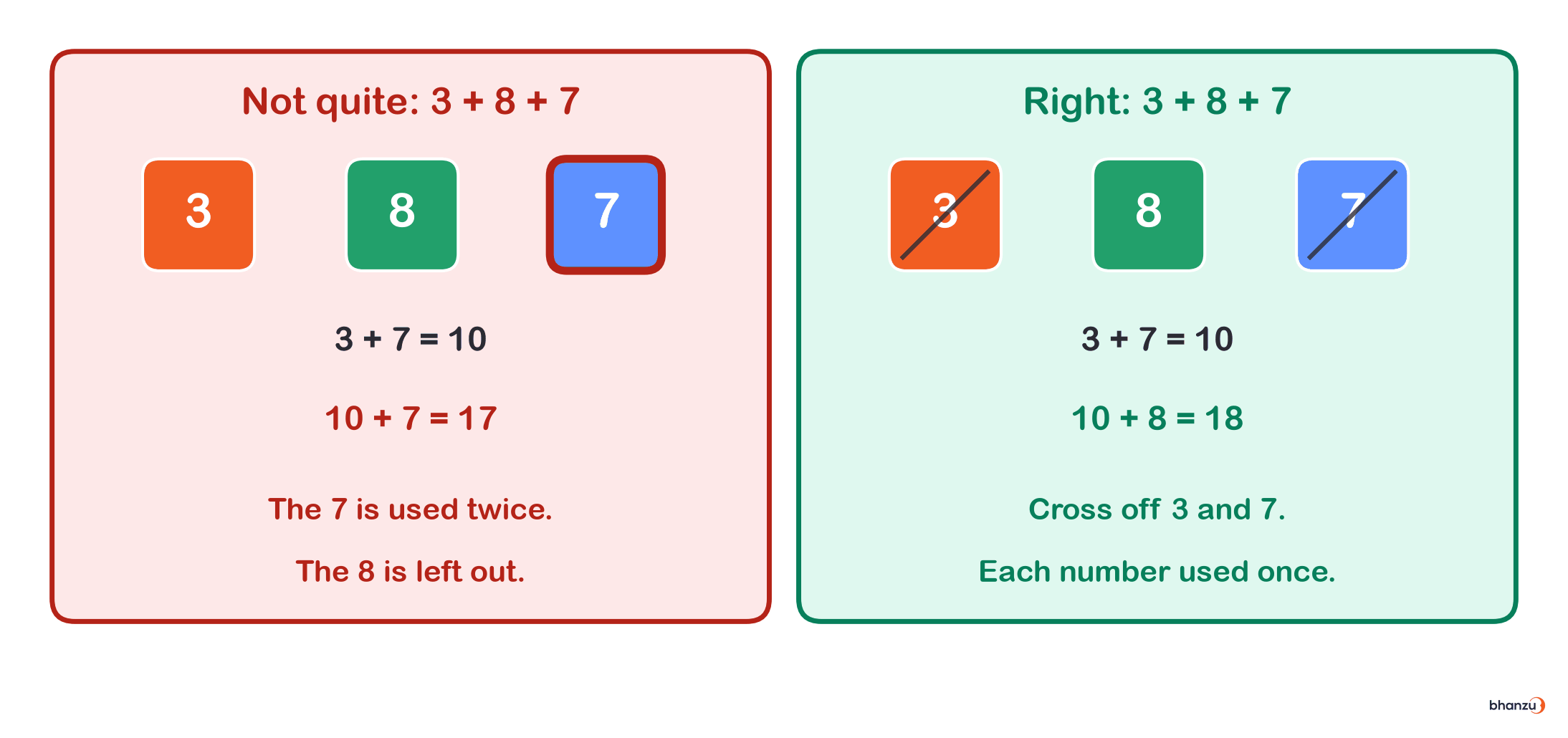
Where it slips in: Right after making a ten in . The last number a child touched still feels fresh, so it gets added again.
Don't do this: Adding , then , which uses the 7 twice and skips the 8.
The correct way: Add , then . Cross off each number as you use it (a pencil tick is enough).
Mistake 3: Adding left to right into a hard fact
Where it slips in: Problems with the ten pair at the two ends, like . A child who starts adding before looking at all three numbers walks right into the harder fact .
Don't do this: Adding , then counting on 9 more and losing track at 16.
The correct way: Join the ends first, , then .
The part of adding three numbers nobody explains
The rule "add in any order" is really two moves, swapping and grouping. Swapping changes which number comes first, as in , and grouping changes which two you join first. Making a ten in needs both, so swap the 9 and the 4, then join the 6 and the 4.
The two moves don't arrive together. A 2017 study of 3rd to 5th graders found they understood swapping two numbers moderately well but grouping three numbers only weakly.
Show your child grouping on purpose by pushing two piles of counters together, then joining a different two. Rules written with letters can wait until middle school.
Key Takeaways
- Say all three numbers out loud before you add any of them.
- When adding three numbers, hunt for a ten, then a double, then any pair.
- Cross off each number once you use it.
- When a story gives the total, the ? is the missing part.
- For more help spotting the ten in a three-number sum, explore Bhanzu's 1st grade math tutor or math classes for kids.
Read More
- Fact Families for Addition and Subtraction
- The Equal Sign and True or False Equations
- Adding Within 100 by Making a New Ten
- Two-Step Word Problems Within 100
- Mental Math for Kids
Research Behind This Article
- Common Core State Standards Initiative, Grade 1, Operations and Algebraic Thinking (2010). thecorestandards.org
- OpenStax, Prealgebra 2e, 7.2 Commutative and Associative Properties (2020). openstax.org
- Canobi, Reeve and Pattison, The role of conceptual understanding in children's addition problem solving, Developmental Psychology (1998). pubmed.ncbi.nlm.nih.gov
- Wong, Cognitive predictors of children's arithmetic principle understanding, Journal of Experimental Child Psychology (2023). pubmed.ncbi.nlm.nih.gov
- Robinson, Dubé and Beatch, Children's understanding of additive concepts, Journal of Experimental Child Psychology (2017). pubmed.ncbi.nlm.nih.gov
Quick Quiz: Check Yourself
Three levels, new numbers every time: use a ten or a double, find a missing number or add with no ten, then solve story problems.
Was this article helpful?
Your feedback helps us write better content
Frequently Asked Questions
How do you teach adding three numbers in a fun way?
How do you teach adding three numbers to 10?
Is the associative property of addition taught in grade 1?
Can you add 3 or more numbers the same way?
Why is adding three numbers difficult for kids?