Key Points
- Multiplication and division word problems in 3rd grade have three numbers: the number of groups, the size of each group and the total.
- A missing total means multiply, so 4 trays of 8 seeds make 32 seeds. A missing group size or number of groups means divide.
- The word "each" can point to either operation. Splitting 30 tomatoes evenly into 5 baskets puts 6 in each, because that story hides a group size.
- Common Core places one-step multiplication and division stories within 100 in 3rd grade, and times-as-many stories wait until 4th grade.
One picture, three different questions
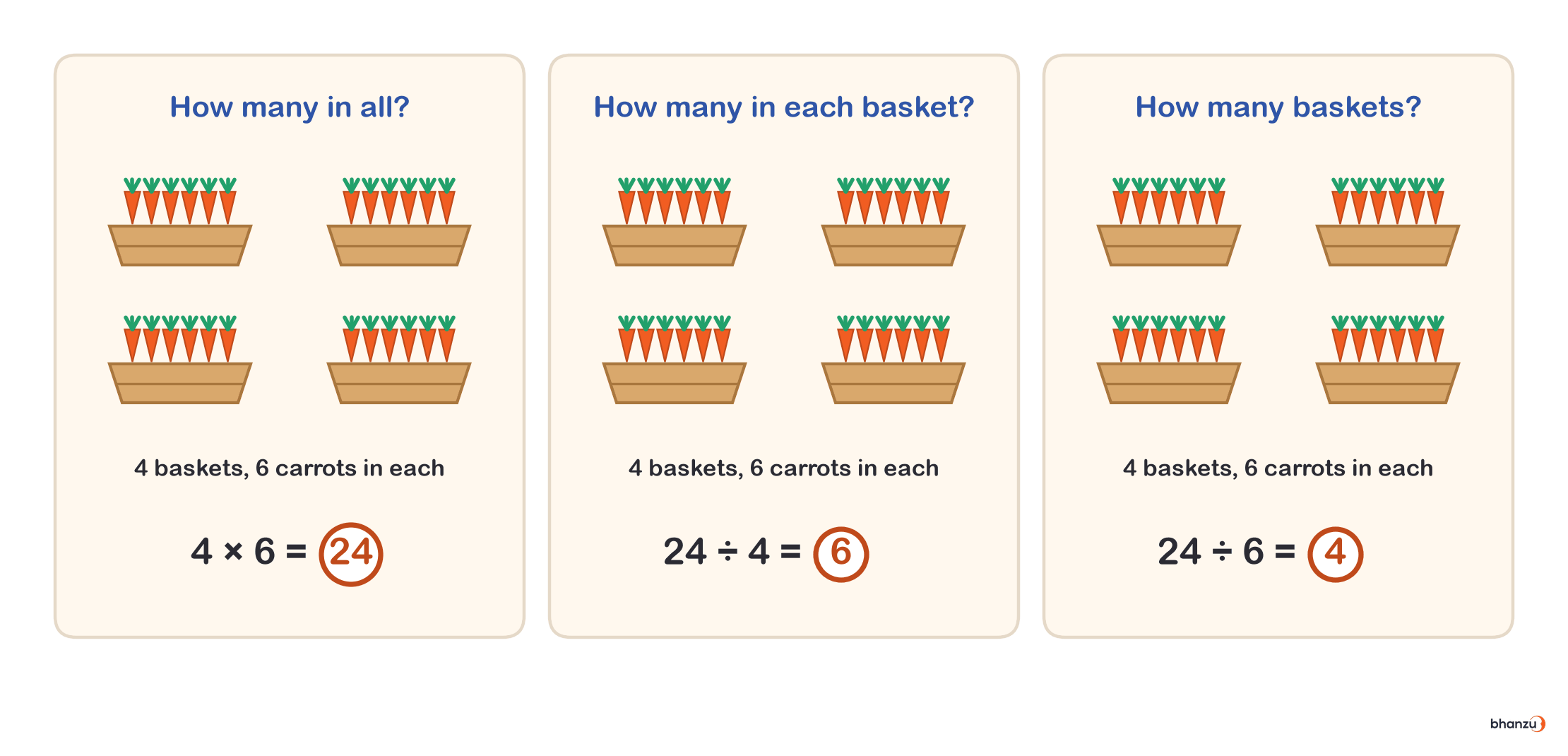
The same three numbers can tell a times story or a sharing story. One garden picture, 4 baskets with 6 carrots in each, answers three questions. It can ask how many carrots there are in all, how many go in each basket, or how many baskets 24 carrots fill.
The picture never changes. Only the hidden number does, and that number decides whether you multiply or divide. In 4th grade, the same hidden-number question will solve stories where one ribbon is 3 times as long as another.
What are multiplication and division word problems?
Multiplication and division word problems are stories about equal groups, which are groups that all hold the same number of things. You know two of the story's three numbers and find the missing one. The basket picture shows all three.
- The number of groups, such as baskets or rows.
- The size of each group.
- The total, or how many in all.
A multiplication answer is called the product, and a division answer is the quotient. Unequal groups need adding instead, as with 5 red apples and 7 green ones. These stories are one family of math word problems.
This skill is Common Core standard 3.OA.A.3, which covers equal groups, arrays and measurement stories within 100. By the end of 3rd grade, your child is expected to solve one-step stories like these, often by drawing them or by writing an equation with a box for the missing number.
How do you know whether to multiply or divide?
Find the number the story is hiding. A missing total means multiply, and a missing group size or number of groups means divide the total by the number you know.
| Story | Groups | In each group | Total | So you |
|---|---|---|---|---|
| 5 packets with 9 seeds in each. How many seeds? | 5 | 9 | ? | multiply, |
| 45 seeds shared equally into 5 packets. How many in each? | 5 | ? | 45 | divide, |
| 45 seeds, 9 to a packet. How many packets? | ? | 9 | 45 | divide, |
- Say what one group is (a packet, a row or a piece of string).
- Write the three numbers and mark the empty one.
- Multiply if the total is empty. Otherwise, divide the total by the number you know.
- Draw one circle for each group, then write an equation with a box, the skill behind finding the unknown in multiplication and division equations. In the second story the box stands for the seeds in each packet, so matches .
- Check by multiplying back, . Every division fact has a times fact that undoes it, the idea behind relating multiplication and division.
Drawing every seed as a dot gets slow past about 30. A child who draws all 45 seeds one by one often loses count in the 30s, so write the number inside each circle instead.
In the 2024 Nation's Report Card, 69% of fourth graders got full credit on a one-step story asking for a total, changing hours into minutes. Only 27% got full credit on a two-part story that needed multiplying and then dividing (117,900 fourth graders took part). Your child may know every times fact and still need practice choosing the operation.
Which kinds of stories count in 3rd grade?
Common Core lists three kinds of 3rd grade stories.
- Equal groups. 3 pots with 7 tulip bulbs in each hold bulbs.
- Arrays. 5 rows of 8 pepper plants make plants, since each row of an array is one group.
- Measurement. 2 pieces of string, each 7 inches long, make inches. A bar model draws this as one bar split into equal pieces.
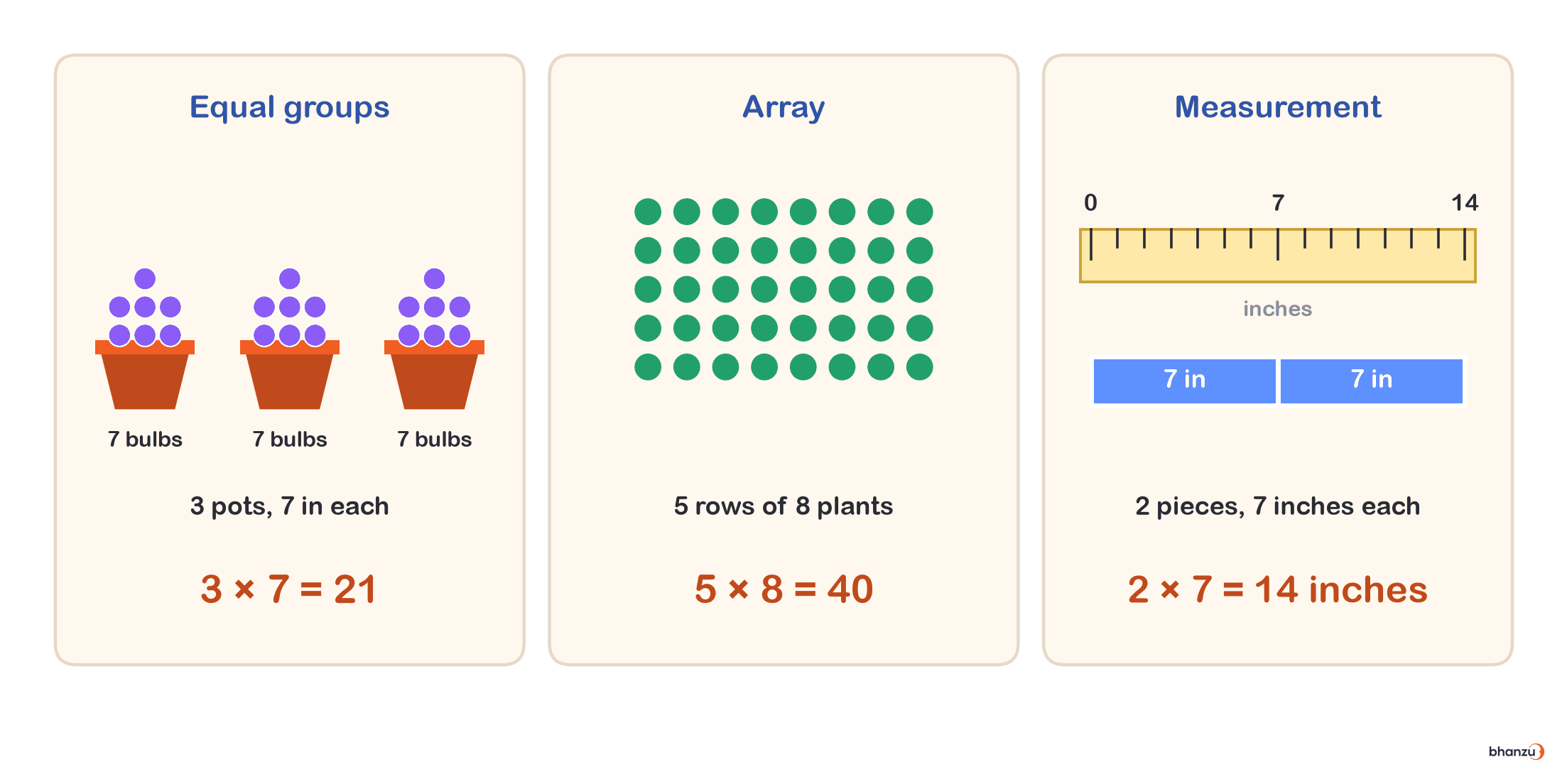
Division comes in two kinds, and the same 14 inches of string shows both.
| Story about 14 inches of string | Kind of division | What the answer counts |
|---|---|---|
| Cut it into 2 equal pieces. How long is each piece? | sharing | inches in each piece, |
| Cut it into pieces 7 inches long. How many pieces? | grouping | pieces, |
Common Core's own table calls these "How many in each group?" and "How many groups?" problems. They look the same on paper, which is genuinely confusing, since both start with 14 and divide. Only the answer's label tells them apart.
Children who solve sharing stories easily often stall on grouping stories, because nothing gets handed out one at a time. Start your child with stories about things you can count, like seeds, before stories about inches. Once a story is set up, division facts within 100 finish the job, and both kinds return with fractions in 5th and 6th grade.
Try It Yourself
Read the garden story, then build rows with the plus and minus buttons, the arrow keys or a tap on the grid. The times sentence updates as you build. When your array matches, Check names the number the story hid and whether to multiply or divide, and New story brings fresh numbers.
Examples of multiplication and division word problems
Example 1
Priya fills 4 seed trays with 8 seeds in each tray. How many seeds does she plant?
There are 4 groups of 8, and the total is missing, so multiply.
Priya plants 32 seeds.
Example 2
Noah splits 30 tomatoes evenly into 5 baskets. How many tomatoes go in each basket?
The word "each" tempts a times sign.
That puts 150 tomatoes in one basket, more than the 30 Noah started with, so the story can't be asking for a total.
Noah has the total, 30, and the number of groups, 5. The size of each group is missing, so share 30 into 5 equal groups by dividing.
Each basket gets 6 tomatoes, and checks it.
Example 3
Aisha has 36 bean seeds. She puts 9 seeds in each pot. How many pots does she fill?
The box stands for the number of pots.
Divide to find how many groups of 9 fit in 36.
Aisha fills 4 pots. Multiply back to check, .
Example 4
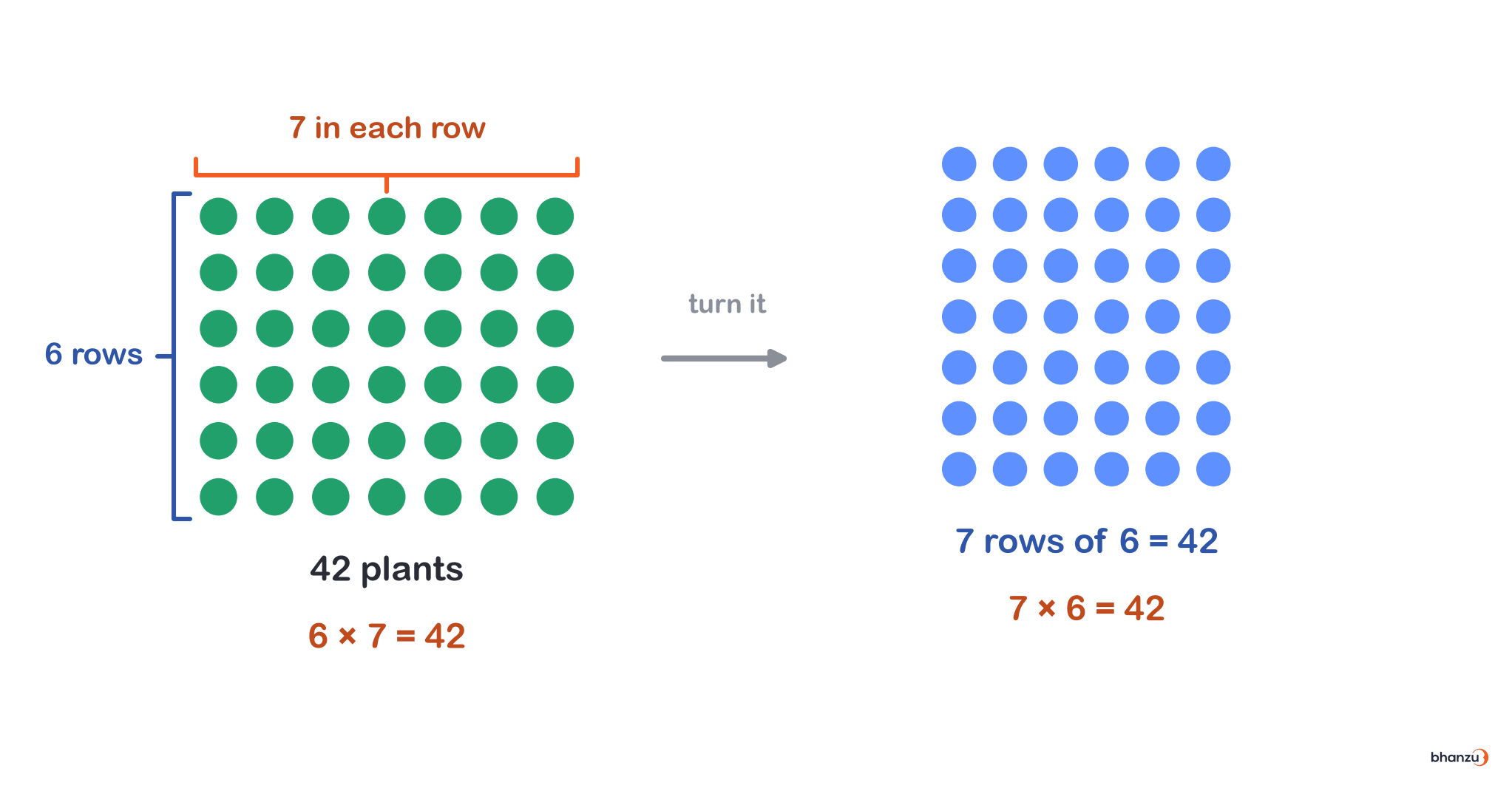
The garden club plants 42 pepper plants in 6 equal rows. How many plants are in each row? How many rows would 6 plants in each row make?
Each row is one group, and the row size is missing, so divide by the 6 rows.
There are 7 plants in each row. Turn the same array on its side and it becomes 7 rows of 6.
With 6 plants in each row, there would be 7 rows.
Example 5
Ben cuts 48 inches of ribbon into label pieces 8 inches long. How many pieces does he get?
Each piece is a group of 8 inches, and the number of pieces is missing, so divide.
Ben gets 6 pieces. Multiply back to check, inches.
Example 6
Maya cuts a string into 5 equal pieces to tie up bean poles. Each piece is 7 inches long. How long was the string?
The word "cut" sounds like dividing, yet the total is missing. The 5 pieces are the groups and 7 inches is each group's size, so multiply.
The string was 35 inches long. Divide back to check, inches.
Multiplication and division word problems beyond the textbook
Multiplication and division stories exist because sharing, packing and measuring all run on equal groups. Each job hides a different number.
- It makes sharing fair. When 12 cookies go to 2 friends, each, and proves nobody got shorted.
- It plans rides. Fifteen kids riding 5 to a car need cars.
- It catches impossible answers. Sharing 72 pencils among 8 friends gives 9 each, while multiplying instead gives 576 each, more pencils than exist.
- It works for lengths. A 24-inch shelf split into 3 equal spaces gives inches for each pot.
Every one of these starts with the same question about which number is hiding.
What are the most common mistakes with multiplication and division word problems?
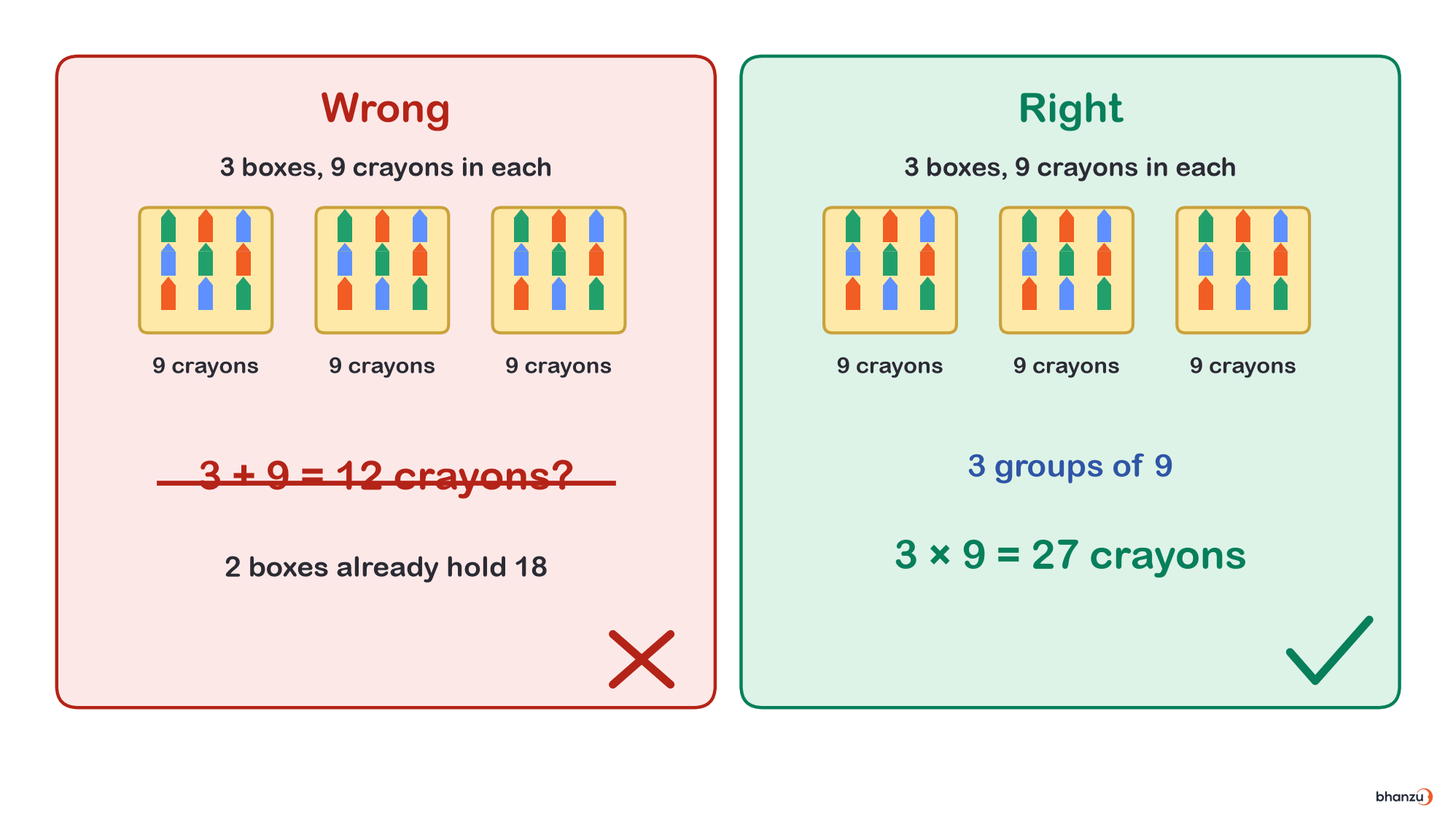
Mistake 1: Adding when the story says "in all"
Where it slips in: Equal-groups stories that ask how many there are in all or altogether. A child who grabs the two numbers often adds them, because "in all" sounds like adding.
Don't do this: Sam has 3 boxes with 9 crayons in each box. How many crayons are there in all? Adding gives crayons.
The correct way: Three equal groups of 9 make crayons. An answer of 12 can't be right, since two boxes already hold 18.
Mistake 2: Writing the division backwards
Where it slips in: Array stories that name the rows before the total, such as 4 equal rows with 28 chairs in all. Children who write it backwards usually copy the numbers in the story's order.
Don't do this: Writing , then answering 7 anyway or saying it can't be done.
The correct way: Put the total first. chairs in each row, and checks it.
Mistake 3: Giving the answer the wrong label
Where it slips in: Grouping stories, where the answer counts groups instead of things. A child who finishes the arithmetic often moves on without saying what the number counts.
Don't do this: Leo has 63 stickers and puts 7 on each page. He works out and labels the answer 9 stickers.
The correct way: The 9 counts pages, since every page holds 7 stickers. Leo fills 9 pages.
The pattern hiding inside equal groups word problems
Many keyword charts list "each" under multiply, yet the same word shows up in stories that need dividing. "Each" only names the size of one group, and a story can give that size or hide it.
What does each mean in math word problems? It names one group's size and nothing more, in all four of these stories.
| Words in the problem | Math it means |
|---|---|
| 4 trays with 8 seeds in each tray | total missing, |
| 30 tomatoes split evenly into 5 baskets, how many in each? | group size missing, |
| 36 seeds with 9 in each pot, how many pots? | number of groups missing, |
| 5 equal pieces, each 7 inches, how long was the string? | total missing, |
The US Department of Education's What Works Clearinghouse told teachers to avoid keyword teaching in its 2021 guide. That guide rated its word-problem advice as backed by strong evidence from 18 studies. Its own table shows "each" pulling a student toward a wrong times sign.
A 2019 article in Teaching Children Mathematics reached the same verdict on keyword charts. One fact can tell three stories.
Key Takeaways
- Before picking a sign, ask which of the three numbers the story is hiding.
- Multiplication and division word problems that say "each" or "cut" can still need either operation, so let the missing number decide.
- Write the total first in every division sentence, then multiply back to check.
- Say what the answer counts, such as pots, pieces or inches, before calling a problem finished.
- For practice finding the hidden number with a teacher who catches the in-all-means-add mistake, explore Bhanzu's 3rd grade math tutor or Common Core math curriculum.
Read More
- Two-Step Word Problems
- Associative Property of Multiplication
- Multiplying by Multiples of 10
- Multiplicative Comparison
- Two-Step Word Problems Within 100
- Dividing Fractions Word Problems
Research Behind This Article
- Common Core State Standards Initiative, Grade 3 Operations and Algebraic Thinking (2010). thecorestandards.org
- Common Core State Standards Initiative, Grade 4 Operations and Algebraic Thinking (2010). thecorestandards.org
- OpenStax, Prealgebra 2e, 1.5 Divide Whole Numbers (2020). openstax.org
- National Center for Education Statistics, NAEP Mathematics: National Trends and Student Skills, Grade 4, 2024 (2025). nationsreportcard.gov
- Common Core State Standards Initiative, Mathematics Glossary: Table 2, Common Multiplication and Division Situations (2010). thecorestandards.org
- Karp, Bush and Dougherty, Avoiding the Ineffective Keyword Strategy (2019). eric.ed.gov
Quick Quiz: Check Yourself
Three levels, new numbers every time: find the total of equal groups, solve sharing and grouping stories, then choose the operation for arrays and measurement.
Was this article helpful?
Your feedback helps us write better content
Frequently Asked Questions
What grade do kids learn multiplication and division word problems?
Do division word problems in 3rd grade have remainders?
How can you use multiplication to solve a division problem?
How can I help my child with math word problems at home?
Where can my child practice multiplication and division word problems with answers?